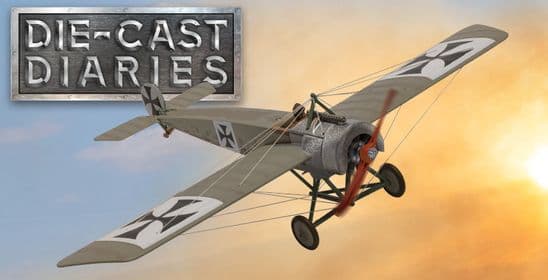

Welcome to our latest edition of CORGI Die-cast Diaries, your fortnightly blog review bringing collectors all the news, updates and topical stories from the captivating world of CORGI die-cast model collecting.
As we continue to bring our readers details from projects listed amongst the current January – April 2026 CORGI model range, we have an appealing Vanguards model sandwich for you this time around, with a hearty filling of Aviation Archive goodness. As always, we will have a selection of exclusive sample model images from each model project for your inspection, with two of the models having just arrived in our warehouse, and the third expected to join them in the very near future.
As you may have deduced from our latest title, Ford’s muscular Ranger Raptor will be taking star billing this time around, as a Vanguards of this stature demands, but it will be ably assisted by a non-Ford hot hatch phenomenon which is making a welcome return to the CORGI range. Our Aviation Archive subject this time around is a future classic in the making, and if we have time, we’ll also be including a second, heritage model subject feature, one intended to mark the 108th anniversary of the Red Baron ending March 1918 with 72 aerial victories.
We would be delighted if you would join us this weekend as we spring into summer with another Die-cast Diaries selection of the latest and greatest CORGI model projects.
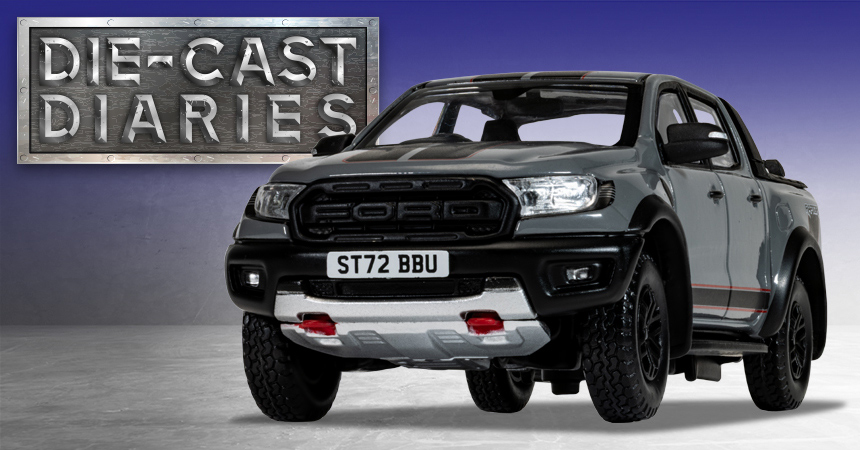
I think I’m right in thinking that there’s a saying which states how good things always come in BIG packages, and when that statement is used to describe our Vanguards Ford Ranger Raptor tooling, it could hardly be more appropriate. Jointly the largest and heaviest model we’ve ever inducted into the Vanguards tooling hall of fame, the impressive stature of this model could hardly be more appropriate a representation of the vehicle which inspired its range inclusion, one which demands respect whether its driving through a town centre, or negotiating some particularly challenging off-road terrain.
Unquestionably a top of the range vehicle, and one which is as desirable as it is capable, the Raptor is a real stunner of a head-turner, one which you could imagine being driven by ‘very cool people’, or those who certainly wish to appear so. Owning a Raptor is a real statement of style and adventurous nature, people who don’t necessarily like to conform, or have interests which may be a little more active than most - even if you are not a rock climber, MMA fighter or professional rugby player, if you own a Raptor, people will think you might well be. The ultimate incarnation of the Ford Ranger line, the Raptor is aimed at those who are looking to combine the ability to take their lives ‘off the beaten track’, without having to compromise on either luxury, performance or style.
With the ability to go where other forms of transport wouldn’t dream of venturing, the Raptor has been designed to excel in these challenging environments and is described as a street legal derivative of an off-road competition vehicle - how could you not want one of those?
Even though it possesses all the credentials to be an off-road winner, it is surely on our normal roads where this vehicle will find its strongest sales support, as it is the very embodiment of a ‘don’t mess with me’ type of vehicle. With its stunning good looks and purposeful styling, you would expect to see footballers, athletes and aspiring boxers behind the wheel of a Raptor, because just like them, this beast has been bred to perform. It truth though, it is probably just someone who wants to drive a rugged and stylish vehicle who will find themselves thinking Raptor in the Ford showroom.
The latest release from this tooling only serves to cement the popularity of this relatively new tooling addition to the Vanguards range, and is a colour way could have a name which was completely appropriate for the vehicle on which it was to be used, then surely Conquer Grey is that colour.
VA15205 – Ford Ranger Raptor SE in Conquer Grey
The rally-inspired Ford Ranger Raptor Special Edition (SE) was launched in late 2021 for the 2022 model year and was something of a last hurrah for the 4-cylinder Raptor, which had originally appeared in 2019. The SE was made in limited numbers to ensure exclusivity and cost £54,086, a modest £900 more than a regular Raptor. This made it something of a bargain because the extra cost got the lucky buyers front-to-rear racing stripes, 17-inch black alloy wheels fitted with huge 33-inch tyres, red recovery hooks and jazzier interior trim. It does. however, share the standard Raptor’s impressive 10-speed automatic transmission, towering 283mm ground clearance and Fox Position Sensitive Damping (PSD).
The SE’s eye-catching design also included LED headlights, a matte black grille and door handles. The integrated black sports hoop and lockable Mountain Top roller shutter allowed owners to secure goods in the load bay and added to its showroom appeal. Its off-road ability was very impressive, but it performed on tarmac too and was equipped with intelligent speed assistance, a lane keeping aid, and a collision mitigation system; features which helped it to achieve the maximum five-star Euro NCAP safety rating. It had a payload rating of 620kgs, lower than the more workmanlike vehicles in the Ranger lineup, and as a result was not taxed as a commercial. It was, however, aimed at the leisure market where school-run street cred trumps load capacity.
This magnificent new all-conquering Ranger Raptor is in stock and available now.
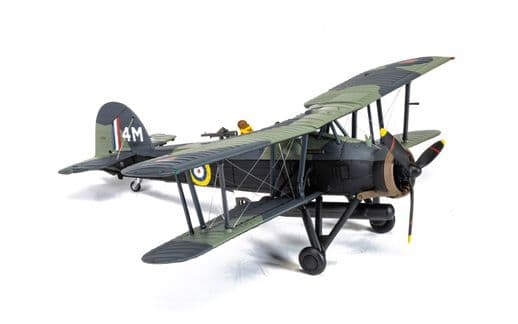
Within the history of the Aviation Archive range, when the first release from our 1:72nd scale Fairey Swordfish tooling joined the range in 2006, it proved to be something of a revelation. Quite a large model for a single engined type, the Swordfish not only featured innovative folding wings, but also the wire rigging between its wings which was such a feature of this famous aircraft.
From a die-cast collectable hobby perspective, this was quite the development, and the Swordfish became something of an overnight sensation, further establishing the Aviation Archive range as the leading brand for collectors of Second World War era aircraft models. The Swordfish was absent from the CORGI range for more than a decade, but made a successful return with an Operation Torch release in 2024, where the development team were able to assess every aspect of the model’s tooling for ongoing production validity. Everything went well and the Swordfish was warmly welcomed back into the collector fold, and we’re pleased to report that a new Swordfish release is now on the horizon, and it’s an absolute cracker!
First taking to the air in 1934, the venerable Fairey Swordfish may well have had the appearance of an aircraft which should not really have seen service during the Second World War, but it would go on to serve through the entirety of the conflict, proving to be a critical component in Britain’s naval strike capabilities. Interestingly, the Swordfish was originally referred to by its internal Fairey design designation, T.S.R.1 (Torpedo, Spotter, Reconnaissance 1), which were the roles for which the new aircraft was intended. When a second, slightly improved aircraft was subsequently constructed, this received the designation T.S.R.2, something which would turn out to be quite a famous acronym with regard to another famous post war British aviation design.
Belying the slightly ungainly appearance of the Fairey Swordfish, it would prove to be an exceptionally robust and adaptable aircraft, earning a reputation as one of the most famous naval aircraft of the Second World War. It’s nickname ‘Stringbag’ is thought to be both a reference to both its obsolete appearance and the fact that its docile handling characteristics would allow it to be flown in almost any conditions. In addition to this, it appeared that no matter what size or shape of offensive ordnance the aircraft was required to carry, the Swordfish just accepted the challenge and got on with the task at hand. Proving crucial to Britain’s war effort during WWII, most of the 2,400 Swordfish built were actually constructed by Blackburn Aircraft Limited at their Sherburn-in-Elmet facility in North Yorkshire, with the final aircraft delivered as late as 18th August 1944 - not bad for a biplane with a top speed of just 140 mph.
In the hands of an experienced crew, the Swordfish could be devastatingly effective against enemy shipping and submarines, using its slow speed and manoeuvrability to ensure a successful attack. For the inexperienced pilot, the Swordfish proved rather forgiving, with its low take-off and landing speeds helping to make this notoriously dangerous phase of flight much less challenging for them. An extremely rugged aeroplane, the Swordfish excelled in the often harsh environments in which it was required to operate, however, when pressing home their attacks, crews would often be forced to endure a hail of fire from their target warship, or when under attack from an enemy fighter aircraft.
There is no doubting that these famous old biplanes were flown by a special breed of airmen, heroes to a man.
Following Italy’s declaration of war against Britain on 10th June 1940, Britain had was thrust into a dangerous new phase of the war. With the powerful Italian Navy posing a huge threat to British forces across the Mediterranean, something had to be done, and the wheels of action were set in motion. ‘Operation Judgement’ called for Fleet Air Arm Fairey Swordfish aircraft to attack the Italian Fleet moored in Taranto Harbour and score a decisive victory against them, but could a formation of ageing biplane strike aircraft take on one of the most powerful naval fleets in the world? On the night of 11th/12th November 1940, a first attack wave of 12 Swordfish took off from HMS Illustrious with a flight time of about 2 hrs 20 min ahead of them at a cruising speed of around 80mph.
After an hour or so, fog and low cloud caused the flight to become separated, and with all aircraft heading for the harbour independently, L4M flown by Lt(A) H. Swayne arrived at the harbour approaches 15 minutes before the other aircraft, and had to orbit just off the coast, potentially alerting the defenders to their presence. The first Swordfish aircraft to attack were the two machines carrying flares, but once the Italian ships were illuminated, the strike could begin in earnest.
Swordfish L4M was part of the first wave, second element torpedo attack, lining up on the Battleship ‘Littorio’ and releasing their torpedo at low level from 400 yards, actually passing through the ships masts during the pullout from the attack, so low was their attack run. Their torpedo struck the vessel causing serious damage, and with a second Swordfish also finding its mark, this Battleship was put out of action, buying British forces valuable time.
The attack was successful, however, a second attack wave consisting of a further 8 Swordfish took off from Illustrious around 40 minutes after the first wave, arriving over the harbour around 20 minutes after the first strike.
Relying on the skill, courage and determination of a relatively small number of Naval airmen and their support crews, the raid showed that powerful warships were no match for air power, and how the aircraft carrier and its aircraft would now rule the waves. This successful raid was studied closely by Japanese naval commanders in advance of their infamous raid against Pearl Harbor the following year, even though that raid was significantly more powerful in terms of both the number of aircraft used, and the aircraft carriers which launched them.
When it comes to the world of popular motoring here in the UK, is there any sector of this market that has been more enthusiastically contested, or been of more interest to the general public than the ‘Battle of the Hot Hatches’? A colloquial, but widely used reference which came to prominence during the early 1980s, it was associated with the emerging popularity of attractively styled, high performance hatchback cars produced by several of the major manufacturers at the time, vehicles which held a particular fascination for younger, sportier and more image conscious drivers.
These cars were so popular at that time that vast amounts of development money was spent by almost every manufacturer to ensure they had an automotive player in this lucrative arena, and if their styling and marketing teams had done their jobs right, their hot hatches would sell in huge numbers and attract plenty of admirers.
Amongst the finest exponent of this breed of cars, debate still rages to this day about which was the best of Britain’s hot hatches, with vehicles such as the Peugeot 305 GTI, Volkswagen Golf GTi and Vauxhall Astra GTE 16V all being at forefront of this exciting grouping, with each one scoring performance points over their rivals. The 16 valve offering from Vauxhall was arguably the performance king of this trio, and if driven in a straight line, was difficult to beat. A real speedster, the Astra GTE was the choice of hot hatch aficionados and bad lads alike, and at one time was the most stolen car in the UK.
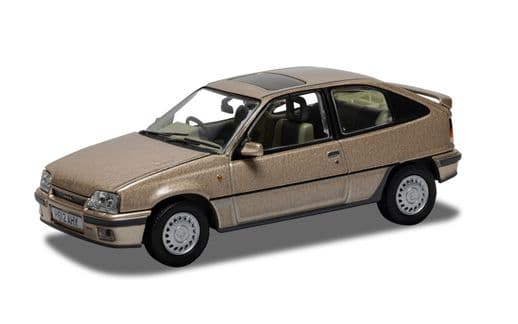
The Astra GTE 16V may not have been everybody's cup of tea when it came to looks, but it terms of pure performance, the Vauxhall was always regarded as something special - it just went like stink! Vanguards collectors will be pleased to see that we’ve just welcomed our latest scale tribute to this hooligan of the roads back into the range, although it has to be said that in this Rembrandt Silver colour, this one is less hooligan and more a paragon of popular motoring virtue.
VA13209 – Vauxhall Astra Mk2 GTE 16V in Rembrandt Silver
The GTE 16V modelled was originally registered as a ‘Vauxhall Fleet Management’ car with Vauxhall Motors Ltd, Kimpton Road, Luton, Bedfordshire on 29th November 1990. It was finished in Rembrandt Silver, one of the more unusual colours offered. Like all 16V GTE’s, it featured GM’s futuristic Liquid Crystal Display dashboard so drivers could see the revs rapidly rising on the car’s magnificent 2-litre DOHC 16-valve ‘red top’ engine, a characterful rev-hungry unit that gave the GTE its appealingly raucous demeanour. It went on to owners based in Kent, Dorset, County Durham, and Bedfordshire, before being purchased by Bedfordshire-based enthusiast, Lee Proctor, a former Vauxhall employee and subsequent car body shop proprietor, in late March 2013.
The car had covered 125,000 miles and was complete, but in poor condition. It was bought by Lee as a restoration project, and he soon embarked on a three-year nut-and-bolt structural, and mechanical rebuild to concours standard, in which he used as many new old stock original parts as possible. He did most of the work himself, bringing the car back to original specification except for the fitting of an ‘Astra Champion’ leather interior, which he had retrimmed. Lee enjoyed driving and showing the finished car, but in November 2020 he sold it to fellow enthusiast and Mk2 Astra Owners Club member, Derbyshire-based Clive Emery. He has added some original equipment finishing touches and enjoys using it to attend classic car events.
This beautiful new Vauxhall Astra Mk2 GTE 16V model is in stock and available now.
Throughout history, there have been a handful of aviators who managed to command worldwide recognition, and even though some of their exploits and achievements took place more than a century ago, their fame and notoriety continue to be a source of fascination to this day. Perhaps the man who best illustrates this phenomenon, Manfred Albrecht Freiherr von Richthofen may well have been an enemy airman, but his deeds made him feared and admired by friend and foe alike, holding the world spellbound with stories of his courage and airmanship. It hardly mattered that this young airman didn’t even live to hear the Great War guns fall silent, because he had already created a legacy for himself that would never die.
There is actually some historian conjecture as to whether the Red Baron ended March 1918 with seventy-two or seventy-four aerial victories to his name, but what certainly isn’t in doubt is the fact that he was suffering from exhaustion and combat fatigue by that date, and just 21 days later, the most famous airman the world had ever known was lying dead in the cockpit of his famous red Fokker Dr1 Dreidecker.
With our Aviation Archive series of 1:48th scale Great War fighters proving such a popular range of models over the years, it will come as absolutely no surprise to learn that releases presenting representations of aircraft which were either flown by, or had links to von Richthofen have met with incredible collector support over the years, and in their own way, play a small part in preserving the history of this famous airman.
Although von Richthofen is probably best known for flying the red Fokker Dr.1 fighter in which he met his end, he actually scored the majority of his aerial victories whilst flying various models of the larger Albatros, one of the most successful fighting aeroplanes of the Great War. The first release from our Albatros tooling back in 2007 presented an all red aircraft used by von Richthofen during the summer of 1917, and was followed by by a further release in 2019 which presented a different Red Baron Albatros in very different markings.
This special centenary release from 2018 proved incredibly popular, with a sizeable consignment of models heading to the USA.
When it comes to the Dreidecker, we actually have 6 previous releases which are either examples of aircraft which were flown by von Richthofen, or had strong links to him and that final, fateful flight. Releases in 2009 and 2018 present two different Fokker Dr.1 fighters flown by the Baron during the final year of his life, whilst a double set release which also featured the Sopwith Camel flown by Canadian ace Roy Brown proved to be one of the releases of 2009 – it was just so difficult to get hold of.
Captain Roy Brown was for many years celebrated as the RAF pilot who downed the Red Baron, however, research conducted many years later proved beyond much doubt that the fatal shot came from the rifle of one of the many Australian troops who were stationed on the Morlancourt Ridge.
Other ‘linked’ Fokker Dr.1 releases include three aircraft which were linked to that final combat which claimed the life of the Red Baron – the aircraft flown by his cousin Wolfram von Richthofen, and the reason why Manfred broke his strict, self-imposed combat engagement rules to go to his aid, and two aircraft flown by Hans Weiss and Werner Steinhauser which were part of that final patrol for von Richthofen.
Completing this scale aviation story, we also released the Sopwith Camel which was being flown by Wilfred ‘Wop’ May on 21st April 1918, the aircraft the Red Baron was trying to shoot down when he was fatally wounded by the bullet fired from behind Allied lines.
One of several Manfred von Richthofen model releases in the Aviation Archive range, each one a collectable classic.
If you have all these models in your collection, then you have quite the Manfred von Richthofen die-cast tribute, not to mention a linked series of models which would be the envy of many fellow collectors.
With April 2028 marking the 110th anniversary of the end of the Red Baron’s reign, could we see further Aviation Archive additions to this most appealing range of linked releases?
That’s it for this latest blog update, but we’ll be back as usual in two weeks’ time with another selection of the latest CORGI die-cast model updates and exclusive previews for your delectation, but as always, if you would like to drop us a line to comment on anything CORGI model related, or to suggest a future blog topic, we’re always happy to hear from you.
As ever, our diecastdiaries@corgi.co.uk address is always the one to use.
If you can’t wait for the next blog, you will find plenty of CORGI model collecting discussions taking place on our official social media channels, access to which can be obtained by clicking on the respective links at the foot of the CORGI website homepage.
Link access to CORGI social media sites.
Thank you for continuing to support your CORGI Die-cast Diaries blog, as we head into our eleventh year of production. Our next edition is scheduled for publication on Friday 10th April.
Until next time, once again, thank you for your continued support.