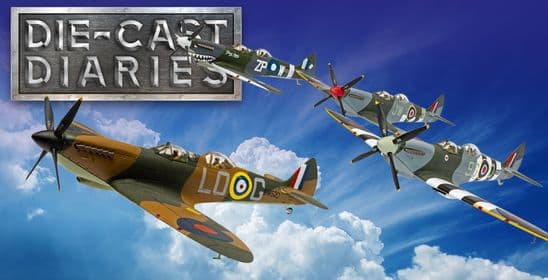

Welcome to our latest edition of CORGI Die-cast Diaries, your fortnightly blog review bringing collectors all the news, updates and topical stories from the captivating world of CORGI die-cast model collecting.
With just one week to go before the latest CORGI model range announcement, that’s going to leave us with a blog free week to allow everyone time to inspect all the new models for themselves, before we have the opportunity to look in a little more detail at the individual projects, and provide developments updates as they proceed towards eventual release. Before we get to that, this week’s blog will be something of a retrospective look at the Aviation Archive range and how since 2007 (in the case of fixed wing aircraft subjects), our 1/48th scale range has been charting the development of military aviation in some style. By the way, we also have a significant new model exclusive for you in this edition.
In an attempt to keep the model exclusives coming for you this week, we will also be bringing you the interesting story of a 1/72nd scale English Electric Lightning F.6 model which made it all the way through to the pre-production sample model stage, before being eventually replaced by a model wearing a completely different livery. The model which made it into production has gone on to become a much sought after release, but would you have welcomed the dropped model into your own collection? This is a feature no self-respecting Aviation Archive collector is going to want to miss.
We have new model announcements in advance of range launch, and a Lightning killed by a Firebird in the latest edition of CORGI die-cast Diaries.
The Fokker Eindecker was the first aircraft developed and introduced specifically to dominate the skies, hunting enemy aircraft to prevent them from obtaining battlefield information.
When it comes to the subject of famous aeroplanes from throughout 123 years of manned, powered flight, enthusiasts could have many long and vociferous debates discussing which aircraft they think deserve to be included in this list, and whilst they may be able to arrive at a consensus regarding several of the suggestions, they will probably overlook one which positively demands to be included. Despite looking rather primitive, and certainly emanating from the early days of aviation, the Fokker Eindecker had a profound impact on the world of aviation, the first aircraft designed from the outset as a ‘hunting’ aeroplane, and the father of all the fighter aircraft which would go on to follow in its wake.
With their clear understanding of the absolute necessity to gain a control of the air and the wider implications this would have on the future of the ‘War to end all Wars’, the German High Command duly instructed their aircraft manufacturing industries to immediately develop a completely new kind of aeroplane, one designed specifically to hunt other aeroplanes and dominate the skies.
The result of their work was the Fokker Eindecker, a monoplane fighter aircraft which represented the very pinnacle of aviation technology at that time, one which made use of all the flight research data designers had available from the front lines, and incorporating all the very latest technological advances the world of aviation had to offer.
With the ability to fire its machine gun/guns through the arc of the propeller, utilising a clever engine driven machine gun synchronisation mechanism known as interrupter gear, all the pilot of an Eindecker had to do was to aim the nose of his aircraft in the direction of his target through his line of sight and fire his gun, something which was a revolutionary concept in aviation at that time, but one which clearly still required much skill to operate effectively.
It has to be remembered that the aeroplane was still in its relative infancy at that time the Eindecker was being developed and even though history regards it as something of a technological marvel, it was still rather primitive an aircraft and relatively underpowered, making the airmen who flew them true pioneers in the art of aerial combat. If they were competent enough to manoeuvre their aircraft into a favourable attack position behind an enemy aircraft, the rudimentary wing warp flight control system still needed a steady hand, and if the situation got the better of them, they could quickly find themselves in a world of trouble.
If they allowed the thrill of combat to overtake their judgement, too tight a turn to stay on the tail of their intended victim could see them entering a dangerous spin, losing valuable combat altitude at best, with their aircraft not stopping until it hit the ground at worst. Early Eindecker pilots were essentially writing the rules of aerial combat engagement with each sortie made, with names like Boelcke, Immelmann and Udet all becoming students of the art, and sharing their expertise with those following in their footsteps.
The Great War saw the aeroplane transform from an information gatherer to an aerial dominator. This fantastic image has been borrowed from our colleagues at Airfix.
With their fearsome new mount beneath them, and plenty of Allied aircraft targets to help hone their skills, Luftstreitkräfte pilots began to rule the skies for the first time in history, with so many Allied aircraft falling to the guns of the Eindecker that the period between July 1915 and early 1916 became known as the ‘Fokker Scourge’. In fact, Allied airmen were so dismissive about the capabilities of their own aircraft that they described any mission in contested airspace as them being nothing more than Fokker Fodder, and whilst this was unquestionably a difficult time to be an Allied airman, it could have been so much worse.
For an aircraft which had such a seismic impact on the history of aviation, it can come as something of a surprise to learn that relatively few aircraft were ever sent to the front lines, and initially at least, they were used sparingly by the Luftstreitkräfte. Desperate to avoid their technological secrets from falling into the hands of the Allies, Eindecker pilots were forbidden from flying over enemy lines, and at first, the aircraft were only used in small numbers to fly as protection for friendly reconnaissance aircraft.
In addition to this, Eindecker pilots were engaging in a completely new type of flying, almost like a man-made Peregrine Falcon attacking a pigeon, however, nobody had ever done this before, so they were very much learning on the job. Each new ‘Hunting Unit’ was only allocated three of four aircraft, and these would have a heavy workload in attempting to protect other German reconnaissance aircraft. When they did encounter the enemy, they usually did so on their own, yet still managed to change the course of aerial warfare.
Once pilots began to master their aircraft and understand the strategic advantage they now held, the tactics they employed altered dramatically, and larger groups of Eindeckers were allowed to go hunting the enemy, the first aerial interceptors in the history of warfare. Things would never be the same again, and despite the Eindecker’s superiority reign only being a relatively short one, it changed the course of history, initiating an arms race which continues to this day.
The model was the second release from the Fokker Eindecker tooling, our scale tribute to an aircraft flown by Manfred von Richthofen.
Desperate to halt the dominance of the Fokker Eindecker, Allied manufacturing companies started to develop their own hunting aeroplanes, even though they still lacked the synchronisation technology which gave the Eindecker its most significant advantage. Aircraft such as the forward firing ‘pusher’ Airco DH.2 and French Nieuport 11 were significantly more manoeuvrable than the Eindecker and helped to put an end to the ‘Fokker Scourge’. Nevertheless, despite its relatively short period of dominance, the Eindecker had already made its significant contribution to aviation history, and stimulated an aerial arms race which would see supremacy changing hands several times during the remainder of the war, and significantly, continues to this day.
Relegated to non-combat and reserve roles by 1917, the Fokker Eindecker would also be used by the first fighter pilots of the Austro-Hungarian and Turkish air forces during the Great War, despite the fact that only 416 of this historic aircraft were ever produced. Could any other aircraft type claim to have had an impact as great as the Fokker Eindecker?
Aviation Archive collectors have come to appreciate the many charms of our 1/48th scale model range, from the much larger scale of the subject aircraft covered, to the greater levels of detail this scale allows designers to incorporate, making for truly impressive display centrepieces. Since 2020, the Fokker Eindecker has been a popular tooling in this range, allowing this father figure of military aviation to be displayed next to some of the latest cutting edge jets that patrol todays skies.
By way of our latest DCD exclusive, we’re delighted to confirm that next week’s range launch will include our latest 1/48th scale tribute to this historic aircraft, one of ELEVEN aviation subjects due to be unveiled next week. This is the largest number of new Aviation Archive subjects we have ever unveiled in a single range, in the current triannual format.
Let’s take a look at the new Eindecker now.
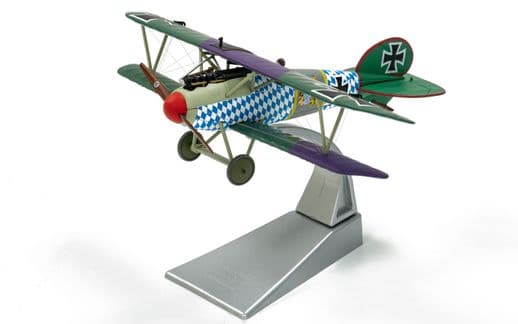
AA28704 - Fokker E.III Eindecker 339/16, Lt. Josef Jacobs, Fokkerstaffel West, Le Faux Ferme Aerodrome, west of Chambry, France, June 1916 – The fifth most successful German Air Service ace of the Great War, and last surviving recipient of the Pour le Mérite.
Fascinated by aircraft from an early age, Josef Jacobs learned to fly in 1912 at the age of eighteen and by the outbreak of the Great War joined the Imperial German Army, initially as a motorcycle dispatch rider, but then as an observer/artillery spotter in a long range reconnaissance aviation unit. With his studious nature and skill in the air, Jacobs was invited to join his more senior friend Erich Hönemanns at the newly formed Fokkerstaffel West, where he would become one of the earliest dedicated hunting (fighter) pilots in the world, flying the Fokker Eindecker series of fighters.
He would continue flying on the Western Front for the remainder of the war, and is thought to have been the German pilot to have spent the longest operational period over the trenches, coming into contact with all of the most successful Allied aces. He would end the war as commander of Jagdstaffel 22 flying the Fokker Dr.1, an aircraft with which he would score 30 victories, and become the most successful ‘ace’ pilot in this famous aircraft. In fact, the first Aviation Archive release of the Fokker Dr.1 featured the distinctive black ‘Dreidecker’ flown by Josef Jacobs, making this latest Eindecker an ideal companion release.
An exclusive look at the artwork file produced in support of the new Joseph Jacobs Eindecker.
A fastidious record keeper, Jacobs allowed his memoirs to be published during the inter-war years, which serve as a first-hand account of the birth of aerial combat and the rise of the fighter ace. He would end the Great War with 48 aerial victories, which placed him as the joint fourth most successful German ace with Werner Voss, and the recipient of the coveted Pour le Mérite, the ‘Blue Max’. Although accepting a reserve commission as Major during the Second World War, his anti-Nazi stance brought him into conflict with the new regime, however, it’s thought that his position as a Great War hero and his ‘Blue Max’ saved him from a fate being suffered by many adopting similar stances, allowing him to be tolerated by the new order in Germany.
Fortunate to outlive most of his Great War aviation contemporaries, prior to his death in 1978, Jacobs had been the last surviving recipient of the Pour le Mérite, and an invaluable link to the aerial combat engagements which took place over the trenches of the Western Front. Incredibly, despite being a national hero, Jacobs joined the Luftstreitkräfte as a reserve officer, so didn’t even qualify for a military pension in later life.
Look out for this latest Fokker Eindecker release amongst next week’s May to August 2026 range announcement.
Even though the two aircraft could hardly be more different from aesthetic and performance perspectives, the Eurofighter Typhoon and Fokker Eindecker do share one significant attribute, they were both designed to dominate the skies. In fact, as the RAF’s current multi role aircraft, surely a Typhoon wouldn’t look out of place displayed next to an Eindecker due to the fascinating discussion this could stimulate, or at least we certainly hope it wouldn’t, because that’s the link we’re making with this feature.
Although not a model exclusive like the previous feature, we still think its worth including the Typhoon here because it illustrates how the Aviation Archive range encompasses 111 years of aviation development within its ranks, and helps tell the story of how the aeroplane became an essential weapon of war.
For those people who enjoy attending Airshows during the summer months across the UK, without doubt, the highest profile individual aircraft in current Royal Air Force service is their display Typhoon, an aircraft which makes a celebrity of its pilot for the duration of the season and attracts thousands of youngsters to consider a career in the RAF. Over recent years, it has become something of a tradition for the RAF Display Team’s Typhoon display jet to wear attractive special markings, making the aircraft a highlight display act on any Airshow programme in which it appears, and unquestionably, one of the most appealing subjects for enthusiast photographers.
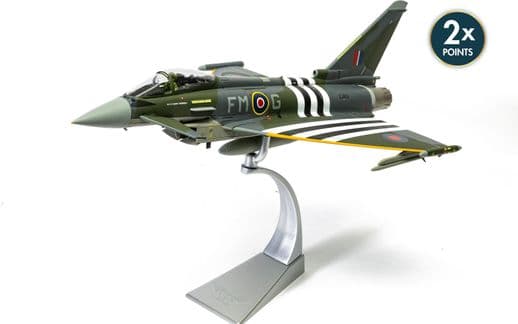
To mark the 80th Anniversary of D-Day in 2024, the RAF presented Eurofighter Typhoon ZJ913 in the markings of a WWII Hawker Typhoon of No.257 (Burma) Squadron, one which was flown by Squadron Leader Denzil Jenkins in support of the D-Day landings during the summer of 1944. During the Airshow season, at commemorative events in both the UK and France, and completing a successful Canadian tour, the aircraft, which its support team and enthusiasts alike referred to as ‘Moggy’, displayed the legendary agility of the Eurofighter Typhoon and highlighted the professionalism of the modern Royal Air Force in some style.
Although now retired from the Airshow scene, and performing a new role as an instructional airframe at RAF Lossiemouth, ‘Moggy’ will always be remembered as one of the most popular individual RAF aircraft of the post war era.
Would Moggie look out of place with an Eindecker parked under its wing in your display cabinet?
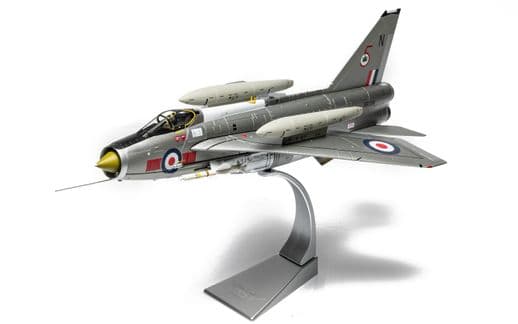
This is how collectors will remember Lightning F.6 AA32315, however, it wasn’t originally supposed to look like this.
Although this subject is rarely discussed outside the CORGI team, when it comes to suggesting proposed new model additions to the Aviation Archive range, not every die-cast idea egg goes on to become a metal chick and in some rare circumstances, that decision isn’t made until late in the development process.
That certainly proved to be the case when a new livery addition to our 1/72nd scale English Electric lightning tooling was proposed for release in the 2016 range, an unusual selection for sure, but one that would have been familiar to anyone who has either worked at, or visited RAF Coningsby. For those hoping to catch a Typhoon practice display over the ‘live’ side of RAF Coningsby, a trip to the end of Old Fen Lane will probably get photographers to an appropriate location, and whilst waiting for the action to start, a walk down to the base gate will reveal something rather unexpected – a preserved English Electric Lightning.
Resplendent in an unusual RAF No.11 Squadron scheme, this aircraft underwent this presentation transformation whilst the squadron was still based at Leeming. She was serving as a gate guardian then as well, but as the unit were in the process of retiring their Tornado F.3 fighters, it was decided to give their much loved Lightning something of a makeover. Although not exactly authentic, the Lightning really was a looker, and it didn’t take long for her to become a firm favourite with squadron members and aviation enthusiasts alike.
Following No.11 Squadron’s transition to the Eurofighter Typhoon, and relocating to Coningsby, squadron members felt it only appropriate that their Lightning should be allowed to relocate with them, and in 2007, she arrived at her new home, to take up residence outside the squadron’s new HAS site. She can still be seen there today, and is such a beautiful aeroplane that once seen, definitely never forgotten.
Taken on a recent visit to RAF Coningsby, English Electric Lightning F.6 stands on the HAS site of No.11 Squadron.
That was the story rationale behind the suggestion that this model should join the range, a most unusual Lightning livery, but one with an interesting story to tell, and a model that would certainly be easy on the eye. Approved for range inclusion, the initial research file was completed to allow the product artwork to be produced, and once this had been checked by our researcher, the artwork was sent to the factory so that a pre-production sample model could be produced.
That’s where this story takes something of an interesting turn. As the sample model was being produced, discussions between research/development team members had started to question the appeal of a livery which was essentially a ceremonial one, not one that was worn by an operational aircraft during its service live. These discussions started to unnerve the CORGI brand manager at the time, and just as we were expecting the sample models to arrive at CORGI HQ, a second research file was submitted for artwork production, and it became clear that AA32315 would end up looking very differently than initially intended.
Instead of allowing this hard working Lightning gate guardian to take its place in the range, XR753 was usurped by a ‘Firebird’, a model which actually went on to be an incredibly popular addition to the range, and certainly not one that disappointed the collector. In fact, these are some of the most difficult models to get hold of these days, so it seems as if this unusual story had a happy collector ending.
An Aviation Archive exclusive. AA32315 was initially progressed as No.11 Squadron’s gate guardian aircraft XR753, and made it as far as the pre-production sample model stage. Ordinarily, these unwanted samples would have been destroyed, but we rescued them because there was such an interesting story behind them.
AA32315 was eventually released as a ‘Firebird’, and has become a favourite within many a collection.
As for our short-lived tribute to Lightning F.6 XR753, the sample models were duly produced, but were never seen outside of the CORGI offices, that is until now. Ordinarily, the models would have been destroyed as they were now not required, with the model not making it to production, however, this is such an unusual story that we had to save them from such a fate. Indeed, had it not been for this unusual DCD feature, nobody outside the CORGI team would have ever known this project existed.
So, there you go, now you have the full story - would a 1/72nd scale model of RAF No.11 Squadron’s beloved Lightning F.6 gate guardian XR753 have made it into your collection? Please do let us know using the email contact details below.
That’s it for another edition, but please don’t forget that its May – August range launch at 10am BST next Friday, so please clear your diaries for that. Our blog schedule is back on track now, so we’ll be back as usual in two weeks’ time with another selection of all the latest CORGI die-cast model updates and exclusive previews for your delectation. As always, if you would like to drop us a line to comment on anything CORGI model related, or to suggest a future blog topic you’d like to see covered here in DCD, we’re always happy to hear your views.
As ever, our diecastdiaries@corgi.co.uk address is always the one to use.
If you can’t wait for the next blog, you will find plenty of CORGI model collecting discussions taking place on our official social media channels, access to which can be obtained by clicking on the respective links at the foot of the CORGI website homepage.
Link access to CORGI social media sites.
Thank you for continuing to support your CORGI Die-cast Diaries blog, as we head into our eleventh year of production. Our next edition is scheduled for publication on Friday 22nd May.
Until next time, once again, thank you for your continued support.