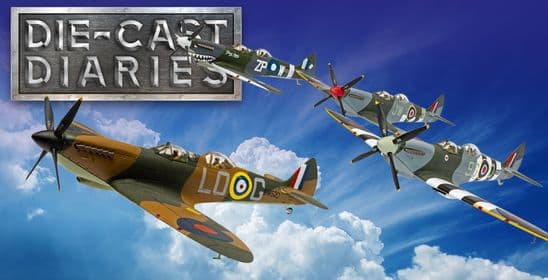

Welcome to our latest edition of CORGI Die-cast Diaries, your fortnightly blog review bringing collectors all the news, updates and topical stories from the captivating world of CORGI die-cast model collecting.
For one reason or another, it's been quite a slow couple of weeks for new model arrivals and development progress in recent times, but rather than defer this latest edition of our blog and mess up the schedule completely, we felt sure we could come up with something, even if it was going to be more CORGI legacy models than contemporary project updates this time around.
The focus of our attentions will therefore be current and impending anniversaries, even if we do need you to use a little imagination with us along the way. Firstly, the month of April proved to be rather significant for a pair of aircraft which attracted the TSR acronym, and even though they were very different aircraft from different eras of aviation technology, they will still be sharing the blog spotlight in this addition.
Secondly, this coming December will be marking the 85th Anniversary of the infamous Pearl Harbor attack, and America’s subsequent entry into the Second World War. We will be taking this opportunity to look at two classic Aviation Archive releases which many readers will no doubt have within their collections, two aircraft which are representations of ones American airmen used to strike back at Japan in 1942 and 1943 respectively. Both deserve to be moved to the front of our displays during 2026, just so we can tell these stories more effectively in this significant anniversary year.
We’re looking at classic and much coveted models which continue to help preserve aviation history in this latest edition of CORGI Die-cast Diaries.
When it comes to famous British aircraft that have been the subject of vociferous debate over the past 61 years or so, despite the fact that it never made it into RAF service, the British Aircraft Corporation TSR-2 stands head and shoulders above all others. A spectacularly futuristic aircraft which should have provided Britain with the most advanced strike aircraft in the world was so technologically advanced that its complexity ultimately contributed to its demise, but not before it managed to captivate the nation, and leave many asking why?
An aircraft which was so stunning to look at that it would surely still look futuristic if it was in service to this day, TSR-2 stood for Tactical Strike and Reconnaissance Mach 2, and was arguably the great development hope for Britain’s aviation industry at a time of great political upheaval and international tensions. As we all know only too well, just a single development aircraft ever made it into the air, and due to cost and development overruns and a change in government during the mid 1960s, this particular story of aviation triumph would end in a most ignominious, almost brutal manner.
From the perspective of Britain’s aviation history, many commentators over the years were of the opinion that the BAC TSR-2 project represented everything that was wrong with the British aviation industry during the 1950s and 60s, whilst at the same time illustrating how the country’s finest minds could still lead the world in the technological advancement of aviation. Had the aircraft completed its development program, it would undoubtedly have resulted in the Royal Air Force being equipped with a strike and reconnaissance jet which was significantly more capable than anything else in service at that time, a real world-beater of an aeroplane which would have been well ahead of any competition.
Right from the very beginning, it was clear that the new aircraft engineers at the British Aircraft Corporation were working on would be a significant leap forward in technological terms, with almost every aspect of its design incorporating new and ground-breaking equipment, materials and technologies. Unfortunately, the extremely advanced nature of the project, whilst undoubtedly extremely impressive, would also prove to be its Achilles heel, as the various manufacturing companies, sub-contractors and indeed government of the day, all failed to establish a coherent management structure to oversee this monumental aviation project.
Due to the advanced nature of this project, it could be argued that the development programme slowed to a pedestrian pace at times, suffering almost constant delays and numerous setbacks because of the technologies being adopted, with costs rising all the time as a consequence. In addition to this, official interference resulted in numerous frustrating requirement and design changes being regularly requested, to a point that when the prototype aircraft was nearing its first flight, this astonishing aircraft was being held back by the very bureaucracy which should have been there to champion it.
The first release from our BAC TSR-2 tooling, this is the first time that the deco guide for this classic model has been published within the CORGI blog.
Despite all the aircraft’s many challenges, all the clouds of doubt appeared to be blown away on 27th September 1964, when BAC’s chief test pilot Roland Beamont accelerated TSR.2 XR219 down the runway at Boscombe Down and into the annals of aviation history. As the world looked on in awe, it genuinely seemed as if Britain was on the verge of introducing the most capable military aeroplane the world had ever seen and for the British public, their spectacular new TSR.2 was a source of immense national pride. On that day, a bond was formed between the British public and TSR-2 which continues to endure to this day.
Ultimately, despite possessing huge potential, the incredibly ambitious nature of the TSR.2 project arguably doomed it to failure before it ever had the chance to progress beyond the development stage. With project cost overruns now spiralling at an alarming rate, the new incoming government of the day already found themselves in a period of severe financial austerity and serious questions were being asked. Despite the fact that the test program had already highlighted how good an aircraft TSR-2 was, the new government’s first budget in April 1965 included the announcement of the immediate termination of the TSR.2 project, contrary to the many assurances given to BAC by the previous government.
Perhaps the most distressing development within this entire sorry episode was how the government directive also included orders for the immediate destruction of not only the TSR.2 airframes already at various stages of construction, but also the actual manufacturing jigs used to produce them.
Was the end of Britain’s BAC TSR.2 dream all about project overruns and future costing uncertainties, or were there more sinister international forces at play behind the scenes? Presenting the British public what appeared to be the most capable aircraft in the world, only to snatch it away in an almost vindictive manner, still gives rise to many conspiracy theories and has people scratching their heads in disbelief.
The first and the last in CORGI TSR-2 terms, many collectors will no doubt regard this beautiful model as one of the standout releases of their collections.
Undoubtedly, if you’ve been fortunate enough to stare admiringly at one of the two surviving (complete) airframes at either Cosford or Duxford, it’s difficult not to think the government made a huge mistake in cancelling TSR-2, because of all the aircraft on display around them, TSR-2 still looks to be by far the most capable. Surely, a modern Royal Air Force equipped with hundreds of these mighty aircraft would have been a force to be reckoned with, and may just have made the Cold War a little less chilly by virtue of the deterrent threat it possessed. Can you imagine seeing one of these magnificent beasts wearing full RAF Strike Command markings?
April is always remembered as the month in which the British Aircraft Corporation TSR-2 project was formally cancelled, making this a sad month for post WWII British aviation. Historically, TSR-2 XR219 was the only example of this magnificent aircraft to ever take to the skies, completing 24 test flights between 27th September 1964 and 6th April 1965, spending just 13 hours and 9 minutes in the air. Whilst this aircraft was brutally scrapped to stop her becoming something of an aviation martyr, her sister aircraft XR220 does still survive at the RAF Museum Midlands, where she helps to preserve the legacy of this potentially world-beating British aircraft that never was. This aircraft does possess a fascinating history of its own and must therefore be considered as one of the most important preserved items of Britain’s rich aviation heritage in its own right.
British Aircraft Corporation TSR.2 XR220 was one of nine development aircraft ordered as part of an ambitious programme to equip the Royal Air Force with the world’s most advanced strike jet. This airframe was subsequently damaged during its road transport delivery to A&AEE Boscombe Down in early September 1964, an incident which would prove incredibly significant in its history. The repairs the airframe needed, combined with the fact that numerous components were stripped and used to support the maiden flight of the more famous XR219, resulted in XR220s own maiden flight date being delayed several times.
If we had been in any doubt as to the collector appetite for a ‘What if’ TSR-2 model release, we needn’t have been concerned, because it proved to be one of the releases of 2024.
The aircraft would embark on a series of live engine tests in preparation for her first flight, however once again, various technical issues conspired to prevent this from taking place as planned. Finally, a maiden flight date for the aircraft was scheduled for the afternoon of 6th April 1965, the very day the TSR-2 programme was subsequently cancelled. It has been documented that the aircraft was fuelled up and ready to go when the aircraft’s Certificate for Flight was revoked and even though some members of the team wanted to fly anyway, it was over, the TSR-2 dream had been killed.
Much of the ground-breaking technology developed in support of TSR-2 would subsequently find its way into the Jaguar and Tornado programmes which followed in the years to come, and although this is open to some debate, neither of those aircraft could claim to possess the imposing presence of their famous strike predecessor, even though they did both go on to prove their impressive service credentials.
As one of the most impressive model additions to the Aviation Archive range, it will come as no surprise whatsoever to learn that the initial release from this much loved tooling back in 2009 was a scale representation of XR219, the only TSR-2 to fly. Subsequently however, further models were released presenting the two complete aircraft which are currently on display at IWM Duxford and the RAF Museum Midlands respectively in model form, a spectacular model trio of arguably Britain’s most spectacular aircraft.
The latest release from this tooling was something of an Aviation flight of fancy, and our attempt to imagine what an operational TSR-2 might have looked like had the aircraft entered Royal Air Force service, and didn’t it look magnificent. It remains to be seen whether it will be a case or ‘four and out’ for our TSR-2 tooling, or if we still have exciting plans for our die-cast tribute to one of the most impressive looking aircraft the world has ever seen.
Watch this space!
If you didn’t already know, you might be interested to learn that the TSR-2 wasn’t the first British aircraft to have attracted the TSR acronym, with that predecessor taking to the air for the first time in April 1934, and arguably being even more famous. The Fairey Swordfish may have had the appearance of an aircraft which shouldn’t really have seen service during the Second World War, however, it would go on to serve through the entirety of the conflict, proving to be a critical component in Britain’s naval strike capabilities.
Originally referred to by its internal Fairey design designation, which was T.S.R.1 (Torpedo, Spotter, Reconnaissance 1), this description related to the roles for which the new aircraft had been designed, roles at which it would excel. Although the Swordfish would go on to be produced in large numbers, serve throughout the Second World War and make a real name for itself, it remains largely anonymous when it comes to its original Fairey project designation, as that TSR acronym is now forever linked with the infamous British Aircraft Corporation project which took to the skies some 30 years later.
As we featured our latest impending 1/72nd scale tribute to the Fairey Swordfish in the previous edition of DCD, we don’t intend to repeat details about this famous aircraft here, but will include this link access which will take you straight to edition 191.
With April being such a significant month for both the TSR-1 and TSR-2, we thought this was more than an adequate excuse to include our scale tributes to both of these magnificent aircraft in this latest edition of the CORGI blog.
Marking one of the most momentous days in world history, the 7th December each year is the date on which much of the world commemorates the infamous Japanese attack against the US Pacific Fleet and other military facilities at Pearl Harbor on the Island of Oahu, Hawaii, a devastating raid which would result in the United States entering the Second World War. This year will mark the 85th anniversary of the attack, and as it occurs in the same year as the equally significant 250th anniversary of the signing of the Declaration of Independence, it will probably take on even greater significance than usual.
As we’re using this as an opportunity to place the Aviation Archive spotlight on some of the classic models releases which posess historic links to this important anniversary, you might expect that they would be aircraft which were involved in the actions during that most infamous of days, like the image above, which features two of the models released in commemorative packaging to mark the 80th anniversary of the raid back in 2021, however, we’ve decided to go in a slightly different direction.
With the Pearl Harbor raid leading directly to America entering the Second World War the day after the raid took place, we wanted to focus on two of the previous releases which marked America’s response to the raid, operations which showed Japan that they had made a huge mistake, and with this conflict only destined to end in defeat for them.
AA35313 – North American B-25B Mitchell 40-2249, ‘Hari Kari-er’, USS Hornet, 18th April 1942 ‘Doolittle Raider’. Release year 2017.
The months following the Japanese attack on Pearl Harbor were some of the darkest in the history of the American nation. Japan was continuing her seemingly invincible advance across the Pacific, and German U-boats were raiding US shipping off the east coast of the country. America was under attack and the population was in a state of panic. At times like those, they needed heroes to step forward, and America was fortunate enough to be able to call upon men like Jimmy Doolittle, a daredevil pilot and national celebrity.
Doolittle devised an audacious plan to strike at the very heart of Japan, showing the Japanese people that the war was coming to them and despite what their leaders were telling them, America would have their ultimate retribution for Pearl Harbor. Although still early in America’s involvement in the war, the raid would also serve as a huge morale boost for the American people, a population which at that time were fearful that their armed forces were incapable of defending them. All Doolittle needed to do was to recruit around 80 brave and capable airmen who would be prepared to undertake what on the surface looked to be something of a top secret suicide mission. Thankfully, America’s sons were ready to do their duty, and he would have no shortage of volunteers.
As the USS Hornet task force approached the Japanese coast, their position was spotted by an enemy ship, so the decision was made to launch their strike aircraft early. Just after 8am on the morning of 18th April 1942, sixteen B-25 Mitchell bombers lifted off the dangerously short deck of USS Hornet on heavy seas and set course for Japan. For most of them, this would be the first time the crews had taken off from the deck of an aircraft carrier at sea, and they would be doing so in aircraft not designed for the task.
Once airborne and flying at extremely low altitude, the raiders had a six-hour flight ahead of them before reaching their targets, navigating over open ocean and almost certain to come under attack by enemy fighters. If they did manage to complete their mission, they would then fly on to Chinese territory, and take to their parachutes, where it would be very much a case of every man for himself.
Full scheme details for this scale tribute to one of the most historic bombing raids in the history of aerial warfare.
The crew of B-25 ‘Hari Kari-er’ were assigned to bomb targets in the city of Yokohama, but on reaching the Japanese mainland, the bomber inadvertently flew right over an active enemy air base and almost immediately came under fighter attack. Whilst pilot Ross Greening prepared for his bombing run, his gunner shot down one enemy fighter and damaged a second, before turning his guns on any targets of opportunity he could see. With their bombload dropped on a large oil refinery and storage facility, the aircraft set course for China, but always on the lookout for further enemy attack.
Unable to locate their assigned relief airfield, the crew bailed out of their aircraft some 200 miles inland of the coast and despite sustaining a few minor injuries, all the men landed safely. Their aircraft ‘Hari Kari-er’ did continue to fly on for a while, but eventually crashed in a mountainous area.
Although the attack proved to be a huge American success from both a propaganda and national morale perspective, Doolittle himself regarded the mission as a failure. All sixteen of those valuable aircraft had been destroyed, and three of his men had been killed in action, with others being taken captive. Tried by their Japanese captors, three of those men were later executed for alleged war crimes. As terrible as this was, once the fate of these men was delivered to the nation by President Franklin D Roosevelt, the people of America responded by purchasing $11 Billon in war bonds to support the war effort.
One relatively unheralded story relating to the Doolittle raid was the selfless way in which ordinary Chinese people helped the surviving raiders, giving them shelter and transporting them to safety at great personal risk. Many would pay a heavy price for assisting the Americans, as Japanese troops exacted a vicious revenge.
On reaching safety, most of the Doolittle Raiders returned to active duty with the USAAF, serving in the Far East, the Mediterranean, Europe and North Africa.
The CORGI North American B-25 Mitchell tooling can actually boast no fewer than THREE of the Doolittle Raiders amongst its ranks, with the first being AA35302 from 2005, and ‘Hari Karri-er’ being the third from 2017. AA35312 ‘Ruptured Duck’ was released in 2013 and completed this scale raiding trio.
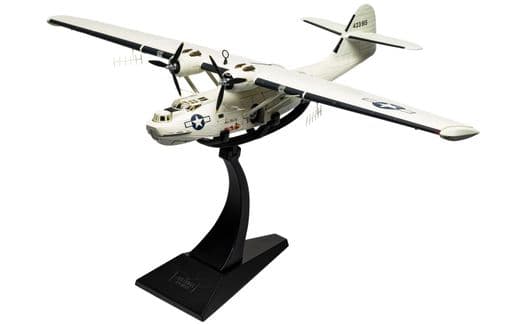
AA36615 – Lockheed P-38G Lightning 43-2264 ‘Miss Virginia’ White 147, 339th Fighter Squadron, 347th Fighter Group, ‘Operation Vengeance’, Guadalcanal, 1943. Release year 2020.
Following the Doolittle bombing raid against the Japanese mainland, American forces slowly started to gain a military foothold in the Pacific, with her forces challenging the Japanese at every strategic opportunity. Despite this, they never forgot the pain inflicted by of the Pearl Harbor attack and there was still a significant score to settle.
Having been forced to endure the horrors of the devastating sneak Japanese attack at Pearl Harbor, the American people found themselves dragged into a war they had tried so hard to avoid, but were now determined to avenge that day of infamy. Their long fightback began with victory at the Battle of Midway in June 1942, but for the men of the USAAF 347th Fighter Group, their opportunity to inflict a huge psychological blow against the Japanese nation, and specifically against man who had planned the Pear Harbor attack, would come in April the following year.
US Navy intelligence codebreakers had been monitoring Japanese radio communications for months, and managed to intercept details of Admiral Isoroku Yamamoto’s planned flight from Rabul to visit troops stationed in the Solomon Islands, in order to boost their morale in the wake of the Midway defeat. Flying in one of two Mitsubishi G4M ‘Betty’ bombers and protected by six Zero fighters, the formation was intercepted by sixteen US Lockheed P-38G Lightnings, whose pilots had made the long flight from Guadalcanal with one specific aim – to exact vengeance.
In the ensuing dogfight, Lockheed P-38G Lightning ‘Miss Virginia’, piloted by Rex T. Barber, slipped in behind the bomber carrying Admiral Yamamoto and unleashed a torrent of bullets from his .50 calibre machine guns, sending the enemy bomber crashing into the jungle below. ‘Operation Vengeance’ had been a success, and one of America’s most deadly enemies had been eliminated.
A classic Aviation Archive release, featuring a historic aircraft in the annals of USAAF history.
In what proved to be one of the most significant aerial engagements of the Second World War, ‘Operation Vengeance’ was the ambitious plan to intercept an aircraft carrying Japan’s most accomplished military tactician and the architect of the Pearl Harbor attack, Admiral Isoroku Yamamoto. The mission was entrusted to brilliant US aviator Major John Mitchell, who would have to plot a course far enough away from islands inhabited by Japanese spotters and at altitudes low enough to avoid detection by enemy radar, but also to ensure his fighters were in exactly the right piece of sky at the right time to intercept the enemy formation.
With only a map, his watch and a high quality compass borrowed from the US Navy in the cockpit of his fighter to help him, in truth, the mission only had a very slim chance of success, but the prize was worth the risk, and the airmen were determined to take their chance. The only aircraft capable of undertaking such a long and arduous 1000 mile plus round trip was the Lockheed P-38 Lightning and even then, only by using external drop tanks containing the additional fuel required. In actual fact, due to the short supply of those tanks, each aircraft was fitted with a single large 330 gallon drop tank and well as a smaller 150 gallon tank, just to make sure they had enough fuel for this clandestine mission.
As the sixteen P-38 Lightnings took off from Kukum Field, Guadalcanal at 7am on 18th April 1943, they were unaware of the enemy force which awaited them, or indeed if they would even manage to intercept them. In what turned out to be a feat of exceptional airmanship, the USAAF formation executed the outward flight flawlessly, arriving at their intended target interception point just one minute behind schedule. With one of the pilots yelling ‘Bandits’, the attack group dived in on the bombers, whilst the majority of the force kept the defending Zero fighters occupied.
The combat which followed was short but decisive, and ‘Operation Vengeance’ struck a huge blow for America and her fortunes in the wider Pacific War. It also highlighted America would accept nothing less than total victory now that they were in the war.
Both the models featured above underline how the Aviation Archive range has managed to introduce representations of some of the most historically important aircraft the world has ever seen into its ranks, and how the stories which inspired their inclusion help to preserve that incredible history. As he head towards America’s 250th birthday and the 85th Anniversary of the Pear Harbor attack, we have plenty of models within our collections which help to tell those stories from an aviation perspective, and long may that continue.
New banners grace the CORGI website
Not wanting this entire blog to be of a legacy nature, we decided to end by including a more contemporary update featuring a couple of new web-banner additions to the site, both of which serve as a visual call to action for collectors with a particular interest in craft which starred in classic TV series’ of the 60s and 70s.
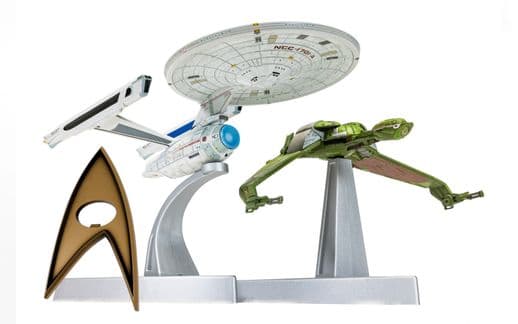
Created in celebration of last weekend’s Star Trek First Contact Day, the first new banner announces our die-cast tribute the 40th anniversary of Star Trek IV: The Voyage Home with a new bundle which combines the two hero ships of the classic movie!
After saving Earth while aboard the stolen Klingon Bird-of-Prey ‘HMS Bounty’, Captain Kirk and his crew are rewarded for their heroism with the command of a new ship – the U.S.S. Enterprise NCC-1701-A.
This bundle features highly detailed die-cast models of the two ships in separate premium collector packaging.
In addition to this, the bundle includes a special extra to help you enjoy returning home after a hard mission as well – a Star Trek commbadge-inspired bottle opener created by Raven Forge!
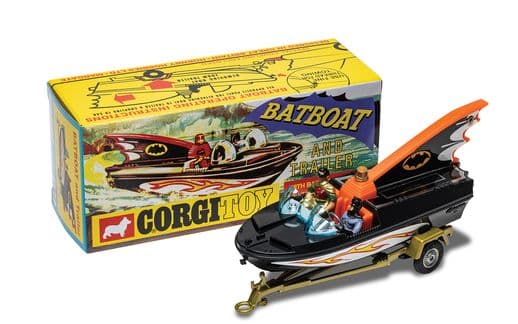
Holy die-cast model bat type offerings, we really do need to get to that Bat Boat! The second new web-banner added to the CORGI website over the past few days will be of interest to any budding Caped Crusader, as it’s the essential towed accessory when fighting crime on the ocean waves.
Inviting us to ‘ZAP’ this beautiful retro styled model into our webstore basket, this true classic of a model was introduced into the CORGI range in 1967, after the Bat Boat appeared in the previous year’s Batman movie. The problem of hitching the iconic boat to CORGI’s original 1966 Batmobile (which was tooled without the addition of a tow-hook) was solved by adding a small plastic sleeve that fitted neatly over the Batmobile’s turbo exhaust.
Based on CORGI’s existing Dolphin 20 Cabin Cruiser on a die-cast trailer (that was hitched to a Buick Riviera in Gift Set 31), the early CORGI Bat Boat can be distinguished from the later ‘Whizzwheels-era’ version by the graphics and Batman logo on the fin, flame graphics on the sides of the hull and a beacon cage between the Batman and Robin figures.
Whether it’s contemporary of classic, you can be sure that when it comes to appealing, collectable die-cast models, there’s always something interesting to be found on the CORGI website.
That’s it for this latest blog update, but we’ll be back as usual in two weeks’ time with another selection of the latest CORGI die-cast model updates and exclusive previews for your delectation, but as always, if you would like to drop us a line to comment on anything CORGI model related, or to suggest a future blog topic, we’re always happy to hear from you.
As ever, our diecastdiaries@corgi.co.uk address is always the one to use.
If you can’t wait for the next blog, you will find plenty of CORGI model collecting discussions taking place on our official social media channels, access to which can be obtained by clicking on the respective links at the foot of the CORGI website homepage.
Link access to CORGI social media sites.
Thank you for continuing to support your CORGI Die-cast Diaries blog, as we head into our eleventh year of production. Our next edition is scheduled for publication on Friday 24th April.
Until next time, once again, thank you for your continued support.