
Welcome to our latest edition of CORGI Die-cast Diaries, your fortnightly blog review bringing collectors all the news, updates and topical stories from the captivating world of CORGI die-cast model collecting.
In this latest post range launch edition of Die-cast Diaries, we’ll be returning to the world of Vanguards 1:43rd scale vehicle models, as we take a look at a new model addition to the range which is already causing something of a stir. The Vanguards range is described as a collection of real cars driven by real people, just replicated in 1:43-scale die-cast metal, and as this name suggests, our usual subject fare are scale tributes to cars which appeared on Britain’s roads during the post war years. Sometimes though, the cars which attract our attention as very special indeed, road legal cars for sure, but cars which are definitely more ‘Super’ than car supermarket.
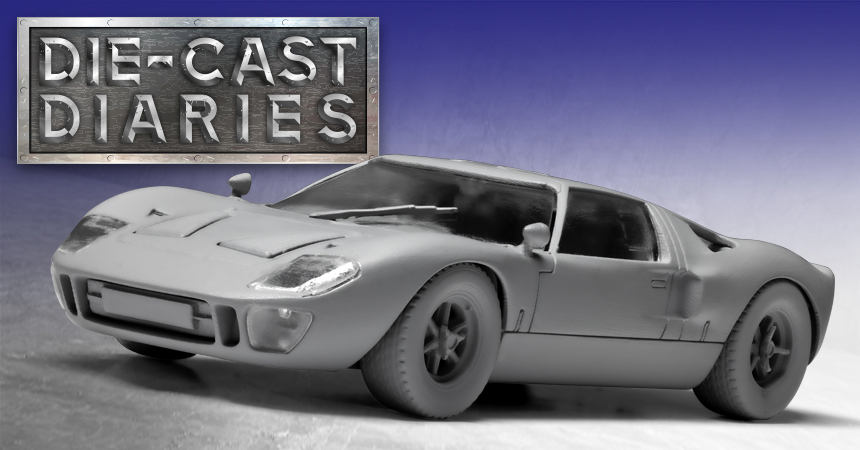
That being the case, we’re delighted to confirm that our main feature is an exciting EXCLUSIVE check-in to one of the most eagerly anticipated new tooling project additions to the Vanguards range for many a year, a car which is considered iconic in the world of motorsport/motoring history, and one which always commands the attention of all in attendance when one makes a rare appearance at a car show, or classics rally. Our header image has already given the game away, but if you weren’t already looking forward to the release of the first model from this new tooling project, we’ll be hoping to draw your attention to it during the course of this latest exclusive blog update.
Remaining in the Vanguards world for the rest of this edition, our second model focus update brings popular Ford motoring a little closer to current times, whilst still celebrating the brand’s impressive and much cherished motorsport heritage. This model is our tribute to arguably the finest example of this particular vehicle model to be found anywhere in the world, which therefore also makes it a fitting subject for inclusion in the Vanguards range.
We’re staying on four wheels in this latest edition of CORGI DCD, even if those impressive wheels are turning at quite a rate.
We have exclusive images galore for you in this latest edition of DCD, as we bring you CAD files created in support of our new Vanguards Ford GT40 model project.
When it comes to the world of popular motoring, there is nothing like high profile motorsport success to drive the development and public awareness of a parent brand, particularly if that success comes in the world’s most prestigious endurance race. During the early 1960s, Ferrari cars dominated Le Mans 24, the world’s oldest active sports car endurance race, winning the high profile event six years running from 1960 onwards. Whilst this success captivated a world fascinated by everything to do with this annual motorsport spectacle, not everyone was delighted by their success, particularly those who were in a position of authority at Ford.
The Ford company had long held a desire to become a major player in the world of motorsport, with the Le Mans 24 competition holding a particular fascination for them. The very specific requirements of the cars competing in this race meant that Ford’s attempts to gain competitive entry into this field had proved fruitless, with many inside the company believing that the only way to see a Ford car taking the chequered flag at this event was to take the Ferrari badge off a Ferrari car, and replace it with a Ford badge.
Although this sounds like a facetious, almost throwaway comment, it’s interesting to note that negotiations to that end actually did take place between the two companies, and for a time, it looked as if there was a very real possibility that Ford could take this incredible and unprecedented step. In the end though, the negotiations ended in a mutual termination of discussions, and Ford creating their High Performance and Special Models Operation Unit, with the sole intention of creating a racing GT car capable of competing at the front of such races as Sebring and Le Mans.
The actual car our engineers arranged to scan at the start of this exciting project.
A crack team of highly talented designers, engineers and drivers was assembled, with Carroll Shelby being notable as one amongst them, and with their main initial task being to select a partner team to actually build the cars. There was a frontrunner, a small, specialist motorsport company based in Slough, England, a company which had cleverly brought the world of aerospace engineering into the world of high end motorsport, and created their high performance monocoque constructed Lola Mk.6 GT. This spectacular car used a Ford powerplant and took on the seemingly invincible Ferraris at the 1963 Le Mans race, impressing hugely, but failing to disrupt Ferrari’s dominance by virtue of a gearbox issue.
Ford struck a deal to purchase the Lola GT company, and the two Mk.6 GT cars they still owned, with the expert team behind the cars now being charged with creating a Ferrari beating race car for Ford. In essence, Lola GT brought the expertise and Ford brought the money, with Henry Ford II being more determined than ever to shatter Ferrari’s celebrated dominance.
The rest, as they say, is the stuff of motorsport and high performance racing car legend, a car which was a beast of a performer, and one which placed the Ferraris firmly in its rear view mirrors. Having said that, the rise of the GT40 wasn’t without its challenges and frustrations, but by the time the Shelby/Lunn partnership had worked their magic, the car was ready to take on the endurance motorsport world. The car was precise, responsive and FAST, and it was now ready to line up next to the all-conquering Ferraris.
The Ford GT40 would go on to win the Le Mans 24 hour race in 1966 and for the next three years running, with that first win seeing the car taking the first three places, but with the 1969 race only seeing the car triumph over a Porsche car by a few metres after 24 hours of racing. Ford had their Ferrari beater, and the world had a motorsport legend for the ages – surely that needed to be a Vanguards model.
Such an iconic car, surely everyone knows about the iconic Ford GT40, but would it be a good subject fit for the Vanguards range?
When looking at the wider heritage of the Vanguards model brand, despite the legendary status possessed by the Ford GT40, this endurance racing behemoth does seem like a rather strange subject for inclusion in the range. Clearly, from a subject perspective, there will be few collectors who wouldn’t love to have a 1:43rd scale Ford GT40 within their collections, but how could we do this and retain the integrity of the brand’s legacy.
This was the major question we were asking ourselves when we initiated some subject marketing insight work for the Vanguards range several months ago, where we asked a cross section of existing collectors, and an external sample of UK based residents to tell us which vehicle types they would be interested to see us create scale die-cast models of. From the current collector section, there were three clear front runners, with the Ford GT40 (road legal) being amongst them and interestingly, with the other two car types already in our plans for impending range inclusion.
From the wider, arguably more inclusive audience, the Ford GT40 was by far and away the most popular subject suggested, as it seems this iconic sports car is the one subject that would appeal to most people, potentially seeing them entering the world of die-cast model car collecting for the first time.
If we were looking for a clear answer to our question, the responses really couldn’t have been any clearer – we had to start work on a Ford GT40 at the earliest possible opportunity. With regard to the heritage lineage of the Vanguards brand, producing one of the 31 road legal Ford GT40 cars in 1:43rd scale die-cast for the first time in our 70th Anniversary year, one which also happens to be the 30th Anniversary year of the Vanguards range, was clearly the right subject for us to do, a timeless classic of a sports car which continues to stand the test of time, and appeal to a great many people.
A car which needs no introduction, the Ford GT40 enjoys an iconic status which has endured many decades since its Le Mans successes, meaning it’s still one of the most famous and desirable cars ever produced.
Once the decision to proceed had been made, our development team started the task of looking for a suitable vehicle for us to LIDAR scan, which was no mean feat considering the iconic status these vehicles hold, and the fact that once they’re in private collections, they often become cherished and closely guarded secrets. Thankfully, through our contacts in the motoring industry, we did hear of a car that would fit the bill perfectly, one which had been amongst the collection of a high-profile classic car dealership in central London, and one which had been with them for some time.
Contact with the dealership was duly made and permission for the scanning project granted, so the team looked forward to not only getting close to one of these legendary vehicles, but also to starting the project to bring it to our Vanguards range.
Just days before the scanning trip was due to take place, the dealership contacted the CORGI office to inform us that they had just accepted an offer for the car, and it was about to be sent to a new owner outside the UK. After some frenetic rearrangements and thanks to the incredible support of the two classic car dealerships concerned, arrangements were made for the scanning team to visit a different dealership in a south coast port city, which were about to prepare the car for an onward sea journey, but agreed to delay a few hours, to allow the LIDAR scanning procedure to take place.
This final series of CAD imagery takes a more detailed look at the design of the new model in software, including some detail never previously incorporated into a CORGI Vanguards model.
We would like to place our grateful thanks on record for the incredible support we received in allowing our Ford GT40 scanning day to take place.
Once we had the scan data in the can, we could begin the time honoured process of cleaning up the data and supplying the files to our designers, along with a robust supporting research file detailing all the requirements and variant/component options we needed to be incorporated into the design. The car scanned was Demonstrator P1018 and in line with most of the 31 vehicles produced at the time, was intended to be used for promotional purposes, and was shipped out to the US after construction here in the UK. Indeed, this was thought to have been one of the cars specified by Carroll Shelby himself, produced to race car specification and used by Shelby and Ford as their star demonstrator during the glory years of the GT40. Significantly, she is thought to have been one of the two GT40s actually driven by Carroll Shelby.
She was originally finished in maroon over black, but has worn other distinctive liveries over the years. She’s been a film star, has graced many a motorsport event, and during the 2000s, came back to the UK to captivate enthusiasts at Goodwood Revival, and several other commemorative motorsport events. Recently restored back to the original maroon livery with which she arrived at Shelby American, this historic car made for the perfect motoring muse for this project, and we very much look forward to adding her to the Vanguards range. If we only sell models to her previous owners, or those people who came into close contact with her, we’ll have a sell-out release on our hands, such is the pedigree of this beautiful car.
The next series of images all feature the recently received 3D stereo prototype models produced from the new Ford GT40 CAD files – enjoy!
As you can tell from the tone of this latest update, we’re all really excited to be advancing through this project at some pace now, and are therefore equally pleased to be in a position to bring you this exclusive development update from what we already know will be a popular addition to the Vanguards range. As in every case when showing prototype and advanced sample models, we do have to impress on those viewing the images that they are still pictures of development sample models and as such, may well be subject to design modification prior to going into production.
Obviously, the CAD images all emanate from the design phase of the project, and whist only a digital representation of the tooling design files produced using the LIDAR scan data as reference, are nonetheless fascinating from a project perspective, and of great interest to those invested in the die-cast model collecting hobby.
The images which feature the grey coloured Ford GT40 models are 3D stereo sample models produced from the CAD files, and are created to allow the development team to see what these files would produce if committed to tooling. A vital stage in the process, seeing the model in this state allows us to inspect every aspect of its replication in design, surface detailing, fit and location, highlighting if any design changes are required prior to advancing to the next stage.
Please remember these are prototype models and may be subject to further change before being cleared for production.
If you look closely at these images, you will already be able to see that the design team have highlighted a couple of areas which need attention within the CAD files, particularly in relation to the side sill panel fit and location, and how the nose vent/grill detailing has had to go back into design. It was initially thought that tooling separate grille parts to be used on alternate variants of the model would be the most cost effective way of replicating this details, however, on inspecting the 3D sample model closely, they were not happy with how this detail came out, and have therefore since decided to tool completely separate bonnets for the different car models which feature the different grille types.
We have much more to bring you from this project at it advances towards initial release, but for now, we hope you enjoy this exclusive insight behind the scenes of our impressive new Ford GT40 project, our scale tribute to this modern high performance motoring icon.
Please keep checking your Die-cast Diaries blog for further details of this, and all future new model tooling projects.
Staying with the subject of new Vanguards models, and maintaining our association with Ford’s impressive motorsport heritage, we bring things forward a couple of decades in featuring another highly desirable now classic Ford vehicle type, our model tribute to a very specific car which has been described as arguably the finest example of this particular model in existence.
Already an extremely popular range of cars right across Europe, the launch of the second generation of the Ford Escort model served to further enhance the reputation of this classic small family car, introducing squarer styling features than those of its predecessor. Although the L and GL models in both two and four door options would be the money-earning bread and butter cars with regard to overall Ford sales numbers, the sporty and exciting RS Mexico and RS 2000 models clearly highlighted the fact that these cars possessed genuine motorsport credentials, even if your particular Escort was much more conservative in appearance and performance.
At that time, it seemed as if hardly a week went by without the sight of a racing Escort taking the chequered flag at some rally/motorsport event or other across the world and who wouldn’t want a motoring association with success such as this. Even though the vast majority of Escorts on Britain’s roads were what you would expect a popular small family car to look like, everyone who saw them knew that beneath that plain exterior, there was a rally sport beast just waiting to be unleashed!
The Ford Escort series was first announced to the motoring world back in January 1968 and over the course of the next 33 years, around 4.1 million vehicles in six distinctly different marks would be produced for the British, European and world motoring markets. On several occasions during that time period, the Escort had the distinction of being Britain’s best-selling car, a fact which is a clear indicator as to why the Escort has made such a popular transition to the scale diecast model collector world. That being said, collectors will be delighted to see that these new models of this second generation Escort RS 2000 are advancing towards release, and we can all now start to rearrange our displays in preparation for their arrival.
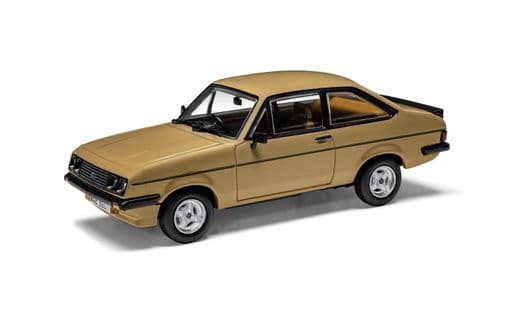
VA14911 – Ford Escort Mk2 RS2000 Custom in Tuscan Beige
The 1975 Mk2 incarnation of the Escort RS2000 took the name upmarket and was promoted by Ford as their ‘Executive Express’. Demand was strong until production ceased in 1980, after 23,000 had been made. It was offered in a range of striking colours that suited its sporting demeanour, and although production figures are unknown, very few were made in the rather unpopular Tuscan Beige, which was only offered for one year from August 1978. The example modelled, which is affectionately known as ‘Werthers’ because of its toffee colour, features an even rarer ‘Chocolate’ interior and is an icon of the RS2000 scene, and multiple concours winner; Many consider this to be the finest restored example in existence.
It was originally purchased from racer Vince Woodman’s RS dealership, VMW Motors, South Gloucestershire, on May 26th, 1979. It covered 1818 miles in its first month but, by 2004, had been with second owner Alan Reynolds in Gloucestershire for 24 years and covered 54,000 miles. Buckinghamshire-based enthusiast Ian Parker purchased it in 2004, after looking for a rust-free example for over a year. He planned to produce the finest restored RS2000 in the world, to Ford’s ‘Group 1’ dealer accessory specification. Over the following two years he far exceeded that aim and the finished car is a testament to his phenomenal determination and attention to detail. Current owner, Aled Hopwood from North Wales, purchased it on August 1st, 2022, and enjoys showing this remarkable machine.
Whilst that’s all the new model subject matter we have for you in this latest edition of Die-cast Diaries, we couldn’t let you go without reminding you that the new digital edition of our May to August model catalogue is available for download on the CORGI website. An invaluable aide memoire when it comes to our model collecting, these digital publications are now becoming as essential component of our hobby and as they’re both free to obtain and easy to store, have become as popular on range launch day as the new model announcement it contains.
Obviously, as the new collection of models are still fresh in everyone’s minds, and still a hot topic within the wider hobby, people are still coming to terms with what we’re intending to release over the next few months, and are probably still inspecting the range to identify their own personal highlights. As always, we will endeavour to bring you all the development details from the most anticipated projects from the new range as they advance towards release here on DCD, but just wanted to remind you that if you have yet to download your copy of the catalogue, its there waiting for you.
That’s all we have for you this time around, but we’ll be back as usual in two weeks’ time with another selection of all the latest CORGI die-cast model updates and exclusive previews for your delectation. As always, if you would like to drop us a line to comment on anything CORGI model related, or to suggest a future blog topic you’d like to see covered here in DCD, we’re always happy to hear your views.
As ever, our diecastdiaries@corgi.co.uk address is always the one to use.
If you can’t wait for the next blog, you will find plenty of CORGI model collecting discussions taking place on our official social media channels, access to which can be obtained by clicking on the respective links at the foot of the CORGI website homepage.
Link access to CORGI social media sites.
Thank you for continuing to support your CORGI Die-cast Diaries blog, as we head into our twelfth year of production. Our next edition is scheduled for publication on Friday 5th June.
Until next time, once again, thank you for your continued support.