

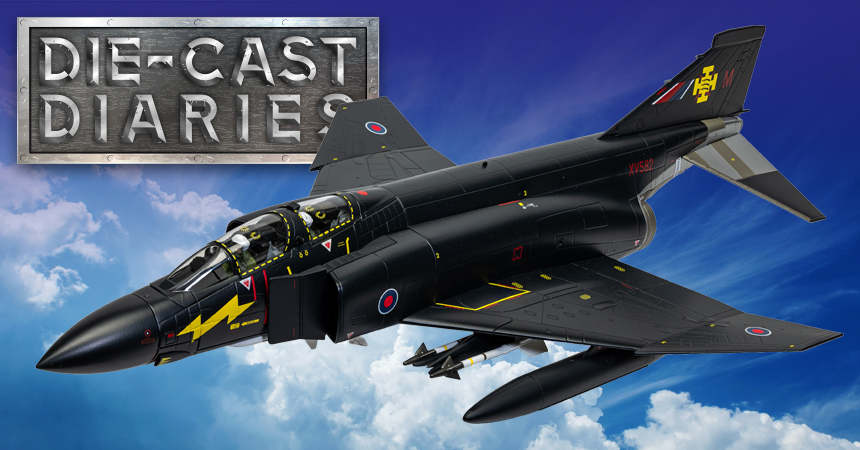
Welcome to our latest edition of CORGI Die-cast Diaries, your fortnightly blog review bringing collectors all the news, updates and topical stories from the captivating world of CORGI die-cast model collecting.
Well, the best laid plans, and all that! As you may have gathered from the title of this latest DCD update, we should have been taking the CORGI roadshow to RAF Fairford this weekend, to attend the popular Royal International Air Tattoo, one of the most impressive Airshow events to be found anywhere in the world today. Unfortunately, world events dictated that the show was unable to take place this year, leaving a huge hole in the diaries of enthusiasts, businesses and support services, including the team here at CORGI, and we had some big plans for show weekend.
Even though we have to deal with the disappointment of show cancellation, and losing the ability to speak to thousands of CORGI and Aviation Archive collectors in the flesh during RIAT weekend, we are determined to still have our own RIAT launch party, and bring you a selection of new model announcements which would have been unveiled at the show. The only difference is that this will now be DCD style, rather than in the CORGI marque at Fairford, although thinking about the weather we’ve been experiencing lately, this might not be such a bad thing.
So, for this latest edition, you can look forward to the EXCLUSIVE unveiling of FOUR new model additions to the Aviation Archive range, a similarly exclusive series of CAD imagery detailing tooling modification work to one of the most popular models in the range, and a few hints at other exciting things to come for Aviation Archive fans in 2026.
May we welcome you to our Die-cast Diaries RIAT 2026 new model launch party, the one that’s not actually being held at RIAT, but will still be great nonetheless.
Although we can’t welcome you to the CORGI marquee at RIAT this year, we do have some new model exclusives to share with DCD readers.
Catering for both hard-core aviation enthusiasts and those people just looking for an exciting day out spent with aeroplanes, the Royal International Air Tattoo is something very special in the nation’s event calendar, an unmatched gathering of air power from around the world on a scale that’s simply breathtaking. With static displays that stretch for miles, and a collection of aircraft which is usually pretty much unique for any airfield anywhere in the world, RIAT is the must attend event for tens of thousands of people each year, even though most will be in need of a holiday after successfully negotiating their latest event.
From a CORGI perspective, RIAT 2025 proved to be rather significant for us as a brand team. For the first time since coming under Hornby ownership, the CORGI team had a standalone presence at the show, and even though we were positioned next to our colleagues at Airfix, our marquee was 100% Corgi – it was a proud occasion for us. We used our attendance to reveal an impressive selection of new models over the course of show weekend, which proved to be a popular highlight, however, it was the chance to meet so many CORGI collectors both current and lapsed that left the lasting impression on us. It left us with a steely determination to ensure that if at all possible, we would be making this an annual undertaking.
That being the case, planning for our attendance at this year’s show started not long after we’d unpacked back at CORGI HQ last July, and we had plenty of ideas about how we could make things even better for those coming to see us. As it transpired, those plans were unable to come to fruition, however, when it came to the model announcements we were intending to make, the consensus within the team was why should we change our plans? Clearly, there wasn’t going to be a CORGI marquee at this year’s show, and we weren’t going to be welcoming large numbers of model enthusiasts to see the exclusive product reveals in person, but we could do it through DCD.
No RIAT Aviation Archive model displays for us this year, but we do still have some new model announcements to make.
Unlike the covered display plinth new model reveals of last year, this was going to be much more of a visual run-through of new model additions to the range, but from a subject exposure perspective, you could argue that this format has even greater reach potential. However you choose to look at it, this is the only game in town for RIAT weekend 2026, so that being the case, who fancies seeing an exclusive collection of new CORGI Aviation Archive models?
In order to keep the release suspense going throughout RIAT weekend, our original intention was to unveil some of the models on Friday, with the rest on Saturday, meaning that visitors on two show days out of three would have had the opportunity of being the first to see new models on either day. In truth, the way things worked out, we actually had so much news and so many new models to reveal that there would be something new to share every day, but at this stage, we’re going to be keeping two of those projects up our sleeves for now, including BIG news of a significant new tooling addition to the Aviation Archive range, one which few people will be expecting.
For now though, let’s begin with a brand new addition from our 1/48th scale McDonnell Douglas Phantom tooling, and our tribute to one of the best loved individual aircraft to have seen Royal Air Force service during the post WWII era.
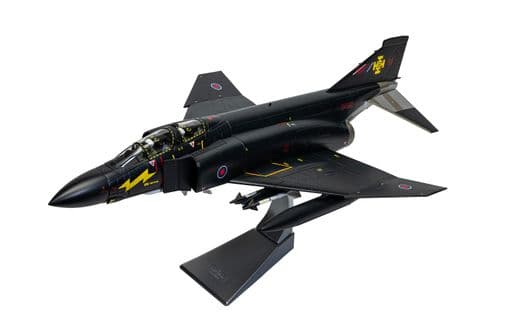
When it comes to RAF aircraft which have benefitted from the application of special commemorative schemes, there’s one machine which still enjoys legendary status amongst Britain’s army of aviation enthusiasts, Phantom FG.1 ‘Black Mike’. An aircraft which had recently transferred to the care of RAF No.111 Squadron at Leuchars, XV582 was selected to receive this unique scheme as the squadron wanted to mark both the RAF service of the Phantom, and the heritage of their famous unit, heritage which included the ‘Black Arrows’ Aerobatic Display Team.
Between 1955 and 1960, this team flew aerobatic demonstrations in their gloss black painted Hawker Hunter jets at Airshows all over Britain, including the Farnborough show in 1958, where the team captured a world record by looping 22 Hunters in formation. In commemoration of this, XV582 was given this smart all-over gloss black scheme, initially for just a static ‘At Home’ Airshow appearance at Leuchars in 1989, but proved so popular that she exhausted her remaining airframe hours the following year as Treble One squadron’s display aircraft. Known as ‘Black Mike’ because of her colour and her squadron letter, XV582 became the aircraft every RAF pilot wanted to fly, but with her Airshow commitments and low remaining flying hours, only a fortunate few managed to do so. Making her final flight on 22nd September 1990, ‘Black Mike’ was retired to become a static star of many a Leuchars Airshow, but always retaining her iconic status with aviation enthusiasts.
Box artwork and sample model imagery featuring what we hope will be a popular addition to the 1:48th scale range of Aviation Archive models.
McDonnell Douglas Phantom FG.1 XV582 saw service exclusively with the Royal Air Force, making its first flight in early 1969 and delivered to No.43 Squadron later the same year. In RAF service, this magnificent aircraft continued to build its operational reputation, eventually becoming one of the most famous of all the British Phantoms – her notable achievements include the fact that she was the only FG.1 to serve with No.228 Operational Conversion Unit and the first Phantom to exceed 5000 flying hours. XV582 was also the aircraft used in the record breaking ‘Lands End to John O’Groats Run’ on 1st April 1988, when this impressive fighter covered the 590 mile distance in just 46 minutes and 44 seconds. It posted an impressive average speed of over 757 mph.
The fateful decision which ensured Phantom XV582 would become one of the most famous aircraft to ever see RAF service occurred in the late 1980s, when she was selected as the aviation canvas for a striking official commemorative repaint for Leuchars based No.111 Treble One Squadron. Intended as a high-profile acknowledgement of the illustrious history of this famous flying unit, which had previously displayed large formations of Hawker Hunters (The Black Arrows) and English Electric Lightnings during Britain’s classic jet era, the Phantom was given a striking gloss black paint scheme and adorned with the famous yellow Squadron markings of ‘The Tremblers’. XV582 was selected because her extensive service dictated that she was categorised as a limited fatigue life remaining airframe, specifically as it was initially intended that this visual tribute would only be a short-term arrangement.
Something special from our talented photographer, as he brings us ‘Black Mike’ at night.
The smart all-black Phantom attracted so much interest that she immediately became one of the most popular aircraft in the RAF and although initially only intended for static display duties, she continued to be flown for a short while - it seemed as if anyone with the opportunity to do so, wanted to have some flight time in this beautiful aircraft in their logbooks. Retaining its ‘M’ code, it didn’t take long before XV582 gained the nickname ‘Black Mike’, a name which would go on to become synonymous with Britain’s Phantom operations, becoming one of the most distinctive aircraft ever to see Royal Air Force service.
Whilst only continuing to fly on for a short while, Black Mike would go on to become the static display highlight of many a Leuchars Airshow, with enthusiasts travelling many a mile just for the annual opportunity to photograph her. Following the closure of RAF Leuchars, this beautiful aeroplane spent quite some time on one of the airfield’s hardened aircraft shelters, but was saved from being scrapped and transported to RAF Cosford in 2017, where she was scheduled to be one of the star attractions at their RAF 100 Airshow static display the following year. The aircraft currently resides at the South Wales Aviation Museum, where her famous legacy continues to be preserved.
We’re delighted to be inducting this most distinctive, and much loved British jet aircraft into the Aviation Archive Hall of Fame, and hope that a great many people will be pleased to have our 1:48th scale tribute to this beautiful aeroplane as part of their collection.
Douglas C-47 Skytrain ‘Night Fright’ proved to be one of the most popular Aviation Archive releases of recent years.
When it comes to modelling famous aircraft as scale die-cast representations, few can claim to have had the impact on the Aviation Archive range as the Douglas DC-3/C-47 Skytrain. First introduced into the range in 1:72nd scale form during 2009, the Skytrain has to be considered one of the most popular models in the entire range, with most releases finding new collector homes in extremely short order, and new additions to the range always being welcomed with open arms. This actually comes as no surprise, because in addition to being a beautiful die-cast representation of this famous aircraft, the DC-3/C-47 has quite the reputation in aviation terms.
It really is incredible to consider that one of the most influential aircraft in revolutionising the world of passenger transport in the 1930s would also go on to become the transport backbone of Allied air forces during the Second World War. Indeed, the Douglas C-47 Skytrain would even be described by the Supreme Commander of Allied Forces in Europe, General Dwight D. Eisenhower, as one of the handful of machines which proved vital to Allied success during WWII, so reliant were the Allies on the aircraft’s supply and paratrooper delivery capabilities.
The military variant of the Douglas DC-3 would differ from its previous airliner configuration in several different ways, perhaps most noticeably by its inclusion of a large two piece cargo door located at the rear port side of the aircraft's fuselage. It would also have reinforced flooring to cope with the rigors of military service, and have the main cabin floor angled slightly upwards, to make this surface parallel to the ground during loading of the aircraft. The fuselage seating arrangements consisted of fold back metal and canvas benches down both sides of the fuselage, with windows featuring rifle grommet apertures to allow troops to fire out from inside the aircraft, should that situation arise.
‘Night Fright’ featured our para rack and pack tooling modification for the first time.
The DC-3/C-47 tooling has been the subject of further modification – read on for further details.
Skytrains could also be fitted with a heavy duty glider tug attachment point positioned centrally at the very back of the fuselage and often hidden behind a removable tail cone. A specialist paratrooper delivery variant of the aircraft was also produced, designated the Douglas Skytrooper in US parlance, however, the many aircraft operated by British and Commonwealth air forces would be known affectionately as Dakotas. As we’re throwing names around, the C-47 would go on to be referred to by several less than flattering nicknames during its military service, names which included the Gooney Bird, Dumbo and even Old Fatso. It does have to be stressed though that these were all meant as terms of endearment, as the Skytrain was always held in extremely high regard by those who crewed and flew in them.
Perhaps the most poignant nickname the aircraft inherited was the ‘Vomit Comet’, a name given to the Skytrain by paratroopers, presumably due to the severe buffeting they experienced during the flight to their latest drop zone, and in no small part linked to the dangerous undertaking which lay ahead of them.
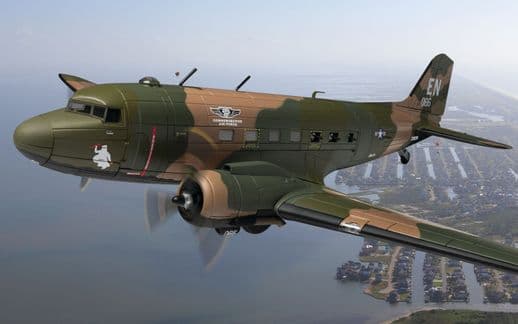
As one of our most popular toolings, the DC-3/C-47 has benefitted from some additional tooling modification over the years, with the front of the model receiving update after just the first two releases, and the latest ‘Night Fright’ release in 2023 introducing the under-fuselage para racks and packs which were often carried by these aircraft during paratrooper delivery missions. We’re delighted to confirm that our C-47 tooling has undergone further modification to allow us to produce a different representation of our paratrooper delivering aircraft models, and a very different variant which came to prominence during the Vietnam War, the fearsome AC-47 Spooky Gunship. This new model derivative would have been unveiled at the double had we been exhibiting at RIAT this year.
With its unmatched aviation achievements during the Second World War ensuring many of these aircraft continued in military service for many years, it will come as no surprise to learn that hundreds of these aircraft were also deployed during the Vietnam War, with around 50 being converted to undertake a very specific new offensive role. Rather than just hauling cargo, the C-47 was tasked with performing airborne fire support for US troops on the ground, whose often remote outpost positions placed them in danger of being overrun by attacking Viet Cong forces.
These aircraft were equipped with several rapid firing 7.62mm Gatling/mini guns, each capable of firing 6000 rounds per minute, bringing down a withering rate of fire onto any identified target. Positioned next to the cargo door at the rear of the port side of the aircraft, pilots would fly a steep left-hand banking turn over a target, allowing the guns to rain down a fearsome lead rainstorm against enemy positions, with many US troops owing their lives to this new form of support from the air. Used extensively for firebase and Special Operations support, whilst around 53 of these aircraft were converted, it’s thought that only 41 aircraft actually saw service during the Vietnam War.
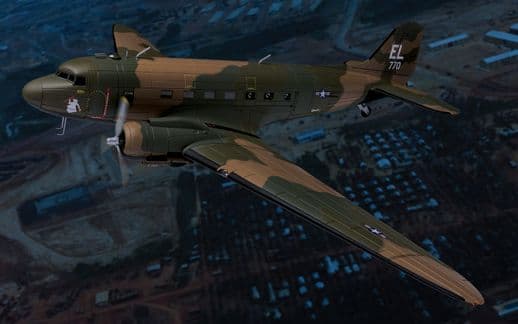
In the dark night skies over Vietnam, a terrifying new weapon had been introduced by American forces trying to protect their troops on the ground, a combination of older aeroplanes and cutting edge technology that resulted in the creation of fire spewing dragons capable of laying down 6,000 rounds of suppressing fire every minute. The venerable Douglas C-47 Skytrain had been modified to become one of the most feared weapons of the conflict, however, ‘Spooky’ crews wouldn’t always have it their own way.
Artwork file produced in support of our (joint) first AC-47 Spooky model project.
On the night of 24th February 1969, the crew of gunship 43-49770 ‘Spooky 71’ had been called to provide fire support for troop under attack at Long Binh, but whilst doing so, their aircraft had taken a direct mortar round hit in the right wing, resulting in a gaping hole and the aircraft being peppered with 3,500 shrapnel holes. The aircraft lurched violently and the fire crew were thrown off their feet, all suffering from multiple shrapnel wounds. Bleeding profusely, Airman First Class John Levitow could see one of his crewmates was in danger of falling out of the open cargo door, and fought through the pain of his wounds to drag him to a safer position.
Unfortunately, he also saw that the flare his colleague had been trying to throw out of the aircraft prior to the mortar hit had blown back into the cabin and was smoking, about to detonate. He threw his body on top of the flare and slowly ushered it towards the open door using his last reserves of strength, rolling it into the night sky seconds before it detonated. For his heroic, selfless actions which saved both his aircraft and crewmates, John Levitow was rightfully awarded the Medal of Honor.
Despite the drama and devastation in the night sky above the Long Binh US Army post, the aircraft did manage to make it back to its home base safely, where ground crews were able to assess the damage from the mortar strike, and count every one of the 3,500 shrapnel holes which peppered the wings and fuselage of their aircraft.
Our DC-3/C-47/AC-47 tooling can now boast some impressive new features.
Breathing new life into our DC-3/C-47 tooling, there was more to this project undertaking than might at first meet the eye, and called upon the experience of both our development team here in the UK and their colleagues out in the Far East. The original C-47 tooling was designed prior to the CORGI brand coming under Hornby ownership, and in the days before such projects could rely on LIDAR scan data to support tooling design. That dictated that that this was far more complicated a project than it would be these days, and essentially required our team to scan an existing C-47 model, and make all their CAD modifications from there.
In addition to this, whilst the modifications were intended to allow us to produce models of the AC-47 ‘Spooky’ gunship in future, we wanted to include as many range permutations as possible into the altered design, not just to incorporate different armament variations for these famous gunships, but also to breathe new life into the Skytrooper variant of the aircraft.
To this end, we supplied as many references of C-47s in operation to our development team as possible, including some with paratroopers stood in the open doorway in the moments prior to taking to their chutes. Ingeniously, the references for the new CAD figure were taken directly from this photographic detail and were not created using clay models or scale sculpted figures, which really does highlight the impressive skill levels our design team possess.
This next series of images all feature CAD screenshots of some of the new features of our DC-3/C-47 tooling. This particular CORGI classic has got some new tricks up its sleeve.
The final stage of the project did allow the team to inspect 3D printed parts for scale accuracy and authenticity, but it wasn’t until they received the first metal shots created by the modified toolset that they could really assess what had been created. For the paratrooper stood in the doorway of the model, we also had to design a little ‘office’ for him, because opening up this door also revealed the interior of the model, and would have allowed collectors to see inside the Skytrain.
As we didn’t want to design a full interior for the model and therefore increase its cost significantly, we had to ensure that the ‘jumpers’ position was a little more private than it would have been in operation. Having said that, we’re really pleased with how these modifications have turned out, and look forward to releasing the first paratrooper equipped version of the Douglas C-47 in the near future. For the purposes of this RIAT release update though, we are delighted to be confirming that the Vietnam War AC-47 Gunship will be joining the range this year, and it will be AT THE DOUBLE! We’ll have more on that in just a moment or two.
The CAD images being exclusively shown here were all supplied whilst this latest edition was being penned, so talk about being hot off the Aviation Archive press. They mark the culmination of a project intended to further enhance the appeal of this already popular model, and have already been ‘finessed’ in preparation for their use in producing our first AC-47 Gunship models.
A second exclusive piece of CORGI AC-47 artwork to share with DCD readers.
Although confirmed at our latest range launch announcement and included in the current CORGI catalogue, RIAT show attendance for us this year would have seen us proudly unveiling our model production partnership with the Commemorative Air Force, and would have seen us with the first two models (at least) due for release on show ‘in the metal’.
The Commemorative Air Force is a truly inspiring organisation, describing themselves as the world’s largest flying museum, dedicated to keeping historic aircraft flying to honour those who built, flew and maintained them. Now boasting over 180 historic aircraft mainly in the US, but with 80 different units across the globe, members travel the US to bring their aircraft and their stories to the public, allowing everyone to see these historic aircraft in the air where they belong, not languishing in a museum.
The story of the Commemorative Air Force may have started back in 1957, but continues to go from strength to strength to this day, something we wanted to mark in launching this new collection of model releases. We’re therefore delighted to be unveiling our 1:72nd scale tributes to the very first, and the latest aircraft additions to the Commemorative Air Forces’ inventory, P-51D Mustang ‘Red Nose’ and AC-47 ‘Spooky’.
Although the North American P-51 Mustang is unquestionably regarded as one of the finest fighting aeroplanes of the entire Second World War, it can be surprising to learn that the bubble canopy equipped ‘D’ variant of the fighter only started flying combat operations in the European Theatre from the summer of 1944 onwards. With its impressive reputation, the Mustang has long been a favourite with Warbird and Airshow enthusiasts, with one aircraft possessing a particularly rich heritage in the world of historic aviation.
P-51D Mustang ‘Old Red Nose’ was purchased by a group of WWII veteran pilot friends in 1957, who pooled their resources to secure a Mustang they could all fly, with this aircraft now regarded as the founding aircraft of the Commemorative Air Force (CAF). Always flown with a distinctive red spinner, this Mustang was colloquially known as ‘Old Red Nose’, so when it came time to select a suitable authentic wartime scheme for her, they went with one of the red nosed Mustangs of the 4th Fighter Group, which flew out of Debden in England during the Second World War, a unit which would become the highest scoring USAAF Fighter Group in WWII.
She was donated to the Commemorative Air Force (CAF) in 1991 and since that date, has been honouring the heroes of yesterday by informing the public about the people who built, flew and maintained these magnificent aeroplanes. She is part of CAF’s Airbase Georgia ‘Flying Museum’ collection of aircraft, based at Atlanta Regional Airport - Falcon Field.
When it comes to allowing the public to interact with historic aeroplanes, nobody does so quite like the Commemorative Air Force (CAF). Honouring the heroes of yesterday by inspiring the heroes of tomorrow, those involved with CAF are dedicated to this vital mission, inspiring millions of people by educating them about their aircraft and the people who built, flew, and maintained them.
One of the latest aircraft to join the CAF fleet is a Douglas AC-47 Gunship, known as ‘Spooky 086.’ The aircraft is assigned to the CAF’s Texas-based Gulf Coast Wing, where members have worked hard to prepare it for its debut on the US historic aviation scene. The AC-47 is a beautiful example of the fire support platforms that served with distinction during the Vietnam War. This aircraft was originally built as a C-47B in 1944 and later assigned to the US Navy as an R4D-6. Although this aircraft didn’t serve in Vietnam, the CAF intends for this project to highlight the aircraft's adaptability, which enabled its conversion into an airborne fire support platform 25 years after it was originally built.
Spooky gunships could loiter over a battlefield, circling and concentrating fire, making them an effective early counterinsurgency aircraft. The code markings worn by “Spooky 086” do not designate a specific AC-47 that served but rather pay tribute to 86 individual AC-47 crew members who lost their lives whilst serving during the Vietnam War.
Obviously, even though we’re making these exclusive new model announcements in this alternative RIAT update edition of Die-cast Diaries, we do still have much more development information to bring you with regard to the two new AC-47 Spooky models, and the Commemorative Air Force Mustang before they’re ready for release, but at least you all now know about their existence. We also had other exclusive reveals to bring you had our stand at RIAT gone ahead this year, but it is a known fact that it’s actually possible to bring you too many Aviation Archive exclusives in a single edition of DCD, and we wouldn’t want to be guilty of doing that to you, now would we.
That being the case, please keep an eye out for updates in forthcoming editions of our blog, as we will endeavour to keep you fully informed on these and all the other new model developments from the world of CORGI.
For now though, we hope you don’t miss RIAT too much this year, in addition to also hoping this new model announcement edition of Die-cast Diaries did help to soften the blow just a little. There’s one thing for certain though, ours would have been the only place on the RIAT 2026 showground where you would have been able to see a beautifully presented pair of Douglas AC-47 ‘Spookys’.
I wonder what Aviation Archive delights we’ll have for you at RIAT 2027?
Ending where we began with our die-cast tribute to one of the RAF’s most distinctive aircraft of the post war era – enter McDonnell Douglas Phantom FG.1 ‘Black Mike’.
That’s it for this special RIAT edition of our CORGI update blog, but we will be back as usual in two weeks’ time to bring you a further exclusive selection of updates. As always, if you would like to drop us a line in the meantime to comment on anything CORGI model related, or to suggest a future blog topic you’d like to see covered here in DCD, you’d be more than welcome, and we’re always happy to hear your views.
As ever, our diecastdiaries@corgi.co.uk address is always the one to use.
If you can’t wait for the next blog, you will find plenty of CORGI model collecting discussions taking place on our official social media channels, access to which can be obtained by clicking on the respective links at the foot of the CORGI website homepage.
Link access to CORGI social media sites.
Thank you for continuing to support your CORGI Die-cast Diaries blog, as we head into our eleventh year of production. Our next edition is scheduled for publication on Friday 31st July.
Until next time, once again, thank you for your continued support.