

It’s not often that the Air Display world gets to boast an exciting new event for aviation fans and die-cast model collectors to experience, but that’s what we’re proud to be announcing in this special edition of our regular Die-cast Diaries blog.
As we all know, the UK Airshow scene has had to endure the cancellation of its premier event this year, as the massive Royal International Air Tattoo fell victim to the current world situation and was unable to welcome the many thousands of visitors who would usually flock to this famous Gloucestershire airfield. The CORGI team were looking forward to exhibiting at this year’s show and catching up with collector friends old and new, and whilst cancellation was disappointing, we immediately started thinking about creating something new of our own.
An idea which formed in the CORGI office at our Margate headquarters soon started to take shape, and as we’re proud to boast an impressive collection of aircraft ourselves, we wondered if we could actually host an Airshow of our own, one which would be a little different to anything people had ever experienced before, but one which would feature a collection of the most impressive aircraft the world had ever seen, some of which had never previously displayed at a UK Airshow event. After many hours work and quite a few sleepless nights, we’re proud to be announcing the very first Margate International Scale Die-cast Airshow, an event which we hope will be considered one of the highlights of this year’s Airshow scene, even if it’s only in scale form.
Obviously, this isn’t intended to be a RIAT replacement, and is just a bit of fun for CORGI collectors everywhere, however, we will be following something of an Airshow display format with our presentation, and will be including some aircraft that would be highlight acts at any event they attended, if we could only find full size equivalents of them.
To encourage everyone to support our inaugural event, we have a SHOW SPECIAL OFFER for all those who join us, with all the display acts attracting a 20% discount this coming weekend, our way of saying thank you for your attendance support. This discount will end at midnight on 26th July, after which time all remaining models will return to their usual prices.
We will have more details regarding this offer at the end of the display, but as I can hear the distinctive whine of a Rolls-Royce Pegasus engine firing up in the background, I’d better make my way to the commentary position.
Everyone is welcome and we hope you enjoy your day.
The CORGI Team
Harrier international
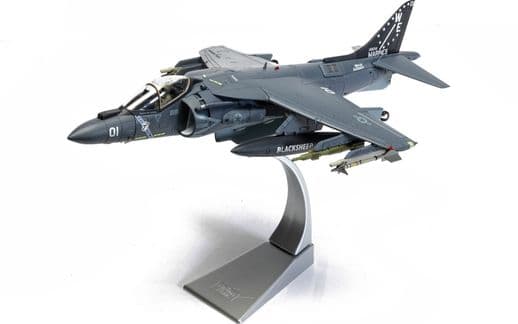
We’re delighted to be able to start our show with an illustrious overseas visitor flying an aircraft type which still means so much to the British people. Developed at a time when aviation technology was advancing at an astonishing rate, the Harrier was something very special when it came to its capabilities, an attack aircraft which could do things that no other jet aircraft could. The envy of the aviation world at the time, the British public couldn’t get enough of the Harrier, not just because it was an incredible source of national pride, but also because it was the consummate Airshow performer, an aircraft still sorely missed on the display circuit to this day.
The much improved Harrier II was developed in partnership with McDonnell Douglas in America, so it’s fitting that this rare appearance of a Harrier on the UK scene comes to us from across the Atlantic, one representing US Marine Attack Squadron 214, a unit which would expect to be at the forefront of any US or coalition call for military intervention. The aircraft wears a beautiful commemorative scheme, one which honours celebrated ‘ace’ pilot Major ‘PAPPY’ Boyington, the WWII fighter ace who was the first to exceed the victory total attributed to the famous Great War ‘Ace’ Eddie Rickenbacker.
What a spectacular aircraft with which to get our show underway.
Wings over the Ocean
The next aircraft to grace the skies over Margate both represent famous WWII aircraft types which operated over the world’s oceans during the conflict, one being a heavyweight amphibian, whilst the other is a Fleet Air Arm classic.
One of the most distinctive aircraft in the history of flight, the Consolidated Catalina was an incredibly versatile flying boat/amphibian which was produced in large numbers during the Second World War. Surprisingly agile for an aircraft of its size and appearance, the Catalina proved to be such an effective design that aircraft were still in service around the world many years after the end of the war, with around 3,300 aircraft eventually being built. As a long-range maritime patrol aircraft, the Catalina was an essential asset in a number of critical areas, including general naval patrols, anti-submarine operations, night intruder and autonomous shipping raider.
The aircraft on display here today represents an aircraft stationed in East Anglia during the closing stages of WWII, one charged with rescuing airmen from aircraft forced to ditch in the North Sea, as they made their way home from their latest operational sortie. She is presented as Consolidated OA-10A Catalina 44-33915 ‘Miss Pick Up’ from the 5th Emergency Rescue Squadron, and as UK based enthusiasts will know only too well, is the same scheme worn by the only airworthy Catalina currently operating in Europe.
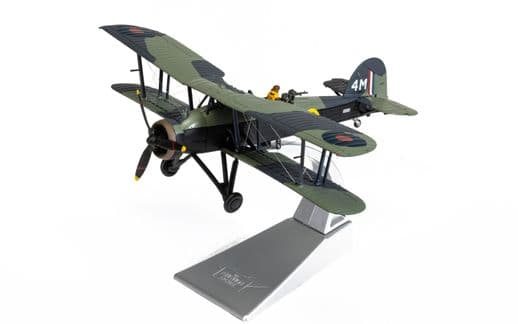
Aircraft operated by the Fleet Air Arm have always held a particular fascination for aviation enthusiasts, as their pilots not only had to display the same airmanship as their land-based counterparts, but how they also had to operate their aircraft from the heaving deck of a relatively small British aircraft carrier at sea. In addition to this, aircraft like this Swordfish were also considered obsolete by the start of the Second World War, yet their brave crews continued to operate them in the face of the latest enemy naval anti-aircraft fire, and operate them incredibly successfully.
Flown by heroes, the Fairey Swordfish would prove so successful that the aircraft continued to serve throughout WWII, and incredibly, even managed to outlast its intended successor, something naval planners could never have envisaged at the start of the conflict. First taking to the air in 1934, the Swordfish may not have the sleek appearance of a Spitfire, but it’s still without doubt one of the most famous aircraft of the Second World War.
This particular example is presented as one of the Swordfish which attacked the Italian fleet at anchor in Taranto Harbour in November 1940, a raid which was executed so successfully that every detail was studied by Japanese naval commanders in advance of their infamous raid against Pearl Harbor which took place the following year.
With the Swordfish crew expected to salute the crowd during their final pass, we expect this to be one of the most popular displays of the day.
Rotary Air Power
When it comes to aviation flexibility, nothing comes close to matching the operational effectiveness of a modern helicopter, and whether it’s used in a rescue situation, or at the spearhead of a military offensive, the helicopter will always be found front and centre. The Westland Puma is a fine example of rotary air power, and was the culmination of an innovative collaboration between the aviation industries of Britain and France to introduce a series of different helicopter designs for service with their respective military forces. An exceptionally versatile machine, the Puma possessed both speed and agility, and was capable of carrying 16 passengers, 12 fully equipped troops, or 2 tonnes of cargo, either carried internally, as an underslung load, or via a combination of the two.
UK helicopter force were determined that their contribution to today’s display would be a memorable one, and sent without doubt the most distinctively presented Puma to have ever seen Royal Air Force service. No.230 Squadron’s XW231 is resplendent in the scheme applied for her attendance at the 2005 NATO Tiger Meet event held at Balikesir Air Force Base in Turkey, where it will come as no surprise whatsoever to learn that she came away with the Silver Tiger Trophy award for her spectacular presentation. She would also go on to become one of the stars of the show at that summer’s Royal International Air Tattoo.
As we don’t have a runway here at Margate, the Puma is one of the few aircraft that will be landing back at CORGI HQ following the end of her display.
When it comes to the subject of famous helicopters of the post WWII era, few can claim to have been as successful and widely used as the Sikorsky Sea King, so as you can imagine, we’re delighted to be able to welcome this incredibly rare US Navy example to our display line up.
Entering service with the US Navy in June 1961, the Sea King was the largest amphibious rotorcraft in the world at that time, and the first all-weather helicopter to reach full production status for the US Navy. An incredibly capable and adaptable aircraft, it didn’t take long before the Sea King started to take on additional tasks other than the anti-submarine role for which it was intended.
This particular aircraft is presented as one of the Sea Kings which performed armed search and rescue missions in the Gulf of Tonkin during the Vietnam War, coming to the aid of downed airman either at sea, or overland, but at great risk to their crews. Wearing a camouflage scheme in an attempt to provide crews with some visual protection whilst they were engaged in these incredibly dangerous missions, a great many downed US airmen owed their lives to the Sea King and the brave crews who operated them.
Obviously, the display organising team are excited to see whether this exotic overseas visitor will choose to land at CORGI HQ following the end of its display today.
Patrolling Britain’s Skies
Whilst our helicopter section has been really enjoyable to experience, it has given our ears a false sense of security – now it’s time to BRING THE NOISE!
When it comes to the modern Royal Air Force and the aircraft that currently police Britain’s airspace, the Eurofighter Typhoon FGR.4 probably stands as one of the highest profile aircraft types in post war RAF inventory, an air superiority fighter which has developed into an incredibly versatile multi-role platform during its 20 years in service.
For this display, with the Typhoon team hearing that the Helicopter force were sending their Tiger Meet Puma, they wanted to make a presentation statement of their own, allocating ZJ914 ‘Blackjack’ to the task. Continuing a tradition which started back in 2015 with a Typhoon repainted in a representation of a Battle of Britain era Hawker Hurricane scheme, Blackjack is unashamedly the most patriotically presented military aircraft of recent times.
This impressive scheme really is a head-turner, taking design inspiration from the Union Flag and Royal Air Force roundel, applied over a smart black aggressor scheme and it didn’t take long before it worked its way into the hearts of enthusiasts and aviation photographers everywhere. Colloquially referred to as ‘Blackjack’, the RAF’s display Typhoon is a headline performer of growing repute and for the 2022 Airshow season, was flown by Flt Lt Adam O’Hare, operating the aircraft under the dramatic callsign ‘Anarchy 1’.
Flight Lieutenant O’Hare took the stunning good looks of his jet and combined it with a dynamic display routine full of exciting high energy manoeuvres and high-speed passes, making full use of the aircraft's powerful afterburners to leave spectators in awe and desperate for more Typhoon action.
If we’re talking about British aircraft with a spectacular reputation, one which also had the distinction of being revolutionary as opposed to simply being evolutionary, the English Electric Lightning was something very special indeed. A high performance interceptor, flying the Lightning must have been exhilarating and terrifying in equal measure, with pilots christening the aircraft ‘The Frightening’. When asked how his first flight in the Lightning went, one pilot famously replied, ‘It was great – I was with it all the way, until I released the breaks!’
New Lightning pilots posted to operational squadrons must have felt great about themselves, because they knew they were considered elite amongst their RAF peers, allowed behind the controls of an aircraft most people could only ever dream of flying. Unfortunately for them though, no other aircraft would ever come close to matching the sheer adrenalin rush of flying the Lightning, an aircraft which would always have a special place in their hearts.
Lightning XR726 was constructed as an F.6 variant during late 1964, making her first flight in June the following year. Spending much of her RAF career with No.5 Squadron, she would be one of the Lightnings to wear most of the camouflage finish variations worn by RAF Lightnings during their service career, including this particularly striking one in natural metal.
We’re particularly delighted to be the only UK Airshow this year to be able to boast a Lightning on the display program, and will remember that zoom climb final pass for many years to come.
Great War Air Power
This next section of the display program takes us back to the very early days of aerial combat and the rise of the aeroplane as a vital military asset. It’s fascinating to think that when the first aircraft appeared over the trenches of the Western Front at the start of the Great War, they were doing so only eleven years after the Wright Brothers had made their historic first flight, meaning that pilots who served during that time should all be considered aviation pioneers in their own right.
One of the most important British aircraft of the Great War era, the Bristol F2B Fighter was an exceptional fighting aeroplane, and once pilots realised this large machine was strong and agile enough to be flown like a scout, a great many Luftstreitkräfte aircraft would fall to its guns. The Bristol could be described as a multi-role aircraft, one which was definitely of interest to the Home Defence units attempting to stem the nightly tide of German Zeppelin and biplane bomber raiders over southern England.
This aircraft is presented as an RAF No.39 Squadron home defence fighter from the summer of 1918, one which intercepted and destroyed a mighty German Gotha G.V bomber on the night of 19th/20th May. The enemy bomber came down near East Ham, and would be the first and only victory over a Gotha night raider for No.39 Squadron.
Wearing toned down markings, this attractive aircraft carried the name ‘Devil in the Dusk’, which proved rather apt during that fateful sortie.
A display aircraft which must be in the running for the most elaborately presented aircraft of the day, this Albatros D.V fighter is an example of one of the most important German fighter aircraft of the Great War, a type which was developed and improved throughout the conflict. Significantly, the Albatros would become the mount of many of the most celebrated ace pilots of the war, including Manfred von Richthofen, who used various Albatros fighters to score the majority of his 80 aerial victories.
The ”D’ in the aircraft’s designation refers to the fact that it featured two wings (Doppledecker) and their use of inline as opposed to rotary engines gave these aircraft a sleek and purposeful appearance. The original Albatros D series fighters featured a much squarer, slab sided fuselage design, however, the arrival of the later D.V variant during the summer of 1917 brought about the introduction of an even more capable fighter.
Adopting more mature technology, the D.V series fighters had a noticeably more rounded fuselage and large, rounded tails and horizontal stabiliser, with the fighter’s two Spandau machine guns firing through the arc of the aircraft’s propeller via a synchronised interrupter gear and in the direct line of sight of the pilot.
Allied pilots serving over the Western Front definitely would not have wanted to see an Albatros glued to their tail.
Our American Friends ‘Over Here’
When American Eagle Squadron volunteer pilots were eventually allowed to join USAAF units in Britain following America’s entry into the Second World War, many of them were faced with exchanging their sleek and agile Spitfires for a new American type, the Republic P-47 Thunderbolt. The Thunderbolt was a massive aeroplane by comparison, and their former RAF squadron mates joked that they now wouldn’t have to avoid the bullets if they were intercepted by a Luftwaffe Messerschmitt, they could just dodge them by running around inside the P-47’s fuselage.
Despite any initial misgivings, the Thunderbolt proved to be an exceptional fighting aeroplane, and even though it would eventually be overshadowed by the North American P-51 Mustang, it would always be regarded as a rugged, hard hitting fighter-bomber. In fact, P-47 pilots had a saying that a Mustang might get you in the fight, but a Thunderbolt would get you home!
The aircraft we have on display today is an early razorback variant of the P-47 Thunderbolt, and one which represents the first aircraft flown in the European Theatre by future ‘Ace’ pilot George Preddy. Preddy is famous for becoming the leading Mustang ace in the ETO, but before making his mark in the P-51, he would claim his first three victories whilst flying the mighty Thunderbolt.
All of George Preddy’s fighters in the ETO were named ‘Cripes A’ MIGHTY’, a term he heard people using for luck whilst playing the dice game craps. It appealed to him so much that he painted on the fuselage of his Thunderbolt, and all his future Mustang fighters.
Yet another coup for this first Margate International Airshow, we’re pleased to be the first UK Airshow to boast the appearance of a flying Martin B-26 Marauder, one of the most successful medium bombers to have ever taken to the skies. That statement seems to be quite a stretch for an aircraft which initially attracted such unwanted nicknames as ‘Widow Maker’ and the ‘Flying Coffin’. Indeed, crews training to convert to the Marauder used to decry its handling challenges as causing, ‘one a day in Tampa Bay’ because of the high number of aircraft lost to training crashes.
Knowing how problematic its introduction was, it can therefore be surprising to learn that the Martin B-26 Marauder would actually go on to post the lowest loss rate of all USAAF bombers used during the Second World War. A high performance aircraft incorporating advanced technologies, the Marauder was a delight to fly, but had some vices which could cause problems for the unwary and inexperienced, however, some design modifications and a revised training program soon improved the aircraft’s fortunes and allowed it to reach its full operational potential.
This rare aircraft is presented in the colours of a 444th Bomb Squadron, 320th Bomb Group Marauder which operated in North Africa and the Mediterranean Theatre during WWII. The Group would be awarded a Distinguished Unit Citation for pressing home an attack against Axis troop concentrations at Fondi, in support of the 5th Army’s push towards Rome, despite coming under heavy enemy anti-aircraft fire.
This particular aircraft was one of the most flamboyantly decorated of all the 444th BS Marauders, with not only striking sharks teeth to put fear in the hearts of enemy fighter pilots, but also benefiting from beach belle artwork on both sides of the aircraft’s nose.
Isn’t she an absolute beauty, and a sight for sore eyes in Kent skies.
Heroes of the Royal Air Force
As there are no airworthy examples of the Handley Page Halifax left in the world, we actually have no idea how we managed to pull this next display item off, but we’re certainly glad we did. When it comes to RAF heavy bombers of the Second World War, even though the Avro Lancaster usually takes all the glory, Handley Page Halifax crews would argue that their bomber was actually the more capable aircraft, and one they became extremely attached to.
During 1943, the men of No.427 Squadron Royal Canadian Air Force, known as ‘The Lion Squadron’, were extremely proud of their Halifax bombers and invited the film company Metro Goldwyn Mayer to adopt them for the duration of the war. The MGM film company were famous for having a roaring lion showing during the opening credits of their movies.
In a high profile event, which was covered by a national film unit, the managing director of MGM (UK), Mr Samuel Eckman Jr, accepted the invitation and presented the squadron with an impressive bronze lion for luck, also giving smaller versions of the lion to all members of the unit’s air and ground staff, along with the offer of free entry into MGM studios. For the crews, the most interesting aspect of the day was a draw to see which MGM movie star individual crews would draw, with the prize being to have that star’s name displayed on their bomber.
Handley Page Halifax Mk.V DK186 / ZL-L was already named ‘London’s Revenge’, but was further embellished with distinctive flying lion artwork (based on the MGM logo), and subsequently drew the most sought after star, Lana Turner – ‘L for Lana’, who’s name they proudly took to war.
How on earth did we manage to carry this display off?
As the most famous British aircraft type to have ever taken to the skies, no Airshow event in the UK would ever be complete without having at least one Supermarine Spitfire on the display program, and we’re delighted to say that our friends at Rolls Royce Heritage were only too pleased to send us their magnificent photo reconnaissance variant to thrill the Margate audience. As a later variant of the Spitfire, the crowd could also expect to marvel at the sound of this aircraft as well as its celebrated aesthetic appeal, as the Rolls Royce Griffon engine could growl this aircraft to an impressive 450 mph.
PS853 was one of 79 Spitfire PR.XIX aircraft built by Supermarine at their Southampton factory towards the end of 1944 and was subsequently delivered to the Central Photographic Reconnaissance Unit at RAF Benson on 13th January 1945. She would fly operationally with RAF Nos. 16 and 268 Squadrons from bases at Melsbroek and Eindhoven in Holland, sorties which included nine information gathering mission against suspected German V-Weapon sites.
Following the end of the war, PS853 would become associated with performing commemorative flypasts, becoming one of the first aircraft initially allocated to the RAF’s Historic Flight at Biggin Hill in 1957.
Serving as a fitting flying tribute to the work of Photographic Reconnaissance Units during the Second World War, Spitfire PS853 also proudly represents the rich heritage Rolls Royce possesses in the field of aero engine technology and is a much-loved focal point of their impressive Heritage Flight activities from their East Midlands Airport base. Unarmed and alone, these reconnaissance Spitfires relied on speed and piloting skill to bring back the vital imagery Allied military planners needed during the latter stages of WWII.
Show Finale Highlight
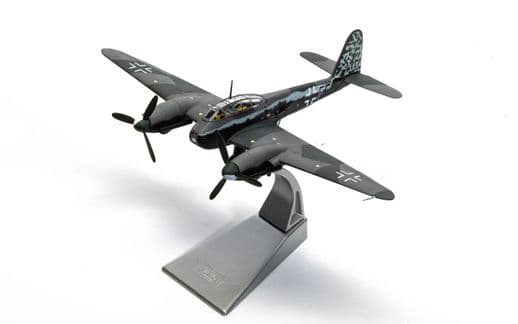
As the sun begins to set on this first ever Margate International Scale Die-cast Airshow, we couldn’t think of a more appropriate aircraft with which to bring our day to a close, another aircraft which has never previously displayed on the UK Airshow circuit, and one which has to be considered the absolute highlight of what we hope you will agree has been an incredibly successful show. Although an example of an enemy aircraft type from the Second World War, we think that the rarity value of this impressive looking heavy fighter will appeal to our audience as a fitting finale act.
With its reputation as the most effective German heavy fighter of WWII, the hard-hitting Messerschmitt Me 410 Hornisse was an obvious choice of aircraft when the Luftwaffe were looking to mount night intruder operations over Britain during the latter stages of the conflict. Intended to wreak maximum disruption on Allied air operations by infiltrating bomber streams and picking off aircraft, or striking at aircraft whose unsuspecting crews had allowed themselves to ‘switch off’ as they approached their bases at the end of another long mission.
The Messerschmitt Me 410 was ideally suited to this task, fast and heavily armed, these Fernnachtjagd aircraft operated in conjunction with the regular Blitz bomber force, but often with more specific targets and often operating alone in the dark night skies. Despite being an extremely capable aircraft in this role, night intruder Me 410s were themselves hunted mercilessly by the RAF the second they crossed the English Channel, ensuring that no mission would ever pass without incident. Britain’s air defence network had been fine-tuned to make any incursion over the country a torrid experience for Luftwaffe pilots, and the cover of darkness offered them little in the way of protection.
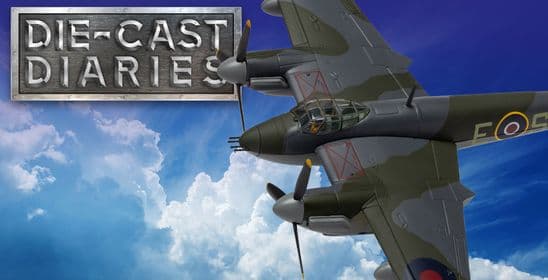
RAF de Havilland Mosquito nightfighters proved to be exceptional nocturnal hunters, and took a heavy toll of Luftwaffe aircraft of all types, including the capable Messerschmitt Me 410.
Thankfully, we were all happy to have the Hornisse close our show, so the crew were assured of a much warmer welcome than those operating the aircraft in late 1943 could have expected.
So that’s it, our first ever scale die-cast Airshow event is over, and what a show it was. We just have the RAF Puma to clear our Margate HQ, and we can start the big clear-up in preparation for a return to work on Monday, and some new scale model projects to bring you.
Please don’t forget that in celebration of this inaugural event, all the aircraft which took part in the display are available at a 20% discount over the coming weekend (until midnight on Sunday 26th), with the dedicated landing page accessible via the individual header links, or by using this Airshow Offer link.
We really hope you’ve enjoyed our rather creative way of hosting an Airshow event, even if it was on a much smaller scale that you will be used to. If it catches on, who knows, it might become an annual event for us.
Once again, thank you for taking the time to find out what our first Margate International Die-cast Airshow was all about, and we hope it raised a smile or two. Can you imagine how good it would be if we could see a Halifax, Lightning and Messerschmitt Me 410 Hornisse at a UK Airshow – now that really would be a show worth attending.
Thanks again
The CORGI Team