
Welcome to our latest edition of CORGI Die-cast Diaries, your fortnightly blog review bringing collectors all the news, updates and topical stories from the captivating world of CORGI die-cast model collecting.
As we’re still flying high following the success of hosting our inaugural Margate International Die-cast Airshow event last weekend, our Aviation Archive range will again be taking a position of prominence in this latest edition of DCD, even though we will also be bringing you an EXCLUSIVE new tooling image update that comes straight from the final frontier.
Although only ever intended as a bit of fun for CORGI website visitors, we would like to start this latest update by thanking all those readers who took the time to visit our Margate International Die-cast Airshow post last weekend, and for helping make this a successful exercise. Obviously, this was just a bit of a fun angle taken in the wake of our inability to attend RIAT this year, and to share a little discount joy amongst our loyal readership. All in all, it seemed to be received rather well, and that’s clearly all down to you, so thank you very much for your support. If we decide to repeat the event, we will provide more notice next time, although it hopefully won’t be dependent on the cancellation of another RIAT.
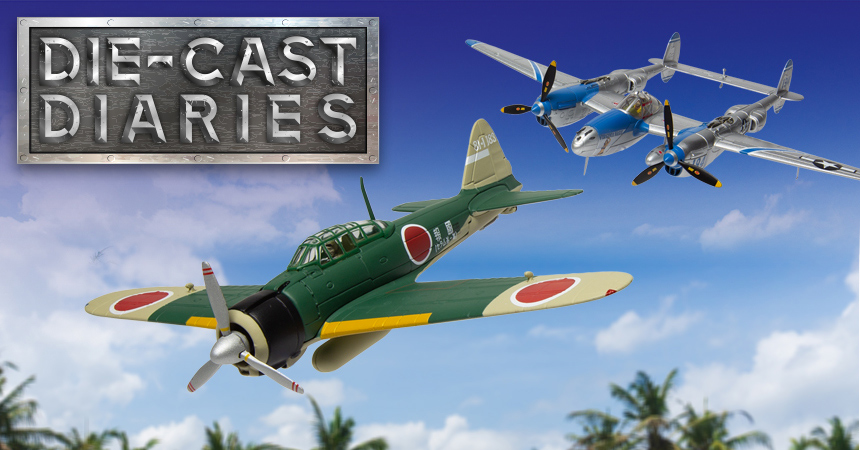
For this latest update, we will be featuring advanced production sample model images of two aircraft types which were engaged in the savage aerial combat which took place over the vast expanses of the Pacific Ocean during the Second World War, two very different looking aeroplanes, but both being significant in their own right.
We will also be needing to put phasers on stun for a significant update exclusive on an impending addition to our growing Star Trek range, one that’s quite literally out of this world, from a presentation perspective.
We have new models aplenty for you in this latest edition of CORGI Die-cast Diaries.
Eagles of the Pacific Air War, the Mitsubishi Zero may have ruled the skies during the early months of the Second World War, but the arrival of the Lockheed P-38 Lightning gave the Americans a fighting advantage.
Although aircraft enthusiasts here in the west are only too aware of the aerial rivalry between the Spitfire and Messerschmitt Bf109, we rarely look towards the Far East when considering similarly capable aircraft types, and are therefore guilty of overlooking a true aviation classic, the Mitsubishi A6M Zero. When it was first introduced during the summer of 1940, the Zero was unquestionably the most capable naval fighter the world had ever seen, and through a combination of speed, agility, range and firepower, would go on to completely dominate the war in the Pacific for many months.
Japan’s search for a new naval fighter resulted in them issuing specifications that were so demanding, they were considered unachievable to all but the design team at Mitsubishi. If they were to be successful, the new design would need to make use of materials which were light, yet incredibly strong and even then, would have to employ further weight saving measures if the aircraft was to satisfy the demanding range requirements the new fighter must possess.
In support of their efforts, designers made use of a new type of aluminium alloy throughout construction of the aircraft, a top secret material which whilst been developed in Japan, had yet to be used in the construction of an aeroplane. It possessed the strength they were looking for, but was significantly lighter than traditional materials, and even though they would still be required to develop new manufacturing techniques in order to use this material effectively, their new fighter project was off and running.
The design team would incorporate further weight saving measures, drilling holes in this already light material, just to save a vital few additional pounds, clear in the knowledge that the military favoured speed, manoeuvrability and range over firepower and survivability. Their thinking must have been something along the lines of, what use was a heavily armoured aircraft if it didn't have the range and speed to come into contact with the enemy? History would cruelly expose this thinking during the latter stages of WWII.
Lightweight and manoeuvrable, the Mitsubishi A6M Zero proved to be the most capable naval fighter the world had ever seen following its introduction during the summer of 1940.
What Mitsubishi managed to produce was nothing short of an aviation marvel, a naval fighter aircraft which possessed performance superior to any similar aircraft currently flying anywhere in the world, and one which more than satisfied the incredibly challenging brief which had frightened off their major design competitor at the outset of the project.
On entering service in July 1940, the Mitsubishi A6M Zero was the most advanced naval fighter in the world and the aircraft the Japanese Navy had been hoping to equip their forces with. Now, they truly had an aircraft capable of sweeping Pacific skies clear of all potential adversaries, whilst at the same time presenting their naval units with unmatched 'eyes in the skies'.
Light in weight, relatively heavily armed and possessing the ability to operate over incredible distances with its fuel carrying capabilities, the Zero was a revelation, and when all this was combined with the robust pilot training program Japan established, it would go on to become a formidable opponent in the Pacific Theatre. In pure air combat terms, there was nothing to challenge the dominance of the Zero until the introduction of the Grumman Hellcat in 1943, by which time Japanese forces had captured vast swathes of territory across the Pacific region.
With excellent visibility for its pilot, a sturdy wide-track undercarriage for ease of operation, and boasting an incredibly low stall speed, the Zero proved to be the ideal naval fighter, one they felt was more than capable of taking on the Americans.
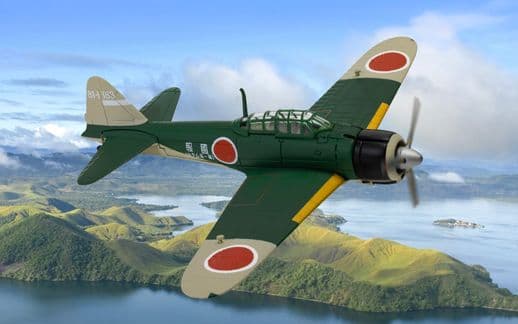
Wearing unusual markings, this 381st Kokutai Zero served as a ground unit support aircraft during the final days of the Japanese occupation of Jefman Island.
Keen to assess the capabilities of their new fighter, a small number of Zeros were sent to bolster forces fighting in China during September 1940, with the first combat engagement taking place on the 13th of the month. On that occasion, thirteen Zero fighters were escorting bombers raiding the city of Chungking, when they were engaged by a formation of around 40 Russian built Polikarpov I-15 and I-16 fighters. During the ensuing dogfight, at least 27 of the Chinese fighters were quickly shot down, without the loss of a single Zero – the day of the Zero had arrived.
This engagement was also reported to have been significant for another reason, as it produced the first Mitsubishi Zero 'Ace', as pilot Koshiro Yamashita claimed five of the Chinese Air Force Polikarpovs fell to the guns of his aircraft.
In combat, the Mitsubishi Zero would initially be without equal, possessing the range to engage the enemy far from its home carrier, returning from combat with fuel to spare and in many cases, with more victory claims for its pilots to celebrate. A proficient dogfighter, the Zero would boast an early combat success ratio of 12 to 1 and during early engagements against Chinese and Russian aircraft, actually posted figures far in excess of these, helping to earn the fighter a fearsome reputation amongst those forces unfortunate enough to have faced it in combat.
By the time of the Pearl Harbor attack, Japan had amassed around 330 Zero fighters equipping front line units, with more held in reserve for home defence and training duties, with new aircraft rolling off the production lines each and every day.
During the early stages of the Second World War, the Mitsubishi Zero was unquestionably one of the most capable fighter aircraft in the world and was a contemporary of both the Messerschmitt Bf 109 and Supermarine Spitfire. Optimised for operations over the vast expanses of the Pacific Theatre, the Zero was heavily armed and incredibly manoeuvrable, and during early combat operations against Chinese aircraft, posted an impressive success ratio of 12:1. Unfortunately, where the Spitfire and Bf109 were capable of accepting successive upgrades, the Zero proved much less adaptable and would quickly be overtaken by more capable Allied types.
The nomenclature applied to the Zero was in line with the Japanese Navy system, where A6M identified the Zero as the 6th carrier fighter type to enter service, with the M denoting Mitsubishi as the aircraft’s manufacturer. Around 3,700 of this relatively early variant of the fighter were produced, with manufacturing responsibilities split between Mitsubishi and Nakajima. The Type 21 was significant in introducing folding wing tips to better support operations from Japanese navy carriers.
Similar in stature to the Messerschmitt Bf 109, the Mitsubishi Zero proved to be the perfect aircraft to support Japanese expansionist operations during the first year of the Second World War.
The 381st Kokutai was formed on 1st October 1943 as a fighter-bomber unit and would be assigned duties in support of Japanese land forces engaged in savage fighting with American and Australian troops. By May 1944, the unit was fighting an attritional war against superior Allied air forces in West Papua, and with little hope of reinforcement, the outcome was inevitable.
An unusually presented example of this important WWII fighter, it’s interesting to note that from an Aviation Archive perspective, the Zero’s introduction into the range reflected its historical importance as a fighting aeroplane, as it only came after the Spitfire, Mustang, Hurricane and Bf 109E in the 1/72nd scale tooling pecking order. We are therefore pleased to announce that this beautiful model has just arrived in our warehouse and is therefore available to grace model display cabinets everywhere.
Even though we’re taking a bit of a liberty using this title, it’s a well known saying that we should never let the truth get in the way of a good story. For many young aviation enthusiasts and modellers, we were captivated by the exploits of the world’s most celebrated fighter aces and the incredible machines they flew, and when that machine proved so devastatingly effective that adversaries named it the ‘Fork tailed Devil’, well that was an aircraft we wanted a model of.
Unfortunately, when we actually learn to question most things and how to conduct research, we often find out that the stories that captured our imaginations so completely when we were young, weren’t always based on actual fact, something we find when looking a little deeper into the history of the Lockheed P-38 Lightning. Although this was unquestionably one of the most unusual, yet most effective fighting aeroplanes of the Second World War, the ‘Fork-tailed Devil’ story has its origins in Allied propaganda, rather than how it was regarded by its Japanese opposition, even though the fighter did come as an unwelcome surprise for them.
Having seen the introduction of advanced monoplane fighter designs in Britain, Germany and Japan, America was only too aware that the aircraft equipping their own air force was in need of upgrade as a matter of some urgency. That being the case, an official requirement was issued in February 1937 for the production of a new pursuit fighter, an aircraft which would need to possess performance which had never previously been seen on not only an American aircraft, but anywhere else in the world.
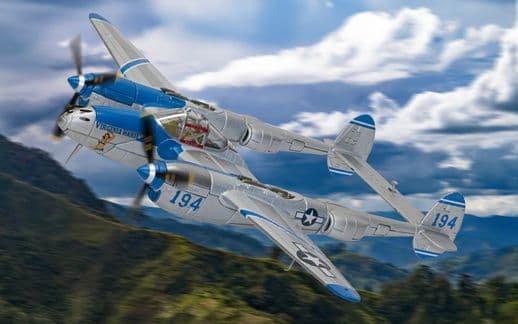
The Lockheed P-38 Lightning is always a welcome and popular addition to any Aviation Archive model range, and this colourful ‘Satan’s Angel’ looks set to continue that tradition.
The Lockheed Aircraft Company would subsequently be one of six competing companies determined to satisfy these demanding requirements, and entrusted the design of this radical new aircraft to talented designer Clarence 'Kelly' Johnson, who was basically given a free rein during the development phase. Almost immediately, he was convinced that a single engined aircraft could never satisfy these demanding specifications, and therefore started work on a twin engined design, one which featured twin booms to house the engines which featured superchargers and a centrally positioned nacelle housing the cockpit and the fighter's heavy nose armament.
The new aircraft really did look incredible and was a radical departure from any fighter aircraft design that had gone before it, with Lockheed being awarded a contract to produce a prototype example. The XP38 was a thing of beauty and after just a short 38 minute maiden flight, everyone at Lockheed knew they had a winner on their hands.
In fact, the team behind it were so impressed with the aircraft's early performance that they immediately decided to make an attempt on the US Transcontinental speed record to highlight the new aircraft’s potential, an attempt which saw the XP38 shatter the existing record by an impressive 23 minutes. Unfortunately, it appears that officials at the destination airport were not expecting the arrival of the strange new fighter and kept it in the landing holding pattern so long that it actually ran out of fuel and had to make an emergency landing on a local golf course. Nevertheless, the aircraft had shown its potential and the US Army Air Force immediately ordered sixty-six aircraft - America had its first 400 mph capable fighter.
The service introduction of the P-38 Lightning was not without its challenges, however, this was not surprising, as the aircraft’s performance and configuration were so radically different to anything which preceded it. Almost constant development would see the Lightning develop into a devastatingly effective high altitude interceptor and with engines which both drove outwardly rotating propellors, would also prove to be an incredibly stable gun platform.
Possessing impressive range and devastating firepower, the Lightning would eventually be used to avenge the Pearl Harbor attack, when sixteen P-38s of the 339th Fighter Squadron intercepted a bomber carrying Admiral Isoroku Yamamoto, the mastermind of that infamous raid, and shot it down. The P-38 Lightning would go on to serve with distinction in both the Pacific and European theatres, becoming one of the most capable and distinctive aircraft of the Second World War.
‘Boom and zoom’ Corgi P-38 Lightning style.
When Japanese intelligence first learned of the P-38, they were initially dismissive of the new aircraft. Appearing to have been developed adopting almost the opposite methodology they had themselves used when designing their all-conquering Zero, surely this large aeroplane wouldn’t be able to compete with the Mitsubishi fighter, particularly as they were being flown by battle-hardened, experienced pilots. The new aircraft was surely nothing more than a long range escort fighter that would soon be falling to the guns of their tried and trusted zero.
When they did meet the Lightning in combat, they were actually in for a rude awakening. Fast and heavily armed, P-38 pilots would avoid dogfighting with the nimble Zero at all costs, adopting a ‘Boom and Zoom’ tactic which suited the attributes of their new fighter. Significantly, the impressive range of the American fighter meant that they were now operating in contested airspace deeper into Japanese occupied territory, and were able to loiter for longer.
Much more robust that a Zero, the Lightning was able to both hand out and absorb much heavier punishment than their nimble adversary, and by the time the Japanese had learned just how good the Lightning was, it was too late, the course of the Pacific air war had already entered a devastating new phase. The P-38 Lightning would become the mount of aces, and no Japanese aircraft was safe when they were in the air.
Although the Lockheed P-38 Lightning fighters of the USAAF 5th Air Forces’ 475th Fighter Group ‘Satan’s Angels’ were some of the most flamboyantly presented aircraft of The Second World War, they were also deadly effective combat aircraft, and would take a heavy toll of Japanese aircraft across the Pacific Theatre. With two engines and heavy firepower, the Lightning proved to be a nightmare for Japanese pilots, but provided American airmen with confidence and reassurance, due to its combat performance and the benefit of that second engine. The Japanese referred to the 475th Fighter Group and their Lightnings as the ‘Bloody Butchers of Rabaul’, which serves as an effective indicator to the combat success of the American Group.
This particular aircraft was delivered to the 433rd Fighter Squadron at Hollandia Airfield in early 1944, and according to its pilot Carroll R. Anderson, inherited its striking markings progressively over a period of several weeks. Although there was a plan for the final scheme, it had to be completed over time, whilst making liberal use of the 433rd Fighter Squadron’s medium blue colour. The final touches were made whilst the Group Commander was away from the unit’s home airfield for a few days, which presented to team assigned to her with the opportunity they needed to express their artistic talents.
Flamboyantly presented, the P-38 Lightnings of the USAAF 433rd Fighter Squadron backed up their confidence with combat performance during the Pacific air war.
Apparently, ‘Virginia Marie’ was the only aircraft in the 433rd Fighter Squadron to receive its full intended paint job. Whilst pilot Carroll R. Anderson wasn’t credited with any aerial victories during his WWII service, he did become a prolific writer, spending the post war years recounting his combat experiences flying with ‘Satan’s Angels’ in the Pacific, allowing us all a fascinating insight into the savage aerial combat he and his fellow pilots engaged in across the Pacific Theatre during the latter stages of the war.
A handsome addition to our P-38 Lightning range, this model is still a few weeks away from arriving in our warehouse, but is expected towards the end of next month. Thankfully, there are still unallocated models available for pre-order, so it’s not too late to secure your example of ‘Virginia Marie’.
For those DCD readers who like their adventures to take place a little further afield, there is one famous craft which has done more than any other to beam TV and film audiences to new galaxies, allowing us to go where no one has gone before, the Starship Enterprise. No matter how engrossing the storyline proved to be, and how much we came to love the individual characters involved, for many, the undisputed star of the show was the USS Enterprise itself, a starship which was not only the catalyst for all those exciting space adventures, but was also a craft which captured everyone’s imagination. Feature packed and futuristic, Enterprise was the spacecraft we all wanted a seat aboard, the catalyst for a great many TV adventures.
In episodes where the crew got themselves into one of their many scrapes with alien life-forms and the odd Klinger-on, Enterprise was always there to come to their rescue, because as we all learned from the very beginning, nothing could withstand being on the receiving end of a phaser strike, or photon torpedo barrage!
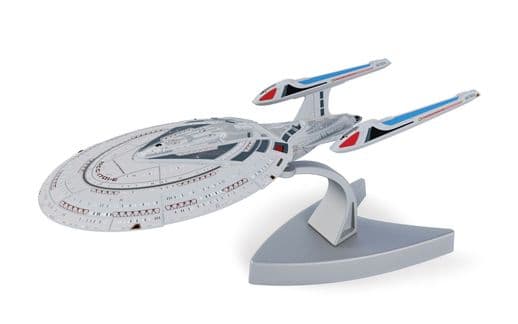
Almost ready for service amongst our growing Star Trek collections, we’re delighted to be bringing you images showing the latest sample of this highly detailed new model.
With the Star Trek franchise easily made the transition to the world of die-cast model collectables, and CORGI have earned a proud reputation in providing many of these classic models, particularly our recent series of highly detailed, beautifully presented models. We’re pleased to confirm that this range is looking forward to adding it’s latest new tooling addition in the near future, and we’re pleased to be in a position to share the latest sample model produced on that journey towards release.
Just received at GORGI HQ this week is the first painted pre-production sample of the next model in our Star Trek collection, the U.S.S. Enterprise NCC-1701-E. This beloved ship made its first appearance thirty years ago this year in the eighth big screen Star trek adventure, Star Trek: First Contact. This model is tooled entirely from metal with no plastic parts, giving it a really pleasing feel in-hand. While this sample is still subject to revisions, it’s one of the better early samples we’ve received in this range, so here is an exclusive first look at the detail in this brand-new tooling.
It’s award season, and CORGI have bagged a BAFTA …… well, a Partner of the Year award!
AND that’s not all - this isn’t our only piece of Star Trek news for this edition. Just a couple of weeks ago, the CORGI team were surprised and delighted to be named Paramount’s Partner of the Year at the 2026 Paramount Products & Experiences UK Summit, held at BAFTA headquarters in Piccadilly. With a growing range of new Star Trek models being released and exciting Top Gun products in development, we were honoured to be recognised by the Paramount team!
Keep an eye out for exciting things to come.
We end this latest edition of our CORGI blog by bringing you news of an exciting event the CORGI team will be attending at the back end of next week, one which will see us bringing an exciting display of models to the Coventry Transport Museum. Our attendance will be in celebration of our 70th Anniversary, and we will have a spectacular display of classic CORGI models past and present to share with those who come along.
Our display will hopefully bring back pleasant model collecting memories for a great many people, in addition to showcasing some of our latest models and new tooling developments that have yet to join the range. Media outlets and specially invited guests will all be welcomed to the CORGI display stand, but for all those who won’t be there, we’ll be gathering plenty of images over the two days to share with DCD readers in our next edition, which incidentally will be the 200th edition of Die-cast Diaries.
If you’re coming along to the Coventry Transport Museum, we look forward to seeing you there, but for everyone else, we’ll try to bring you a flavour of what we hope will be a memorable occasion in the bicentennial edition of DCD.
We’re afraid that’s all we have for you in this latest edition of our CORGI update blog, but we will be back as usual in two weeks’ time to bring you a further exclusive selection of updates. As always, if you would like to drop us a line in the meantime to comment on anything CORGI model related, or to suggest a future blog topic you’d like to see covered here in DCD, you’d be more than welcome, and we’re always happy to hear your views.
As ever, our diecastdiaries@corgi.co.uk address is always the one to use.
If you can’t wait for the next blog, you will find plenty of CORGI model collecting discussions taking place on our official social media channels, access to which can be obtained by clicking on the respective links at the foot of the CORGI website homepage.
Link access to CORGI social media sites.
Thank you for continuing to support your CORGI Die-cast Diaries blog, as we head into our eleventh year of production. Our next edition is scheduled for publication on Friday 14th August.
Until next time, once again, thank you for your continued support.