
Welcome to our latest edition of CORGI Die-cast Diaries, your fortnightly blog review bringing collectors all the news, updates and topical stories from the captivating world of CORGI die-cast model collecting.
We have another feature packed edition for you again this time around, with model updates, a host of exclusive content and news of a 70th Anniversary event which saw the CORGI team actually being sent to Coventry.
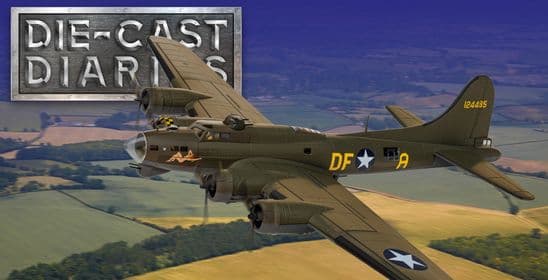
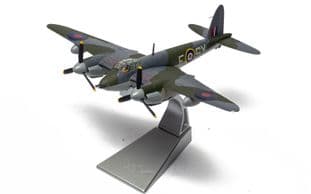
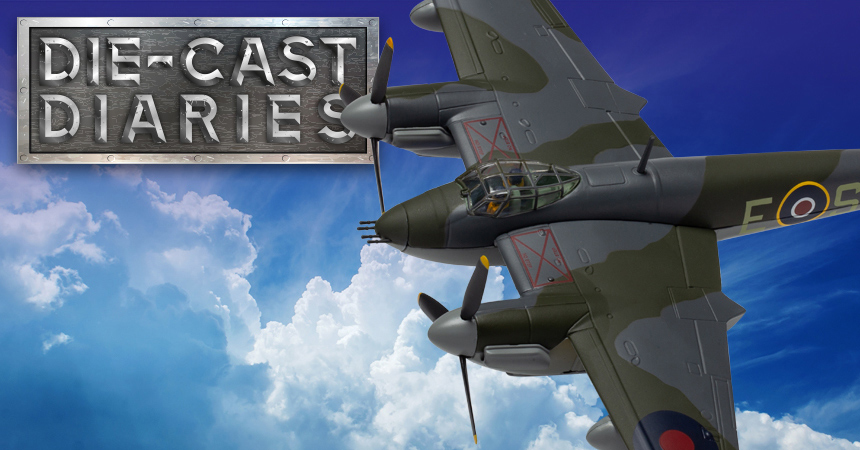
As you can see from our header image, our lead subject features the second impending release from our recently modified 1/72nd scale de Havilland Mosquito tooling, a collectable model we think is just a little bit special. Flown by a true British aviation hero, we’ll be telling the story of Wing Commander John ‘Bob’ Braham and how this new model will be a fitting tribute to an incredibly brave pilot who most people will not even be aware of.
As we break away from new and impending model releases following this, we’ll also be looking at a successful event attended by the CORGI team just a week or so ago, one which saw a handsome collection of Corgi models being assembled in celebration of our 70th Anniversary. Even though we did find ourselves being sent to Coventry, we’re pleased to say that rather than being sidelined as the phrase suggests, we were actually something of a headline attraction.
Looking ahead towards the future of CORGI and our growing model range, we will be bringing this edition to a close by showcasing two brand new models which made it onto our 70th Anniversary display at Coventry, with both being ready to propel the range forward into another 70 years of proud die-cast model making achievement.
It’s new CORGI models all the way in this latest edition of our Die—cast Diaries blog.
Not all the RAF’s ace pilots of the Second World War flew single engined fighters.
Since the end of the Second World War, the exploits of the many ordinary men who went on to become ‘Ace’ pilots during six years of fighting has inspired many millions of people, with some of those men still celebrated as household names to this day. Men such as Erich Hartmann, Douglas Bader, George Preddy, Hans Joachim Marseille, Pat Pattle and Richard Bong proved to be anything but ordinary and inspired their mother nations during the war, but achieved almost mythical status during the years that followed, as peacetime made their exploits seem all the more incredible.
When it comes to the roundel of the Royal Air Force, names such as Johnnie Johnson, Ginger Lacey and Stanford Tuck still conjure up images of daring exploits at the controls of Fighter Command aircraft, with artwork and model releases providing highly desirable representations of actions those men actually experienced first-hand, over the years. The Aviation Archive range has accessed this fertile subject territory many times over the years, with the Aircraft of the Aces always being popular with huge sections of our collector base, and the models becoming highly prized display items within our collections.
Our scale representations of the aircraft flown by ace pilots is about to grow further still, with the release of a new de Havilland Mosquito model which was the mount of the most successful British pilot to have been operational on twin-engined aircraft, a man whose name is still relatively unknown to much of the population, even hardened aviation enthusiasts. The Aviation Archive range is about to put that right!
When the population of Britain was in desperate need of heroic figures to galvanise the nation towards victory in their greatest hour of need, they were fortunate enough to be able to count on men like RAF airman John Randall Daniel ‘Bob’ Braham. Born in Somerset in April 1920, Braham applied for a short service commission in the Royal Air Force whilst still only 17 years old, and whilst surprised to be accepted, grasped the opportunity with both hands. Joining No.29 Squadron on the successful completion of his training, Braham would fly the Bristol Blenheim in a night fighting role, with this unit helping to establish a cohesive hight defence force for Britain, and help introduce airborne interception radar technology to the force.
Braham was thought to have scored just a single aerial victory during the period which covered the Battle of Britain, however, his squadron’s conversion to the Bristol Beaufighter in September 1940 resulted in many more successful missions being flown from that date forward, with 1941 being particularly successful for him. Following one such victory over a Luftwaffe He-111, Braham was presented with the vanquished pilot’s Iron Cross decoration and a pair of life vests from the crash site as souvenirs. Preferring the slimline German vests to the bulkier RAF issued life preservers, Braham and his regular navigator/radar operator Bill ‘Sticks’ Gregory would use these Luftwaffe vests on every subsequent mission until they were shot down and captured in June 1944.
With Luftwaffe night raids becoming less frequent following the end of the Blitz, the RAF began mounting night intruder raids into Europe in support of Bomber Command operations, hunting German nightfighters and saving the lives of countless bomber crews in the process. Braham believed that flying ‘freelance’ hunting sorties at the same time as the main bomber formations might draw enemy nightfighters to them and away from RAF bombers, where they themselves could be targeted by this proven nightfighter specialist and his powerful aircraft. In this role, he is thought to have shot down at least four high-scoring Luftwaffe nightfighter aces, becoming the scourge of German defensive operations.
All these images feature an advanced production sample of the second Mosquito release since this classic tooling benefitted from significant modification.
Dedicated to his duty and a determined fighter pilot, Braham was becoming exhausted from all the operational flying he had undertaken, and developed a dangerous habit of only opening fire on his victim when at very close range, as he felt that his eyes had started to affect his targeting judgement. Although this would usually result in a quick victory, it often also resulted in his Beaufighter becoming showered with debris from his vanquished opponent, an extremely risky practice when operation over enemy territory. It wasn’t uncommon for his aircraft to return home exhibiting plenty of damage from the previous night’s actions.
Against his wishes, Braham was forced to take time away from operational flying, and was instructed to attend a staff officer course, in preparation for a senior ground based role within the Royal Air Force. He later took a position as ‘Wing Commander night operations’, at No.2 Group RAF HQ, but not before convincing his superiors to allow him to fly regular ‘freelance’ intruder missions on borrowed de Havilland Mosquitos, but no more than one sortie per week.
In this manner, Braham continued to increase his victory tally, and once again reunited with his long-time navigator and friend Bill Gregory, continued to be the scourge of the Luftwaffe over Europe. By now though, it was clear that his judgement had been affected, and he appeared to be taking unacceptable risks when it came to challenging the enemy. On 12th May 1944, his Mosquito had been damaged by a Bf 109, but with another enemy fighter in his sights, continued to press home his attack at such low altitude that his aircraft’s undersides actually bounced off a hillock, damaging its propellers in the process.
Shooting down the fighter, Braham climbed to altitude over the enemy coast to radio a distress call, prior to ditching the aircraft in the sea. Whilst the pair were successfully rescued, this would be the last time both Braham and Gregory flew together operationally, as his long-time friend was so traumatised by this situation.
By now, Braham was almost addicted to the thrill of engaging in the opportunistic ‘Ranger’ missions which were intended to cause maximum disruption to enemy infrastructure and communications deep behind their lines, missions which required cloud cover to maintain the element of surprise. Unfortunately for Braham, his luck finally ran out on 25th June 1944, when after receiving an electronic notification that his aircraft was being tracked by enemy radar, he still continued to press home an attack against an official looking building flying German insignia, with an impressive staff car outside – he thought that there must be high-ranking officials in there.
This latest Mosquito release is intended to mark the achievements of Fighter Command’s most decorated airman of the Second World War.
By the time he made good his escape, he was being hunted by a pair of Focke Wulf Fw190 fighters, and unable to outrun them, turned to face them in a risky head-on attack. Both enemy aircraft hit the Mosquito, which crash landed on a nearby beach at high speed, however despite both pilot and navigator managing to climb out of the wreckage without suffering serious injury, they were immediately captured by German troops stationed in the area. They had been shot down by Luftwaffe ace pilot Robert Spreckels.
After initial interrogation in the crash vicinity, the pair were transported back to Germany for further interrogation and internment, however, on the journey, actually feared for their lives on several different occasions, as both troops and the general public showed genuine hatred towards them. The German propaganda machine had successfully portrayed Allied airmen as terrorists of the skies, so it was little wonder that they had nothing but distain for the captured airmen being forced to travel through their beleaguered country.
During further questioning, Braham was introduced to the pilot who shot him down, who told him that he had lost his parents in an Allied bombing raid, but would still buy the British airman a drink when the war was over. The Luftwaffe ace seemed convinced that Germany would win the war despite his country’s rapidly deteriorating situation, and when Braham offered to do the same when Germany surrendered, the pair parted with an amicable handshake. They would become firm friends in the post war years.
The British airmen were initially interned at Stalag Luft III, but with Russian troops threatening to overrun the camp, were marched further west with little in the way of food and warm clothing. Local people and German troops making the same journey at this late stage in the war shared what they could, something which the POWs must have appreciated greatly. They were finally liberated by British troops at Lübeck on 2nd May 1945.
A fine future addition to our Aircraft of the Aces series.
Britain’s most decorated Fighter Command airman, ‘Bob’ Braham ended the war as the most successful British pilot operating twin-engined aircraft, and was also a leading nightfighter ace, scoring 19 of his 30 aerial victories at night. He had 9 intruder victories whilst flying the de Havilland Mosquito to his name, and must have proved significant in saving the lives of many hundreds of Bomber Command airmen as a result of his actions.
The aircraft presented with this latest release is the de Havilland Mosquito he borrowed from RAF No.613 Squadron on 5th March 1944, the aircraft in which he managed to score his first Mosquito victory.
A stunning future addition to the Aviation Archive range, we’re expecting this model to be in our warehouse during November, however, as these images all feature an advanced production sample of the release, this date may well push forward a little. Please keep an eye out for future editions of DCD, where we will include updates on its release, should they become available.
Classic Corgi models were in plentiful supply at the recent CORGI - 70 Years of Making Memories, held at Coventry Transport Museum.
As any committed CORGI collector will know only too well, this year sees us celebrating our 70th Anniversary, an occasion which presents us with an opportunity to talk about and display, some of the most significant models ever produced in die-cast metal. Having said that, this is all happening around the current punishing workload for a small, yet committed team, however, there’s nothing we like more than having the opportunity to talk CORGI models with the people who have always been part of the CORGI story, our collectors.
As part of our anniversary plans, an exhibition event opportunity recently presented itself through our friends at the Coventry Transport Museum, and a small team made their arrangements for what they hoped would be an enjoyable occasion for all concerned. The Museum provided us with tables and display cabinets, and we raided the heritage model displays down in our Wonderworks exhibition in Margate to ensure we had a suitable collection of classic CORGI models to go along with some of the very latest new model announcements.
The display featured models from yesteryear, the classic CORGI blue and yellow branding appearing everywhere, development sample models galore and a healthy selection of the very latest Vanguards development samples – well, we were at a transport museum. The team also had all the new Aviation Archive models which would have been unveiled as exclusives at this year’s RIAT had the event gone ahead, and we had public debut appearances for the James Bond ‘007 First Light’ Aston Martin Valhalla, and something very special for Star Trek fans in advance of impending Star Trek Day 2026.
Invitations were sent out to a selection of CORGI collectors, and visitors to the museum were allowed to enjoy the exhibition if they came on Friday, as Thursday was reserved for press, trade partners and licensors, but whether it was a local news reporter, or a CORGI collector of some years standing, it was a great opportunity for everyone to immerse themselves in the fascinating world of CORGI model collecting, and to admire some of the most iconic, and well played with models from the past 70 years.
Even though we hope this selection of images taken over the two days of the event will hopefully provide you with a flavour of the proceedings, we’ve also decided to include the press release created in support of the event for those readers who manage to watch any of the TV reports which were produced at the Transport Museum, and are now in electronic format for perpetuity.
Maker of world-renowned James Bond toy car, CORGI, celebrates its 70th anniversary
• The beloved British brand marked its 70 years of imagination and play this week with a landmark exhibition at the Coventry Transport Museum.
• From the original ‘ones with the windows’ to world-famous James Bond classics, the exhibition showcased seven decades of iconic history and unveiled iconic new models including the Star Trek 60th anniversary edition, new James Bond releases, and the first-ever CORGI Ford GT40.
Thursday 6th August 2026: CORGI has long been one of the most celebrated names in die-cast model vehicles, and 2026 marks the iconic brand’s 70th anniversary of bringing the joy of real play across generations - evolving from a playground favourite into a prized staple for fans and collectors worldwide.
Fielding uncomfortable questions – No, I’m afraid we can’t tell you what new tooling projects we have up our sleeve.
Originally introduced by Mettoy Company in the UK in the summer of 1956 and manufactured in Swansea, Wales, CORGI revolutionised the toy car market as ‘the ones with the windows’ - introducing windshields, interiors and diamond-crystal headlights, as well as innovations like spring-mounted suspension and doors, bonnets and boots that opened.
Over seven decades, CORGI has become synonymous with British pop culture, producing some of the most recognisable model vehicles in history. The growing popularity of TV and movie themed models, heralded by the 1965 James Bond DB5, helped CORGI achieve iconic status around the world with the original selling close to 4 million units, becoming the fastest selling toy of all time.
The brand's enduring appeal lies in its unique ability to evolve alongside shifting technology and culture, expanding beyond classic motoring into modern pop culture, dynamic film franchises, and high-end display replicas, all without losing its original magic.
Celebrating this milestone, CORGI held a landmark event, CORGI: 70 Years of Making Memories, at Coventry Transport Museum on Thursday 6th and Friday 7th August. The showcase brought together iconic models spanning the decades, celebrating the pieces that defined their eras like the first CORGI model (Ford Consul), an original vintage 261 James Bond Goldfinger Aston Martin DB5, original vintage 267 Batmobile, the first Vanguard release and first Aviation Archive release.
Careful with that young man, you’ve got CORGI die-cast royalty in your hands there!
Not only that, but visitors were also offered a first look at exclusive new products including the Star Trek 60th anniversary model, new James Bond models – Aston Martin Valhalla & CORGI 70th James Bond DB5 Collection, and the first ever CORGI model of the legendary Ford GT40.
The new releases joining the CORGI portfolio come at a significant moment. New research from Hornby Hobbies reveals that 35% of grandparents want to pass a modelling & construction cluster hobbies from their childhood on to the next generation, 89% of parents and grandparents believe hands-on hobbies help keep children away from screens.
By seamlessly bridging the gap between nostalgic childhood memories and the way hobbies are enjoyed today, CORGI is giving families across generations another way to connect and create lasting memories together.
Guy Stainthorpe, MD for CORGI Brand and founder of CORGI Model Club said, "CORGI is one of those rare brands that genuinely transcends generations. For 70 years it has been part of British family life - not just as a toy, but as a shared memory passed from grandparent to grandchild. At a time when our own research tells us that hands-on hobbies are being squeezed out by screens, that feels more significant than ever. This anniversary is a celebration of everything that CORGI stands for; the craft, the stories, and the very British instinct to make things with care and keep them for a lifetime."
The CORGI boss entertaining the masses with his boundless wit and modelling repartee.
About CORGI
CORGI is one of the most iconic names in die-cast collectibles, renowned for its detailed model vehicles that have captivated generations of collectors since 1956. Now, as part of the Hornby Hobbies family, CORGI continues to celebrate Britain’s rich automotive, aviation, and cultural heritage through a wide range of meticulously crafted models. From classic cars and military aircraft to pop culture icons, CORGI blends nostalgia with precision engineering to bring timeless pieces to life.
As our picture selection will hopefully portray, this proved to be a fantastic event for both the CORGI team and our visitors, with pleasant model memories from years past being relived, and new models appealing to new and existing CORGI collectors, both young and old. If you do get chance to watch some of the event reviews which were filmed over the two days spent at the Coventry Transport Museum, and are now out there in the digital world, please do so, because you might just see your favourite CORGI model from your youth on display in all its pristine glory.
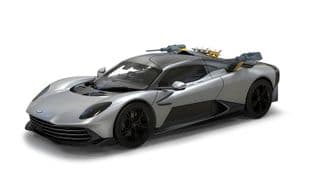
CC08101 Aston Martin Valhalla [Tactical]
Amongst the impressive display of die-cast delights the CORGI team had arranged at the 70th Anniversary event at Coventry, fans of Britain’s most famous fictitious Secret Agent would have been delighted to have been the first members of the collector community to see our new Aston Martin Valhalla model in the metal, as this exciting addition to the range was making its public debut at the event. With our 007 collection playing a significant role in the heritage of the CORGI brand, there was always going to be a handsome collection of James Bond related models on our display, and showcasing the latest impending addition to this range really did seem like the right thing to do.
A Double 0 agent needs the fastest, most dynamic, and the most striking car when they are on duty. Meet the Aston Martin Valhalla. A hybrid twin-turbo V8 with over 1000 horsepower and a few tactical modifications from Q Branch that you won't find in the brochure. To drive this, Bond will first have to Earn The Number.
The Aston Martin Valhalla is the manufacturer’s first-ever mid-engine PHEV supercar, with true hypercar performance. Inspired by the Aston Martin Valkyrie and featuring a carbon fibre monocoque chassis, it combines unprecedented aerodynamics with race-derived engineering, striking form and exquisite detailing.
A thing of Bond beauty, the new Aston Martin Valhalla model was making its public display debut at the Coventry Transport Museum.
Powered by a 4.0-litre twin-turbocharged V8 in conjunction with two electric motors to deliver unparalleled performance and a revolution in driver engagement, Valhalla is the extreme edge of technological advancement. Production of the Valhalla is limited in numbers to 999 vehicles.
The first James Bond videogame in over a decade, 007: First Light has exceeded sales expectations following its release at the end of May 2026, with 2.7m units sold worldwide within the first week of release. Featuring an original cinematic story worthy of the franchise’s legacy, the game reveals how a young Royal Navy aircrewman named James Bond is recruited into the new MI6 00 training programme after a covert mission goes wrong. As Bond navigates the murky world of modern technology fuelled espionage and a reluctant tutor who doesn’t see eye to eye with him, he travels the globe on a globe-trotting adventure that grants him the status of 007.
Sure to be an extremely popular addition to the range, the new Aston Martin Valhalla collector’s model is available for pre order now.
There’s something rather spectacular on the horizon Jim!
With our range of Star Trek related models now occupying such a significant position within the current CORGI model hierarchy, it seemed somehow fitting that this 70th Anniversary event also proved to be a suitable occasion to exclusively unveil the latest edition to this range, something very special for those who like to boldly go where no die-cast collectors have gone before.
For those of us who were glued to our TV sets when the original Star Trek series was aired here in the UK, the sight of the Starship Enterprise takes us right back to those carefree days when Captain James T Kirk was possibly more important to us than almost any other person we knew, a man who inspired us to look beyond, and to go in search of adventure. As for his ship, U.S.S Enterprise held us spellbound every second it was on our TV screens, not only because of its iconic appearance, but also as this was the haven for Kirk and his crew throughout their many adventures, and the means by which they travelled to all those strange new worlds.
As this year marks the 60th Anniversary of Star Trek, and we’ve seen something of a Star Trek range renaissance here at CORGI over recent times, we wanted to mark this occasion with a very special limited edition model release, one which was again allowed to make its public debut at the recent 70 years of making memories event at the Coventry Transport Museum. You could say that this unique model is a shining example of our model association with Star Trek and the U.S.S. Enterprise.
CC96610S U.S.S. Enterprise NCC-1701 – 60th Anniversary Edition
Inner Lid:
Debuting in 1966, Star Trek has gone on to become a legendary science fiction franchise that spans multiple television series and feature films. This very special die-cast model of the U.S.S. Enterprise NCC-1701 is a single run Limited Edition to commemorate the 60th anniversary of the Original Series.
One of the most iconic science fiction spaceships to appear in popular culture, the U.S.S. Enterprise NCC-1701 was conceived by Gene Roddenberry and designed by Matt Jefferies with the intention of looking unlike anything seen in the genre until that point. Several models of the ship were built for filming, with the largest 11-foot-long model currently on prominent display in the Smithsonian National Air and Space Museum in Washington D.C.
Collector Card:
The legendary fleet flagship of the golden age of interstellar discovery, the Constitution-class U.S.S. Enterprise NCC-1701 was launched in 2245 and served the United Federation of Planets for over forty years, most famously under the command of Captain James T. Kirk.
Additional:
This very special chrome plated die-cast model is limited to 3000 units worldwide, featuring a premium finish collector box with a silver holographic foil finish. The inner lid is detail is inspired by the dedication plaque found on the Bridge of the Enterprise, and each model comes with a numbered collector card as well as a cotton glove to avoid fingerprints on the model when handling.
It will be available for pre-order on Tuesday September 8th at 10:00am – Star Trek Day 2026, and the model’s RRP will be £69.99 RRP.
Initial supplies of the model are expected in our warehouse just a few days later, so you won’t have to wait too long before getting your hands on this beauty, but make sure you wear your gloves before doing so.
We’re afraid that’s all we have for you in this latest edition of our CORGI update blog, but we will be back as usual in two weeks’ time to bring you a further exclusive selection of updates. As always, if you would like to drop us a line in the meantime to comment on anything CORGI model related, or to suggest a future blog topic you’d like to see covered here in DCD, you’d be more than welcome, and we’re always happy to hear your views.
As ever, our diecastdiaries@corgi.co.uk address is always the one to use.
If you can’t wait for the next blog, you will find plenty of CORGI model collecting discussions taking place on our official social media channels, access to which can be obtained by clicking on the respective links at the foot of the CORGI website homepage.
Link access to CORGI social media sites.
Thank you for continuing to support your CORGI Die-cast Diaries blog, as we head into our eleventh year of production. Our next edition is scheduled for publication on Friday 28th August.
Until next time, once again, thank you for your continued support.