
Welcome to our latest edition of CORGI Die-cast Diaries, your fortnightly blog review bringing collectors all the news, updates and topical stories from the captivating world of CORGI die-cast model collecting.
We have an impressive bumper update edition of our CORGI blog for you this time around, as a host of new and impending model releases have all arrived at HQ over the past few days. Rather than drip feed the model updates over the next few editions, we decided to make this one of the most feature packed editions we’ve ever published, with no fewer than SIX new model releases to tell you about.
As our latest title suggests, new Aviation Archive models feature heavily in this edition, and we begin by featuring two Luftwaffe night raiders from the Second World War, aircraft which used the cover of darkness to cause havoc across southern England. One of the models is just the second release from its tooling suite, whilst the other is joining the range again after an absence of eight years.
If models on four wheels are more your thing, our Vanguards range also features heavily in this update, with the central section of the blog being devoted to a trio of 1/43rd scale Ford model releases, each one presented in very different, and really quite striking colour finishes.
We will be closing with a further Aviation Archive model update, one which last appeared in a Corgi range in 2020, and one which will soon be available in a configuration never previously seen from this particular toolset.
Please join us as we bring you a blog packed full of all the latest model developments from here at CORGI HQ.
As the Aviation Archive range enters its 28th year of existence, collectors now not only have a large and mature range of die-cast aircraft models to choose from, but they will also have their own favourites from amongst the large number of aircraft types already covered. Obviously, when any new model tooling is announced as joining the range, this is big news for the collector fellowship, but can be quite a stressful time for the CORGI team, as we always want our selection to meet with the approval of those already invested in the range. We know that we won’t be able to appeal to everyone with any new model tooling announcement, but if we have the support of the majority, then surely that’s all we can hope for.
When it came to releasing our first model from the new 1/72nd scale Messerschmitt Me 410 tooling, we didn’t have to wait too long for vindication of our decision, as advanced orders showed this model had wide appeal across the hobby, and indeed the model itself only remained in stock for a very short time – our Hornisse proved to be a real winner.
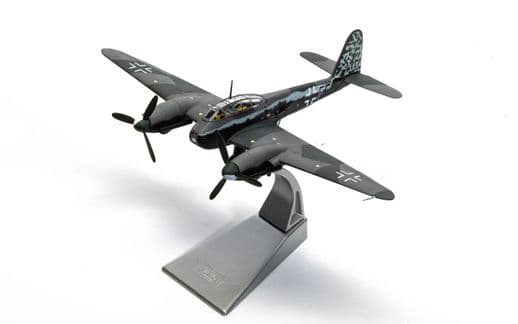
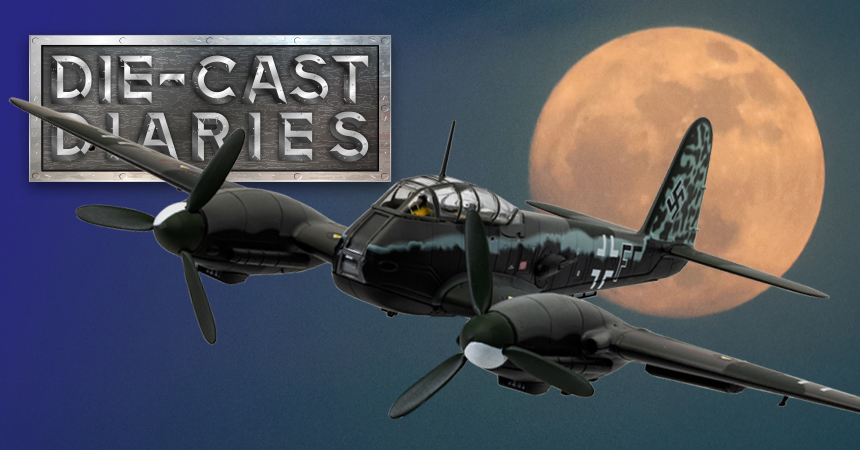
When it came time to select our follow-up release from this popular model, we knew that we wanted to bring a very different looking Messerschmitt to the collector table, not only a differently configured example of this capable aircraft, but one which looked very different from its predecessor, a night intruder. We have to say that we’re delighted with how this model has turned out, a really sinister looking example of an aircraft which was rather sinister looking in the first place, one which was tasked with targeting British airfields and general infrastructure under the cover of darkness, whilst being particularly difficult to intercept.
The prototype Messerschmitt Me 410 made its first flight during the Spring of 1942, and immediately showed itself to be a much more capable aircraft than its predecessor, essentially the Zerstörer the Luftwaffe had been hoping to have introduced two years previously. Now given the name Hornisse (Hornet), they were hoping the new heavy fighter would stir up a storm in the air, and like its predecessor, was ordered in large numbers shortly after the flight of the prototype, even attracting the same priority production status.
This exclusive series of images all feature an advanced production sample of this second release from the 1/72nd scale Messerschmitt Me 410 tooling.
From the outset, even though the first aircraft were produced as Schellbombers (fast bombers) and intruders, it could easily be argued that the Messerschmitt Me 410 was a true multi-role aircraft, one capable of performing a variety of different tasks effectively, with flexibility intentionally built into its overall design. Could we even go so far as to suggest that this was the closest the Germans ever came to producing their own version of the British de Havilland Mosquito they hated and admired so much?
With its ventral weapons bay in the nose of the aircraft, the Me 410 could be configured to perform a multitude of operational tasks, with fast bomber and heavy fighter being its primary roles, but with others such as night fighter, reconnaissance, bomber killer, torpedo bomber, dive bomber, long range/maritime strike and training roles all eventually being undertaken. In fact, something of a design industry was to grow around the concepting of proposed future variants of the Me 410 throughout its service life, even though it entered service two years later than initially anticipated.
Although developed as a Schnellbomber, many of the first Me 410s entering service were used in nightfighter/intruder or reconnaissance roles, however, it didn't take crews long to discover that this was a much better aeroplane that its predecessor, as it was welcomed into widespread service.
Production of the Messerschmitt Me 410 ended during August 1944, when the manufacturing lines were switched to producing more single engined Messerschmitt Bf 109G fighters for home defence duties, however by that stage in the war, things were already looking futile for the beleaguered Luftwaffe. Remaining Me 410 units continued fighting until the final days of WWII, although very few aircraft would be left intact by the end of hostilities.
The Luftwaffe’s long range night intruder campaign towards the end of the Second World War was intended to disrupt Allied air operations, spreading confusion and panic by infiltrating bomber streams, or striking at aircraft whose crews had ‘switched off’ as they approached their base at the end of another long mission. The Messerschmitt Me 410 was ideally suited to this task, fast and heavily armed, these Fernnachtjagd aircraft operated in conjunction with the regular Blitz bomber force, but often with more specific targets and often operating alone. Despite being an extremely capable aircraft in this role, night intruder Me 410s were hunted the second they crossed the English Channel, and no mission would ever pass without incident.
Britain’s air defences had been fine-tuned to make any incursion over the UK a torrid experience for Luftwaffe pilots and the cover of darkness offered little in the way of protection. RAF de Havilland Mosquitos proved to be the perfect nocturnal hunters, taking a heavy toll of Luftwaffe aircraft of all types, including the Messerschmitt Me 410. On one particularly successful occasion for Britain’s defences, of the 14 Messerschmitt Me 410 Hornisse night intruders sent to harass over Britain, just a single aircraft made it back across the Channel, so effective was the opposition they faced.
This particular aircraft wears a camouflage scheme presentation perfect for night intruder operations, and was flown by one of the Luftwaffe’s very best, Rudolf Abrahamczik, a highly decorated bomber pilot with at least 233 combat missions to his name, many of which were flown in support of night intruder operations.
A very different looking Hornisse from the successful model which preceded it, we can look forward to this beautiful model mounting raids against our display cabinets in the very near future. If nothing else, our recently announced Mosquito needs something to chase!
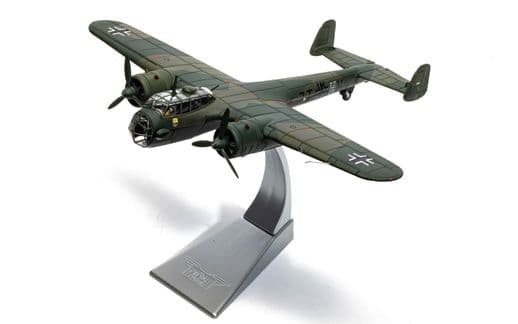
Another example of a Luftwaffe multi-engined aircraft which started life masquerading as a high speed civilian type, the Dornier Do.17 was very much a wolf in sheep's clothing, and one which would go on to become a familiar sight in the skies above France and Britain. Flight testing of the new aircraft began in November 1934, but would not progress without the odd incident. The first prototype aircraft featured a single tail unit and suffered from instability issues whilst in the air, so subsequent development aircraft and indeed future production machines would incorporate a distinctive twin tail boom configuration, a definite identifying feature of the type.
The narrow, slender fuselage of the new aircraft would eventually be deemed too restrictive for use as a mail carrying aircraft by Lufthansa, a decision which initially stalled further development, however, everything would change once Lufthansa's chief pilot had the opportunity to fly one of the stored prototypes. Really putting the Dornier design through its paces, he effectively flew an aerobatic routine in this relatively large aeroplane and on landing, described the aircraft as having almost fighter-like performance. Furthermore, if improvements were made regarding flight stability, it could be an outstanding high-speed bomber and reconnaissance aircraft.
Dornier engineers were instructed to modify the aircraft in line with these recommendations, with the aircraft now receiving official backing and the intention to proceed towards production. The aircraft would now shed its initial subterfuge and advance as the E-1 high speed bomber version and F-1 reconnaissance aircraft for the Luftwaffe, types which would eventually enter squadron service from early 1937.
At the time of its introduction, the Dornier Do.17 was a highly advanced aircraft. Fast and agile, possessing an extremely distinctive profile, the aircraft would soon inherit the name by which it would become infamous, the Luftwaffe's 'Flying Pencil', a name by which it would be referred to throughout its service career, by both friend and foe alike. These first ultra-sleek aircraft would be powered by Daimler-Benz in-line engines, however, the constant shortage of engines added to a need to endow the aircraft with ever greater power would see the aircraft equipped with several different powerplants, including the Bramo Fafnir radial engine, which gave the aircraft its classic profile, and the one by which most modellers recognize it.
This latest Dornier Do.17 model release features new parts to allow this Z-5 anti-shipping strike variant of the ‘Flying Pencil’ to be modelled.
This popular addition to the Aviation Archive range made its release debut in 2009, since when it has become a firm favourite with collectors, beautifully detailed and with that always appealing high metal content. This latest release is very different to any Dornier model which has gone before it, not only because it features a modest, yet highly significant modification to the tooling, but also in how it’s presented from a finish perspective.
The Z variant of the Flying Pencil was the most heavily produced of the entire production run, and the Z-5 was an interesting sub-variant of this mark of aircraft. Intended to perform specialist maritime reconnaissance, or anti-shipping operations, these aircraft would be tasked with operating over large expanses of ocean, with the problem being that the aircraft didn’t have a particularly good reputation when ditching.
In order to provide crews with more time on the surface of the water before their Dornier slipped beneath the waves, inflatable flotation buoys were positioned in the engine nacelles and behind aerodynamic bulges on the nose of the aircraft. On contact with water, these buoys would self-inflate, keeping the aircraft on the surface of the water for much longer, even allowing stricken crews to stay with their aircraft until they could be rescued.
As the Dornier Do.17 was essentially obsolete by the time of the Battle of Britain, the cynics amongst us might suggest that this modification was made to reassure crews assigned to fly these aircraft, rather than actually making a significant contribution to the aircraft’s performance. Nevertheless, the Aviation Archive range now has an example of one within its ranks.
One of the most distinctive aircraft to have taken part in the air battles of the Second World War, the Dornier Do 17 is usually referred to by its nickname and for good reason, as the Luftwaffe’s Fliegender Bleistift translates to ‘Flying Pencil’. The Z variant was the most heavily produced of all the Do 17s, addressing many of the shortcomings of previous versions, but still struggling to maintain its place as a front-line Luftwaffe strike bomber. The Z-5 was the last major bomber variant of the aircraft produced, and featured the addition of specialist survival/flotation equipment, as these aircraft were intended for operation over large expanses of water.
Operated almost exclusively by 1./KüFlGr 606, this particular aircraft was one of six sent to attack aircraft factories around Liverpool during the twilight hours of 11th October 1940. Unfortunately for them, the raid was picked up by British radar and the Spitfires of No.611 Squadron were sent to intercept them. This particular aircraft, wearing its attractive nocturnal camouflage presentation, did not evade the attention of the Spitfires, and was seen trailing smoke from both engines, presumed crashed in a remote area of Wales.
Despite being damaged and two crew members having bailed out, the pilot managed to nurse the stricken aircraft back to France, making a crash landing at Brest. After this mauling, 1./KüFlGr 606 would only engage in night bombing sorties.
This really attractive addition to the Aviation Archive range is now on finals and should be in our warehouse by the end of the month.
Of all the many famous model types to grace the Ford range over the past 70 years or so, the Ford Escort range has to be considered amongst their most successful, and even arguably the most successful model to ever wear the Ford badge. First appearing back in 1967, the Escort quite literally allowed British families to get motoring, a reliable motor car which featured the latest technological innovations the industry had to offer. For this reason, the Escort could be considered the vehicle model which touched the lives of more people in the UK than the majority of others.
A new Ford small family car which, as already mentioned, was unleashed on an unsuspecting motoring world in 1967, the Escort must have delighted Ford executives in the months following its launch, as it really did seem as if everyone in Britain wanted to get behind the wheel of one of these appealing new cars. This desirability factor would only be enhanced further following the success of the Ford works team in various rally sports competitions and the subsequent release of such exciting new Escort variants as the RS 1600 and 2000 models, introducing the British public to the concept of the attainable 'Hot Hatch'.
The success of the original Mk.I Escort was further enhanced following the release of the updated Mk.II variant in January 1975, a design which was something of a collaboration between Ford UK and Ford Germany. The bodywork facelift gave the new Escort a more angular, purposeful appearance than its predecessor, with the car already occupying an extremely lucrative position in the European marketplace.
VA09534 - Ford Escort Mk1 1300GT in Marine Blue
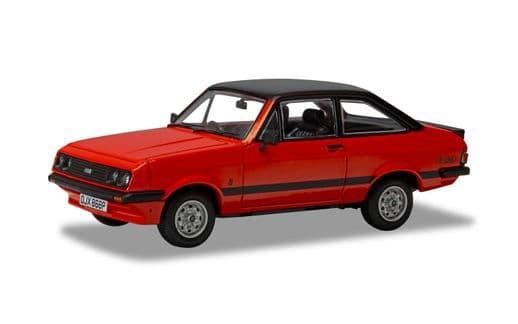
VA14910 - Ford Escort Mk2 RS2000 in Carnival Red
Although the base L and slightly higher spec GL models in both two and four door options would continue to be the bread and butter cars for overall Ford sales numbers, the sporty RS Mexico and RS 2000 models clearly highlighted the fact that this car possessed genuine motorsport credentials, even if your particular Escort was much more conservative in its appearance, a link the Ford marketeers were ruthless in exploiting at every available opportunity.
At that time, it seemed as if hardly a week went by without the sight of a racing Escort taking the chequered flag at some rally/motorsport event or other on TV screens or in the newspapers and as such, who wouldn't want to own a car model which possessed such racing pedigree? Even though the vast majority of Escorts on Britain’s roads were what you would expect a popular small family car to look and perform like, everyone who saw them knew that beneath that plain exterior, there was a rally sport beast just waiting to be unleashed!
Further celebrating the legendary status of the Ford Escort in Vanguards form, we have two new models about to join the range, both early variants of this much-loved vehicle range.
VA09534 - Ford Escort Mk1 1300GT in Marine Blue
The Escort GT modelled was initially purchased from Mayne’s Garage, Redruth, Cornwall, on August 1st, 1973, by a retired army major who actually bought a pair of 1300GTs that day, this blue example for himself and a red one, which is believed to have had a sequential number plate, for his wife. He had both Ziebart rust-protected then painted inside the bumpers and hubcaps himself to prevent corrosion. He covered 72,000 miles before taking this car off the road and, eventually, both Escorts were purchased by a local 15-year-old enthusiast for £25 each. In 2013, he sold the blue example to Berkshire-based Ford enthusiast Gary Cook, who stored it under a cover for several years.
In January 2018 Gary’s close friends, Ford enthusiasts Maria and Kevin McDermid, purchased it for Maria’s 50th birthday. It looked solid but, after stripping and blasting the bodyshell, they realised nearly every panel was perforated. Because Kevin already owns a modified Escort, they decided to restore this rare survivor to its original specification. Ford specialists, Bishop’s Bespoke Builds, rebuilt the bodyshell and it was painted in the original Marine Blue by Tony Littlejohn of Porsche specialists GTR Motorsports. The pair then reassembled it, refurbishing components, and scouring the world for rare trim parts. It was finished in August 2021 and featured in Classic Ford magazine in June 2022. Maria loves driving it to retro Ford events, where it is often the only unmodified car.
VA14910 - Ford Escort Mk2 RS2000 in Carnival Red
The RS2000 modelled is one of the oldest surviving UK-market examples and was manufactured in Saarlouis, Germany, in December 1975. The first owner was Mike Collins, then RAF personnel, based at RAF Dishforth, Thirsk, North Yorkshire. He purchased it from the Ford RS dealership, Polar Service Garage, Barnsley on 12th January 1976, then registered it the following day. It had ten further owners before the current custodian, well known North Wales-based Ford enthusiast Aled Hopwood, purchased it on 7th June 1996. He wasn’t initially aware of its rarity but was captivated by it and has amassed a comprehensive history file containing all the previous MOTs and tax discs, plus a list of previous owners.
The car had covered 73,000 miles and was in excellent condition, and Aled enjoyed using it on several European tours, as well as the North Wales Snowdonia Tours and Lakes Tours. It was featured extensively in the book ‘Factory-Original Sporting Mk2 Escorts’, by Dan Williamson, with many detailed photographs of the car by Simon Clay being included in the RS2000 chapter. It has also appeared in Classic Ford Magazine. In the summer of 2021, Aled embarked on a nut-and-bolt restoration to as-new condition. He returned the underside to its original dove grey paint before having it fully resprayed, although all the original panels and Beta Cloth interior were retained. Aled proudly showed the finished car at the 2021 NEC Classic Motor Show.
It’s always interesting to learn that even though the Ford Fiesta ended up being one of the most successful models in the Ford range for almost five decades, encompassing eight different model incarnations, Ford’s iconic small car could have actually been on the market ten years earlier than it was. When the project was first considered, it was felt that existing small cars on the market were so well established that the cost of development would be prohibitive, so Ford placed their attentions in other directions. Years later, the oil crisis gripping the world saw public demand for smaller, more economical cars increase exponentially, and the Fiesta was finally born.
The Fiesta was marketed as the ‘little car that thinks it’s much bigger’, and even though it never matched the Escort in pure sales terms, it would become an incredibly successful range for Ford, with the Fiesta remaining in production from 1976 until 2023, covering seven generations of this popular car, with more than 22 million cars sold during that time. With numbers like these, is it any wonder that this second incarnation of the Fiesta has long been requested as a range addition by Vanguards fans.
The British motoring public have developed something of an obsession with smaller cars over the years, particularly those which occupy a classification we have come to know as ‘Superminis’. This is probably because these cars were produced with economy and practicability at their heart, but as they were also some of the most affordable cars on our roads, tended to touch the lives of more people than most other vehicle types.
These popular little cars were all about getting the nation moving, allowing us all to go about our daily lives, whether that be work, or leisure related. In some ways, these little cars actually became part of our families, but as they were always there to get us from A to B with a minimum of fuss, rarely received the care and attention our reliance on them probably deserved. Well-loved and well used, it was rare for these cars to survive more than a decade or two and indeed, it’s rare to find examples which have been preserved in pristine condition, but when we do see one, we not only marvel at how much the motoring world has advanced over the past few years, but also how much these little cars meant to us back in the day.
VA14404 - Ford Fiesta Mk2 1.1L in Citrine Yellow
The Fiesta modelled was supplied new by Ford main dealers Gilbert Rice Ltd, Sussex, and first registered on 31st January 1986. Its first four owners looked after it very well and used it sparingly. In the summer of 2016, it was offered for sale by well-known classic car dealers KGF Classic Cars, having covered 40,679 miles. The mileage was confirmed by an accompanying history file containing a brochure, invoices and previous MOT certificates, as well as the original service wallet and handbook. Remarkably, the car’s grey ‘Fife’ trim was perfect, and it also still boasted its original dealership-stamped number plates, which is unusual as these often get damaged in low-speed parking incidents.
It was purchased on 26th July 2016 by lifelong Mk2 Fiesta enthusiast Christian ‘Bisty’ Dann, a restaurateur from Cornwall who has grown up in a family that are passionate about classic cars. He christened her ‘Geraldine’ and created a popular TikTok account called ‘geraldinethefiesta’, which features films about Geraldine’s adventures in Cornwall and Bisty’s other classic, an American-built 1974 GMC van he uses to offer grilled cheese delicacies to the people of Falmouth. In 2020, Geraldine needed some welding to pass her MOT and Bisty decided to have new sills fitted on both sides by local specialist Perranwell Garage, who also carried out some major engine work and various other jobs in order to make her as good as new in every respect.
This rather striking addition to our Ford model range is now in our warehouse and available to take up a spot amongst your Vanguards display.
With our Cold War British jets series of models proving to be a little thin on the release ground over the past few years, Aviation Archive collectors will have been pleased to see the return of the SEPECAT Jaguar in the latest range launch event, particularly as this model is presented in an offensive configuration never previously seen on one of our Jaguar releases. The previous Jaguar release came in 2020, with that model commemorating the aircraft which operated from the newly opened M55 motorway near Blackpool, a model which proved incredibly popular with collectors everywhere. Thankfully, we now have another RAF Jaguar model in the range, and though we say so ourselves, it’s a bit of a classic.
Entering Royal Air Force service in 1973, the Jaguar GR.1 (Ground Attack/Reconnaissance Mk.I) would prove to be a more sophisticated and technologically advanced aircraft than those of their French counterparts, and immediately showing itself to be a potent performer. It would become one of the most important British aircraft throughout the Cold War era, with pilots always training for a role at the spearhead of any future military engagement and therefore, serving as a significant deterrent to possible Eastern Bloc aggression. A vital component of RAF Germany’s offensive inventory, they maintained four squadrons of Jaguars for strike and battlefield support operations, with a further squadron performing the tactical reconnaissance role. Further squadrons were based in the UK, and served as a deployment ready mobile force, should their services be required.
From a design perspective, the Jaguar’s distinctive undercarriage was specifically developed to allow this capable performer to operate from damaged airfields, roughly prepared grass strips and even larger roads, as the RAF assumed that in times of war, any first strike by the enemy would be directed towards known operational airfields. This ability was regarded as a valuable deterrent asset and was ably demonstrated to the nation’s media on 26th April 1975, when the second production development Jaguar GR.1 XX109 made a parachute assisted landing on the carriageway of the soon to be opened M55 motorway near Blackpool. Pushed under a bridge over the carriageway, the aircraft was fitted with bombs, before taking off again, demonstrating the impressive operability of the Jaguar.
The Jaguar would go on to enjoy an impressive 34 year service career with the Royal Air Force, undergoing regular upgrades to improve and perfect its operational capabilities during that time. It would earn a reputation as a hardworking and reliable strike and reconnaissance platform, something which was illustrated by its performance during the first Gulf War. The twelve Jaguars deployed during Operation Granby flew 612 combat sorties, with one Jaguar flying 47 missions, the most of any aircraft in theatre.
Although starting out as an Anglo-French training aircraft project, the RAF’s Big Cats certainly went on to live up to their name, showing themselves to be aircraft not to be messed with. If the Jaguar showed its offensive claws, you knew you were in big trouble.
AA35417 – SEPECAT Jaguar GR.1 XX963/AL, No.14 Squadron, Royal Air Force Germany, Brüggen, Germany, 1976. Cold War peacekeeper – ‘The task of this station in peace is to prepare for war’
Arguably, the most significant operator of the SEPECAT Jaguar in British service was RAF Germany, who maintained a force of four squadrons in the country as part of the 2nd Allied Tactical Air Force under SACEUR (Supreme Allied Commander Europe). When Jaguars arrived at RAF Brüggen, they took up residence in newly constructed dispersed hardened aircraft shelters, with each squadron having their own area featuring nine shelters, each one capable of housing two Jaguars. No.14 Squadron took delivery of their first Jaguar on 7th April 1975 and were declared operational on 1st December that same year.
RAFG Jaguar pilots would train tirelessly in the roles of tactical nuclear and conventional bombing attacks, as they were on the front line of preventing war in Europe, and would be the first line of attack in the event of conflict, quite some responsibility for them. Jaguar XX963 is a fine example of a Cold War RAF Germany machine, but she also has another, rather significant claim to fame – she was shot down by an RAF Phantom! On 25th May 1982, at the height of the Falklands War, this Jaguar was conducting its latest training sortie when it was ‘intercepted’ by a Phantom carrying LIVE munitions.
In a series of unfortunate circumstances, what should have been a radar ‘kill’ turned into a real one, because when the Phantom pilot pressed to register the interception, a Sidewinder missile left its rail. The missile struck home and the Jaguar disintegrated, thankfully not before the quick thinking pilot had managed to eject safely. Unfortunately, Jaguar XX963 lay strewn across a German field, 50 miles from its home base at Brüggen.
A beautiful representation of an RAF Germany Jaguar, this one has an incredible story behind it, and is definitely worthy of commanding a place amongst any collection of die-cast model aircraft. Jaguar AA35417 is now scheduled for imminent release.
We promised you a bumper update edition, and I think it’s fair to say that we delivered on that promise. We’ll be back as usual in two weeks’ time with another selection of the latest CORGI die-cast model updates and exclusive previews for your delectation, but as always, if you would like to drop us a line to comment on anything CORGI model related, or to suggest a future blog topic, we’re always happy to hear from you.
As ever, our diecastdiaries@corgi.co.uk address is the one to use.
If you can’t wait for the next blog, you will find plenty of CORGI model collecting discussions taking place on our official social media channels, access to which can be obtained by clicking on the respective links at the foot of the CORGI website homepage.
Link access to CORGI social media sites.
Thank you for continuing to support your CORGI Die-cast Diaries blog, as we head into our eleventh year of production. Our next edition is scheduled for publication on Friday 27th February.
Until next time, once again, thank you for your continued support.