


Welcome to our latest edition of CORGI Die-cast Diaries, your fortnightly blog review bringing collectors all the news, updates and topical stories from the captivating world of CORGI die-cast model collecting.
As the dust finally starts to settle on our latest new model launch event, we can get now down to the enjoyable business of introducing all those new 2026 range models to our loyal Die-cast Diaries audience in earnest. That being said, we’re going to be kicking off this new year of die-cast model update goodness in a very different way, by looking at the fascinating process of how our beloved models are actually produced, from CAD design files, right through to receiving our new model from the warehouse or our model shop of choice.
With grateful thanks to our friends at the Corgi Model Club, we will not only be bringing you images taken from a video which shows their 270 James Bond Aston Martin DB5 Silver Grille Edition in production, we will also be embedding that fascinating piece of die-cast collecting insight into the main body of this update – you’re in for a real treat.
Continuing the new model mood for the second half of this latest update, we will be returning to the subject of our 1/72nd scale de Havilland Mosquito tooling which is one of the highlight additions to in our latest model range, but is a model possessing some significant differences. In a first for DCD, we will be bringing readers an exclusive first look at CAD imagery produced in support of the upgrade project for this classic model tooling, work which will make an already popular model even more irresistible.
As always, it’s new CORGI model exclusives all the way in this latest edition of your Die-cast Diaries blog, and we even have a video feature to boot!
Although we love nothing more than bringing our readers the latest details of all the models we currently have under production, models which will be vying for our attention when it comes to potentially taking up some future space in our display cabinets, it’s actually been quite a while since we featured the production of the models we all hold so dear, the business end of die-cast model collecting, if you will. We did post a couple of consecutive editions back in 2018, where we featured one of our Avro Lancaster models as it negotiated the manufacturing stage, but nothing since then and nothing featuring a classic CORGI model.
That being the case, we thought it about time we did something about that situation, and a recent video production created by our good friends at the Corgi Model Club provided the stimulus we needed. The CMC team work tirelessly to recreate some of the classic CORGI models from the golden era of die-cast model production, beautiful models that many of us will remember from our youth, the ones we played with for hours on end. As a consequence of all that playtime attention, the vast majority of these much loved models have long since given up the ghost, having served their playing purpose and long since been discarded to the dustbin.
Now we’re older, and in the reflective position to remember just how important these little models were to us, many of us would love to have the same models available to us now, in exactly the same presentation, including the packaging which whilst being so appealing back then, was the first thing to be discarded back in the day. If one of two rare examples did manage to survive intact, these will be in the hands of committed collector’s and even if you could persuade them to part with their prized possessions, it would undoubtedly cost you an arm and a leg to do so.
Our friends at the Corgi Model Club came up with a plan to address this situation, and to say they’ve been successful in their endeavours would be a die-cast understatement of 1/32nd scale Aviation Archive de Havilland Mosquito proportions. They have literally been able to engage with tens of thousands of ordinary people who all had the same shared experience of wanting to re-own the classic CORGI models of their youth.
If you were to visit the About Us page on their website, they provide something of an insight into what drove them to establish this ever growing range of beautiful models, starting with the line which has us convinced from first viewing - We are Corgi Toys fans, just like you!
A series of CAD imagery featuring the subject of this Corgi Model Club model production article in various poses and configurations.
They go on to say –
We’re fans, first and foremost. The Corgi Model Club Online Shop is where we can show off our fantastic re-issue models that launch every month and add to our growing collection of gifts for those wanting to re-live special childhood memories.
The Corgi Model Club represents a carefully curated cross-section of some of the greatest die-cast models ever to come out of Corgi’s famous Swansea factory. Now brought exclusively and directly to you, thanks to our unique relationship with Corgi’s owner – the illustrious British toymaker, Hornby Hobbies plc, no less. Hornby have given us the exclusive rights to re-produce some of the rarest and sought after models from their 1960’s catalogues. The intrinsic value and collectability of the original models is testament to the enduring quality of their superb die-cast metal construction and detailing – not to mention the wonderful memories that names such as Aston Martin, Jaguar, Lotus, Porsche and Ferrari evoke.
This next series of images are all screengrabs taken from the excellent model production video recently posted by the Corgi Model Club, a great watch which can be accessed a little further down this article.
As collectors, when our new model arrives from the CORGI warehouse, we will all no doubt excitedly remove the packaging and carefully inspect the model, hoping that it passes muster and can take its place amongst our collection. Even though we probably all follow this same time-honoured routine, do we ever even spare a thought for how the models are made, and indeed, is it even of that much interest to us?
It has to be said that most die-cast model collectors are both knowledgeable and usually possess much hobby experience, and at some time or another, will have no doubt availed themselves of information highlighting how modern die-cast models are produced. If they had, they would probably have been surprised at the level of human dexterity involved in the process, and the sheer number of hands each model passes through before it leaves the manufacturing plant.
Even with this information to hand, we can often be guilty of quickly slipping back into our old ways of admiring our new model, but disregarding what it took to get it into our hands, and whilst that’s fine, it really is interesting to consider just what it takes to make our beloved models, even if just for our own reference, or as a hobby conversation point amongst friends, or fellow collectors.
The truth of the matter is that die-cast model production is an interesting combination of cutting edge digital technology and traditional heavy industry, with people playing a huge role in every stage of this process. Here on DCD, we’re regularly presented with details of the work undertaken by team members at the front end of a model’s production journey, usually the creation of the initial research file and associated artwork which are both vital during the production phase, but then tend to miss out on everything between that and the marketing/sample model stage and the back end of the process.
Quite simply, this leaves out all the stages which involve the largest amount of human interaction with a model, as by adopting this format, we remain squarely in the territory of the relatively small Corgi team and mainly focussing on stages controlled here in the UK. This recently created video posted by our friends at the Corgi Model Club allows us to provide some interesting balance to that story, with perhaps the only thing missing being the lads who have to store, move and check the sizeable metal tooling blocks which are the life blood in the production of any new model release – now that really is heavy industry in its purest form.
The design files go into tooling production, where a computer guided precision milling machine turns a digital file into a high quality model tooling.
The cast model component as ejected from the manufacturing tool.
Preparing the newly tooled casting for the filing and preparation process.
The video itself starts by looking at CAD files being worked on prior to the cutting of metal and the production of the tooling blocks themselves, but then moving on to show images of the tool milling process actually taking place.
This then gives way to perhaps the most interesting stage of the entire process and the production of the main body of the model itself, where the molten zamak alloy is injected into the CAD created tooling block under pressure, is ejected, therefore allowing the process to continue with production of a new part. The video shows the ejected component collected in a bin, all the while cooling and ready to undergo the next, incredibly labour intensive stage of the process – frame tree and sharps removal.
Before we go any further, this is probably the right time to let you know which exact model is going down the production line in the video (which is embedded for your viewing pleasure below).
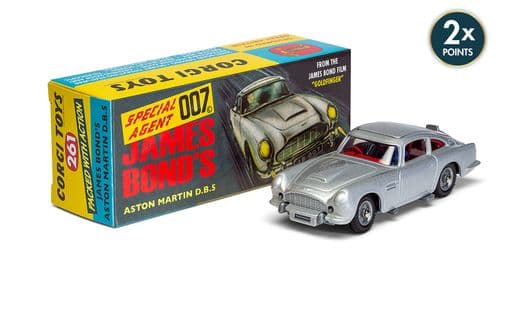
The model in question is Corgi 270 – James Bond’s Aston Martin DB5. This model is a recreation of one which was issued in 1968, and following on from the success of the 1965 gold plated 261 model. The new Corgi 270 gave fans what they’d been calling for – a James Bond Aston Martin DB5 in silver, just like the movie car.
It was produced in a slightly larger 1:43rd scale as opposed to the Corgi 261, which was in 1:46 scale, to allow two really exciting new features to be incorporated – revolving number plates and pull-out rear wheel tyre slashers. It did, however, also retain the ejector seat, pop-out machine guns and overriders of the earlier model, along with the rear window bullet proof shield.
The Corgi Model Club Gold Grille Edition replicated the classic period-correct Corgi 270 livery, is presented in a facsimile of that original model’s iconic illustrated packaging and comes complete with the all-important secret instructions, lapel sticker and spare bad guy. As with many such models, despite this being one of Corgi’s all-time best selling model releases, precious few survive today in pristine condition, making this quite the historic release, in terms of Corgi heritage. So now you’re in the know!
The production of a die-cast model is a labour intensive process, and requires extremely high standards of dexterity.
The painting process – how do they manage to make everything look so good?
All present and correct, on His Majesty’s Secret Service. Models ready for quality checking.
Getting back to the video once more, we now start to see plenty of hands coming into shot, as the next stage of this process requires much human intervention. As the metal body of the DB5 emerges from the tooling block, it does so complete with part frames and any sharp edges and flashing which are often part of the process, all of which will require removing and filing. The supporting frame and bracing sections all need to be removed, but in a careful and professional manner, as no marks can be allowed to spoil the look of the resultant model.
Once they’ve cut as close to the model as possible, the long and arduous process of carefully filing all sharp and protruding parts can begin, where skilled workers spend a fair amount of time removing all traces of the die-cast manufacturing process, turning this into a beautiful scale replica of a DB5’s body shell. Clearly, this means that every single model will come into contact with any number of people throughout this process, meaning that we really do have a point when saying that in actual fact, every single one of these models are unique examples of die-cast model memorabilia – there’s no magic model creation machine involved in this process.
The next stage sees all the beautifully finished body shells being prepared for painting, being hung on paint carousels, before receiving the all important paint which identifies this specific release. This is again an extremely industrialised process, and whilst we know the finished models always look magnificent, when looking at this process and the mechanics behind it, how on earth do they do that?
After painting, it’s yet another round of quality control inspection, before arguably the most fascinating stage of the entire manufacturing process can take place, tampo printing. This process involves machines using paint pads to hit layers of individual colour onto a model, building up the paint detail until the desired effect has been created, often requiring a great many paint ‘hits’ to be made in the same small area.
More human involvement, as the model is checked, assembled and made ready for packaging.
Shaken not stirred. This is how we collectors first come into contact with a new Corgi model, long after all the hard work has been done.
The machines are full of paint and operators will manually produce their own wooden or resin baffles to ensure the model remains firmly in place and at exactly the right angle when being addressed by the tampo printing machine. The video shows the painting of the rear lights on the model, and you can clearly see the red paint reservoir at the left hand side of the screen. Can you imagine how difficult it must be to use this process to print detail such as the sharks teeth on a Curtiss P-40 fighter, or the complex livery on an Original Omnibus model? It’s all hugely impressive, and really does afford us the opportunity to have a much greater appreciation of the models in our own collections. Once again, we could even claim that each and every one are unique.
The back end of the video shows more inspection processes taking place, as work to start assembling the model can be seen taking place. All the model’s many working features have to be checked for accuracy and the model given a final inspection, before work to protect the model during transit can take place.
Finally, we see the model being married with the bespoke packaging created for this release, something which is yet another important aspect of the overall presentation of these classic heritage release models. Hopefully, when your latest model arrives, you will have a much clearer understanding of how it was created, and dare we say, may even love it just that little but more.
We would like to thank our friends at the Corgi Model Club for allowing us to include this production feature in this latest edition of DCD, and implore you to head over to their website if you want more details on the impressive work they do in preserving some of the most significant die-cast models of the 20th century.
For now though, please sit back and enjoy our production video presentation.
Target for tonight. Our 1/72nd scale de Havilland Mosquito tooling has been the subject of some significant re-working.
When it comes to the Aviation Archive range, there are some models which have truly ascended to die-cast greatness, models which collectors could hardly believe their good fortune when they first appeared, and continue to demonstrate their enduring appeal to this day. One such model is our 1/72nd scale de Havilland Mosquito tooling, a model which first arrived on the scene back in 2001, the same year the incredible Avro Lancaster tooling appeared in the same scale, and the year after the 1/72nd scale range launching Spitfire, Hurricane and Messerschmitt Bf 109 posted their die-cast statement of collectability intent.
Since that first release, we’ve seen Mosquito models produced in any number of operational variant guises, from bombers to fighter-bombers, and reconnaissance aircraft to trainers – we’ve even had a civilian variant involved in the wartime transportation of ball bearings from Sweden! When it came to the collector reception for these models, almost across the board, they would all become both popular and highly sought after in equal measure, something made all the more interesting when considering that release run sizes were typically three, four and sometimes five times those of production runs these days.
As we now find ourselves in the 28th year of the Aviation Archive range, we’re delighted to say that our scale die-cast tribute to the incredible ‘Wooden Wonder’ will be continuing in 2026, however, the model scheduled for release this summer will be very different from the previous model released in 2021.
As one of the finest fighting aeroplanes of the Second World War, it can often come as something of a surprise to learn that the spectacular de Havilland Mosquito wasn’t exactly embraced by the British Air Ministry at the outset, as they feared production of a new aircraft type might divert resources away from important existing manufacturing commitments, whilst also placing an unacceptable strain on the availability of strategic materials. Thankfully, the de Havilland design team had answers for all those concerns, along with the belief that the new aircraft they were working on held incredible potential.
Yet another DCD exclusive, this time featuring CAD screengrabs from the Mosquito tooling files, showing the modified nose and undersides with bay doors closed and open.
Other than requiring two Rolls Royce Merlin engines to power their new bomber, de Havilland intended to use ‘non-strategic’ materials on the project wherever possible, including the adoption of advanced wood laminate bonding processes in its construction. This actually created something of a fascinating aviation dichotomy, using traditional aircraft construction methods from a previous era of aviation to produce what was arguably, the most advanced and highly capable aircraft in the world at that time.
The bonded plywood and glue construction method of producing aircraft was perfected during the Great War, with this technology taken straight from the world of boat building. Featuring on such aircraft types as the German Albatros series of fighters and several successful Allied machines, de Havilland went back to this method of construction for his new aircraft, knowing it would endow the aircraft with great strength and also that modern bonding and moulding processes would allow for a highly streamlined design to be produced. The lamination process involved cross-graining sheets of wood veneer, in this case the finest Ecuadorian Balsa, with thin Birch ply, using strong glues to bond the layers together.
The shape of the fuselage was moulded over beautifully produced internal section mahogany master moulds, with the laminated sections laid over the mould, braced and heated to ensure it perfectly followed its shape. The surface of the mould itself had raised detail to mark where internal structural features would need to be fitted and as the fuselage was produced in two halves, just like a huge 1 to 1 scale Airfix kit, much of the internal fitting out work could be completed prior to the two halves coming together, something which greatly reduced manufacturing times. Concerned that the original mahogany moulds would not survive the rigors of mass production, de Havilland's later produced many concrete replicas of these moulds, which proved to be much more durable, if less appealing to look at.
As the date for the first flight of the prototype DH 98 approached, the aircraft was taken by road from its Salisbury Hall home to a facility with runway access close to the Hatfield factory site and around three miles away from where it had been built. Once there, it underwent final checks, ran its engines and performed several taxiing trials in advance of the first flight. That historic occasion took place on 25th November 1940, with Geoffrey de Havilland Jr. and the controls and engine installation expert John Walker in the jump seat.
More CAD screenshot delights which show what we have to look forward too with the release of our next de Havilland Mosquito model.
Once their new aircraft was ready to be tested and could subsequently be displayed for Air Ministry officials, the decision to proceed with its development was fully justified, as de Havilland clearly had a winner on their hands. Possessing blistering performance and impressive handling characteristics, the Air Ministry immediately placed an order for 150 aircraft, but perhaps of even greater significance to the project, also allocated a ‘priority status’ production requirement on the new Mosquito. The fastest aircraft in the world at that time, the Mosquito would go on to prove something of an aviation phenomenon.
The rest, as they say, is the stuff of aviation legend, and the Mosquito would go on to become one of the most important Allied aircraft types of the entire war, and aircraft which was said to have been the one most coveted by Hermann Göring. In rebuking his own nation’s aviation manufacturing capabilities, he was reputed to have said that the English can even get piano makers to build a better aeroplane than they could.
With its unmatched aviation reputation, the Mosquito remains an incredibly popular subject with Aviation Archive collectors and the latest impending release not only marks an aircraft flown by Fighter Command’s most decorated airman, but it also features significant tooling modification to make this the most appealing Mosquito we have ever released in this scale.
The image selection included with this feature show CAD screenshot imagery which details the changes made to the tooling, work which proved to be rather extensive, and represent a significant upgrade to this particular toolset. The work included the designing of a new nose and more accurate guns, along with a complete re-tool of the underside of the model. This now has the option to have its bomb/access doors displayed in either the open or closed position, and if open, allows an impressive level of internal detail to be seen.
Allowing the model to be configured as either a bomber, or a fighter-bomber/strike variant of the Mosquito, this work has been completed by the design and production of a completely new stand cradle, one which will allow all this internal detail to be viewed, once these models make their way into our display cabinets, where we hope they will take pride of place.
Our 1/72nd scale de Havilland Mosquito model is looking better than ever, and our next release is looking like being a little cracker, one which will help continue the popularity of this classic aircraft as a die-cast model collectable.
Though we say so ourselves, the upgraded Mosquito tooling looks fantastic, and we can’t wait to show you more details of a sample model in the very near future. As we emerge from Chinese New Year, we expect new model projects to start speeding along at pace, with the new Mosquito project being one we’re expecting to arrive first. That being the case, we’ll share that information just as soon as we have it available, but feel confident that you won’t be disappointed.
Our updated de Havilland Mosquito tooling looks set to continue the impressive legacy of this popular die-cast model, and serve as an even more accurate scale representation of one of the Second World War’s most effective combat aircraft types.
We’re afraid that’s all we have for you this time around, but we’ll be back as usual in two weeks’ time with another selection of the latest CORGI die-cast model updates and exclusives for your delectation. As ever, you could always drop us a line if you felt moved to do so, to comment on anything blog, collecting or CORGI model related, or even perhaps to suggest a topic you might like to see the team cover in a future edition. As always, our diecastdiaries@corgi.co.uk address is the one to use.
If you can’t wait for the next blog, you will find plenty of CORGI model collecting discussions taking place on our official social media channels, access to which can be obtained by clicking on the respective links at the foot of the CORGI website homepage.
Link access to CORGI social media sites.
Thank you for continuing to support your CORGI Die-cast Diaries blog. Our next edition is scheduled for publication on Friday 13th February, when we look forward to seeing you all back here then.
Thank you so much for your continued support.


