
Welcome to the latest edition of Corgi Die-cast Diaries, your regular blog review of all the news, updates and topical stories from the captivating world of Corgi die-cast model collecting.
So, now you all know our little Aviation Archive secret and how we now have a BAC TSR-2 model in a Corgi range for the first time in over a decade. The new model was unveiled on our stand at this year’s Royal International Air Tattoo at 10am last Friday and in this latest update, we will be providing you with all the details of a project which has been quite some time in the making and one we’re delighted to finally be in a position to tell you about. As we said to the many people who dropped by our marquee prior to last week’s announcement, we think this release will not be one you were expecting.
In this latest update, we will be introducing you to our new model with full details of the release and the research carried out in support of its presentation, whilst also bringing you details of the unveiling event itself. It’s also important to reaffirm that the model is available now, because the vast majority of the models produced have already been snapped up, but we’ll have more on that a little later. For now though, let’s take a look back to RAF Fairford last Friday morning and the coordinated unveiling of a surprise addition to the current Corgi range, the culmination of many months of research, development and planning.
Any Corgi collector will tell you that there’s nothing quite like finding out about a new Corgi model, and if that model’s an Aviation Archive subject, could there possibly be a better place to make the unveiling announcement than at the largest military Airshow in the world! That being the case, RAF Fairford was the only place to be last Friday as the events team from Corgi and Airfix prepared to welcome thousands of visitors over the weekend, but to start proceedings off with a bang by unveiling a new Aviation Archive model at 10am, with the launch coordinated with the simultaneous publication of the product web page and notifications across our various social media platforms. Perhaps of even greater significance, the model was already in our warehouse and available for ordering at the time of announcement, something which is quite the rare occurrence these days.
Before we move on to look more closely at the model announcement itself, I would first like to extend my sincere thanks to everyone who dropped by our marquee over the weekend to discuss matters Corgi and to let us know what you would like to see joining the range in the years to come. Everyone was really enthusiastic and it was such a joy to spend time with such knowledgeable collectors, many of whom had been with the Aviation Archive range since the very start – there was quite a lot of reminiscing and story telling going on, and it was so nice to be a part of it. Obviously, everyone had their own areas of interest and aircraft types they would like to see joining the range in the future, but it was a real treat to spend time with you all, so thank you so much for dropping by.
As for the unveiling itself, the model had inadvertently made it into the display cabinet during set up on Thursday, so if anyone had been allowed onto the airfield overnight, the die-cast cat would have been out of the bag prematurely, so to speak. As it was, we hid the new model under one of the display tables and awaited the allotted time and the announcement of a model we thought few, if any, would be expecting. One chap did drop by prior to the unveiling and proclaim that he definitely knew what it was going to be, as there had been a leak online overnight. I was actually a bit scared to ask, fearful that he might be about to steal our thunder, but curiosity got the better of me and I had to know. Thankfully, he was wide of the mark and actually thought it was the big Spitfire Mk.VIII Airfix had announced the previous Monday.
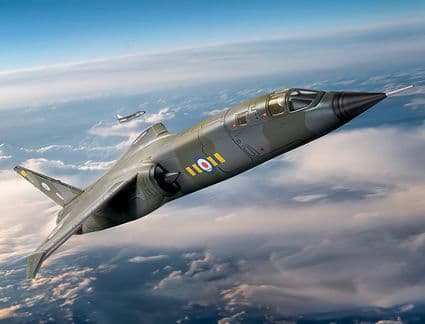
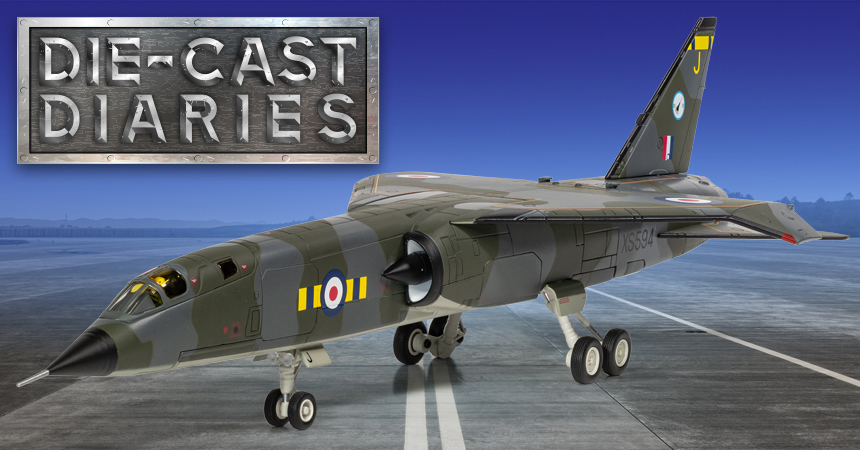
New addition to the Aviation Archive range, please say hello to our 1/72nd scale ‘What if’ BAC TSR-2 in RAF No.40 Squadron markings.
It was interesting to hear people’s thoughts on what the announcement might turn out to be, during the couple of hours we had to spare before the allotted time. As one of the themes of this year’s RIAT show, the most popular suggestion was an F-16 Fighting Falcon in 1/48th scale, closely followed by an F-35 Lightning in the same scale, but suggestions ranged far and wide, before conversations inevitably turned to more generic matters and releases people would like to see coming over the coming months.
At 10.00am, we carried the new model shrouded in a Corgi T-shirt to the crowd gathered around the display case, making one final announcement that we didn’t think anyone would be expecting this particular model. Once the TSR-2 had been revealed, it appeared to have been received really well, even though everyone confirmed that they were not expecting this. It’s been well over a decade since a TSR-2 has been in the Corgi range and obviously never available as a ‘what if’ scheme presentation. When we came in on Monday morning, only one third of the production run was still remaining and if we needed an indication on how well the model had been received, we had the answer right there – thank you to everyone who has ordered the model and for helping make this such a successful surprise announcement.
From a range inclusion perspective, releasing this model was actually quite a brave move by the Corgi team and it has been quite some time in the planning. As this is a ‘what if’ scheme, we did have quite an amount of artistic latitude available to us, however, we were determined that in conjunction with our experts, we were going to produce a thoroughly plausible model of what is possibly the most famous British aircraft to have never entered service.
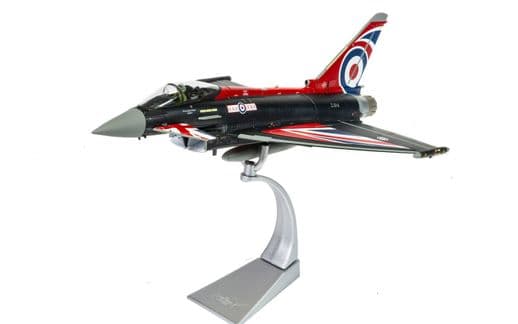
A small but perfectly formed Corgi display at RIAT 2024, with the new 1/72nd scale TSR-2 sharing the display case with the pre-production sample model of our 1/48th scale RAF Display Team Typhoon FGR.4 ‘Blackjack’.
Scouring archive material, we checked the serial numbers allocated for production TSR-2s and used one of these for our model, before moving on to study the list of squadrons identified as being earmarked to operate this technologically advanced aircraft. Not wanting to go with one of the more obvious contenders, we elected to proceed with RAF No.40 Squadron and set about producing our interpretation of what that unit’s markings would have looked like, had they been worn by a service BAC TSR-2. We think the new model looks absolutely stunning and if a real one of these magnificent aircraft had been in the display line-up at this year’s RIAT show, it would still have unquestionably been one of the highlight acts and would have still looked spectacularly futuristic, even though it would have entered service over 55 years ago.
The sight of this beautiful model does get you thinking about what the likelihood of persuading the RAF Museum at Cosford to apply a temporary camouflage scheme on their own TSR-2 …… can you imagine how spectacular that would look. Time for a crowdfunding project I think!
Before this new model disappears from the range for good, let’s take a closer look at the details behind the actual BAC TSR-2 project and how defeat was snatched from the jaws of aviation technological victory.
Throughout the history of aviation, there are some aircraft which simply demand our attention, be they the first of their kind, the most effective in what they do, or by virtue of their service achievements. Amongst this number, there is one British aircraft which managed to do this despite the fact that only a single development aircraft ever made it into the air, an aircraft which was so advanced that it held the potential of providing the Royal Air Force with an aircraft which was a genuine world-beater, the still futuristic looking BAC TSR-2. Unfortunately, due to cost overruns and a change in government, this particular story of aviation triumph ended in the most ignominious manner and the almost brutal dismantling of anything to do with the programme. Thankfully, one of these magnificent aircraft is preserved at the RAF Museum’s Cosford site and for those lucky enough to set eyes on it, they will attest to the fact that TSR-2 still looks futuristic to this day.
From the perspective of Britain’s aviation history, many commentators over the years maintain that the BAC TSR-2 project represented everything which was wrong with the British aviation industry during the 1950s and 60s, whilst at the same time illustrating how the country’s finest minds could lead the world in the technological advancement of aviation. Had the aircraft completed its development programme, it would undoubtedly have resulted in the Royal Air Force being equipped with a strike and reconnaissance jet which was significantly more capable than anything else in service at that time, a real world-beater of an aeroplane which would have been well ahead of any competition.
Right from the very beginning, it was clear that the new aircraft engineers at the British Aircraft Corporation were working on would be a significant leap forward in technological terms, with almost every aspect of its design incorporating new and ground-breaking equipment, materials and technologies. Unfortunately, the extremely advanced nature of the project, whilst undoubtedly extremely impressive, would also prove to be its Achilles heel, as the various manufacturing companies, sub-contractors and indeed government of the day, all failed to establish a coherent management structure to oversee this monumental aviation project.
Due to the advanced nature of this project, it could be argued that the development programme slowed to a pedestrian pace at times, suffering almost constant delays and numerous setbacks because of the technologies being adopted, with costs rising all the time as a consequence. In addition to this, official interference resulted in numerous frustrating requirement and design changes being regularly requested, to a point that when the prototype aircraft was nearing its first flight, this astonishing aircraft was being held back by the very bureaucracy which should have been championing it.
Our new TSR-2 model is a stunning addition to the Aviation Archive range.
Artwork file produced in support of our TSR-2 project.
Despite all the aircraft’s many challenges, all the clouds of doubt appeared to be blown away on 27th September 1964, when BAC’s chief test pilot Roland Beamont accelerated TSR.2 XR219 down the runway at Boscombe Down and into the annals of aviation history. As the world looked on in awe, it genuinely seemed as if Britain was on the verge of introducing the most capable military aeroplane the world had ever seen and for the British public, their spectacular new TSR.2 was a source of immense national pride. On that day, a bond was formed between the British public and TSR-2 which continues to endure to this day.
Ultimately, despite possessing huge potential, the incredibly ambitious nature of the TSR.2 project arguably doomed it to failure before it ever had the chance to progress beyond the development stage. With project cost overruns now spiralling at an alarming rate, the new incoming government of the day already found themselves in a period of severe financial austerity and serious questions were being asked. Despite the fact that the test programme had already highlighted how good an aircraft TSR-2 was, the new government’s first budget in April 1965 included the announcement of the immediate termination of the TSR.2 project, contrary to the many assurances given to BAC by the previous government.
Perhaps the most distressing development within this entire sorry episode was how the government directive also included orders for the immediate destruction of not only the TSR.2 airframes already at various stages of construction, but also the actual manufacturing jigs used to produce them.
Was the end of Britain’s BAC TSR.2 dream all about project overruns and future costing uncertainties, or were there more sinister international forces at play behind the scenes? Presenting the British public what appeared to be the most capable aircraft in the world, only to snatch it away in an almost vindictive manner, still gives rise to many conspiracy theories and has people scratching their heads in disbelief.
Undoubtedly, if you’ve been fortunate enough to stare admiringly at one of the two surviving (complete) airframes at either Cosford or Duxford, it’s difficult not to think the government made a huge mistake, because of all the aircraft on display around them, TSR-2 still looks to be by far the most capable. Surely, a modern Royal Air Force equipped with hundreds of these mighty aircraft would have been a force to be reckoned with, and may just have made the Cold War a little less chilly by virtue of the deterrent threat it possessed. Can you imagine seeing one of these magnificent beasts wearing full RAF Strike Command markings?
Another trio of production model images which show why the TSR-2 has attracted plenty of admirers since its announcement at RIAT last Friday.
This September will mark the 60th anniversary of the first flight of TSR-2 XR219, the only example of this magnificent aircraft to ever take to the skies and whilst she was subsequently scrapped, her sister aircraft XR220 does survive at Cosford, helping to preserve the legacy of this world-beating aircraft that never was. This aircraft does possess a fascinating history of its own and must therefore be considered as one of the most important preserved items of Britain’s rich aviation heritage.
British Aircraft Corporation TSR.2 XR220 was one of nine development aircraft ordered as part of an ambitious programme to equip the Royal Air Force with the world’s most advanced strike jet. This airframe was subsequently damaged during its road transport delivery to A&AEE Boscombe Down in early September 1964, an incident which would prove incredibly significant in its history. The repairs the airframe needed, combined with the fact that numerous components were stripped and used to support the maiden flight of the more famous XR219, resulted in XR220s own maiden flight date being delayed several times.
The aircraft would embark on a series of live engine tests in preparation for her first flight, however once again, various technical issues conspired to prevent this from taking place as planned. Finally, a maiden flight date for the aircraft was set for the afternoon of 6th April 1965, the very day the TSR-2 programme was subsequently cancelled. It has been documented that the aircraft was fuelled up and ready to go when the aircraft’s Certificate for Flight was revoked and even though some members of the team wanted to fly anyway, it was over, the TSR-2 dream had been killed.
Much of the ground-breaking technology developed in support of TSR-2 would subsequently find its way into the Jaguar and Tornado programmes which followed in the years to come, and although this is open to some debate, neither of those aircraft could claim to possess the imposing presence of their famous strike predecessor, even though they did both go on to prove their impressive service credentials.
This year will mark the 60th anniversary of the first flight of the BAC TSR-2 and as the nation will be forced to remember this high-profile story of aviation defeat snatched from the jaws of success, we won’t be able to help imagining what achievements were awaiting this aircraft had it been allowed to enter service. Still one of the most impressive exhibits on display at the RAF Museum Midlands site at Cosford, can you imagine how magnificent a sight the scrambling of a squadron of TSR-2s at RAF Coningsby would have looked like? At least we can still dream, and this stunning new Aviation Archive release will certainly help us do just that.
A model release which is destined to become the pride of many a collection in the years to come, our new ‘What if’ TSR-2 is a real beauty.
In this 60th anniversary year of the aircraft’s first flight, we have attempted to recreate such a sight in 1/72nd scale diecast, selecting a serial number allocated to a service TSR-2 aircraft and a squadron destined to operate the aircraft, initially on a trials basis, but then potentially as the RAF’s first operational TSR-2 Squadron. All this is clearly the subject of aviation speculation, however, there’s certainly no doubting how good a TSR-2 would have looked in RAF service.
The story of TSR-2 is one of triumph and tragedy for Britain’s aviation industry, a world leading aircraft which was never allowed to reach its incredible potential. An aircraft which can still be the cause of heated debate and genuine incredulity, we sincerely hope that our new model does justice to the legacy of this famous aeroplane and gives us all an indication of how magnificent it would have looked wearing the camouflage of the Royal Air Force.
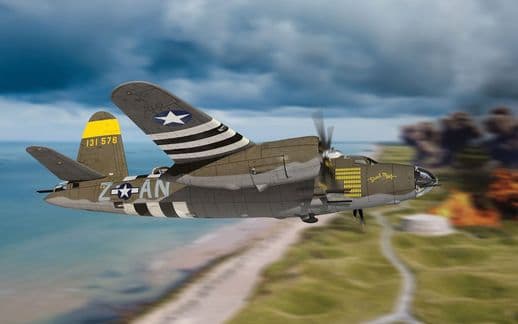
Before we end this latest update, we would just like to confirm that those people who had pre-ordered their newly tooled 1/72nd scale Martin B-26B Marauder ‘Dinah Might’ should have, or soon will be adding this fabulous new model to your collection’s, as the model is now in stock and shipping. We would like to thank you all for sticking with us on this one, as it has taken a while to negotiate its development from announcement to release, even though we think she’s been worth the wait.
The headline release in our D-Day 80th Anniversary Collection, the new Martin B-26B Marauder is available now.
That's all we have for you in this latest edition, however, please join us again in two weeks’ time for another exclusive insight into the wonderful world of Corgi model collecting. Between editions, we are always interested to hear your views on all things Corgi, so if you feel like dropping us a line to comment on anything blog, collecting or Corgi model related, or perhaps to suggest a topic you might like to see us cover in a future edition, please do get in touch at diecastdiaries@corgi.co.uk.
If you can’t wait for the next blog, you will find plenty of Corgi model collecting discussions taking place on our official social media channels, access to which can be obtained by clicking on the respective links at the foot of the Corgi website homepage.
Link access to Corgi social media sites.
Thank you for continuing to support your Die-cast Diaries blog. Our next edition is scheduled for publication on Friday 9th August.