
Welcome to the latest edition of Corgi Die-cast Diaries, your regular blog review of all the news, updates and topical stories from the captivating world of Corgi die-cast model collecting.
We have a rather unusual story from the world of Vanguards to start this latest edition of our Corgi blog, as something of a research conundrum has resulted in an impending dual model addition to the range which will definitely be a collector talking point in the years to come. With a selection of advanced production sample images of both models to illustrate this feature, we’ll be seeing how a model release which was already destined to be popular has actually turned into something of a dynamic duo.
We will be following this by taking a look at a classic addition to the Aviation Archive range, the scale mount of an ace pilot who has so far has managed to evade our research attentions. One of the Luftwaffe’s leading aces of the Second World War, Otto Kittel had an incredible 267 victories to his name, placing him as the fourth most successful air ace of all time and significantly, the highest scoring ace to himself fall in combat. We will be featuring our scale tribute to the Focke Wulf fighter he flew during his final few missions in this update, with box artwork, research details and a selection of advanced production sample imagery as part of this comprehensive update.
We will bring proceedings to a close by providing an update regarding the reception our collection of Thunderbirds models have enjoyed since release, and how the affection held for this iconic series ensures that anything related to the distinctive craft appearing in this series still commands significant hobby attention.
We’re on Corgi time again this weekend, so let’s celebrate the ever increasing minutes of daylight by shining a spotlight on our latest die-cast model developments.
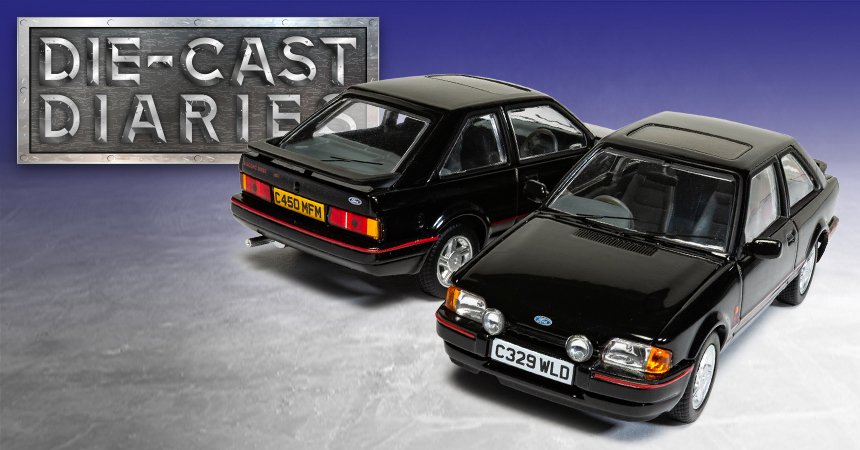
A pair of black Escort Mk4 XR3i models, what’s the story here? All will be revealed.
When it comes to the subject of discussing cars which have managed to appeal to much wider sections of the British population over the years, the reasons for that popularity are obviously open to debate, however, we can definitely find some common ground for consensus. Although cars are essentially machines which allow us to go about our daily lives more effectively, certain vehicle types have managed to break down the barriers of functionality over the years, cars which are more aspirational and created for the enjoyment of driving, as opposed to simply getting from A to B. Significantly, to achieve that wider appeal, they don’t have to be ‘Supercars’ and they certainly don’t have to cost the earth.
Cars such as these work their way into our hearts through effective styling, keen pricing and clever marketing, but once in there, tend to go on and stand the test of time. A car which had such an appeal on us when we were young can still immediately capture our attention if we see a beautifully restored example many years later, and we would probably still love to own one. That clever marketing often takes inspiration from the car’s use in motorsport, implying that if you own and drive one, you’re a little more interesting than the average motorist by association, and that being the case, who wouldn’t want to be viewed in this way, if we could afford to do so.
One company which has excelled in such practices over the years is the Ford Motor Company, with sporty versions of their family cars always occupying a lofty position within the affections of the British motorist, with some models absolutely qualifying for the title of ‘Classic’. Unfortunately, not all of us have the funds, capability or time to own and take on the restoration of one of these vehicles no matter how much we might want to, but thankfully for those people there is an answer – a Vanguards scale die-cast version of it.
Throughout the 24 year history of the Vanguards range, model releases which feature cars wearing the famous badge of the Ford Motor Company are always amongst the most popular in any model range in which they appear, often going on to become highly collectable in the months and years following release. Indeed, that popularity rarely sees a year go by without a new Ford model tooling project being undertaken by the Corgi team, and in some years, even more than that. Back in 2020 the range announced at the turn of the year included no fewer than FOUR new model tooling projects, one of which was going to be the long overdue and much requested Ford Escort Mk.4, a variant of this famous family car series which can arguably claim to be the most popular. It also happens to be the subject of this latest impending release update.
The hugely popular Ford Escort series was first unleashed on the motoring world back in January 1968 and over the course of the next 33 years, around 4.1 million vehicles in six different incarnations were produced for the British and European motoring public. On several occasions during that time period, the Escort had the distinction of being Britain’s bestselling car, a fact which is a clear indicator as to why the Escort has made such an effective transition to the scale diecast model collector market. With few, if any, accurate 1:43rd scale model representations of the Escort Mk.4 available today, it is no wonder that this latest addition to the Vanguards range has proved to be so popular!
Double Trouble – there’s an interesting collector story behind this black XR3i model release.
Of all the various models to grace the Escort range over the years, the XR3 series was the model targeted at those who wanted more from their car, a vehicle they could have pride in, and have pride being seen in by others. Beautiful cars which benefited from appealing styling and were always positioned at the front of any Ford showroom, because the salesmen knew we all wanted one, even if we couldn’t really afford one. Often described as ‘Boy Racer’ cars, or more sympathetically, ‘Hot Hatches’, these beauties appealed to boys and girls of all ages, and always sold in good numbers.
With the Mk4 XR3i tooling being a popular addition to the Vanguards range, we were looking for a suitable new subject to include in the 2025 range and dispatched our esteemed researchers to find such a vehicle. These chaps have contacts everywhere, and it didn’t take long before they approached two proud owners with details of our plans to immortalise their cars in die-cast metal, both Mk4 XR3is and both in black, and the project was off and running.
It subsequently transpired that both owners were looking forward to having their car as the next release in this series, which did create something of a problem. Should we choose one over the other, informing the second owner that his car would appear in a future range somewhere down the line, or was there a more collectable solution to this unusual Vanguards situation. With both cars having their own stories, and both owners being totally infatuated with their beloved vehicle, the answer was simple – split the run.
As the models would essentially be the same as they travelled down the manufacturing production line, it wouldn’t take too much extra work to give both of them their Vanguards debuts, whilst at the same time giving the real car owners and Vanguards collectors a lower run, highly collectable option for this latest Escort Mk4 XR3i release.
Let’s take a closer look at each model now:
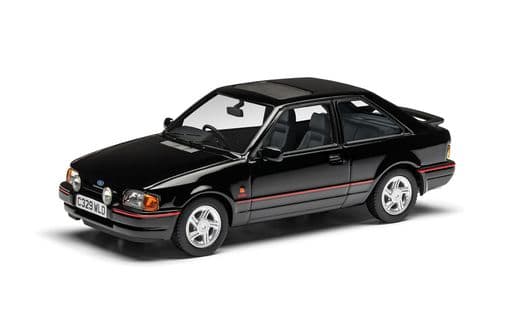
VA14307A - Ford Escort Mk4 XR3i in black – C329 WLD
The XR3i modelled here was ordered from Ford Main Dealer Perrys, High Road, Harrow Weald, Middlesex, on the 24th of April 1986 by the first owner, Malcolm Powell. He purchased it as a company car and was thus able to request nearly every option available. These included an ECU2 Radio Cassette which cost £118.72, a Tilt/Sliding Sunroof at £261.65, alloy wheels at £178.87, a Fuel Computer at £90.71 and electric front windows, which were a bargain at £163.05. The total cost, including a discount of £709.88, was £7692.65. Mr Powell had it serviced meticulously and took personal ownership a year later. He retained it until January 2013, by which time it had covered 28,561 miles.
He advertised it for sale on the XR Owners Club Forum, and it was purchased by Greater Manchester based member Dave McKee, who researched its history and discovered it was the oldest surviving Halewood-built Mk4 XR3i. Dave improved the car, cleaning up the underside and fixing an oil leak before selling it to a Coventry-based collector in 2016. He got the opportunity to buy it back in late 2020 and couldn’t resist doing so, but the current owner, Cambridgeshire-based fast Ford collector and enthusiast Mike Pollard then persuaded Dave to sell it to him in November 2021. It’s still only covered 32,134 miles and has never been painted, so Mike keeps this rare and extremely original survivor in a heated garage to preserve its condition.
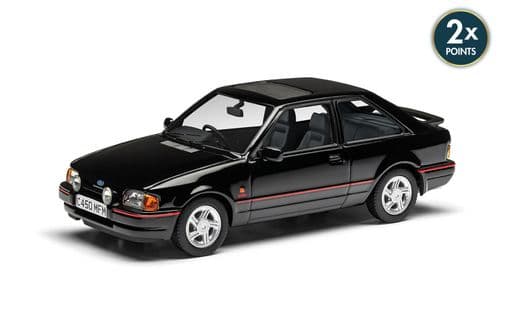
VA14307B - Ford Escort Mk4 XR3i in black – C450 MFM
The XR3i modelled was supplied by Evans Halshaw, Chester, Cheshire in May 1986 and spent its early life in that area. By 2004 it was sitting, unused, on a driveway in Chester, because the owner had passed away. Enthusiast Derrick Oare worked in a building adjacent to where it was parked and approached the owner’s widow to buy it as his son, David, was then restoring an RS1600i. When, almost two years later, she was ready to part with the car, she offered it to David for free as long as he restored it. David then started the restoration process on the drive and was amazed that it jump-started easily on six-year-old petrol.
Although covered in moss, and damp inside, David realised it was fundamentally sound and he returned it to the road after carrying out some welding, paintwork and other recommissioning work. He kept it for three years but by 2022 it was with a new owner who spent £5,000 having further restoration work carried out. The current and ninth owner, South Gloucestershire-based XR Owners Club member Andre Britton, had initially looked for a red example like the one he’d enjoyed as a company car in 1989. The excellent overall condition of this black 67,000-mile example impressed him, however, and he purchased it from classic car auctioneers Manor Park, Cheshire, in September 2023. He drove it home without any problems and continues to enjoy driving it.
The only quandary now is which one of these black beauties is going to be the one making it into our collections?
Both models are now scheduled for imminent release.
The latest release from our 1/72nd scale Focke Wulf Fw190 tooling is something very special indeed.
When talented aircraft designer Kurt Tank started work on his new fighter for the Luftwaffe, he drew on his service with the German cavalry when thinking about what he wanted his new aircraft to achieve. When later explaining his design philosophy behind the Focke Wulf Fw190 following its introduction, Tank described how he likened both the Spitfire and Messerschmitt Bf109 fighters to thoroughbred racehorses, extremely capable performers on good ground and if they had been carefully prepared in advance. For his new fighter, he wanted it to be like a cavalry horse, one which was muscular and rugged, ready to charge into action at a moment’s notice and to be able to give a good account of itself no matter what the conditions.
He went on to describe that how in his opinion, the Spitfire and Bf 109 had been designed to be the perfect flying machines, with the addition of offensive armament only being something of an afterthought, but how his new fighter was going to be very different. Not exactly a workhorse, but more of an airborne gladiator, one built for combat, and one intended to be something of a multi-role aircraft from the start, able to accept a variety of armament options.
Once the Focke Wulf was in service, it immediately showed its air combat prowess and was unquestionably the deadliest fighting aeroplane in the world at that time. As the RAF had made good some of their losses during the Battle of Britain and move on to the offensive, the latest Spitfire Mk.V was more than a match for the Luftwaffe’s Messerschmitts, but once reports of an angular new fighter started to circulate at RAF High Command, alarm bells started to ring. Initially, these sightings were dismissed as pilots having come into contact with former French Air Force Curtiss Hawk 75 fighters now operating in Luftwaffe markings, but as these reports continued to be filed, and were now accompanied by alarming loss figures, there was definitely something wrong.
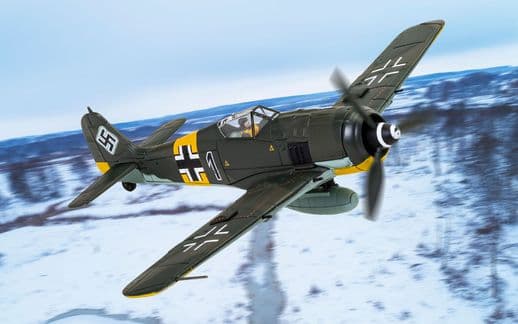
Two images showing an advanced production sample of this ‘Ace’ Focke Wulf model release.
What RAF pilots over France were experiencing was the combat introduction of the Focke Wulf Fw190 and the realisation that this new Luftwaffe fighter was significantly more capable than the current Spitfires in service, effectively providing the Germans with a significant advantage, if not total superiority of the air. The Focke Wulf would challenge design teams at both Rolls Royce and Vickers Supermarine to create an immediate stop-gap fighter which could meet the challenge of the Focke Wulf, a program which would eventually lead to the introduction of the Spitfire Mk.IX, an aircraft which itself was a thoroughbred fighting aeroplane.
Breaking with the traditional design ethos of sleek, streamlined V12 aero engine powered fighters which prevailed in the late 1930s, the Focke Wulf FW190 was rather squat and muscular, in comparison to the more cultured Messerschmitt Bf 109, however, this was a ruthless fighting aeroplane and one which could both take combat punishment and give it out. Its radial engine was a masterpiece in propulsion technology and when the prototype aircraft took to the air in 1939, it was without doubt the most advanced fighter aircraft in the world.
Still an effective fighter at low and medium altitudes until the very final days of the Second World War, the FW190 would be adapted to perform many combat roles during its wartime service, with over 20,000 aircraft eventually being produced. It would be flown by some of the world’s most successful air aces.
The son of a farmer, Otto Kittel didn’t exactly conform to what most people’s opinions of what a successful Luftwaffe fighter ace would be like, being more reserved and modest, as opposed to brash and boastful, simply going about his duties in a ruthlessly effective manner. Initially posted as wingman to a more experienced pilot, where his role was to protect his leader as he went about the business of scoring victories, Kittel didn’t have any victories to his name when assigned to take part in the opening exchanges of Operation Barbarossa with his unit JG54, but that situation would quickly change over the Eastern Front.
Already gaining a reputation as a rising star within Luftwaffe ranks, Kittel started to show his aerial combat qualities once JG54 had converted from the Messerschmitt Bf 109 to the Focke Wulf FW190 in late 1942. The pilot immediately formed a close bond with the rugged new fighter, with one of his fellow pilots commenting that he ‘rode the fighter like a comet’ and on his return to combat flying, the victories soon started to come. By mid-January 1943, Kittel’s victory tally stood at 26 and he would already have a reputation as being something of an Ilyushin Il-2 Sturmovik specialist. These Soviet ground attack aircraft could absorb lots of punishment before they were brought down and as they could also return fire against any attacking enemy fighter, some of the more successful Luftwaffe aces on the Eastern Front would avoid tangling with the dangerous Il-2s whenever possible. Kittel had no fear of the Il-2 and would ultimately become the most successful ace of the entire war against these attack aircraft, however, it would also be a Sturmovik which claimed the life of the celebrated Luftwaffe ace.
With his victory tally growing, Kittel was promoted to the position of Schwarmführer, a significant change, which would see him freed to take the lead during combat sorties, using his talents to score more victories, as opposed to protecting the flank of another pilot. With his destructive potential now unleashed, Kittel would use his trusty Focke Wulf to claim JG54’s 4,000th victory on 19th February 1943, however, he would also be in that same aircraft just a few weeks later when it was hit by enemy fire during combat, and was forced to make a crash landing 60 miles behind enemy lines. With no food and little in the way of warm clothing, Kittel stealthily made his way back to German lines by travelling mainly at night, returning to his unit to great celebration. Once back there, he learned that he had been awarded the Deutsches Kreuz in gold for scoring 47 victories, had been promoted to Oberfeldwebel and been granted a period of home leave – that was a very good day for him.
Kittel returned to combat in time to take part in the aerial support for the Battle of Kursk, where is true talents really came to the fore and during the first six days of action, he was credited with no fewer than eleven Soviet aircraft shot down, a figure which included his 20th Sturmovik victory. By 14th September 1943, the ace pilot had claimed his 100th victory, quickly followed on that same day by his 101st and 102nd, however, that was still only an indication of what was to come. Over the course of the following twelve months, Soviet aircraft continued to fall to the guns of Kittel’s Focke Wulf at an impressive rate and by 26th August 1944, the ace had his 200th victory.
Otto Kittel would eventually be credited with 267 aerial victories, with his final victory being over another Il-2 Sturmovik on 16th February 1945, on what was his 583rd combat sortie of the war. Unfortunately, moments after dispatching his latest victim, the hunter became the hunted, as another Sturmovik attacked Kittel’s FW190 from below, scoring hits on the German fighter and immediately causing it to lose altitude. As the combat was already taking place at low altitude, Kittel didn’t have a chance to react before his stricken fighter ploughed into a forest at speed, with the pilot making no attempt to jump clear. When the wreckage was located in 2013, those who discovered it noted that the pilot had released his harnesses prior to impact, suggesting that Otto Kittel had been alive immediately prior to the crash.
The unassuming and well-liked Otto Kittel was credited with 267 aerial victories, a figure which made him the fourth most successful air ace of all time, in less than four years spent flying over the Eastern Front. He was also to most successful Focke Wulf FW190 ace of the war, and with 94 victories against the excellent Il-2 Sturmovik, also had the distinction of being the most successful ‘Sturmovik Hunter’. Scoring all his victories over the Eastern Front, Kittel would also take the dubious honour of being the most successful fighter ace to be lost in combat.
Perhaps it’s the fact that the quiet and relatively unassuming Otto Kittel didn’t conform to the stereotypical profile of a poster boy Luftwaffe ace that he became arguably one of the less well-known of the leading Luftwaffe aces of the Second World War, despite the fact that he was revered by those who knew and served with him. He does, however, stand in a position of prominence as the Focke Wulf FW190 ‘Ace of Aces’.
A must-have addition to any collection of Aviation Archive models, the fact that one of the world’s most prolific aces has not yet been included in this range is something of a surprise, even though we had to wait until modifications had been made to the Focke Wulf tooling before we could consider this model. Nevertheless, the sight of these advanced production sample images confirms that this beautiful new model is now scheduled for imminent release, and should be terrorising the Allied aircraft in our display cabinets in just a matter of days.
When it comes to Corgi model releases which hold the potential for opening new collector doors and appealing to people who wouldn’t ordinarily describe themselves as die-cast model collectors, our Pop Culture range has a reputation which is second to none. It has been responsible for the release of some models which are amongst the most significant our industry has ever seen, and no matter how committed a Vanguards or Aviation Archive collector we might be, we have to concede the hobby dominance of such models.
With this year marking the 60th Anniversary of the popular Thunderbirds series, we wanted to do something really special with our existing range of models, including modifying some tooling, accessing archive material to perfect decoration, and designing eye-catching bespoke packaging specifically for the occasion. On reflection, we think we did an FAB job and are delighted to confirm that all the models in this collection are now in stock and available.
We say in stock and available advisedly, because it appears that the collector world has been equally impressed with our efforts, and equally determined to mark this significant anniversary year for Lady Penelope and the Tracy boys. If we were to say that the models have gone like hot cakes, that might be a colloquialism too far, but they’ve certainly gone like Thunderbird 1 at blast off!
With the presentation of these models having as much appeal as the models themselves, we’ve seen many an order taking all three of the model sets, creating an instant collection which will serve as a lasting tribute to the impact this popular series had on our young, impressionable minds. With more new models scheduled to join the range in the future, it seems as if the Thunderbirds phenomenon is here to stay and whether you choose to allow young hands play with these models, or keep them in pristine condition for posterity, they make a fine tribute to some of the best loved craft to have ever appeared on our TV screens.
Our entire Thunderbirds 60th Anniversary collection is currently still available, although the dastardly Hood definitely has his ghastly eyes fixed on a couple of them!
I’m afraid that's all we have for you this time around, however, we’ll be back as usual in two weeks’ time with a further exclusive selection of the latest Corgi model updates. As ever, you could always drop us a line if you felt moved to do so, to comment on anything blog, collecting or Corgi model related, or even perhaps to suggest a topic you might like to see the team cover in a future edition. As always, our diecastdiaries@corgi.co.uk address is the one to use.
If you can’t wait for the next blog, you will find plenty of Corgi model collecting discussions taking place on our official social media channels, access to which can be obtained by clicking on the respective links at the foot of the Corgi website homepage.
Link access to Corgi social media sites.
Thank you for continuing to support your Corgi Die-cast Diaries blog. Our next edition is scheduled to be published on Friday 4th April - we look forward to seeing you all back here then.