
Welcome to the latest edition of Corgi Die-cast Diaries, your regular blog review of all the news, updates and topical stories from the captivating world of Corgi die-cast model collecting.
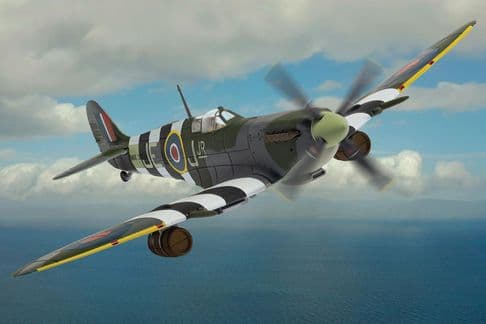
For air and ground crews sent to operate from Allied Advanced Landing Grounds in recently liberated areas of Northern France in the weeks following D-Day, the increased levels of operational activity made them long for a particular home comfort all the more - beer! With breweries working overtime to keep the troops refreshed, the move to temporary bases on the continent left many without access to their favourite tipple and with supply ships needing every available inch of space to bring men and supplies to recently liberated French ports, there was little hope of this situation improving any time soon. Determined to provide their squadron mates with refreshment, several Royal Air Force pilots decided to make an unusual modification to their Spitfire fighters, replacing bombs and external fuel tanks with beer barrels. In this latest edition of Die-cast Diaries, we will be looking at how an impending release in our Aviation Archive range will attempt to commemorate this unusual feature of the European air war and allow collectors to add one of these unusual Spitfires to their model collections.
If your collecting preference happens to be more of the four wheeled persuasion, fear not, because we also have news of a trio of new Vanguards model releases, each one falling into the popular 'Fast Ford' category and each on an eye-catching addition to this ever popular range. Now then, who's in the mood to see our latest collection of exclusive new Corgi model product imagery this weekend?
The unmistakable profile of the Spitfire was first inducted into the Aviation Archive range in 1/72nd scale back in 2000, but this latest model reflects all the very latest developments in both design and manufacturing technology.
Before we move on to the subject of our latest scale tribute to arguably the most famous fighting aeroplane to have ever taken to the skies, let's pause to take a little trip down Aviation Archive memory lane and to the very first Spitfire model we released in diecast metal. Many of our readers will no doubt have spent much of their youth cultivating their fascination for all things aviation by building Airfix model kits, learning about the schemes behind the kit's decal options and becoming totally engrossed in the subject. In most cases, life, careers and responsibility would come along and leave little time for such simple pleasures in the years which followed, however, our interest was always there lying dormant, just waiting for an opportunity to rise to the surface once more.
Although later life may still have left many enthusiasts without the time to take up modelling again to the same intensity as we did during our youth, the release of a new collection of Corgi diecast aircraft in 1998 would have certainly attracted our attention, but as these first models were all in 1/144th scale and predominantly tended to cover civilian aviation subjects, many of us probably didn't take things further at that time. The announcement of a new range of classic 1/72nd scale WWII fighter aircraft in 2000 was a different matter altogether, as things had now just become serios. A series of adverts in several enthusiast magazines undoubtedly found their target audience and had us all planning a trip to our local model shop to see the new models for ourselves, but even though we will have no doubt thought the models looked great in print, how would they hold up in the metal?
In a calculated move, this initial salvo of new tooling releases was made up of a Spitfire, Hurricane and Messerschmitt Bf109E, a Battle of Britain trio released to mark that year's 60th anniversary commemorations of the conflict, just the thing to have us all rushing out to see what all the diecast fuss was about. Once we had the models in hand, we have to admit that they had us hooked and all that latest aviation collecting passion came flooding back once more. These beautiful little models were great scale representations of these famous aircraft, fully painted, attractively presented and with that oh so appealing weight of diecast metal. All we had to do was buy them and enjoy them, no gluing or painting to be done before they went on display - Corgi had a real winner on their hands.
This first release from our new 1/72nd scale Supermarine Spitfire Mk.IX tooling is a thing of beauty and in this scheme, will present collectors with something very different to add to their display cabinets.
Since that time, Corgi and the Supermarine Spitfire have enjoyed extremely close ties and over the years, many different variants of the aircraft have been committed to diecast and flown into our display cabinets. That first tooling representation of the Spitfire in 1/72nd scale actually had quite a challenging design brief to meet, with the design required to allow several versions of the Spitfire to be produced from the same tooling, from the early Mk.I right through to the definitive Merlin powered Mk.IX. Rolls Royce Griffon engine powered Spitfires arrived in the range from 2009 and the following year, Corgi designers returned to earlier marks of Spitfire to produce an updated new tooling project, one which could incorporate all the very latest design and manufacturing advancements the industry had to offer, a tooling which is still very much in use to this day.
Indeed, this process of revisiting existing model toolings to produce more detailed and more accurate versions of the model is how we arrived at our decision to design a completely new tooling of our Mark IX variant of the Spitfire, a variant of the aircraft which was regarded as the most effective of the wartime Spitfires and one which served from its introduction during the summer or 1942, right through until the end of the war. We wanted our representation of this important Spitfire variant to benefit from all the very latest technologies our designers and the diecast manufacturing industry had to offer and where possible, to include some new features.
With his status within the Royal Air Force, celebrated ace Wing Commander James Edgar 'Johnnie' Johnson was able to fly back to the UK to collect some refreshment for his squadron mates, once his unit moved to advanced landing grounds in Normandy.
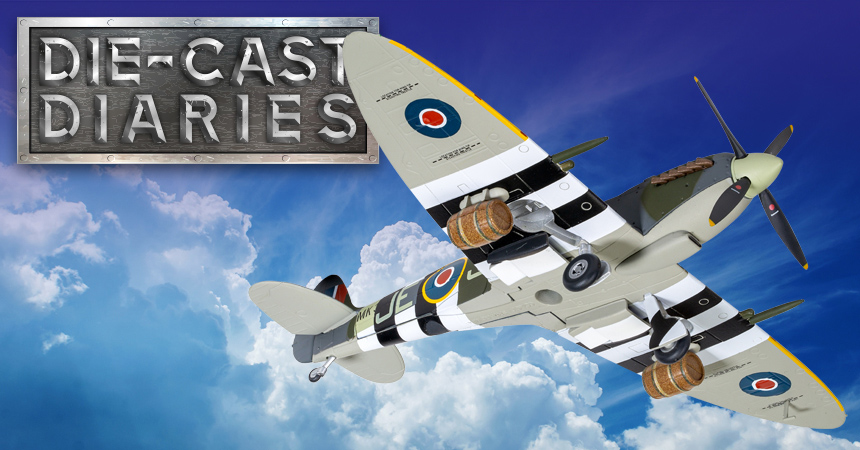
The first release from our new 1/72nd scale Supermarine Spitfire Mk.IX tooling is something just that little bit different, an aircraft which whilst displaying the unmistakable lines of this classic variant of Spitfire was one which its famous ace pilot didn't actually fly in combat. As you can see from the exclusive selection of advanced production sample images we are featuring in this latest blog, this Spitfire has a pair of unusual appendages attached to its bomb/external fuel tank pylon, items more usually transported by dray horses and not the RAF's premier fighting aeroplane of the day.
The arrival of the Luftwaffe’s impressive new Focke Wulf 190 fighter over the Western Front in August 1941 saw RAF Spitfire Mk.Vs operating over the Channel falling victim to the ‘Butcher Bird’ in ever increasing numbers - something had to be done and fast. A major Spitfire upgrade project was in progress at the time, however, the Mk.VIII was still some way off, as manufacturing factories had to prepare their tooling jigs to produce the new aircraft, but there did appear to be a temporary solution. One of the major features of the new Spitfire would be its use of a powerful new version of the Rolls Royce Merlin engine and it was proposed that fitting this new engine to a Spitfire Mk.V airframe would give the fighter a welcome boost in performance.
Referred to as the Supermarine Spitfire Mk.IX, the first 100 of these new fighters were actually Spitfire Mk.Vc airframes adapted to take the new Merlin 61 two stage, two speed supercharged engine, with this combination producing a thoroughbred fighting aeroplane, one which was more than capable of challenging the FW190 and the latest ‘F’ variant of the Messerschmitt Bf 109. In fact, the new Spitfire was considered so successful that this would become the second most heavily produced variant in the entire production run and if including the aircraft powered by the licence built US Packard Merlin 266 (Spitfire Mk.XVI) even eclipsed the Mk.V in production numbers. With further powerplant refinement taking place throughout the production life of this particular variant, the first Mk.IX Spitfires began joining RAF Squadrons from July 1942, with this famous mark of Spitfire going on to see service past D-Day and even on into the post war era. The last major Merlin engine powered variant of the Spitfire, this ‘emergency stop-gap fighter’ would actually go on to be considered something of an aviation classic.
Two further pictures of the advanced production sample model of the new Johnson 'Beer Bomber' Spitfire, a beautiful impending addition to the Aviation Archive range.
Wearing full D-Day identification markings, Spitfire MK329 JE-J 'Junior' was the personal mount of RAF ace pilot James Edgar 'Johnnie' Johnson, one of the RAF's top scoring fighter aces of WWII and one who's impressive tally of 34 confirmed aerial victories was scored exclusively against Luftwaffe single engined fighters. Flying extensively in support of the D-Day landings, Johnson and the squadrons under his command would be employed in aggressively clearing the skies of northern France of Luftwaffe fighter opposition, something they proved rather effective at doing. In fact, by D-Day, Johnson was one of the most successful Allied air aces still flying operationally, with his victories showing no sign of abating.
Following the successful Allied invasion of Normandy on 6th June 1944, Wing Commander 'Johnnie' Johnson and the three squadrons which made up his No.144 (RCAF) Wing were amongst the first Allied fighter units to be sent to operate from temporary forward bases in France. Equipped with their trusty and battle hardened Spitfires, it seems as if not all of their fighters were used to keep the Luftwaffe in check, particularly the one Johnson flew and referred to as 'Junior'. It appears that Spitfire Mk.IX MK329 was something of a hybrid machine, not the one he flew in combat, but more of a hack airframe. It is thought that once his unit had been sent to operate in France, Johnson used this Spitfire to fly back to the UK on unofficial 'Beer Runs', returning to their temporary French home with two beer kegs attached under the wings of his aircraft. This practice was frowned upon by the RAF top brass, so some units came up with ingenious ways around restrictions, using washed out standard external fuel tanks as their makeshift beer carriers, but no matter how well they were cleaned, the beer always had an aftertaste of fuel. As Wing Commander Johnson was highly regarded by both his men and his superiors, a blind eye may have been turned on his unofficial Spitfire sorties and the refreshing cargo they carried.
Not the Spitfire Johnson used in combat, his JEJ 'Junior' had a much more important sortie to undertake.
There are few details regarding the actual production and service career of Spitfire Mk.IX MK329 in existence, which Johnson described in his memoirs as being a collection of components from various different Spitfires, something of a mix and match airframe. This is borne out by the fact that its serial MK329 is very similar to that of his usual and favoured combat mount around that time, Spitfire MK392, an aircraft in which he scored several victories - is this the reason why he referred to this aircraft as 'Junior'? Whatever the details, this beautiful Spitfire and its unusual underslung load certainly makes for a fascinating wartime story.
This beautiful Spitfire model is not only our diecast tribute to this famous and incredibly successful stop-gap variant of Britain's wartime fighter, but also to the story of the few aircraft involved in those fascinating cross channel beer runs, special missions to give squadrons based at temporary forward airfields in Normandy a little refreshing taste of home.
This first release from our new 1/72nd scale Spitfire Mk.IX tooling is being shown here at the advanced production sample stage and is scheduled to be in our warehouse and available for dispatch in March - we will bring you a definitive release update in the next edition of our blog.
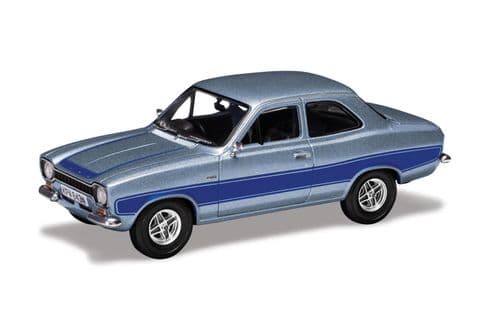
Talk about a classic motoring shape, the Ford Escort Mk.I has definitely stood the test of time and in RS2000 guise is most definitely still a hear turner.
The heading above seems to be rather spurious when used in connection with a range of affordable family cars which were first unleashed on the British public back in 1968, however, the styling gurus at Fords at that time must have been on their game, because their Ford Escort Mk.I really was a little beauty. To this day, if you catch a glimpse of that distinctive front grille and wide set headlights, you will probably find yourself stopping and staring as for many motoring enthusiasts, this is most definitely a classic release.
And then there was the RS2000, a stunner of a car which played on the adage that if a car wins on Sunday, it will be selling on Monday. With style and motorsport pedigree by the bucket load, although these beauties were out of reach for most people, it didn't stop you dreaming about owning one. In the world of popular motorsport, the Ford Escort became the car to beat, a proud position it would maintain right up until the start of the 1980s. By November 1970, Ford had opened a dedicated factory, their Advanced Vehicle Operations (AVO) facility in Essex, dedicated to the production the RS Escorts. In 1973 they launched the most refined and the bestselling MK1 Escort RS, the RS2000, a classic vehicle of which 5,334 would eventually be produced.
VA09530 - Ford Escort Mk.I RS2000 in Stardust Silver.
Most Escort Mk1 RS2000s were produced at Ford’s Advanced Vehicle Operations plant in the UK but some were also built at Saarlouis, Germany, for the European market. The example modelled here is one such car and was ordered from Ford dealers Hans Kohlhoff, Mannheim, Ludwigshafen, Germany by Hans-Werner Winkler in early 1974. He specified various Group 1 motor sport tuning additions, including a rear-mounted roll cage, and used the car for road rallies. During an event in the early eighties the gearbox failed and locked solid so the propshaft was removed to allow the car to roll freely and it was towed to a local farmer’s barn where, amazingly, it would remain until 2015.
The original owner offered it for sale in July 2015 and, on seeing this remarkably original and corrosion free car advertised on the internet, Nottinghamshire-based Ford Escort specialists Montescort snapped it up and collected it from Germany within days. Midlands-based Escort enthusiast Phil Dunbar bought the car and commissioned Montescort to carry out a detailed restoration. Although the car was fitted with new front wings and resprayed in its original colour scheme, the strip-down and subsequent rebuild confirmed how well it had survived in storage. This immaculate, finished car was exhibited at the NEC classic car show in November 2019 and shortly afterwards Phil part exchanged it for an older fast Ford with William Gibson of Ford specialist EFD Restos.
This beautiful new model is now due for imminent release, so should be in our collections over the next couple of weeks.
For many popular motoring enthusiasts, the Ford Escort RS Cosworth has a reputation as being the 'Ultimate Escort' and we are about to welcome two scale examples into Vanguards model range.
As we have seen many times before when reviewing various new Vanguards model releases within the Die-cast Diaries blog, over the years, the Ford company became expert in aligning their popular family cars with success in motorsport. As their racing cars regularly appeared on weekend television in the UK and there always seemed to be at least one Ford car at the head of the racing field, the popular inference was that if you owned a Ford, you were most definitely at the head of the motoring pack. If you were ever fortunate enough to own a performance Ford, the ultimate vehicles in this exclusive series most definitely sported the iconic Cosworth name.
The decision to induct the Ford Escort Mk.5 (Escort RS Cosworth) into the Vanguards model range will not have come as too much of a surprise to most collectors, as we already have Escort models from Mark 1 through to mark 4 within the range and all have gone on to prove incredibly popular. Significantly from a development perspective, the cars on which these models take their inspiration will have touched the lives of many millions of people during the long production life of the Escort range and if you didn’t actually own one yourself, you probably had a family member or friend who did, or at least had an aspiration to do so at one time or another.
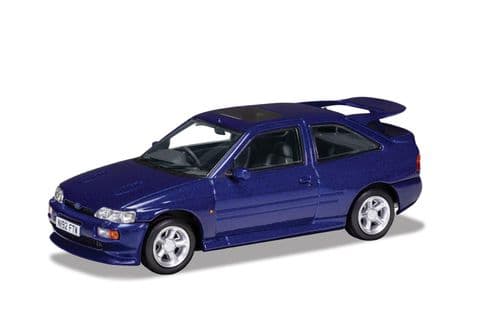
Our photographer Michael has let his creative juices flow after getting his hands on this advanced production sample model of our new Luxury Imperial Blue coloured Escort RS Cosworth and doesn't it stunning!
Ford unleashed their latest range facelift on this ultra-successful series of cars in 1990 and as the first family orientated Escort Mk5 models started to appear in showrooms all over the country, performance car lovers knew there was more to come. Initially, the trade reception for the new model was somewhat indifferent, however, the strong market position the Escort held, coupled with almost constant development assured its long-term success. The company would go on to proudly unveil their purposeful looking Escort RS Cosworth model, a performance car which drew significant inspiration from Ford’s successful rallying credentials and this really was a brute of a car. In addition to its stunning good looks, this performance beast was powered by a turbocharged 2.0L Cosworth 16-valve engine and was capable of attaining speeds of around 150mph, making this the most powerful Escort ever produced and in the eyes of many admirers, claimed the crown as the ‘Ultimate Escort’.
A truly striking vehicle, the Vanguards range is about to benefit from not one, but two beautiful new Ford Escort RS Cosworth releases and as both are due to arrive in the next week or so, we had better take a closer look at each release right now.
VA14802 - Ford Escort RS Cosworth in Luxury Imperial Blue.
The Escort RS Cosworth modelled here was retained by Ford for press and PR duties and once no longer a current car became part of Ford’s extensive heritage fleet. It has appeared in numerous magazine and website features celebrating the Escort Cosworth, starred on the Grand Avenue of the indoor London Classic Car Show and appeared as a studio prop on the Top Gear programme. The Luxury specification featured Recaro seats (leather was optional), a sunroof, electric windows and a heated windscreen. The equipment added 45 kilograms to the car’s weight but transformed the Cosworth into a genuine pocket-sized luxury express that was also usable as an everyday car.
A first sight of the advanced production sample model of this Escort RS Cosworth model, a striking addition to the Vanguards range.
The Escort RS Cosworth was specifically designed to win rallies and sprinkle some motor sport glamour on Ford’s entire range of cars, which it did very successfully, claiming ten World Rally Championship victories in the hands of stars such as Carlos Sainz and François Delecour. It was developed in-house at Ford, but the company contracted well-known coachbuilders Karmann of Osnabrück, Germany, to production engineer and then actually make the car. After almost a year-long pilot build and development programme, production of the Escort RS Cosworth began in earnest on April 27th, 1992, using a facility that had previously built another specialised Ford product, the Merkur XR4Ti. The last of the 7145 Escort RS Cosworths built came off the line on January 12th, 1996.
VA14803 - Ford Escort RS Cosworth Monte Carlo in Jewel Violet.
The Monte Carlo edition Escort RS Cosworth was created to celebrate François Delecour and Daniel Grataloup’s 1994 Monte Carlo Rally victory. Only 200 were built and of those 73 were UK-market right-hand-drive examples; all carried an individual number on a dashboard-mounted plaque. Although the Monte Carlo was mechanically standard, it featured OZ Racing alloy wheels similar in style to those fitted on the winning rally car and unique external badging. The cabin boasted Recaro seats with the centres trimmed in Raven Flow cloth and the single word ‘Motorsport’ embroidered on one thigh support of every seat, plus a Recaro emblem stitched into the rear of the backrest beneath the head restraint.
Same car, different colour, it's double trouble for Escort RS Cosworth fans with the next round of Vanguards releases.
The Monte Carlo was only available in Jewel Violet, Mallard Green or Ash Black and was built by Karmann alongside regular Cosworths between February and July 1994. The example modelled here, number 183, is one of 24 in Jewel Violet and was purchased by its first owner, Mrs Pia Richmond, on September 30th, 1994, from Hendy Ford, Southampton. Since 2008 it’s been owned by Cambridgeshire-based enthusiast Jay Fuller who initially saw it at Santa Pod’s Ford Show but was too late to buy it. The buyer changed his mind a month later however, leading to Jay and partner Rachel undertaking a chaotic 24-hour trip to Southern Ireland to buy it and drive it back. It remains in excellent original condition, having covered only 39,000 miles.
This trio of new Vanguards releases really are an enigmatic grouping and if fast Fords and motoring style are your thing, it has to be said that you might find one or all three of these models simply irresistible. If any are of interest to you, you won't have to wait long to get your hands on one, as we are expecting all three to be in our warehouse and shipping within the next week or so.
Prepare for the imminent arrival of three classic Vanguards, Two Escort RS Cosworths and a Mk.I RS2000, each one a real looker!
That's the first edition of Corgi Die-cast Diaries for 2023 done and dusted, sorry for going on a bit. We will be back with more updates in two weeks' time, when we will have a further selection of all the latest Corgi model developments, project updates and exclusive image reveals for your inspection. Between editions, we are always interested to hear your views on all things Corgi, so if you feel like dropping us a line to comment on anything blog or Corgi model related, or indeed to suggest a topic you would like us to include in a future edition, please feel free to do so at diecastdiaries@corgi.co.uk.
If you can’t wait for the next blog, you will find plenty of Corgi model collecting discussions taking place on our official social media channels, access to which can be obtained by clicking on the respective links at the foot of the Corgi website homepage.
Link access to Corgi social media sites.
Thank you for continuing to support our Die-cast Diaries blog. Our next edition is scheduled for publication on Friday 10th February.