

Welcome to the latest edition of Corgi Die-cast Diaries, your regular blog review of all the news, updates and topical stories from the captivating world of Corgi die-cast model collecting.
Although we have a slightly shorter edition of our Corgi model project update blog this time, we can still promise readers our usual selection of exclusive images and the certain knowledge that you will be hearing about the latest Corgi model developments before anyone else does. For this latest edition, we begin by venturing into the incredibly popular world of our Aviation Archive model range and the latest update from a model tooling which will be taking its place in the range for the first time in almost ten years. Occupying a significant position in the history of British aviation, we will be looking at the latest advanced production sample model of our scale tribute to the majestic Short Stirling bomber, a model tooling which really is one of the jewels in the Aviation Archive crown.
We will be following this up with news of an impending addition to our ever popular James Bond range and a stylish British supercar which has a rather surprising trick up its sleeve - as we are talking about one of Bond’s vehicles, it would have, wouldn’t it! Again showcasing the very latest exclusive advanced production imagery from this hugely collectable release, we will be marking the die-cast cards of Bond fans everywhere, by confirming the impending release of this appealing new model. We will be ending this latest update by confirming the live date of the next Corgi model range for 2022 and when you will be able to catch your first glimpse of our latest collection of beautiful die-cast models.
Let’s begin though by looking at the welcome return of a 1/72nd scale Stirling bomber to the Aviation Archive range.
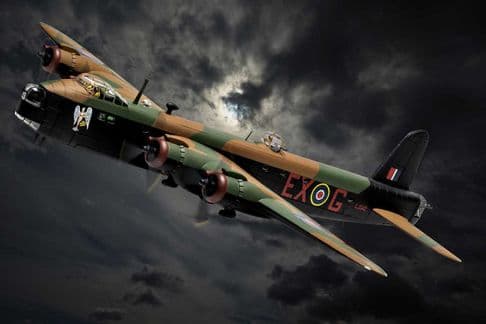
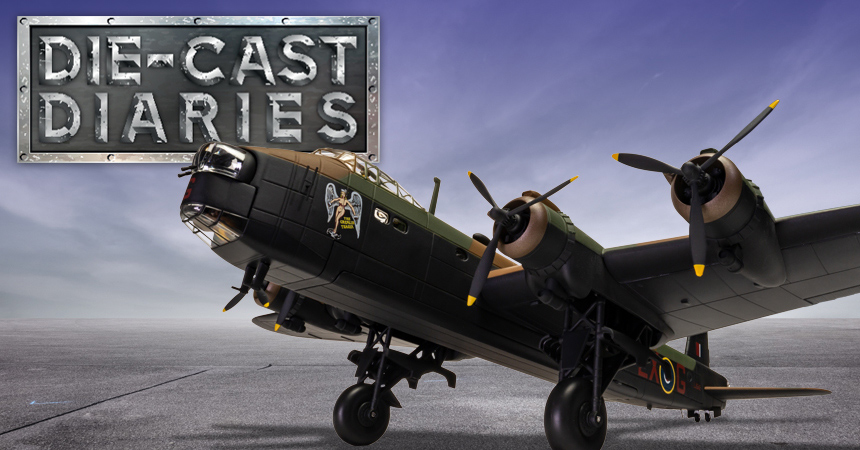
An advanced production sample model of our new Short Stirling release, only the fourth model released from this tooling and the first in ten years!
For anyone with even the slightest interest in the history of powered flight, the story of aviation is one which is littered with significant aircraft types and whether they are the first of their kind, were capable of flying faster than any of their predecessors went on to make a telling contribution in times of conflict, we can usually find something significant in the history of most aircraft which fuels our interest. Since its arrival in 1998, the Corgi Aviation Archive range has been presenting some of the world’s most iconic aircraft as scale die-cast models, beautifully finished and highly collectable and for many people, quickly becoming the most significant range within the Corgi model portfolio. With 1/72nd scale widely regarded as the most popular scale for model collectors both plastic and die-cast, the arrival of the first Aviation Archive models in this scale proved to be a significant moment for the range, providing collectors with something very special indeed and the unlimited potential for future subject inclusion.
For many Aviation Archive collectors, perhaps the most important development in our infatuation with these spectacular models occurred in 2001, with the release of the first Avro Lancaster in 1/72nd scale. Beautifully tooled and possessing that oh so appealing weight of die-cast, the Lancaster truly was a revelation and from that point on, this magnificent range of models has never looked back, with collectors desperate to add the latest releases to their collections and suggest new model toolings they would like to see joining the range. The popularity of WWII subject matter has always been an enduring feature of the Aviation Archive range and over the past twenty years or so, there have been certain aviation subject matter which collectors regard as being in Corgi territory and meeting that criteria head on was our scale representation of the Short Stirling, a model which was first unleashed back in 2010. A hugely popular addition to the range, it is rather surprising to learn that there have only been three releases from this magnificent tooling to this point, with the previous model appearing in a range exactly ten years ago, so with this in mind, we are delighted to be bringing you news of an impending fourth release in our Short Stirling line up.
Within the annals of British aviation history, the Short Stirling occupies a hugely prominent position, the first four engined heavy bomber to enter Royal Air Force service and the aircraft with which Britain would strike back at an enemy which until that time, had been mercilessly pounding the nation. It has been said that one of the most significant reasons why the Luftwaffe failed to secure victory for the Germans during the Second World War was their lack of an effective heavy bomber and when looking at the imposing appearance of the mighty Short Stirling, it is difficult to argue with this thinking. With its nose rising imperiously into the air and three separate bomb bays running down 2/3rds the length of its impressive fuselage, if air power was ever going to win a war, surely this would be the aircraft to achieve it.
Unfortunately for the Stirling, its position as a heavy bomber pioneer was undermined by pre-war thinking and the requirement to design the aircraft around existing airfield infrastructure parameters, something which would limit both its performance and potential, ultimately consigning this impressive aircraft to the position of the least effective of Britain’s wartime heavy bombers. Required to carry a significant bomb load over long distances, the Air Ministry also required the new bomber should be able to operate from smaller existing pre-war airfields, employing catapult assisted take off for heavier bomb loads. For more modest loads, the aircraft must have good short-field performance and significantly, must be able to fit inside a standard RAF hangar of the day, something which would limit the bomber’s wingspan and hamper its operational effectiveness.
More exclusive Stirling model images featuring the advanced production sample of this impressive new model.
Designers at Short Brothers asked the Air Ministry on several occasions if they could proceed with a design featuring a wing which had a span of 112 feet, but on each occasion, they were told to conform to the required specifications. This additional span would certainly have improved the operational effectiveness of the aircraft, however, it is only a matter of opinion as to whether this would have moved the Stirling closer to matching the performance of either the Halifax or Lancaster bombers which followed it into service.
The initial completed fuselage design was a gargantuan 87 feet long, but even though this was ready by 1937, the first flight of a full size Stirling would still be many months away. The first Stirling to actually take to the air was a half-scale prototype, an important stage in the development of this impressive new aircraft, but one which highlighted a number of problems with the design. Even at this stage, it was apparent that the bomber would struggle to get airborne in the required distance when carrying even a modest bomb load and as the lengthening of many runways was not a viable option, a design solution had to be found. That solution was to redesign the main undercarriage legs, making them even longer and therefore increasing the aircraft’s lift during the critical early phase of flight. This would give the Stirling its characteristic nose high appearance, but with this massive undercarriage also proving to be a constant headache during the development of the bomber.
Due to the advanced nature of the Stirling’s design and with the aircraft having to conform to strict official criteria, Britain’s first four engined heavy bomber to enter squadron service would not undertake its first combat mission until February 1941 and only one month before the Handley Page Halifax also entered the fray.
As we reported earlier, despite the fact that the Short Stirling was seen as the perfect new tooling addition to the Aviation Archive range when the first model appeared in late 2010, we have only seen three previous releases from this impressive tooling, with the previous model forming part of the 2012 range. After a release hiatus which has lasted for far too long, we are delighted to be welcoming just the fourth release from our Stirling tooling, or will be in the very near future. The pictures we are exclusively showing here feature an advanced production example of ‘The Gremlin Teaser’ and doesn’t she look magnificent! Let’s take a closer look at the catalogue and website description produced to support this latest release.
Occupying a significant position in British aviation history, the impressive Short Stirling was the first four engined heavy bomber to enter service with the Royal Air Force, providing them with a mighty weapon with which to intensify their bombing campaign against targets in Europe. With its unusually long undercarriage, the lofty Stirling had a majestic appearance whilst on the ground, being prepared for its latest mission, however, its relatively short wing span dictated that this massive aeroplane would perform relatively poorly at higher altitudes and would be superseded in the bombing role by both the Halifax and Lancaster which followed it into service. The aircraft did, however, go on to serve as a capable glider tug and paratrooper carrier, as these operations were flown at significantly lower altitudes and the powerful Stirling was easily capable of towing one Hamilcar, two Horsas, or up to five Hotspur gliders during ferry and training sorties.
Specially modified Stirling Mk.IV glider tugs were used extensively in support of Operation Overlord on the night of 5/6th June 1944, delivering airborne troops to strategically selected targets, which included vital bridges and road intersections, slightly in advance and in support of the main seaborne invasion force. Britain’s first heavy bomber to enter squadron service proved to be at the forefront of airborne operations as the Allies launched their long anticipated offensive against Fortress Europe.
It is difficult to imagine a more imposing aircraft to be found residing on an RAF bomber airfield at the start of 1941 than the newly introduced Short Stirling, a massive four engined heavy bomber and an aircraft which would spearhead Bomber Command’s night operations against German targets in occupied Europe. With its nose rising imperiously into the air, the impressive stature of this aircraft was a result of the massive, lengthened undercarriage the aircraft employed, a design modification needed to give the Stirling a greater angle of attack during take-off, thus reducing the overall length of its take-off run. With a huge bomb bay which allowed the Stirling to carry three times as many bombs as the Vickers Wellington and almost nine times the weight carried by a Bristol Blenheim, this monstrous aeroplane presented the RAF with a significant weapon with which to take the war to the enemy, whilst at the same time pointing the way to the future of night bombing operations.
Stirling Mk.III LJ542 was unusual in that it sported rather elaborate nose artwork, a feature which was nothing like as prevalent on British aircraft during WWII, but was in this case particularly impressive. Named ‘The Gremlin Teaser’, the artwork featured a pin-up girl wearing what appear to be strap-on angel wings, with the inference being that that this angelic figure was flying in defiance of evil in this age old wartime struggle of good against evil. Perhaps the crew felt like this was something they were doing every time they left their home base and headed for occupied Europe with a full load of bombs. Short Stirling ‘The Gremlin Teaser’ would end up a veteran of 60 operational sorties and during her time with No.199 Squadron, was involved in undertaking vital electronic countermeasures missions, particularly around the time of D-Day, confusing enemy defences in advance of the Allied invasion.
A stunning impending addition to the Aviation Archive range, this latest Short Stirling is currently inbound and whilst the current model import situation is a little fluid to say the least, we are hoping to be welcoming this model into our warehouse towards the end of next month. We had better start rearranging our displays to make space for this beautiful new RAF bomber.
Do you know of any other supercar that can boast underwater capabilities?
Throughout the entire history of the Corgi die-cast model brand, our association with the vehicles used by Britain’s most famous secret service agent has been an outrageously successful one and is one which endures to this day. With each successive Bond movie release, new vehicle models reveal themselves for immortalisation as scale die-cast models, whilst at the same time renewing collector interest in the other models we have previously produced to commemorate Bond’s many adventures over the past sixty years. Continuing this successful Bond vehicle formula the selection of exclusive images we are showing here feature the latest new model to join this historic series, the latest and most accurately presented model of arguably the most outrageously equipped car ever used by Bond during one of this many adventures.
Appearing in the 1977 movie ‘The Spy Who Loved Me’, Bond (Roger Moore) took delivery of this striking Lotus Esprit on the Island of Sardinia, personally delivered to him by Q himself (Desmond Llewelyn) and as usual, presented with the caveat to return it in one piece (well, there might always be an unexpected first time). It wasn’t long before Bond and his Lotus were attracting the attentions of a trio of separate baddies, starting with a motorcycle and explosive sidecar, to be followed by a Ford Taunus crammed full of gun toting villains and finally, a machine-gun firing helicopter. With escape routes fast running out, the car headed down a jetty, before plunging into the sea at high speed, almost immediately, and most unexpectedly, beginning its conversion into a fully functioning submarine, complete with periscope and upward firing rockets.
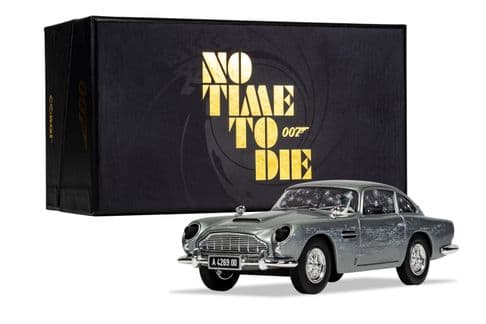
A stunning new collectors model for Bond fans this beautifully produced new model is the most accurately presented representation of this famous movie car we have ever made and will benefit from this attractive premium collectors packaging.
Having dispatched all his pursuers, Bond and his passenger (Barbara Bach playing Russian agent Anya Amasova) enjoyed a pleasant undersea sightseeing tour for all of about twenty seconds, before the bad guys turned up once more, almost as if they were expecting this supercar to possess underwater capabilities. As you would expect, Bond and his Lotus submarine easily dealt with his underwater adversaries, which led to one of the most iconic scenes of the film, the Lotus emerging unscathed from the water, driving up an idyllic beach crowded with holidaymakers, having already returned back to supercar configuration. Looking absolutely resplendent in its striking white paint finish, this Lotus may not enjoy the iconic status of Bond’s Aston Martin DB5, but could that film classic double as a submarine - we think not!
This latest collectable release of this popular model has been described by the development team as the most accurately presented representation of this classic model and will be released in this hugely popular premium collectors pack. A model which will be of interest to any self-respecting Bond fan, this appealing new model is now inbound and should be available by the end of next month, just in time for holiday season and all those snorkelling trips we have planned. Although clearly a little tongue in cheek statement, this is currently the only submarine model currently in the Corgi range, which must make it just that little bit special for us collectors.
Yet another DCD exclusive, a first look at the front of the soon to be announced May - August Corgi model range.
We end this latest edition of our blog by bringing our readers advanced notification of the release of our new model range, the second of this current year. With a host of new models to tempt collectors with, the 2022 May to August range will be revealed on the Corgi website at 10am on Monday 9th May and as was the case with the current range, a pdf catalogue will also be available for download from that point. As an additional perk of ordering from the Corgi website, each new order delivered following the announcement will also receive a printed version of the catalogue, for all those people who like to collect each new edition.
With new models to come across many of our ranges, we hope the new May to August range will include at least a couple of new models which will be of interest to you.
We apologise for the slightly shorter edition of our blog this time, but we will be back with more Corgi model exclusives in two weeks’ time and we would be delighted if you could join us then.
In the meantime, we are always interested to hear your Corgi related views, so if you would like to drop us a line to comment on anything blog related or to suggest a topic you would like to see covered in a future edition of the blog, could we ask if you would use our diecastdiaries@corgi.co.uk email for all correspondence.
If you can’t wait for the next blog, you will find plenty of Corgi model collecting discussions taking place on our official social media channels, access to which can be obtained by clicking on the respective links at the foot of the Corgi website homepage.
Please use these links to access our Facebook, YouTube, Twitter and Instagram social media sites.
Thank you for continuing to support our Die-cast Diaries blog.
Our next edition is scheduled for publication on Friday 6th May.