
Welcome to the latest edition of Corgi Die-cast Diaries, your regular blog review of all the news, updates and topical stories from the captivating world of Corgi die-cast model collecting.
You’re really in for something rather special in this latest edition of the Corgi blog, as we have an exclusive update from our project to immortalise arguably the greatest fictional submarine ever conceived as a collectable die-cast model. Our lead feature this time around is Thunderbird 4, and with a host of exclusive imagery to bring you which will warm the cockles of any International Rescue devotee’s heart, this is intended to serve as a comprehensive introduction to this exciting future addition to the Corgi range.
We will be following this by heading back to dry land and ‘eyes on’ a pair of Vanguards production sample models which place us all on alert that both of these characterful Fords are just about to arrive in our warehouse – it’s time to start those engines.
From the world of Aviation Archive, we have confirmation that Otto Kittel’s Focke-Wulf Fw190A-8 has just started shipping from our warehouse, and we have a reader inspired feature from a collector in Australia, someone who has added several unusual Corgi Dakota models to his impressive collection.
We have lots to tell you about in this latest edition, so let’s go for launch!
A CAD rendered image of the new Thunderbird 4 model tooling. Do you think this was the most interesting of all the fascinating Thunderbird craft?
For anyone who has ever felt the excitement of watching International Rescue and their iconic craft coming to the assistance of a world in peril, it will have not escaped your attention that this year marks a significant anniversary for Thunderbirds, as it’s 60 years since this supermarionation sensation hit Britain’s TV screen, and became required viewing for vast numbers of the nation’s youth. With minds like little sponges back then, and a thirst for excitement, Thunderbirds was a truly captivating television experience for those who remember the early days, and I can still remember how destressing it was when the latest episode finished. Woe betide anyone daring to speak as an episode was about to start, that simply wasn’t on ….. they would be castigated as ‘The Hood’ incarnate!
Something of a tv adventure and cultural phenomenon, as mentioned previously, Thunderbirds took over Britain’s telly’s sixty years ago this year, and went on to become required viewing for young impressionable minds back then, particularly as all the various craft, along with the various characters introduced, were just about the most exciting things we had ever seen. Looking at the original series with contemporary eyes, the characters themselves will definitely appear a little wooden and unconvincing to audiences today (have you watched Eastenders), but the Thunderbirds craft and their exciting adventures more than made up for that, and it’s unquestionably part of their charm.
This futuristic science fiction series featured ‘Supermarionation’ puppetry, as a way of bringing these beloved characters to life, and although they probably wouldn’t stand up in in today’s CGI world, back then, they were a much loved and distinctive feature of this iconic show. Indeed, attempts made in recent years to update the Thunderbirds phenomenon using contemporary animation techniques met with a somewhat indifferent reception, as it fell way short in terms of the appeal of the original – you know what they say, class is permanent!
More exclusive new CAD rendered delights straight from the computer of our development manager – we can’t wait to have this new model join the Thunderbirds range.
The first episodes of Thunderbirds to be aired here in the UK did so on ITV back in 1965, however, they proved so popular that they were repeated many times over the years, much to the delight of viewers young and old. With each episode beginning with opening credits which included music to really get the heart pounding and on-screen explosions which only left us wanting more, is it any wonder that the youngsters of the house booked both the tv and the sofa for the duration of this televisual feast. On hearing that spectacular music, it wouldn’t be uncommon for us to find our dad’s stealthily sneaking into the room as well.
Despite the impact this series had on so many people, it is interesting to note that only ever 32 episodes were ever produced, even though thinking back, it really does seem like there were many more. Thankfully for us, each and every episode hit the spot, with the original Thunderbirds still standing the test of time to this day.
The Thunderbirds series followed the exploits of an organisation we came to known and love as International Rescue, an impressive and rather secretive group of people who were all dedicated to the preservation of human life whenever this was under threat, not only here on earth, but also in space. In order to achieve this, they were equipped with a number of technologically advanced craft, the like of which we had never seen before. Called into action when conventional rescue services were unable to cope, or had proven ineffective for the task at hand, it was time for Thunderbirds!
These magnificent machines were undoubtedly the real stars of this show, machines which completely captivated millions of youngsters for a great many years. For many of us to this day, the second we catch a glimpse of a Thunderbird, be that a model, a magazine feature, or an old TV clip, we’re immediately transported back to those impressionable days of our youth memories of Scott Tracy broadcasting, ‘Thunderbird 1 to Thunderbird 2, do you read me?’
A final selection of CAD rendered Thunderbirds 4 images.
The Thunderbirds were so iconic and formed such an enjoyable part of many people’s youth that it was obvious they would be of interest to toy and model manufacturers, with Corgi being particularly avid admirers over the years. There’s something about these fantastic machines that almost cry out for them to be played with, so a range of robust, die-cast metal models seemed to fit the bill perfectly, and to say they proved popular would be an understatement of Thunderbird 2 proportions.
Our 60th Anniversary collection is now produced and available, and to say we’ve unleashed the latent Thunderbirds collector in thousands of people since the beginning of the year would be something of an understatement. We’re so proud of these models, not just the die-cast representations themselves, but also the stunning presentation packaging they benefit from, and the entire Corgi team is delighted to see the models have found favour with so many people.
Having said all that, there are rumblings on Tracy Island, and rumours that a new Thunderbird model is about to be unleashed!
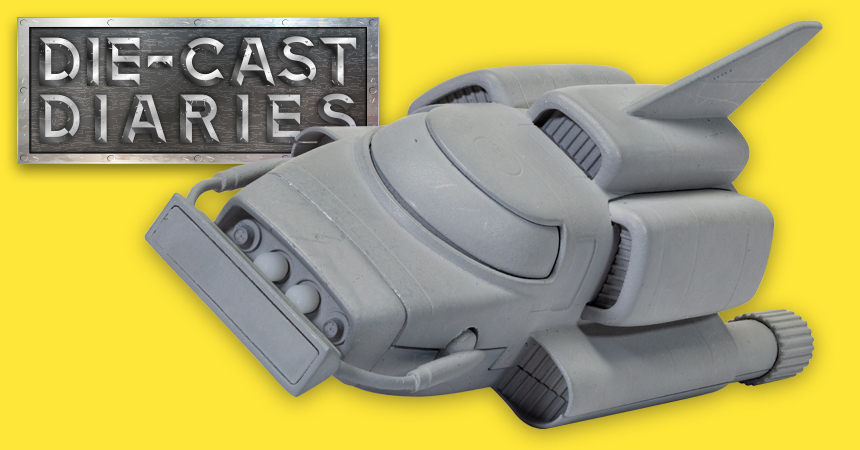
A DCD exclusive image delight. The first time Corgi fans will have found pictures of the prototype model produced from the Thunderbird 4 design files. This one features the existing Corgi Thunderbird 4 model, the one found in the pod of Thunderbird 2.
As we launched our first model range of 2025 last January, our introduction included confirmation that we intended to so something very special indeed in support of this year’s 60th Anniversary of Thunderbirds, producing a pair of new model toolings the like of which had never previously graced the world of die-cast model collecting. In addition to the host of improvements made to our existing toolings, we confirmed that we were already well on the way with the development work in support of allowing both Thunderbird 4 and Thunderbird 5 to take their places within our wider Thunderbirds range. We’re delighted to be in a position to bring you details of our new Thunderbird 4 now, and she’s an absolute beauty.
When it comes to the individual Thunderbird craft, we will all have our personal favourites, and the most memorable scenes involving our favourite Thunderbirds will undoubtedly revolve around their respective launch sequences. Kids love noise, fire and excitement and Gerry Anderson’s mind was wired perfectly to take the youth of the nation exactly where they wanted to go. Although inextricably linked to Thunderbird 2, Thunderbird 4 always possessed something that little bit special, and in the scenes where Thunderbird 2 was selecting its mission pod, we were always on the edge of our seats waiting to see which number would get the call.
Even though every machine contained within a pod would be both interesting and exciting, there was one which just looked so different from the other Thunderbirds and possessed some unique attributes. When the perils facing the International Rescue team were of the nautical variety, there was only one pod for the job, the one containing Thunderbird 4, a little underwater craft which really did seem to be able to punch well above its International Rescue weight.
More images of the Thunderbird 4 prototype sample model.
Piloted by Gordon Tracy, who incidentally could also moonlight as Thunderbird 2 co-pilot when required, the depths of our oceans always appear to be more mysterious and foreboding than any mission into space, which certainly made Gordon a favourite amongst fans. Gordon was a member of W.A.S.P (World Aquanaut Security Patrol), and that being the case, was no doubt inspired to join by Troy Tempest and Stingray, but did the two ever get to meet? Anyway, the two both plied their trade below the ocean waves, and whenever dastardly deeds, or sub-aqua disasters were unfolding, you could be sure that both men and their respective craft would be on the case.
Perhaps one of the main reasons why everybody loved Thunderbird 4 so much, was the fact that its deployment was just more interesting than the other craft. Once selected and with the pod safely secured in the belly of Thunderbird 2, the little yellow one could either be launched after Thunderbird 2 had landed close to a body of water, or with the pod having been jettisoned from its pared ship – however, that wasn’t all …. there was a third method of deployment.
If Thunderbird 2, Virgil Tracy, or both were in dispose, or if the underwater emergency was close to Tracy Island, Thunderbird 4 could be launched directly from the Island, and once in the water, its performance was truly impressive. Only capable of modest speeds on the surface of the water, once submerged, she really came into her own. Able to travel at speeds in excess of 160 knots, Thunderbird 4 could also dive to depths of around 30,000 feet, and was equipped with an impressive array of tools and armament to deal with any situation in faced.
Her missiles could be used in both an offensive capacity, or to blast a hole in rock formations which were preventing her passage – she was truly the most interesting of all the Thunderbirds. 30 feet long, 11 ft wide and weighing in at 16 tons, she was propelled to her impressive performance by a pair of atomic fusion reactors, and if you found yourself in peril at sea, this was the only sight you needed to see.
Now we’ve set the scene for this most appealing of craft, you can be sure that our die-cast homage to Thunderbird 4 is befitting a subject of this importance, and we’re delighted to share more details with you now. The new model comes in at an impressive 15cm in length and features such details as accurate surface detailing, a detailed cabin interior, firing rockets and multi-function arm at the front. Detail throughout is impressive and whilst Thunderbird 4 was the smallest of the Thunderbird craft (other than FAB1), this model certainly shows why this incredible machine punched well above its weight in the affections of the legions of Thunderbirds fans.
The next stage in this project will be to bring you pictures of the first metal engineering sample of this eagerly anticipated new model tooling.
The images being exclusively shown in this update include CAD rendered images taken from the design files produced in support of this project, and the prototype model produced from those files, which allows our development team to assess every aspect of this beautiful model prior to committing the tooling to metal. The next update will allow us to show you the first metal engineering samples of Thunderbird 4, which represents a significant step towards welcoming the model into the Corgi range later this year.
We can’t wait to show you those images when they’re available, but for now, we hope this major update will keep the Thunderbirds celebrations going in this significant anniversary year.
A crop of the artwork decoration file produced in support of the latest Vanguards Ford Transit Custom Sport release.
As one of the most successful motor manufacturing companies the world has ever known, Ford have become expert in designing and producing vehicles for all needs and situations, whether that be allowing your plumber to carry all his tools to his latest job, getting the kids to and from school, or just cruising around attempting to look cool. With Ford cars playing such a significant role in the lives of so many people throughout the post war years, it will come as no surprise that model representations of vehicles wearing the Ford badge have been and continue to be incredibly popular, with our own Vanguards range being no exception. In fact, we pride ourselves in bringing our collectors the models they want in their collections, and certainly make no apologies for this desire.
With this being the case, we’re pleased to inform Vanguards collectors that you will imminently have two new Ford model releases vying for available space in your display cabinets, one a masterpiece of motoring form and function, with the other being an RS Cosworth.
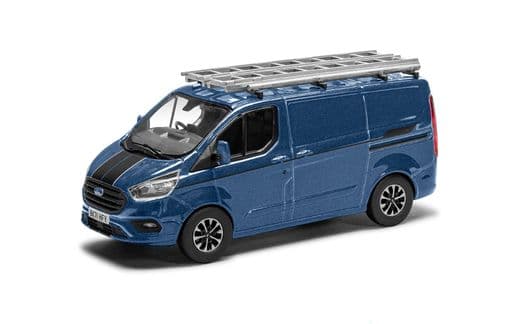
The latest Vanguards addition to the Ford Transit range, VA15104 – Ford Transit Custom Sport in Chrome Blue.
The Ford Transit story began back with the release of the first series 1 vehicles in 1965, when the Ford Company decided they were going to produce a new range of light commercial vehicles to support everyday trade and business activities, whilst at the same time, challenging the market dominance of rival manufacturers in this potentially lucrative field. Those first tentative steps marked the beginning of a period of market domination for Ford, with the Transit going on to be the vehicle of choice for thousands of tradespeople and business owners, going on to become the best-selling vehicle of its type for many years to come.
Ford were extremely clever in maximising the potential of the Transit, taking it away from the feeling that it was just a workman's mode of transport and aligning it much more closely with a large and robust family car, something akin to a modern MPV (Multi-Purpose Vehicle). This feature was actually born out of necessity, as Ford's design teams were instructed to use as many components from their existing car ranges as possible, making both development and manufacture more cost effective, whilst at the same time giving this commercial load lugger a very different feel.
In addition to this, all this stylish load carrying capacity was mainly pulled along utilising Ford's existing range of car engines, with these cost savings ensuring that Transit pricing always remained extremely competitive.
VA15104 – Ford Transit Custom Sport in Chrome Blue.
The Sport was the top model in the 2021 Transit Custom range and featured a sport styling kit consisting of a front lower bumper skirt with a unique fog light bezel, a rear bumper skirt, body-coloured side skirts, front and rear wheel arch extensions and Transit-branded side stripes that rise along the centre crease line of the vehicle, adding dynamism. It also featured 17” alloy wheels with a machined bright and black finish, black centre line stripes with silver accents and a roof rack that shows this vehicle is still very much designed for work. The van modelled was, unusually, ordered with sliding side doors on both sides, making a walk-through space if needed.
The original Transit was launched in 1965 and was the first project on which Ford of Britain and Ford Europe, based in Germany, really collaborated, having hitherto been run as separate divisions under the same umbrella. It was an enormous success and paved the way for Ford’s European integration, which started with the sharing of major components such as engines and gearboxes, and culminated in the range being identical all over Europe by the mid-1980s. The word Transit has since become an eponym for this kind of van worldwide, and the range has become ever more diverse. The midsize Transit Custom range has been a very popular addition to the Transit family and become the market leader in the UK one-tonne van market.
One of the areas where Ford have always been particularly successful is bringing the exciting world of motorsport into their showrooms, turning vehicles which certainly look like ordinary family cars, into extraordinarily desirable speed demons. As much about attractive styling as they were about performance, if you were serious about your motoring, and you had the means to do so, you simply had to get behind the wheel of one of these beasts.
Ford unleashed their latest range facelift on this ultra-successful series of cars in 1990 and as the first family orientated Escort Mk5 models started to appear in showrooms, performance car lovers knew there was more to come. Initially, the trade reception for the new model was somewhat lukewarm, however, the strong market position the Escort held, coupled with almost constant development assured its long-term success. The company would later go on to proudly unveil their striking, yet purposeful looking Escort RS Cosworth model, a performance car which drew significant inspiration from Ford’s successful rallying credentials, presenting the motoring world with a real brute of a car.
In addition to its stunning good looks, this performance beast was powered by a turbocharged 2.0L Cosworth 16-valve engine and was capable of attaining speeds of around 150mph, making this the most powerful Escort ever produced and in the eyes of many of its admirers, was awarded the colloquial title of the ‘Ultimate Escort’.
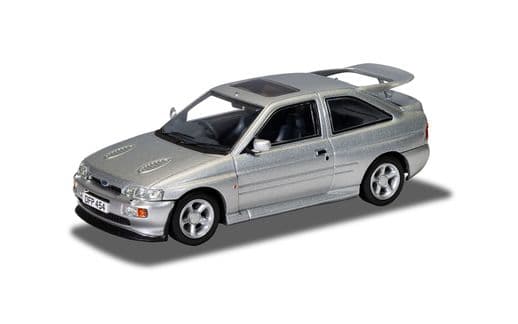
VA14806 – Ford Escort RS Cosworth in Moondust Silver
The Escort Cosworth Mk1 ‘large turbo’ example modelled was ordered new from Wylie's Ford of 370 Pollokshaws Road, Glasgow, and first registered on May 11th, 1994, on a private number plate. It has worn private number plates ever since. The second owner, who was based in Gretna Green, acquired it in November 1996, and records show that when he had it serviced on May 21st, 1997, it had still only covered 12,448 miles. The current owner, Staffordshire-based BT electronics engineer Darren Frederick Parker, a long-standing fast Ford enthusiast, acquired the car in March 1998 after a thorough search for his dream car, and immediately added the number plate it still wears, DFP 454.
Darren was able to purchase the car because his mother, Lillian Parker, had a small lottery win in November 1997 and divided some of her windfall between her four children. Sadly, she passed away in 2001, making the car even more special. Darren had it resprayed after buying it and commissioned Castle Performance Engineering to remap it to 340bhp in February 1999. He’s looked after it fastidiously as its numerous concours trophies, including the RS Ford category winner’s trophy from the 2011 European Ford event in Holland, prove. He also loves driving it, however, and its’s now covered 109,000 miles, attending events in Europe and the UK many of which are organised by the RS Owners Club of which Darren is an enthusiastic member.
All the images included in this Vanguards section of the blog feature advanced production samples of both models, and at the time of producing, both were scheduled for impending release. We’re delighted to confirm that this has moved along slightly, and both are available on the Corgi website and through your usual Vanguards stockist now. The question is, will you want a stylish addition to your display, or are you a Cosworth man?
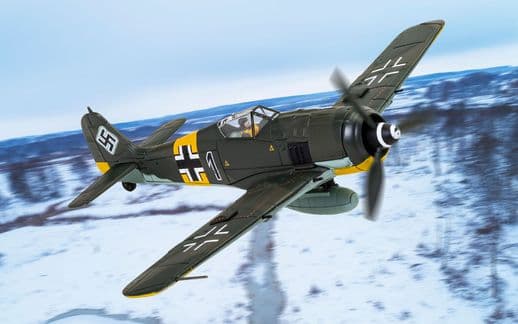
The Aviation Archive range has a long tradition of recreating aircraft flown by some of the world’s most successful air aces in scale die-cast form, something which continues to this day with the release of Luftwaffe ace Otto Kittel’s sinister looking Focke Wulf Fw190A-8 fighter. One of the most successful aces in the history of air combat, Kittel has so far managed to escape our attentions, but we’re delighted to have a representation of what researchers believe to have been his final Focke Wulf now in our collection.
The son of a farmer, Otto Kittel didn’t exactly conform to what most people’s opinion of what a successful Luftwaffe fighter ace was, being more reserved and modest, than brash and boastful, simply going about his duties in a ruthlessly effective manner. Initially posted as wingman to a more experienced pilot, Kittel would eventually take part in the opening exchanges of Operation Barbarossa with his unit JG54, where it would become one of the most successful on the Eastern Front. Otto Kittel would eventually be credited with 267 aerial victories during WWII, with his final victory being his 94th against an Il-2 Sturmovik attack aircraft on 16th February 1945, his 583rd combat sortie of the war.
Unfortunately for Kittel, moments after dispatching his latest victim, the hunter became the hunted, as another Sturmovik attacked Kittel’s Focke Wulf from below, scoring hits on the German fighter which almost immediately crashed into a forest below. The unassuming and well-liked Otto Kittel stands as the fourth most successful air ace of all time, achieved in less than four years of operational flying over the Eastern Front. He was also the most successful Focke Wulf FW190 ace, and with 94 victories against the excellent Il-2 Sturmovik, also had the distinction of being the most successful ‘Sturmovik Hunter’. Scoring all his victories over the Eastern Front, Kittel would also become the most successful fighter ace to be lost during combat.
Please read on if you would like to find out more about an impressive trio of hand decorated former RAAF Douglas Dakota models. This one is Dakota A65-91 has been finished in a smart RAAF Central Flying School livery from the 1970s.
One of the most rewarding aspects of spending a little time looking through the various enthusiast sites which serve our hobby is how some amongst us like to inspire others in extending their collector boundaries, and to perhaps look in a different direction when it comes to our collecting habits. We came across one such post recently which emanated from the other side of the world, but was clearly written by someone with a passion for both die-cast model collecting and aviation – we simply had to find out more.
When making the acquaintance of Alex Le-Merton, it was clear we were talking to a man who had more than just a story about re-pained Corgi Douglas Dakota models to tell, but as we’re not sure if that story would be better told here on DCD, or within our Aerodrome sister blog - that should provide you with a clue about what we discovered.
In any case, the main reason we were originally drawn to Alex was the fantastic selection of pictures he posted online, each one featuring a RAAF Dakota which was close to his heart, and he was kind enough to send us more detailed examples and details behind each livery. Importantly, he also allowed us to share the details with fellow DCD readers, which is how we intend to end this latest update.
Alex was at pains to point out that the actual conversion work had been carried out by a talented acquaintance of his, Jonathan Shearer, who helped him to recreate the trio of Dakotas Corgi style.
Dakota A65-91 has been finished in a smart RAAF Central Flying School livery from the 1970s, when this aircraft was used as a multi-engine Command Instrument Trainer and Dakota type refresher/conversion aircraft. She is still maintained in airworthy condition, but now flies as VH-TMQ with Southern Cross Air Tours, where we must say, she looks as good as new.
A65-94 / VH-EAF is presented in the colours she wore during her service career with the RAAF, and particularly her time with the Aircraft Research Development Unit. She was wearing these colours when she was retired from RAAF service in 1999, but is currently maintained in airworthy condition, in the care of the Historic Aircraft Restoration Society in New South Wales.
Dakota A65-29 is resplendent in the No.38 Squadron RAAF markings worn during the Second World War, and was another aircraft retired from RAAF service back in 1999. Since then, the aircraft has been in the hands of the professional and volunteer team at the Historic Aircraft Restoration Society, where she is also maintained to the highest standards and remains in airworthy condition. She must be much loved by those who maintain, fly and watch her display in Australia, and it’s now wonder Alex wanted a model of her.
Alexs’ models will be of interest to a great many Aviation Archive modellers.
This beautiful trio of Dakotas inspired Alex to create die-cast representations of each aircraft to grace his display cabinet, and we have to say, they do look pretty fantastic. As team, we’re always being asked to include more RAAF subjects in respective Aviation Archive ranges and this feature only serves to illustrate how much interesting aviation subject matter there is with links to the RAAF and Australian crews.
Sight of these beautiful models will certainly be making one or two amongst our numbers a little envious, and I’m sure we’ll be back in touch with you for further details in the very near future. Until then, can we just extend our thanks to Alex once again, and to send our congratulations to modeller Jonathan Shearer, who created these magnificent models – great job sir!
I’m afraid that's all we have for you this time around, however, we’ll be back as usual in two weeks’ time with a further exclusive selection of the latest Corgi model updates. As ever, you could always drop us a line if you felt moved to do so, to comment on anything blog, collecting or Corgi model related, or even perhaps to suggest a topic you might like to see the team cover in a future edition. As always, our diecastdiaries@corgi.co.uk address is the one to use.
If you can’t wait for the next blog, you will find plenty of Corgi model collecting discussions taking place on our official social media channels, access to which can be obtained by clicking on the respective links at the foot of the Corgi website homepage.
Link access to Corgi social media sites.
Thank you for continuing to support your Corgi Die-cast Diaries blog. Our next edition is scheduled to be published on Friday 18th April - we look forward to seeing you all back here then.