

Welcome to this latest edition of Corgi Diecast Diaries, your regular blog review of all the news, updates and topical stories from the captivating world of Corgi die-cast model collecting.
This could well turn out to be the Corgi update blog against which all others will be judged, as this time, we will be bringing Corgi collectors major updates from several new model projects, taking in additions to our Aviation Archive, Military Legends, Original Omnibus and Vanguards ranges - you really are in for a bit of a diecast treat. We begin by looking at the second release from our new 1/48th scale McDonnell Douglas Phantom FG.1 tooling, a model which could hardly look any different from the initial release, before moving on to look at the final (winterized) 2021 release in our popular Operation Barbarossa/Strike East series, the Heinkel bomber.
We follow this up with a Tiger Tank sent to fight British Forces in Tunisia, but which actually ended up becoming probably the most famous individual tank in the world and one which amazingly is still in running condition to this day, before moving on to an attractive pair of buses which benefit from striking wraps advertising popular London musicals. Finally, but in no way occupying the position of blog makeweights, we have two beautiful impending additions to the Vanguards range which fall squarely into the category of desirable British performance cars and will definitely beautify any collection of 1/43rd scale diecast vehicles. As you can see, we have something very special for you in this edition, so without further ado, let’s dive straight into the diecast action.
All the images we are showing here feature the latest advanced sample model of our phantastic new Phantom and are being published exclusively for the viewing pleasure of Diecast Diaries readers.
We know that a great many of our readers will be looking forward to seeing these latest pictures of the newly modified 1/48th scale McDonnell Douglas Phantom FG.1 tooling and we are delighted to be in a position to show them, whilst at the same time confirming that these are of an advanced production sample. It won’t be long now before we can add this beautiful model to our growing 1/48th scale collections. One of the many benefits of being able to regularly update Corgi collectors on the development progress of the latest models is the ability to chart the progress not only of some of the most eagerly anticipated re-livery releases, but also to show how new and modified tooling projects are advancing from the design computer to the manufacturing plant and every stage in between. With that being said, there can be no doubt that the most interesting tooling modification currently underway is the one connected to the new Phantom model, modifications which have been applied to what will only be the second release from this impressive tooling.
When the Aviation Archive range took the brave decision to take our range of Cold War jets into the larger 1/48th scale with the announcement of the English Electric Lightning F.6 at the beginning of 2017, it was arguably one of the most significant developments in the recent history of the diecast industry. Whilst a project of this magnitude did take some time to finally reach our display shelves, collectors were not disappointed with what they were presented with, which was a stunning, high quality scale representation of one of Britain’s most famous jet powered aircraft. As a brand, we were delighted with the reception this model received, however, its arrival immediately raised a couple of important questions for us - what should our next tooling subject be and how soon should we announce/introduce it? We were in absolutely no doubt that the second release in this new series should be the Anglicized version of the mighty McDonnell Douglas Phantom, but for our designers, this new model would present them with a much more challenging project than its predecessor, so how would they get on?
A sight which could soon be replicated in Aviation Archive collections up and down the country, a Corgi Lightning and Phantom fest arranged in our showrooms, during the photo session for this latest impending RAF Phantom release.
A larger aeroplane than the Lightning, the new Phantom was again extremely well received by the collector and was definitely the right choice for the second tooling release in this series, however, despite the eye-watering expense this tooling investment represented for the company, some collectors implored us to consider modifying the tooling in future, to allow the model to be displayed with the canopy in an open position, if so desired. Despite this kind of additional tooling investment rarely occurring between the first and second releases of a new model, our development team were determined to make the Phantom as good as it could possibly be, so design work immediately started on assessing the possibility of making modifications to the tooling. This turned out to be rather a complicated process and one which came with quite a financial outlay for the company, however, the modification expense was duly signed off and the changes applied to the tooling bank. What started as a potential minor improvement turned into quite a major addition to the tooling, most of which will feature on this second Phantom release, so what do collectors have to look forward to?
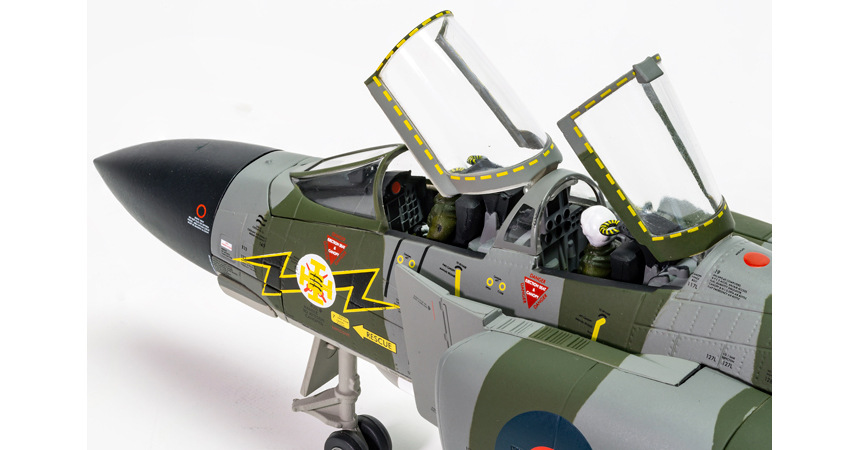
There is no doubting that our new Phantom tooling is already one mightily impressive piece of diecast, but this second model will include several significant differences from the first release, which will make the earlier model pretty unique in the series. The new ‘Treble One’ Squadron Phantom features the completely re-designed and now opening front and rear canopies, with the rear canopy also featuring a newly tooled rear view mirror on the top of the framing of the rear canopy, for the benefit of the navigator/weapons system operator. This unusual, yet distinctive feature was not carried on all Phantoms and indeed when looking at historic photos of service Phantoms, aircraft from the same squadron pictured next to each other show some the mirror fitted and others without. Not making the work of product researchers any easier, this is however, a Phantom feature which is distinctive enough to warrant inclusion in the tooling.
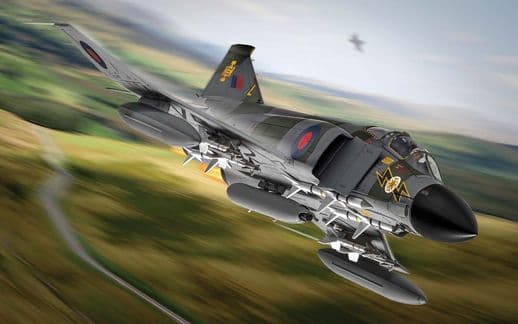
With the modification work undertaken by our design team, this second Phantom release is quite a bit different from its predecessor and also looks much larger whilst wearing this stunning RAF camouflage scheme.
Although not required on this particular release, the modified canopy development works also include the WSO’s periscope/sighting telescope, which protrudes from the port side of the pillar between the front and rear canopies. From a visual perspective, the first two Phantom releases could hardly look more different, with the first release (now sold out on the Corgi website) presenting the aircraft in a smart Royal Navy livery and this second, forthcoming release marking the RAF air defence variant of the Rolls Royce Spey powered Phantom, in these striking camouflage markings. Having seen the new model close up, we can confirm that it is absolutely stunning and anyone with an interest in, or affinity with this much loved British US aviation import will be absolutely smitten with this second Phantom release. We have included this impressive selection of product images to try and give you a clearer picture of what you have to look forward to with this release, but they really can’t do it justice - in the metal, it is absolutely Phantastic!
For an aircraft which was unfortunate enough to attract the rather unflattering nickname ‘Double Ugly’, the new 1/48th scale RAF Phantom is a real looker and we can’t wait for all those collectors who chose to wait for this RAF release to finally get their hands on one - we think you are going to love it. Here are the catalogue and certificate descriptions supporting this particular release.
AA27902 – McDonnell Douglas Phantom FG.1 XV592/L, RAF No.111 Squadron, Leuchars, Fife, Scotland, Late 1970s
Although some historians and enthusiasts may argue that the American McDonnell Douglas F-4 Phantom was an acquisition which was almost forced upon the Royal Air Force during the late 1960s, Britain would soon come to appreciate the rugged qualities of this magnificent aeroplane and accept that it presented them with a hugely capable multi-role platform. McDonnell Douglas F-4K (FG.1) Phantom XV592 had the distinction of being the last aircraft produced for the Royal Navy and it would go on to serve aboard HMS Ark Royal in the markings of No.892 Naval Air Squadron (as they knew they would be the last unit, they added a large black Omega symbol to their aircraft’s tails), until the withdrawal of Britain’s last big carrier at the end of the 1970s. As with the rest of the remaining Royal Navy Phantoms at that time, XV592 would later be transferred to the care of the Royal Air Force at Leuchars in Scotland, where she would perform an air defence role, patrolling the vast expanses of the North Sea, challenging the frequent Soviet incursions into British air space. Her RAF camouflage scheme could hardly be more different from the extra dark sea grey and white colours she adopted during her Navy days, presenting the mighty Phantom in a much more sinister manner, even though both schemes proved incredibly popular with enthusiasts. Indeed, Phantom FG.1 XV592 is fortunate to have worn two of the most iconic British Phantom schemes during the service history of this Anglicized American aviation classic.
We are really excited at how this second Phantom release has turned out, which is probably why we went a little bit mad with the number of pictures, but we knew you would be interested to see them.
Presented in our new Cold War style packaging, our second Phantom release will have real presence when it hits the model store shelves in just a few weeks’ time.
For the Phantoms which previously operated in the colours of the Fleet Air Arm, RAF Leuchars in Fife, Scotland would become as much a home to them as either HMS Ark Royal, or RNAS Yeovilton had been. With the aircraft ‘diverted’ to the Royal Air Force from the ever diminishing original Navy order already equipping No.43 Squadron at the airfield, disbandment of the last remaining Royal Navy Phantoms would also see these aircraft heading up to Scotland, as it was decided all the former Navy F-4K (FG.1 in British service) machines should operate out of the same airfield. During 1974, RAF No.111 Squadron was operating the Lightning F.6 our of Wattisham, whilst a designate unit was working up on the new RAF Phantom F-4M (FGR.2 in British service) at Coningsby. Once this process was complete, the squadron number was transferred and this famous old fighter unit became a Phantom squadron, but flying the multi-role variant of the jet.
The following year, ‘The Tremblers’ made the move to Leuchars and embarked on a long association with the airfield which would last for 35 years and encompass two different aircraft types. With the arrival of the last remaining Fleet Air Arm FG.1 Phantoms from 1978, No.111 Squadron began the slow conversion from FGR.2 to FG.1 variant in the air defence role, with their earlier RAF Phantoms being distributed between other FGR.2 units around the country. For the next two decades, RAF Leuchars would be home to the Phantom Training Flight and the FG.1 Phantoms of Nos.43 and 111 Squadrons, until both units replaced their naval heritage Phantoms with the air defence variant of the Panavia Tornado during 1989 and 1990.
A real triumph for the Corgi development team, this second 1/48th scale RAF Phantom release will be available before the Christmas holidays and will be a much sought after addition to many a diecast aviation collection.
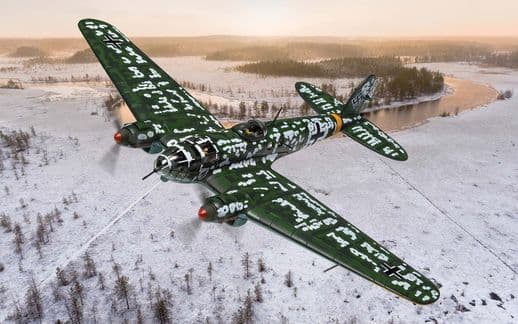
Providing a real test for our manufacturing teams, the Strike East Heinkel He-III H-6 has a representation of the Luftwaffe’s attempt to provide their aircraft with some camouflage protection when operating over snow covered landscapes on the Eastern Front.
When the Corgi team held our initial meeting to discuss the Aviation Archive range for 2021 many months ago now, our boss was adamant that he wanted to include a linked collection of releases to commemorate this year’s 80th anniversary of Operation Barbarossa, the historic German military strike against the Soviet Union. Whilst we had no problem with the challenge, we did have one or two reservations about the title of this collection, because Barbarossa began as a summer offensive and is historically only noted as lasting just over five months, before it descended into a more protracted series of Eastern Front operations. Certainly during the early stages of Barbarossa, the Luftwaffe aircraft taking part in the operation would have been presented almost universally in the standard camouflage markings associated with operations further west, meaning that there would be little to identify them as being used during the Soviet onslaught. The problem we had was that most people associate air operations over the Eastern Front with snow and roughly applied whitewash camouflage on Luftwaffe aircraft, something we were keen to try and replicate on this collection, but very few scheme options would actually have fallen into the official Operation Barbarossa timeline. The solution proved to be a relatively simple one in the end, but one which would give us plenty of subject latitude for this collection and for future releases - using the title ‘Strike East’.
Covering the entire period of the war from the start of Operation Barbarossa until the end of WWII, this collection title allowed us the opportunity to select subjects which collectors would more readily associate with Luftwaffe operations on the Eastern Front and to challenge both ourselves and our manufacturing partners with some really quite ambitious representations for the models. For anyone with an interest in Luftwaffe Eastern Front air operations during WWII and aircraft weathering more generally, you will know that this can be a particularly contentious subject, with weathering and the application of theatre applied whitewash being very much open to interpretation.
There can be no doubting that the Luftwaffe definitely applied a temporary whitewash to aircraft operating over snow covered landscapes, because as the Soviet Air Force became much more powerful, the Luftwaffe needed all the help they could get. There have also been many books written on the subject since the end of the war, but unless those authors are in possession of rare and genuine colour reference images, their views can only ever be taken as an opinion on this challenging subject. Aircraft which arrived in theatre in standard factory applied camouflage would have their wings and fuselage daubed with whitewash, or whatever suitable white coloured substance ground crews were able to lay their hands on at the time. Dependant on the strength and consistency of the whitewash used, from the first time the aircraft took to the air, this whitewash would start to fade or even wash off altogether, first revealing lighter shades of the base colours beneath, then allowing the factory applied colours to show through almost completely, until a new coat of whitewash could be applied.
Applying a full whitewash to a model would be relatively easy to achieve, however, trying to replicase one which is fading and coming off after a few days/weeks of operational flying is much more challenging for the development team.
You may ask yourself in view of the clear difficulties associated with weathering diecast models, why would we bother straying into such dangerous territory in the first place and our answer is that we have to try. As a team, we are always trying to make these models as good as they can possibly be, pushing the manufacturing boundaries and aiming for the most accurate representations of the subject aircraft covered, however, when it comes to weathering models, we are fully aware that there are a great many potential pitfalls and we will never be able to produce a finish which will appeal to all collectors, but should that stop us trying? The easiest thing would be to simply provide painting guidance and a selection of powders and paints with each model, letting each collector weather their aircraft to taste, but for those who would actually attempt the process (defacing a perfectly good model, in the eyes of some people), this would produce a fascinatingly wide variety of finish interpretations.
Deciding to go with a factory applied winter finish for this collection of models was our intention from the start, but we also knew that we wanted to try and make these as appealing as they possibly could be, something which has seen each model go through several finish iterations and involved an incredible amount of work from all concerned. We think the models have been well received in the main and the team have been encouraged by the many positive comments we have seen from collectors posing on various social media platforms over the past few weeks and with the Messerschmitt Bf 110, Junkers Ju88, Bf 109G and Stuka all now released, that just leaves the ground attack Bf 109E and Heinkel to come, with the Heinkel being the last to feature a winter finish. The images we are exclusively revealing to blog readers in this edition represent the latest incarnation of the weathering representation destined for the Heinkel and a model which is already a highly anticipated addition to many a collection. Let’s look at the story behind the aircraft on which the release is based.
AA33718 – Heinkel He-111 H-6, W. Nr. 4500, A1+FN, Lt. Erich Horn, 5./KG53, Crashed behind German Lines, Yukhnov, West of Moscow, 21st January 1942
If the Messerschmitt Bf 109 was the most famous Luftwaffe fighter aircraft of the Second World War, then its direct bomber equivalent had to be the Heinkel He-111, an aircraft which can trace its origins back to the early 1930s and its development as a supposed fast civilian airliner, due to the restrictions imposed on Germany by the Treaty of Versailles. Once the country was no longer concerned with the pretence of trying to plicate the other European powers, the Heinkel showed itself to be a ‘wolf in sheep’s clothing’ and thanks to its large, fully glazed ‘greenhouse’ nose, would become one of the most famous aircraft of WWII. Possessing greater range than other Luftwaffe strike aircraft, the Heinkel He-111 would see heavy use during Operation Barbarossa and the air battles which raged over the Eastern Front from 1942 onwards, but not always in its primary strike role. Due to the rapidly deteriorating situation for the Germans, Heinkel He-111 bombers were also used for casualty evacuation and re-supply duties, where they would supplement the efforts of the lumbering Junkers Ju-52 Trimotors.
This particular Heinkel has added rather effective whitewash blotches over its standard camouflage, something which would have looked rather effective against the frozen Russian tundra from above. Whilst attempting a low level bombing attack against targets in the Kaluga area, south of Moscow, this bomber was hit by accurate Soviet anti-aircraft fire and was forced to crash land, thankfully for the crew, safely behind German lines.
Although the Soviet High Command had a strong mistrust of the Germans, they did not necessarily want to do anything militarily that would provoke them into an attack. Also, despite the fact that their massive air force was coming towards the end of a significant period modernisation and reorganization, this work was still ongoing and on the eve of Operation Barbarossa, even though more modern aircraft were now slowly being introduced, pilot conversion and the general organisation of the force still left much to be desired. With Soviet airfields in the Western districts regularly undergoing air raid drills, when the sirens sounded in the early hours of 22nd June 1941, few on the seventy-six airfields identified for attack by Luftwaffe aircraft that morning actually took any notice, with crews remaining in their tents sheltering from the rain, only rushing to their posts once the explosions started.
These early Luftwaffe strikes proved to be devastatingly effective, with reports sent back to headquarters later claiming almost 1500 Soviet aircraft destroyed on the ground alone, figures which seemed so incredible that Herman Goering had them independently verified. In fact, the figures proved to be a little conservative and as German ground troops overran numerous Soviet airfields during their lightning advance, it became clear that this figure was actually well in excess of 2000 aircraft destroyed. In the air it was a different story and despite flying obsolete Polikarpov I-15 and I-16 fighters, Soviet pilots proved to be tenacious and brave, resorting to ramming their German foes if they could get close enough. This would prove to be the sign of things to come and whilst initial German victories were indeed spectacular, the Russian winter and the nation’s manufacturing prowess and fighting spirit would soon turn the tables in their favour.
This attractive new model is destined for a release later this year.
We are extremely proud of this model, as it is not only one in which we have invested much time and effort, but also as it is a scale representation of arguably the most famous tank in the world and the only time it was used in anger.
Collectors of our Military Legends range will no doubt be looking forward to an impending limited edition model release which is a 1/50th scale representation of a German Tiger I heavy tank which went into combat against British forces in Tunisia in April 1943, only to be abandoned on the battlefield and days later, fall into British hands. This tank would go on to become arguably the most famous armoured fighting vehicle in the world, was the subject of numerous books and official evaluation documents and even star in a wartime recognition film and a recent Hollywood blockbuster movie. She also happens to be the only genuine wartime Tiger I in running condition, the enigmatic ‘Tiger 131’. An armoured vehicle which is now famous the world over, the story behind this and the model project it inspired was covered in edition 82 of our blog, however, let’s take another look at the catalogue and certificate information which supports its release.
CC60515 – Panzerkampfwagen VI Tiger Ausf E (Early production), ‘Tiger 131’, Schwere Panzer-Abteilung 504, Point 174, Gueriat el Atach, Tunisia, 24th April 1943 - ‘To catch a Tiger’
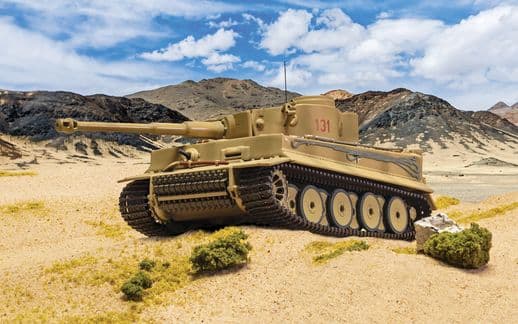
Built at the Henschel tank works in Kassel during February 1943, Panzerkampfwagen VI Tiger Ausf E ‘Tiger 131’ was destined to be one of only a small number of Tiger tanks sent by Hitler to bolster the increasingly desperate situation in North Africa, reinforcing the famous Afrika Korps. Assigned to the 504th Heavy Tank Battalion, she was transported from the factory by rail to the port town of Trapani in German occupied Sicily, before being shipped across the Mediterranean Sea to Tunis by barge, three tanks at a time. Once in Tunisia, the Tiger was prepared for immediate combat operations and as it was destined to be the commanders tank of the 3rd platoon, was adorned with the red turret number 131.
Joining up with what few existing Tigers remained in the area, the tank went into action against British forces in April 1943, where she would be facing the Churchill tanks of the 48th RTR and determined ground forces, which at that time were very much in the ascendancy. Although the 88mm main gun of the Tiger was capable of destroying a Churchill at ranges well beyond the British tank’s ability to return fire effectively, this advantage was negated by the hilly terrain in which they would be fighting. The Tigers would therefore usually be deployed with several smaller Panzer IV tanks and additional supporting infantry units, vital in providing close protection for these battlefield monsters. Unfortunately for the men of the Afrika Korps, this would all prove to be a case of too little, too late.
This latest series of product images feature the advanced production sample of our Tiger 131 model and feature several tooling options which have never previously been seen on a 1/50th scale Corgi Tiger I release - isn’t she a stunner!
Facing overwhelming odds in Tunisia, the newly arrived Tiger tanks of Schwere Panzer-Abteilung 504 travelled around 400km from their disembarkation port of Tunis to first face the British in actions around Djebel Djaffa, however, this would be a period of intense fighting and combat accounts are a little sketchy, to say the least. What happened to Tiger 131 next is still shrouded in mystery and the subject of continued military research. Whilst engaged in fighting with troops of the 2nd Battalion, Sherwood Foresters at Point 174 Gueriat el Atach on 24th April 1943, Tiger 131 was hit multiple times by small arms fire, but significantly, also by an anti-tank shell from a gun captured by the British only minutes earlier and turned against its former owners. The round glanced off the gun mantlet and struck the turret ring, jamming the turret and probably injuring the crew in the process. Shaken up and probably fearful of coming under further attack, the crew quickly abandoned the tank and ran towards German lines, leaving their almost pristine new Tiger I in the middle of the active battlefield.
The Foresters attempted to hold on to their unexpected prize in the face of numerous enemy counterattacks, but it would be several days before the area could be secured and British tank recovery crews could safely enter the area and recover the tank. Tiger 131 was the first German Tiger tank to be captured intact by Allied forces during the Second World War and in the years which followed, would not only be the subject of detailed examination, but would also go on to be regarded as probably the most famous individual tank in the world.
For many reasons, this new model is a real statement release for a Military Legends range which only reappeared in 2019, after a lengthy hiatus which lasted almost ten years. Always a popular subject with collectors, the Tiger I tooling has been used to produce eleven or twelve separate releases since it was produced, but nothing like this next release has ever been seen previously. As this is such famous AFV subject matter, we were really keen to make sure that this model was as accurate a representation of Tiger 131 during the actions which led to her capture in April 1943 as we possibly could, an event which was actually quite well documented at the time. A thorough examination of the existing tooling bank for the parts we would need and requesting several quite dramatically different sample models from the manufacturing facility moved us closer to what we were looking for every time, with each one incorporating additional detail and more effective paint finish for greater accuracy.
This stunning new model will actually feature many components which have never appeared on a previous Corgi Tiger I release and in particular, the early style interleaved roadwheel arrangement which was such a distinctive detail on this relatively early incarnation of the Tiger tank. The model will also feature the early style commander’s cupola, port side turret pistol port and the Feifel engine air cleaning system first fitted to Tigers sent to fight in Tunisia, again all details which will be appearing on a 1/50th scale Corgi Tiger I model for the very first time.
Keep your eyes peeled for this sight! A low run limited edition release, this beautiful new model will not be around for long, following its impending release and Tiger 131 is certain to be popular. The box artwork is our take on the famous wartime picture of Tiger 131 as she lay abandoned on the battlefield at Point 174 at Gueriat el Atach, Tunisia on 24th April 1943.
This is a very special model representation of a very famous tank and one we think collectors are going to be delighted with - the box artwork even features our take on the famous wartime image which shows Tiger 131 abandoned at Point 174 at Gueriat el Atach on 24th April 1943. The images we are exclusively showing here for the very first time are the culmination of a great deal of work by the Corgi team and the final incarnation of this stunning model prior to its production. If you are only ever going to have one 1/50th scale Corgi Military Legend in your collection, then surely Tiger 131 has to be it - she is a real stunner.
As with the previous two models reviewed in this blog, our latest Tiger I is scheduled for a pre-Christmas release.
Two of the impending additions to the Original Omnibus range feature buses complete with advertisements promoting some of the most popular musicals in theatreland.
At a time when car ownership is at an all-time high in the UK, it is still interesting to note that public transport is still a hot topic when it comes to political manifestoes and buses remain some of the most distinctive vehicles on Britain’s roads. With the latest incarnations of these popular vehicles not only carrying increasing numbers of passengers in extremely high levels of comfort, but also acting as mobile advertising billboards, buses are now not only admired for their aesthetic design appeal, but also for the attractive advertisements or full wraps they display. Always certain of turning heads whenever they drive by, buses are now captivating a new audience of enthusiasts, with more modern types now rivalling the classics we all remember from our formative years.
For these and many other reasons, our long standing Original Omnibus range of models have always been a popular category within any Corgi range, with some of the stunning liveries covered attracting more than just the avid bus collecting enthusiast. Whether a particular release represents a vehicle from your local area, or just one which features a livery that appeals to you, these beautiful 1/76th scale models often cross collector boundaries and attract people who would not ordinarily stray from collecting cars, aircraft or military vehicles.
Every Original Omnibus die-cast model comes as part of a strictly limited production run of high quality collectables, with most releases benefiting from individually numbered limited edition certificates and all supplied on a removable presentation plinth, finished off with a high quality Perspex display case. The vast majority of our releases come with a choice of one of two route numbers, each one meticulously researched to ensure the most accurate representation of some of our most distinctive passenger transport vehicles is produced. This range includes some of the most intricate designs we have ever attempted to apply to our models and whilst they pose plenty of challenges for our development team, there is always a huge amount of pride when the latest release hits the model stores and is immediately snapped up by delighted collectors.
The latest pair of models about to grace this series both feature graphics promoting two famous London theatre productions, one quite recent and the other much more established. Whether you are a fan of the respective productions, or have just seen one of these buses whilst out and about, both are attractive additions to this range of models and will undoubtedly appeal to many a committed and casual diecast bus collector.
Route 466 was a replacement for routes 400 and 166 and was introduced on 29th August 1998 to provide a service between Shirley Inn and Caterham-on-the-Hill, transiting via East Croydon, Purley and Old Coulsdon. Operated by Arriva London from South Croydon Garage (TC), the service commenced with MCW Metrobuses and on 20th May 2000 the route was extended to twelve miles from Shirley Inn to Addington Village, via Gravel Hill, with a corresponding increase in frequency, the route being diverted the following day at Addiscombe Road to Addington Tramlink via Route 130 and the Metrobuses were replaced by ECW Leyland Olympians.
A change of operator ensued on 30th August 2003, with Metrobus taking over from Arriva London and low-floor, double-decked Scania Omnidekka vehicles were introduced, operating from Godstone Garage (GD) for three years until that garage was closed. Switching allocation to Croydon Garage (C) from February 2006, on 30th August 2008 Arriva London regained the contract, introducing Enviro 400 vehicles to the route. The contract has since been renewed three times with Arriva London, in August 2013 when the Eclipse Gemini 2 vehicles were introduced to the route, in September 2018 and from August 2020.
LJ13 CCN carried T-side advertising promoting Regent’s Park Open Air Theatre’s production of Evita between 5th to 18th August 2019, the artwork being created by Festive Creative Ltd and featuring the actor Felipe Bejarano from the ensemble. Directed by Jamie Lloyd, Evita ran at Regent’s Park Open Air Theatre from 2nd August to 21st September and won the Evening Standard Theatre Award for Best Musical.
London’s Route 55 can trace its history right back to an unnumbered tram route which commenced operation on 12 December 1912, between Bloomsbury and Leyton Bakers Arms, which extended on Sundays out to Epping Forest via Shoreditch and Hackney. When London County Council introduced a route numbering system to its tram routes on 1 January 1913, this route was allocated the number 55 and this continued until 11 June 1939, when the route was replaced by trolleybus Route 555, running between Bloomsbury and Leyton (Downsell Road) as part of London Transport’s policy to replace their trams with trolleybuses. As a bus route, the 55 was re-introduced on 25 October 1969 as a as a daily crew operated route between Walthamstow Garage and Hackney, this fourth iteration of Route 55 replacing the northern end of Route 170.
Unusually for a bus route in London, the 55 has served three different railway stations; Marylebone between 1969 and 1971, Waterloo between 1978 and 1981 and Victoria between 1981 and 1987 and has also been converted to one-person operation more than any other London bus route, being crew operated for periods between 1969 and 1971, 1981 and 1987 and the final period between 2001 and 2003.
Wright’s New Routemasters were officially introduced to Route 55 on 28 February 2015, although LTZ 1372 entered service a week earlier on 20 February and the vehicle has operated the route exclusively ever since. The vehicle carries the standard advertising NB4L hoardings and during February and March LTZ 1372 carried advertised promoting ‘Only Fools and Horses: The Musical’. The show, based on the 1980s television series of the same name, was written by John Sullivan and features music and lyrics by Paul Whitehouse and Jim Sullivan, with additional music by Chas Hodges and John Sullivan and production by Phil McIntyre Entertainments. The musical made its world premiere at the Theatre Royal Haymarket on 9 February 2019, before opening officially on 19 February 2019 and has featured in at least three different bus advertising campaigns since.
Both sure to be extremely popular additions to the range, these latest low run Original Omnibus models are scheduled for release over the next few weeks and this may well be your final opportunity to make sure you don’t miss out on either model.
Adding a Lotus badge to any car gives it a certain amount of status in the motoring world, but paining it in Amber Gold is just rubbing it in!
We did say at the outset that this was going to be a rather comprehensive impending model release update and you can now see that we weren’t kidding! The final range to benefit from a model release update in this edition is Vanguards and we have two absolute crackers for your delectation. Again illustrated with images of the latest advanced production samples of each model, we have scale representations of two vehicles which whilst both would have graced Britain’s roads in years past, were not exactly in the motoring price range of the average family. Thankfully, the issue of finance will not be a problem when it comes to owning one of our 1/43rd scale representations of these stunning vehicles.
VA04119 - Ford Cortina Lotus Mk2, Amber Gold. Colin Chapman's Car
During the 1960s, Colin Chapman's rapidly expanding Lotus Car Company and Formula 1 team enjoyed a fruitful partnership with Ford. The Lotus Cortina Mk1 won races in spectacular style and Chapman worked closely with Cosworth's Keith Duckworth and Ford PR genius Walter Hayes to develop the DFV, the engine that would revolutionise F1 and which was initially designed for the Lotus 49 F1 car. Chapman was given a new Ford Cortina Lotus as a company car and that is the car we have modelled here. He kept it into the early 1970s, covering 14,233 miles, before it was put on display in the company's museum until 1998.
The Lotus factory museum was closed in 1998 and the contents auctioned. The Cortina failed to reach its £6,000 reserve but US Automotive journalist Jamie Kitman heard of this while visiting the factory and was able to buy it for £4,500. He then spent a similar sum having it substantially recommissioned by Midlands-based Lotus specialist Paul Matty. This included much bodywork and new rubber components, although the experimental department Lotus engine was found to be sound once serviced. He then took it to his hometown of New York and used it regularly, covering 10,000 miles and writing about it in CAR magazine. He even drove it to Dearborn, Michigan, for the Ford Motor Company’s Centenary Celebrations. He sold the car in 2012 for a still modest £22,400 and it’s now owned by a private collector.
VA14701 - Triumph TR6, Magenta
Triumph gradually updated their TR range throughout the 1960s adding independent rear suspension to create the TR4A in 1965, then slotting in a smooth 6-cylinder engine to produce the TR5 in 1967. By then, however, the attractive Michelotti-styled body looked dated so German coachbuilders Karmann were tasked with modernising it. The resultant more muscular 1969 TR6, which featured new panels front and rear but retained the TR5 base-unit and doors, was immediately successful. The TR6 was produced until July 1976 and 91,850 examples of the last separate-chassis TR were built, making it the most numerous of a family started by the 1953 TR2.
The TR6 modelled has been owned since 1979 by Kent-based Mark Treadwell, former Deputy Chairman & South East Area coordinator of the TR Register. It was just four years old and had covered only 36k miles when he bought it from DCM, London, and he has used it regularly ever since, visiting Le Mans and other events in Europe and the UK, as well as many local TR Register Groups. He has never restored it, just maintained it carefully, although over the years he’s rebuilt the engine to a more powerful specification and fitted other enhancements. TR6s in the decidedly 70s colour of ‘Magenta’ are now quite rare, because owners often refinish them in a more traditional hue, but Mark has always loved this shade and wouldn’t countenance changing from a colour the DVLA euphemistically call ‘red’.
Both of these future Vanguards releases represent the slightly more stylish and exclusive side of post war British motoring and should be available over the next few weeks, so if you have pre-ordered either or both, please look out for your in stock notification e-mails.
That is where we are going to leave this latest update, giving our Warehouse Exploration feature a rest for this edition, by virtue of its gargantuan proportions, but we will be back with a new selection of low stock availability models in the next edition of Diecast Diaries. As usual, we will be back in four weeks’ time with a further selection of diecast model update exclusives to bring you, but between editions, you know we are always interested to hear your views on all matters Corgi, especially from readers who would like to suggest a subject for future discussion within our blog. If you do get a spare couple of minutes over the next few weeks, please do drop us a line.
Better still, if you would like to send us pictures of your own model collection, or details of a Corgi model release which has a special significance for you, you may even find your submission featuring in a future edition of Diecast Diaries. If you would like to feature in our blog, please send all details and photographs to our usual diecastdiaries@corgi.co.uk contact address.
Between new editions of our blog, Corgi model collecting discussions are always continuing apace on our official social media platforms - Corgi Facebook, Corgi Twitter and now Corgi Instagram, so please do pay them a visit and get involved. Don’t forget to let us know what you think about the blog and all things Corgi related.
Whenever you do decide to visit, the Corgi website is always the place where you will find out all the latest model availability information, previous editions of our blog, and all the Customer Service details you might need.
Finally, thank you for continuing to support our Corgi Diecast Diaries blog.
Our next blog is scheduled to be lighting up the sky (well, a computer screen near you) on Friday 5th November.

