
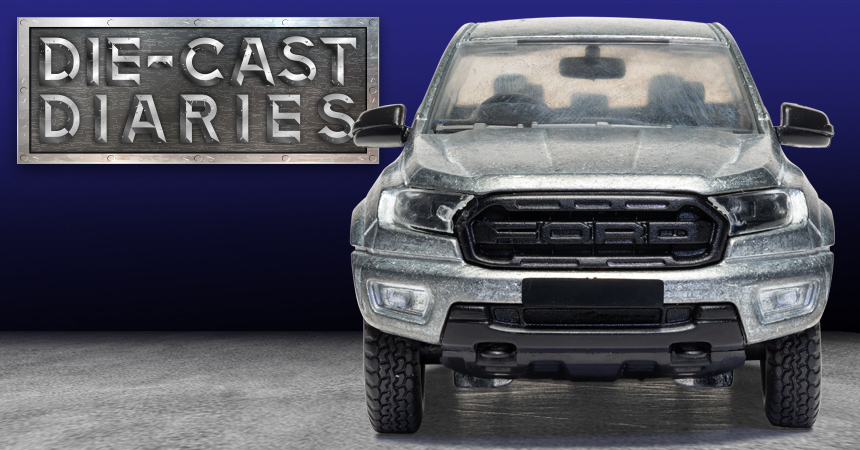
Welcome to the latest edition of Corgi Die-cast Diaries, your regular blog review of all the news, updates and topical stories from the captivating world of Corgi die-cast model collecting.
The dark nights may now be well and truly upon us, but as far as the Die-cast Diaries blog is concerned, it's very much business as usual and we will be illuminating your weekend with another exciting selection of the latest model project updates. The title of this latest update may appear a little sinister to some, but fear not, the Raptor we are talking about here will only be preying on the affections of the Vanguards collectors amongst our number and this predator is particularly appealing! Our headline feature for this 110th edition is our new 1/43rd scale Ford Ranger Raptor model and we will be bringing you a host of exclusive images featuring both a first look at the metal engineering sample models which arrived at our offices recently, in addition to exclusively revealing the first livery in which this beautiful new model will eventually be released.
Although the exclusive updates above are worthy of a blog update in their own right, we have even more for you in this edition. Marking the impending arrival of three stunning and heavily pre-ordered new models, we are also showcasing a fabulous selection of exclusive images featuring advanced production sample models of one Aviation Archive subject and two new Vanguards models, all three of which are surely destined to achieve future classic release status.
We have plenty to get through, so let's begin with a large and impressive new addition to our popular Vanguards range.
A major exclusive for the Die-cast Diaries blog, a first look at the engineering sample model produced from our new Vanguards Ford Ranger Raptor tooling.
Vanguards model collectors will certainly attest to the fact that over recent years, their favourite model range has benefitted from significant new tooling investment and whilst they may not always agree with every new tooling project announced during that time, they surely can't be against the support the range has been receiving. The addition of new model tooling projects to any Corgi range will always be the stimulus for passionate debate and whilst we are fully aware that no subject decision is likely to appeal to every collector, as long as we keep introducing new model and keep the range moving forwards, then surely that has to be a good thing.
Within the recent crop of new tooling projects announcements, one new model has quite literally muscled its way into the picture, demanding that it be considered for die-cast immortality, whilst at the same time providing Vanguards collectors with something just that little bit different, the Ford Ranger Raptor. The purposeful Ford Ranger Raptor series is a range of vehicles which began life as a successful series of compact pickup trucks, but as its name suggests, was always intended to be a range which was a little more ‘exciting’ than your average pickup truck and one which people of a more adventurous nature might well aspire to owning. A muscular series of work, utility and aspirational vehicles, these modes of transport are not for the fainthearted, but despite their rugged nature, also possess more than just a little aesthetic appeal.
More image exclusives featuring the recently received engineering sample model produced using the new Vanguards Ford Ranger Raptor tooling.
Arguably not your usual Vanguards fare, the Raptor project has been a really interesting one for us and as we are now advancing through its development at quite a pace, we can say that the more time we spend with it, we absolutely love it and we think you will too! One of the most pressing issues we have been pondering throughout this process is whether this mighty model would fit inside a standard Vanguards box, or if it was going to be so big that it would require the production of a new, larger display case. Thankfully, we can now report that the Raptor does fit in a Vanguards box, but only just - there is not much oxygen in there, it's definitely all Raptor.
This latest project update is a significant one for the Corgi team, the first time that our designers have seen the Ford Ranger Raptor tooling committed to metal and a stage in the process which requires meticulous close inspection and the creation of feedback reports for the tooling manufacturer. The images we are exclusively showing here all feature this first metal engineering sample produced from the tooling, a model we had to physically prize from the grasp of our engineers in order to take this selection of photographs. Whilst a significant development for the project as a whole, this new model is still very much in the development phase and whilst we knew you would all be interested to see the model at this stage, we do have to stress that it is not yet the finished article and may still be subject to quite a number of changes and improvements.
Highlighting the fact that this is still essentially a prototype model, the clear parts have not been polished and have that scratched, almost milky appearance about them, whilst the casting itself still displays the odd raised ridges, which will not be present on production models. Nevertheless, this is a very impressive model and we are very much looking forward to adding the Raptor to our ever expanding Vanguards range.
From a modern motoring heritage perspective, if you have an opportunity to look through the promotional material produced to support the current range of Ford Ranger vehicles, it leaves you in absolutely no doubt that this muscular vehicle is targeted at several different market opportunities. Clearly, businesses which require the lugging of heavy loads, often in off-road conditions, will be the main target for Ford here, whether that be as a hard-working agricultural vehicle with endless applications, or as a go-anywhere mode of transport for people working in more rural locations. Having said that, once it had benefitted from a good clean, this stylish pick-up would certainly not look out of place in any city centre, as it takes its driver to their latest business meeting, with its stylish exterior matched by interior fittings which make this almost as luxurious as any executive car.
And then there is the Raptor itself - all of the above and so much more! A top of the range vehicle, the Raptor is a real head-turner and one which you could imagine being driven by ‘very cool people’, or those wishing to appear so. Owning a Raptor is a real statement of style and adventurous nature, people who don’t necessarily like to conform, or have interests which may be a little more active than most - even if you are not a rock climber, MMA fighter or professional rugby player, if you own a Raptor, people will think you might well be. The ultimate incarnation of the Ford Ranger line, the Raptor is aimed at those who are looking to combine the ability to take their lives ‘off the beaten track’, without having to compromise on either luxury, performance or style.
With the ability to go where other forms of transport wouldn’t dream of venturing, the Raptor has been designed to excel in these challenging environments and is described as a street legal derivative of an off-road competition vehicle - how could you not want one of those? Even though it possesses all the credentials to be an off-road winner, it is surely on our normal roads where this vehicle will find its strongest sales support, as it is the very embodiment of a ‘don’t mess with me’ type of vehicle. With its stunning good looks and purposeful styling, you would expect to see footballers, athletes and aspiring boxers behind the wheel of a Raptor, because just like them, this beast has been bred to perform. It truth though, it is probably just someone who wants to drive a rugged and stylish vehicle who will find themselves thinking Raptor in the Ford showroom.
The blog exclusives just keep on coming, this time featuring the artwork file produced to support the first release from the Raptor tooling.
Before we leave the subject of our new Ford Ranger Raptor tooling, we just wanted to end with yet another exclusive image, this time showing you all the decoration guide produced for the first release from this tooling. Perfectly underlining the huge appeal of the vehicle, this Performance Blue beast is a real treat for the eyes and shows off the muscular physique of this motoring monster off to a tee - in fact, this was the vehicle Ford made available to motoring journalists when they were reviewing this Raptor for their publications and social media channels. For that reason, this is actually quite a famous and high profile vehicle.
A stunning and rather generously sized future addition to the Vanguards range, we look forward to bringing you the next update from this project, which will hopefully be sight of the first decorated pre-production sample model produced from this new tool. Until then, we hope you have enjoyed seeing these latest update pictures.
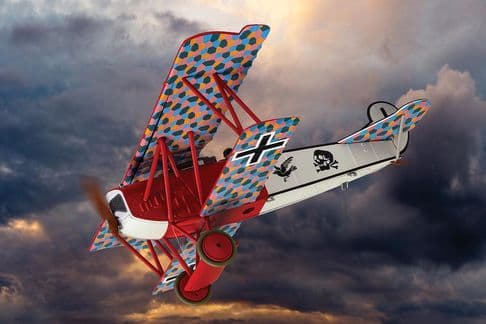
A future Aviation Archive classic, this latest release from our 1/48th scale Fokker D.VII tooling is a real beauty.
Our 1/48th scale series of fighting aeroplanes of the Great War has long been a favourite with die-cast collectors and even though there are now many fantastic models in this series, the latest September to December range announced the impending addition of two absolute classics. Illustrating the development of Luftstreitkräfte fighter technology throughout the First World War, our two latest additions to this range are the stunning black Albatros already featured within a previous blog and this magnificent Fokker D.VII, an example of a fighter which is widely regarded as being the most capable and effective fighting aeroplane of that era.
Whilst admiring these models, please do spare a thought for our poor development team, who have to make the recommendations made by our researcher into die-cast reality and when looking at this beautiful scheme, you can see that this is actually no mean feat. We could be asking them to reproduce a standard fighter of that period, with relatively simple single colour camouflage on the upper and lower surfaces, but where would the fun be in doing that? Part of the appeal of this era of aviation is the flamboyant presentation of many aircraft which duelled above the trenches of the Western Front, particularly those which wore the Ritterkreuz of the Luftstreitkräfte and scale representations of these have proved incredibly popular with collectors over the years. Scheme options such as this fighter flown by ace pilot Kurt Monnington are such appealing additions to the range that we have to consider including them, however, schemes such as this are both challenging and costly for our development team to reproduce, so we remain grateful for their highly professional support. This is perhaps just as well, because we have plenty more appealing schemes from where these came from!
Undoubtedly one of the finest fighting aeroplanes of the Great War and definitely the most capable fighter to ever see Deutsche Luftstreitkräfte service, the Fokker D.VII was developed in response to the introduction of several new Allied fighter types, aircraft which gained a hard fought superiority of the skies over their German opponents. Aircraft such as the Sopwith Camel and Royal Aircraft Factory SE5a had managed to turn the tables on the Luftstreitkräfte in the skies over the Western Front and the Germans knew something had to be done. The Military Aviation Bureau decided to hold a major competition to find a new fighter to redress this imbalance, inviting all the major aviation manufacturers, plus a few smaller companies, to send their aircraft for evaluation by current air aces, with the victorious aircraft almost certain to go into immediate production.
Famous Dutch designer Anthony Fokker was sure that a design he had been working on was capable of winning this competition and instructed his talented lead designer Reinhold Platz to head the project, using all means at his disposal to have the aircraft ready in time. The new aircraft incorporated everything he had learned whilst designing combat aeroplanes, in addition to including some innovations never previously seen on an aircraft to that point, ensuring this machine had the best chance of success. Crucially, although initially intended to be powered by a rotary engine, the availability of the Mercedes D.IIIa engine gave the Fokker team access to a powerful, proven engine, which would allow for trouble free operation, something which would be crucial if this aircraft was to be introduced in large numbers and to have a combat impact.
The prototype aircraft was delivered to the Adlershof airfield near Berlin for the trials in January 1918, where it was pitted against around thirty other competing aircraft, which interestingly included several other Fokker designs. Flown by some of the leading air aces of the day, including the Red Baron himself, Manfred von Richthofen, their D.VII design emerged victorious, after receiving enthusiastic support from von Richthofen and an initial order for 400 machines was placed immediately. With the aircraft proving to be everything the Luftstreitkräfte had been hoping for, the Fokker company were simply incapable of manufacturing the number of fighters required, so a deal was struck to allow their long-time competitor, Albatros Flugzeugwerke, to build the Fokker D.VII under licence. Eventually, three factories would be employed in producing this magnificent fighting aeroplane, Fokker at Schwerin and Albatros at Johannisthal and their subsidiary factory at Schneidemühl in Poland (OAW - Osterdeutsche Albatros Werke).
The model images we are showing here feature an advanced production sample model of the latest Fokker D.VII, a model which will be gracing our display shelves very early in the New Year.
On making its combat introduction, the Fokker D.VII came as an unpleasant surprize for Allied airmen. With an appearance which was neither as streamlined as the Albatros D.Va nor as menacing as the Fokker Dr.1, the new fighter looked almost agricultural in comparison, with its thick wings and boxlike fuselage. This appearance was extremely deceptive, as the D.VII was a thoroughbred fighting machine and Allied airmen quickly learned to respect their new aerial adversary. Possessing ample power and exceptional low speed performance, reports started to circulate that the D.VII could almost hang vertically on its propeller, firing at Allied aircraft from below, then diving away to build up speed for its next attack.
As greater numbers of this capable new aircraft began to appear over the Western Front, so German victory tallies began to increase and Allied airmen were once more forced into an attritional battle for aerial superiority above the trenches. In August 1918 alone, Fokker D.VIIs accounted for no fewer than 565 Allied aircraft destroyed, quickly earning such a fearsome reputation that it would later become a specific requirement of the armistice terms delivered by the Allies - all remaining Fokker D.VIIs must be surrendered to the Allies.
The Ravens
In contrast to the relatively drab presentation of many Allied aircraft operating over the Western Front during the Great War, Luftstreitkräfte units routinely presented their aircraft in brightly coloured and highly distinctive markings, mainly for reasons of combat recognition, but also in part to highlight their confidence and fighting prowess. It is, however, sobering to think that these markings were applied on to nothing more than doped linen and how these intrepid airmen had absolutely no protection from gunfire or explosion whatsoever. Indeed, during the melee of a swirling dogfight, a pilot was in as much danger of being hit by a stray bullet from a friendly machine gun, as he was of being struck by the enemy.
The intricate livery on this latest Great War aviation release challenged our development and manufacturing teams, but they certainly rose to that challenge - it is simply stunning!
In what was rather an unusual occurrence, Royal Prussian Jasta 18 went through an unprecedented change in March 1918, when the unit's commander Rudolf Berthold took all of the pilots under his command with him, when he was transferred to another unit. This left new commander August Raben with a collection of relatively inexperienced pilots and a posting to the heavy fighting near Lille, but despite some early setbacks, soon saw his unit's victory tally increasing. Jasta 18 were known as the 'Red Noses' for obvious reasons, but under Raben's command, he changed the colour of his aircraft from the previous blue to predominantly red and white. The unit's insignia of a black raven was retained, as this was strikingly similar to the personal emblem he carried on his own aircraft (after his surname) - most of the fighters of Jasta 18 would carry the black raven on either side of their fuselage.
In addition to carrying the black raven on the side of his aircraft, Hamburg native Kurt Monnington also painted a sinister skull and crossbones on his aircraft, a personal emblem which was related to the Army unit with which he began his military career and where he won the Iron Cross 2nd class. Embarking on his flying service with a reconnaissance unit, Monnington would not score his first aerial victory until joining Jasta 18 and 'Staffel Raben' in March 1918, but would end the war with eight confirmed victories, the majority of which were scored over British bombers. Initially flying the Albatros D.V on joining Jasta 18, he took delivery of his new Fokker D.VII fighter during the following May and would use this aircraft to score all his aerial victories.
One to look out for, as you would expect, the new Fokker D.VII will be presented in our Great War packaging.
Surviving the war, Monnington passed away in his native Hamburg in February 1939 aged 47, however, his name was circulated once more many years later, when his great nephew made a request for information relating to his pilot relative on various enthusiast websites. It appears that all his great granduncle's records, photographs and wartime memorabilia had been destroyed during an RAF bombing raid in 1944 and he was hoping that historians and enthusiasts could help him with the creation of a contemporary record of his Great War flying service. Hopefully, he found what he was looking for and that this model might make for something of a fitting addition.
This stunning new model is being shown here in advanced production sample form and as such, we can expect this beauty to be with us and taking its place within our collections in the not too distant future - with current manufacturing and shipping schedules, it is looking as if the Fokker D.VII will be with us in the first week of the New Year. This is a model many blog readers will be looking forward to adding to their collections, perhaps even including Kurt Monnington's great nephew - wouldn’t one of these be a great addition to his tribute collection.
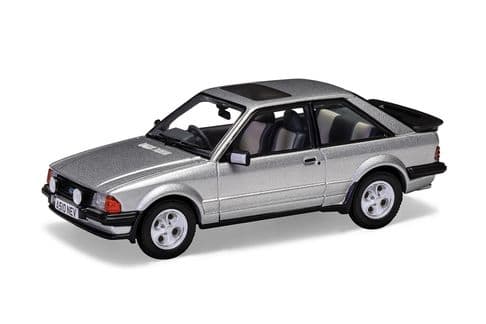
Vanguards collectors will be delighted to see this scale representation of one of the most popular cars to grace Britain's roads, the stylish Ford Escort XR3i.
For many people here in the UK, the Ford Escort Mk.3 XR3i was the absolute pinnacle of motoring desirability, stylish and functional, but above everything else, relatively attainable for many thousands of people. A real hit with younger generations, the XR3i would enjoy something of a cult status and if anyone was silly enough to ever part with one, a buoyant second hand market ensured that this car would not be on the sales forecourt for long. If you were seen behind the wheel of an XR3i, you were regarded as a connoisseur of popular motoring, somebody who needed to get around, but felt they need to do so in style.
The Mk.3 Escort was first released to the UK market in September 1980, a completely redesigned car from its best-selling predecessor and one intended to directly compete with some popular motoring heavyweights, namely the Volkswagen Golf, Honda Civic and Peugeot 205. The model which caught everyone's eye was the XR3i, a feisty little number which was both stylish and comfortable and when combined with aggressive pricing, soon became the aspirational motoring purchase for many people. The car's good looks were enhanced by the addition of cloverleaf alloy wheels and black spoilers to the front and rear, and with the two door bodyshell giving the car a real sporty feel, is it any wonder that the XR3i went on to become something of a motoring classic.
VA11017 - Ford Escort Mk3 XR3i Strato Silver
The Mk3 Escort range was launched in the UK on September 3rd, 1980, and the bold new XR3 appeared within weeks. It was designed as Ford’s entry into the keenly fought hot hatch market and was promoted as having been partially developed by three-time F1 World Champion Jackie Stewart. An appealing mix of performance, style and practicality, it offered supreme value for money and was an immediate sales hit. A revised model, the XR3i, appeared in October 1982 and was developed by Ford’s Special Vehicle Engineering department in Essex. It featured Bosch K-Jetronic fuel injection in place of the original’s Weber carburettor, stiffer springs and gas-filled Girling dampers which improved the ride and handling.
These advanced production sample images highlight the fact that this stunning model will be available before Christmas.
The XR3i we have modelled here was ordered from Ford main dealers RT Rates, of Grays, Essex, by local man William Fitzgeorge, who specified two extras for his new car - a sunroof and tinted windows. It was registered on August 10th, 1983, then serviced regularly by Rates and was always stored in a dry garage. The first owner kept the car for 29 years until it was involved in a small incident in 2012, which resulted in damage the nearside front wing. The lightly damaged car was purchased in November 2012 by Essex-based fast Ford enthusiast Peter Steele, who had the damage professionally repaired and returned the car to roadworthy condition by the spring 2013. Since then, the car has become well known within Ford XR Owners Club circles and has been used for classic car events all over the country.
This beautiful model will be of interest to anyone who has ever owned an XR3i in their lives and as it is due to arrive in our warehouse at the beginning of next month, will make for an ideal stocking filler for the Vanguards collector in your life.
When it comes to motoring good looks, the classic Triumph TR5 is in a league of its own - unfortunately, it has an army of admirers, so picking one up could prove to be an expensive acquisition.
I have to admit that my real passion is most certainly for aeroplanes and as such, rarely do I ever get excited about a car. Having said that, if I was ever fortunate enough to be in a position to own a classic car, that car would definitely be a Triumph TR5 a real classic which I find absolutely irresistible. Unfortunately for me, I am not the only one to be attracted by the stunning good looks of these beautiful cars and if you are lucky enough to find a pristine example, you will be paying a lot of money to be able to call it your own!
The styling of early Triumph TR sports cars was as distinctive as they were difficult to resist, with their high set headlights and classic grilles giving these small sports cars a real personality, even giving their front profile a face-like character. Continually developed following their original launch in 1953, these British built sports cars would benefit from many internal upgrades over the next eight years, however their external appearance would remain largely unchanged, with only cosmetic changes needed to maintain the charm of these stunners.
The launch of the new TR4 model in 1961 saw the introduction of a new and even more appealing body design, a design created by Giovanni Michelotti and making this already attractive vehicle look absolutely irresistible, the birth of one of the truly classic post war small sports cars. Their popularity ensured that when the car was due for another re-style, the same designers were obviously approached to take on the task, however, existing project commitments dictated that they were unable to take on this work. Triumph then approached the German coachbuilder Karmann with the task and sent a pristine example of a TR4A to their facility, to act as a development template. The resultant car would be the Triumph TR6, but that is not the model attracting our interest here.
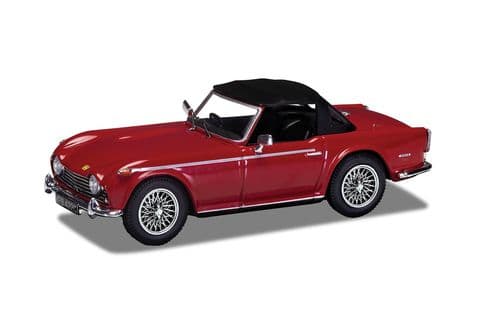
Another advanced production sample exclusive, this new TR5 will surely go the same was as all previous releases and disappear in no time!
Small but powerful, a quintessentially British Sportster with Italian styling influence, the Triumph TR5 was only actually produced for a short period during the late 1960s and was visually quite similar to its predecessor. A stylish and extremely attractive little car, make no mistake, this was a bit of a beast and was powered by a straight 6 2.5 litre engine which featured fuel injection - in fact, Triumph claimed that the TR5 was the 'First British production sports car to feature petrol injection'.
From a relatively low production run of just 2,947 cars, 1,161 would be destined for the UK market and as you might expect from a car which possesses such stunning good looks as these, those cars have become highly sought after in recent years and if you can find a nice example available for sale, you will be paying an awful lot of money to be associated with this particular classic. Extremely rare and with the reputation as being the fastest TR ever produced, is it any wonder that the classic motoring world just loves a TR5! Trust me to go and fall for a rare and expensive classic.
VA11510 - Triumph TR5 Signal Red
The Triumph TR5 modelled here was built on Thursday September 12th, 1968 (exactly a week before the last TR5 left the production line), and despatched to Lankesters Limited, Kingston-on-Thames on the 26th. It’s believed that the second owner of the car, in around 1969 was a Guildford-based David Jacobs who may or may not have been the famous DJ and TV presenter… Ray Gill, of specialists ‘TR Improvements’, would later sell the car to Dorset-based TR enthusiast Tim Toogood in the summer of 1979. He used it for his honeymoon, with his new wife Sam christening the car the ‘Waste Paper Basket’ by virtue of its WPB number plate. The Toogoods sold it in late 1987, by which time it had covered over 80,000 miles and was in need of restoration.
In 1989, the car was purchased by London-based Christopher Lillingston-Price who stripped and partially restored the car but was unable to finish the job. In July 2011, Nottinghamshire-based enthusiast Conrad Hunt bought it and finished the restoration to an extremely high standard. It was returned to the road in 2014 and featured on the front cover of Practical Classics magazine in August 2017, where it starred in a feature celebrating the 50th anniversary of the TR5 which compared it with two period rivals, the MGC and Austin Healey 3000. Somerset-based enthusiast Huw Boyce purchased it in July 2018, achieving a lifetime’s ambition in the process, as he had wanted a TR5 since owning a Spitfire in his youth. He is also an enthusiastic member of the TR Register.
A final look at a future Vanguards classic, if you are not captivated by the stunning good looks of the Triumph TR5, we need to be taking a long hard look at ourselves in the nearest mirror.
An absolutely beautiful new model and one which is sure to sell out very quickly, this latest TR5 release is also due to arrive as soon as we all come back to work in the New Year, so it will be keeping the Fokker D.VII company - two stunning models to start 2023!
We are afraid that's all we have for you in this edition of Die-cast Diaries, but we will be back as usual in two weeks' time with a further look at all the latest Corgi model developments, project updates and exclusive image reveals. Between editions, we are always interested to hear your views on all things Corgi, so if you feel like dropping us a line to comment on anything blog or Corgi model related, or indeed to suggest a topic you would like us to include in a future edition, please feel free to do so at diecastdiaries@corgi.co.uk.
If you can’t wait for the next blog, you will find plenty of Corgi model collecting discussions taking place on our official social media channels, access to which can be obtained by clicking on the respective links at the foot of the Corgi website homepage.
Link access to Corgi social media sites.
Thank you for continuing to support our Die-cast Diaries blog. Our next edition is scheduled for publication on Friday 2nd December - where has this year gone?