
Welcome to the latest edition of Corgi Die-cast Diaries, your regular blog review of all the news, updates and topical stories from the captivating world of Corgi die-cast model collecting.
We have something very special to bring our readers in this Easter weekend edition of our Die-cast Diaries blog, as we mark the release of our latest new tooling addition to the Corgi Aviation Archive model range in some style. Featuring our usual selection of exclusive imagery in support of the update and the inclusion of a new video posting, we will be celebrating the release of our new 1/72nd scale Supermarine Spitfire T.9 model at the airfield which is arguably the one most closely associated with the Spitfire, a location which has been described by Historic England as the most famous fighter station in the world, the former Royal Air Force Biggin Hill.
Thanks to the ongoing support of the Spitfire experts down at the Biggin Hill Heritage Hangar, we were extremely privileged to be allowed to film our model unboxing video on the wing of the actual aircraft we scanned at the outset of this project and the one in whose markings this first release is presented in. As you may imagine, this was a very special occasion for the entire Corgi team and as such, we will be devoting this entire blog to bringing you all the details from this first scale representation of a Spitfire T.9 as a collector's die-cast model release and to the unveiling day down at the Biggin Hill Heritage Hangar itself.
It's time to put down all those chocolate eggs, grab your flying helmet and prepare to make your first Corgi Spitfire T.9 logbook entry - it's chocks away for our new Supermarine Spitfire T.9 TE308 'Grey Nurse' launch.
One of the most distinctive airworthy Spitfires in the world today, the fact that this is a two-seat variant of this famous aircraft means that people are now able to experience the thrill of flying in arguably the most famous aircraft to have ever taken to the skies.
When charged with undertaking the maiden flight of the then prototype Supermarine Type 300 from Eastleigh Aerodrome on 5th March 1936, test pilot Joseph Summers could hardly have imagined that he was opening a chapter in the aviation annals which would be unmatched by any other aircraft, a machine which would go on to be quite simply the most famous aeroplane type the world would ever know. Landing the aircraft after only eight minutes in the air, he was reputed to have yelled at his flight crew, "Don't change a thing", however, the context in which this was meant has been the subject of some debate ever since. What certainly isn't up for debate was the performance of this new aircraft, the development of which proceeded essentially as a private venture, but in response to an Air Ministry requirement for a new high performance, single engined interceptor fighter for the Royal Air Force.
This first Spitfire would undergo a series of modifications and refinements over the six months which followed and would become the production blueprint for the early marks of Spitfire destined to reach RAF squadron service, but significantly, would be the first of almost 23,000 Spitfires and Seafires to be built, helping to establish an aviation legacy which is unmatched by any other aircraft type. Interestingly, the performance of prototype K5054 impressed the Air Ministry so much that an order for 310 fighters was placed even before the full test programme had been completed, however for that prototype aircraft, tragedy would strike on 4th September 1939 at Farnborough, when it was written off in a fatal crash, the day after Britain had declared war on Germany.
When the new Spitfire began arriving at RAF airfields from early August 1938, squadron pilots must have marvelled at the sight of this sleek new fighter, if being secretly a little trepidatious about making their first flight in one. Their usual mounts were the latest biplane fighters of the day, aircraft such as the Gloster Gauntlet, which whilst itself was a fast and manoeuvrable interceptor, could hardly have been more different to a Spitfire. In contrast to their open cockpit, fixed undercarriage and bi-wing design, the Spitfire brought with its sleek monoplane design, a fully enclosed cockpit, retractable undercarriage, eight wing mounted machine guns and perhaps of greatest significance, a maximum speed increase of over 130 mph. In aviation terms, this really did represent a quantum leap in aviation performance and sooner or later, these young pilots would have to try and tame this beast of an aeroplane.
For an aircraft which clearly represented the future of the Royal Air Force and one which was such a huge advancement in aviation technology, it can be surprising to learn that the RAF gave little thought to the production of a two seat training variant of their new fighter. As the first aircraft began arriving with front-line squadrons, they appeared to have great faith in the abilities of their young pilots in their ability to make the transition from biplane to world-leading monoplane fighter. Reading the accounts of pilots who were serving during this tumultuous period, many described how they were petrified of the Spitfire and how some even felt as if the aeroplane was telling them that it wanted to kill them during their first experience of it.
They had negotiated one of the finest and most robust flight training programmes in the world at that time, however, they were going to have to bring all their training and experience to bear, plus copious amounts of courage and resolve if they were going to get over this particular technological hurdle and quickly, as the war clouds were gathering ominously in Europe. So, the young men or the RAF were going to have to read their pilot's notes, pay attention during ground study classes and listen to the instructions given by those already converted to Spitfires who were showing them around the cockpit instrumentation layout, because their first flight in a Spitfire was just around the corner and it would also be a solo affair.
From this angle, it's difficult to tell that there is something very different about this particular Spitfire.
Thankfully, once most pilots had experienced time in a Spitfire and coped with how everything had to be done more quickly and decisively than on the types they had flown previously, especially during take-off and landing, they found that the new fighter was a delight to fly. Of course it had its vices and potential problem areas, but if you had your wits about you and were professional in your preparation, the Spitfire was your friend and not your foe.
The subject of two seat training variants of the Spitfire didn't officially rear its head until after the end of the Second World War and with stories circulating about 'unofficial conversions' carried out on several Spitfires supplied to the Soviet Union under Lend-Lease and with a rather famous two seat 'hack' having been operated by RAF No.261 Squadron in the Middle East. The Vickers Supermarine Company revived their interest in producing a two seat dual control variant of the Spitfire as a private project and in 1946, selected a Spitfire Mk.VIII airframe (MT818) as their donor aircraft. In fact, one of the most interesting facts regarding the two seat Spitfire variant is that there is no such thing as a new build Spitfire T.9 trainer - every single example in existence was originally manufactured as a single seat fighter variant prior to modification.
In early 1947, two seat Spitfire MT818 was sent to Boscombe Down to undergo handling trials and whilst it performed extremely well, the lack of interest shown by the Ministry of Defence effectively ended any hope of large scale production of the aircraft - at that time, the Royal Air Force only had eyes for jet power. The aircraft would be retained by Vickers Armstrong and used for promotional and demonstration purposes, even being allowed to enter several high profile air races around the country. She would eventually be sold to new owners in the US, but in a fascinating turn of aviation fate, now resides as part of the Biggin Hill Heritage Hangar collection, the historic two seat Spitfire which started the flight opportunity phenomenon we all know about today.
With the release of this newly tooled model, Corgi are helping to tell this particular post war story of the Spitfire in die-cast for the first time, at the same time highlighting why the two seat variant is doing a fine job in preserving the legacy of this famous aeroplane and introducing its many qualities to a new, younger generation of admirers.
The question on many a die-cast collector's lips will be, "Why the T.9?" when it came to the announcement of our latest Spitfire new tooling project, particularly as this is a later, arguably civilian incarnation of the aircraft. The simple answer has to be because nobody had done it in die-cast metal before and with so many of these aircraft now in world skies, surely they were worthy of scale recognition and would be of interest to many.
It remains an undeniable fact that despite the passage of time, the popularity of the Spitfire shows absolutely no sign of waning and how its iconic status appears to have effortlessly traversed generational boundaries over the past eighty-seven years. When attending Airshows in an official capacity, it really is interesting to hear the responses of younger modellers and collectors when asked to name their favourite aircraft. Despite the fact that most operational RAF examples of the aircraft (obviously not including the aircraft of the BBMF) were withdrawn from service several decades before they were born, 'Spitfire' is invariably the answer most will give.
A beautiful design to look at either in the air or on the ground, the aura surrounding the Spitfire is as captivating today as it was when it was saving the nation during the Battle of Britain (let's not get into that discussion Hurricane fans), and the fact that we can all enjoy the sight of relatively large numbers of airworthy examples of these magnificent aircraft in Britain's skies today means that the Spitfire is still relevant to grandparents, parents and children alike, very much the aviation icon for the ages.
With all this being the case, if large sections of the population had the opportunity to take a once-in-a-lifetime flight experience in a famous World War 2 era aircraft, surely wouldn't that plane of choice be a Spitfire. Perhaps this was the reason why just a few short years ago, almost every Spitfire under restoration was being converted to T.9 or two seat variant standard, with the ability to offer Spitfire experience flights now becoming such a popular and extremely lucrative business. In any case, this is clearly the only way most of us are ever going to have a chance to fly in this iconic aircraft.
With two seat Spitfires now such a common sight in Britain's skies and also appearing regularly as Airshow display acts, these aircraft are now a much loved variant of this famous aircraft in their own right, effectively maintaining and even enhancing the legacy of this magnificent aeroplane, bringing R.J Mitchell’s classic design to the hearts and minds of a new generation of Spitfire devotees. Under such circumstances as these, who wouldn't want a beautifully detailed die-cast scale representation of this most famous of aeroplanes as part of their model collection, well, that was our thinking anyway.
Few would argue against this magnificent aircraft being described as one of the most distinctive aircraft currently in British skies and as such, it really did need to be inducted into the Corgi Aviation Archive collector's Hall of Fame.
Spitfire homage in die-cast metal, this stunning new model is now available and winging its way into model display cabinets everywhere.
With the first of our new Supermarine Spitfire T.9 models currently winging their way to new homes all over the world, we wanted this latest edition of our Corgi development blog to mark this proud achievement for us and to cover some of the many fascinating features relating to how this beautiful new model became part of the Aviation Archive range. Without doubt, one of the most interesting facts relating to its design must be how this new model was produced having had the opportunity to LIDAR scan the actual aircraft this first release is a scale representation of, thanks to the kind assistance of the good people down at the Biggin Hill Heritage Hangar. Significantly, this is the first time that either Corgi or our sister brand Airfix have ever scanned a Spitfire when producing a new tooling project of this famous aircraft, something our new model will always be able to boast.
Previously, every one of our scale Spitfire models had been produced using genuine Vickers Supermarine drawings and technical specifications during the design phase, just as the real aircraft were manufactured during WWII, but in scale model/kit form. The LIDAR scanning of a new tooling subject may be a modern way of providing a product designer with the accurate information they will need at the start of any new project, however, robust research and the use of original technical drawings (where available) remains of crucial importance to them. Interestingly, in the case of our new Spitfire T.9 project, when our scan data was scaled down and had the original Vickers Supermarine drawing files overlayed on top of them, they were almost an identical match, something which provided us with dual research confidence in our design.
Another interesting aspect of scan day was how our friends at the Biggin Hill Heritage Hanger could hardly have been more helpful, rearranging their fabulous collection of aircraft to allow as much space around Spitfire T.9 TE308 for our researcher Luke to complete his scanning work. The scanning process actually captured the unique markings carried by this most distinctive of Spitfires, a clear indication of just how much detail the current incarnation of this equipment is capable of gathering and something which is only going to become yet more effective in time.
Once Luke had finished his work, TE308 was almost immediately pushed out of the hangar to go through her pre-flight checks, because just minutes after providing the data for our new 1/72nd scale Supermarine Spitfire T.9 model tooling, she was in the skies of Kent taking another lucky customer on their flight experience of a lifetime, something we as a team will always remember. I'm certain that one of these models is destined to be displayed in his home in the very near future, particularly as he was the first passenger in TE308 after she had discharged her scanning duties.
Before going on to look at our latest visit to the Biggin Hill Heritage Hangar and our new model unboxing day, let's take a final look at the release details behind this latest addition to the Aviation Archive model range.
As one of the most successful fighter aircraft of the Second World War and one which was produced in huge numbers, it can be a little surprising to learn that the Supermarine Spitfire was not produced as a two-seat training variant during the war, meaning that pilots converting to this awesome machine would be making their first flight in the Spitfire as their first solo. The Vickers Supermarine company did propose the development of a two seat variant of the Spitfire to Air Ministry officials as far back as 1941, but as there was no official support for the project at the time, they simply returned to further development of single engined fighters.
Once the war had ended, stories of unofficially modified two seat Spitfire projects started to circulate, with the ones produced by the Soviet Air Force being perhaps the most significant. Britain would eventually supply Russia with more than 1000 Spitfires and it was discovered that they actually converted several Spitfires to two seat configuration, however, rather than moving the front cockpit slightly forward as Vickers Supermarine would later do, the Russians elected to simply add a second cockpit behind the existing one, using a narrower section of the fuselage. Making these aircraft extremely distinctive, this must also have created a rather claustrophobic working environment for the second pilot.
With this information in hand, Vickers Supermarine revived their interest in producing a two seat Spitfire as a private venture and in 1946, selected a Spitfire Mk.VIII airframe as their donor aircraft. In fact, one of the most interesting facts about the two seat Spitfire variant is that there is no such thing as a new-build Spitfire T.9 trainer, because every single example was originally manufactured as a single seat fighter.
Something of a post war phenomenon, the two seat Spitfire did attract several military operators over the years, including the Irish Air Corps, however, it has been during the warbird restoration era and more specifically over the past two decades that the popularity of ‘Spitfires made for two’ has really become established. As arguably the most famous aircraft of all time, the ability to boast that you had flown in a Spitfire used to be the preserve of talented and extremely fortunate pilots, however, as they now had the opportunity to carry a passenger, the chance to fly in a Spitfire was now open to anyone and there has been no end of people desperate to claim their Spitfire flying experience.
Today, offering Spitfire experience flights has become an extremely lucrative business, to a point where only a few years ago, almost every Spitfire under restoration was being converted to T.9 or two seat Spitfire standard. These aircraft are now much loved in their own right, regularly appearing at Airshows, in addition to operating in all but the poorest weather conditions, taking its latest lucky passenger on their Spitfire experience flight of a lifetime. These Spitfires made for two are maintaining and even enhancing the legacy of this magnificent aeroplane, bringing R.J Mitchell’s classic fighter to the attention of a new generation of Spitfire aficionados.
The production of any new addition to the Aviation Archive range gets underway with the creation of an artwork file, one which after checking, will be used as guidance during manufacture.
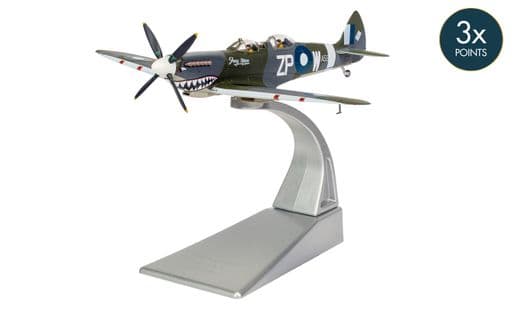
After checking files, artwork, prototype and pre-production sample models, you end up with a beautiful representation of your subject, in this case, the first die-cast example of a Spitfire T.9 in 1/72nd scale.
Stunning from every angle, until we have saved up for our own Spitfire experience flight, this new model will have to serve as our inspiration to keep saving.
Supermarine Spitfire TE307 was originally constructed as a Mk.IXe fighter variant in 1945, but due the end of the war in Europe, was immediately placed in storage, where she would remain for the next five years. She was then selected as a conversion airframe to T.9 trainer standard, initially earmarked for service with the Egyptian Air Force, but when that sale fell through, would embark on a service career flying with the Irish Air Corps. Following retirement and service disposal, she would go on to be used during the filming of the famous movie 'The Battle of Britain', before moving into private ownership and periods spent with different owners in France, Canada and the US over the next few decades. She would later be purchased by Warbird Experiences at Biggin Hill and returned to British skies at that time wearing the standard RAF wartime day fighter scheme the Spitfire is so synonymous with, however, she was about to take on a very different aviation persona.
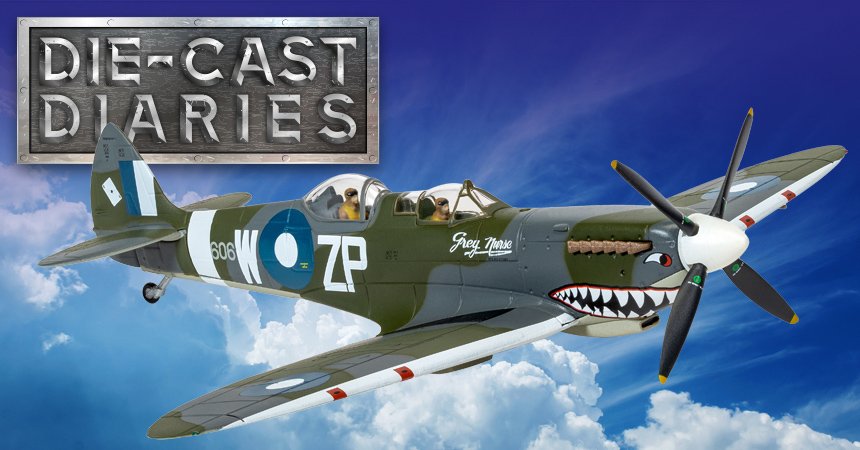
In a development which saw this aircraft become one of the most distinctive airworthy Spitfires in the world today, T.9 TE307 was given a smart new scheme in honour of the fighters flown by the men of No.457 Squadron Royal Australian Air Force during WWII. With each of their aircraft benefitting from the application of sinister looking shark mouths under the engine cowling, the unit was known as the 'Grey Nurse' Squadron and Spitfire TE307 now carries the registration A58-606 and the codes ZP-W in honour of Squadron Leader Bruce Watson, who flew with this unit.
If you would like to fly in one of the most distinctive Spitfires in the world today, you need to get in touch with our friends at the Biggin Hill Heritage Hangar and join the long queue of people hoping to have the opportunity to enjoy this unique aviation experience.
The subject of our infatuation, when a Spitfire looks this good, you just have to make a new die-cast model collectable of it.
All the above information sets the scene rather nicely for the main subject of this latest update. Early last month, a small Corgi team braved snowy conditions (and for one of us, a gruelling 520 mile round trip) to make our latest pilgrimage to the Biggin Hill Heritage Hangar for a very special reason, not only to spend some more quality time in the company of a particular Spitfire T.9 which has become quite special to us, but also to be able to show her the 1/72nd scale die-cast model tribute we had made to her. Once again, we were indebted to our friends at the Biggin Hill Heritage Hangar who not only allowed us access to their facility during their busy winter maintenance schedule, but also for indulging us with our latest request.
Marking the culmination of a project which began back in 2021, one which has since involved so many people here at Corgi, in addition to benefitting from the invaluable assistance of the BHHA team, we were hoping to be allowed to produce an unboxing video the like of which had never previously been seen with a new Corgi tooling release. What we were hoping to be allowed to do was to actually film our new model unboxing video on the wing of the very aircraft we scanned back in 2021, the one which inspired both this entire project and the launch livery selected for its initial release.
Keeping a beady eye and some ominous looking teeth on proceedings, Spitfire T.9 TE307 was taking a keen interest in what was going on during our latest visit to the Biggin Hill Heritage Hangar.
With our videographer Dan directing proceedings on the day and with the sights and sounds of a busy maintenance hangar as our unusual backdrop, that's exactly what we were allowed to do and so very carefully, we unboxed our latest new tooling addition to the Aviation Archive range and proudly showed it to the 'Grey Nurse' Spitfire. As a little Easter treat for our loyal Die-cast Diaries readers, here's the first showing of the video result of our special day:
In addition to having this opportunity to produce a unique new model unboxing video, we also knew that the day would give us the opportunity to allow the people who had been so generous with their time and expertise over recent months to be the first people outside Corgi to see this new model in the metal. What these folks don't know about Spitfires isn't worth knowing and if they were happy with the new model, we knew we had a winner on our hands. Thankfully, our new scale die-cast tribute to one of their most popular aircraft passed this particular test with flying colours and we are delighted to confirm that AA29201 Supermarine Spitfire T.9 TE308 'Grey Nurse' Biggin Hill Heritage Hangar is now in stock and winging its way to all those collectors who had pre-orders in place.
For all those who have, or are about to take an experience flight in this most distinctive of Spitfires, you will now be able to have a beautiful scale representation of the aircraft in which you have flown as a display memento, but don't forget to get the box signed by your pilot on the day. For those of us who have still to book our own flights, this beautiful new model will inspire us to continue saving to allow us this once-in-a-lifetime experience and when we're ready, we know a friendly and professional team of people who will be only too pleased to help you fulfil this particular aviation dream.
Making the great small, this was a proud moment for the Corgi team and we were honoured to be allowed to spend it in the company of such a magnificent aircraft.
Once again, the entire Corgi team would like to extend our grateful thanks to the Biggin Hill Heritage Hangar team and in particular to Darren Dray, our contact throughout this project and a man who quite literally made everything happen for us. Finally, we hope Corgi collectors everywhere enjoy having a die-cast example of the Supermarine Spitfire T.9 in their collections - we think she's a little beauty!
A hangar full of delights, if you have the opportunity to visit the Biggin Hill Heritage Hangar facility, you will see a group of people who are passionate about the preservation, maintenance and operation of historic aircraft and a collection of classic aeroplanes you simply could not see anywhere else in the world.
We are afraid that's all we have for you in this latest edition of Corgi Die-cast Diaries but we will be back as usual in two weeks' time with a further selection of model project updates. Between editions, we are always interested to hear your views on all things Corgi, so if you feel like dropping us a line to comment on anything blog or Corgi model related, or indeed to suggest a topic you would like us to include in a future edition, please feel free to do so at diecastdiaries@corgi.co.uk.
If you can’t wait for the next blog, you will find plenty of Corgi model collecting discussions taking place on our official social media channels, access to which can be obtained by clicking on the respective links at the foot of the Corgi website homepage.
Link access to Corgi social media sites.
Thank you for continuing to support our Die-cast Diaries blog. Our next edition is scheduled for publication on Friday 21st April.