
Welcome to the latest edition of Corgi Die-cast Diaries, your regular blog review of all the news, updates and topical stories from the captivating world of Corgi die-cast model collecting.
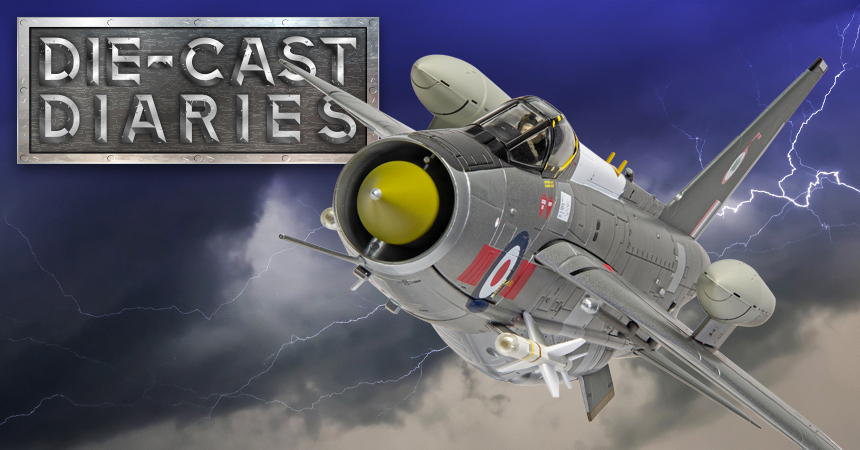
From a development and research perspective, we always like to say that there’s a story behind every one of the models selected to be joining one of the Corgi ranges, and in this latest edition of Die-cast Diaries, we’ll be doing our best to bring you a story or two relating to three impending model releases, two Vanguards models and one destined for the Aviation Archive greatness. Our latest header image sort of gives the game away as to the identity of our lead feature, as the fourth release from our beautiful 1/48th scale English Electric Lightning F.6 tooling is now showing up strongly on our release radar, and we’re excited to tell you more about it.
We will be following this up with a couple of future Ford model releases destined to be gracing the display cabinets of Vanguards collectors everywhere, both 1/43rd scale representations of hugely desirable cars from their day, and still incredibly appealing to anyone with an interest in popular cars of the 70s and 80s. We will also be bringing you a series of images taken during scan day at the Ford Heritage Centre, which will hopefully be of interest to readers, and might also tell a little development story in connection with one of our featured models in this edition.
It's time to get strapped in and for robust constitutions, because we’ll be riding the Lightning in this latest edition of Corgi Die-cast diaries, English Electric style.
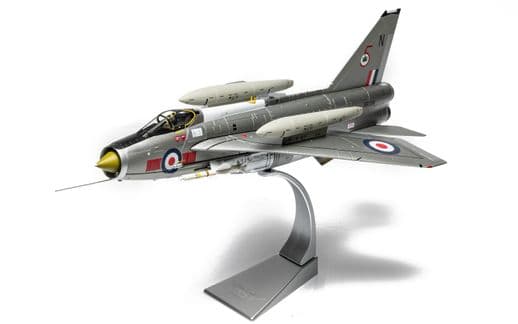
The next impending release from our 1/48th scale English Electric Lightning F.6 tooling is an absolute cracker.
As we come toward the end of a year where significant anniversaries from the Second World War years have been commemorated across the nation, it’s still very clear that our population still has the desire to remember those who gave so much during the 1940s, and remain interested in the people and machines who took part in this conflict. With history/military history programming still proving incredibly popular across all the media outlets, it appears that this is not a situation likely to be changing anytime soon, which is obviously good news for the model and die-cast manufacturing companies for whom this provides significant subject inspiration for their ranges.
From an Aviation Archive perspective, we have to concede that aircraft which took part in the Second World War have always played a significant role in the formation of any release range and continue to do so, and even though B-17 Flying Fortresses, Lancasters and Messerschmitts all still have a prominent role to play as far as our collectors are concerned, this isn’t exclusively so, particularly when talking about British jets of the Cold War era in the larger 1/48th scale.
The beginning of 2017 brought about something of a seismic shift when it comes to our popular Aviation Archive range, as our DCD blog exclusively revealed our intention to produce a die-cast model of the English Electric Lightning F6 in 1/48th scale. This represented an exciting new direction for the Aviation Archive range, and even though this was a project we’d been considering for quite some time, it did represent something of a risk for the Corgi brand, particularly as it was going to use up lots of our hard fought development capital.
All the model images being exclusively shown here all feature the pre-production sample model produced in support of this latest Lightning release, and as such, may still be subject to change.
Regarding subject matter for this new venture, the Lightning had always been our aircraft of choice, Britain’s spectacular Mach 2 interceptor and unquestionably, one of the most exciting aircraft to have ever entered Royal Air Force service. In terms of its legacy, if the Spitfire was Britain’s most famous piston powered aircraft, the Lightning was its jet powered equivalent, and even though it’s been out of service for 37 years, still holds a special place in the hearts of aviation enthusiasts.
The new Lightning model proved to be quite a challenge for our development team to take on, and even though we announced the project at the start of 2017, it would be around eighteen months before we were in a position to provide a definitive release update, something we certainly avoid when announcing new tooling projects these days. Nevertheless, once the new Lightning arrived, it proved to be a resounding success and heralded the beginning of an exciting new range of 1/48th scale post war jet subjects, a range which continues to grow to this day.
One of the cherished memories I have from my time at Corgi relates to a visit to Head office during 2017, where I joined the rest of the team for our monthly development meeting. As I prepared to deliver my update, where I presented my plans for the upcoming blogs for the Corgi and Airfix websites, our researcher at the time brought a box into the room with a tea towel over the top. I thought this was a bit strange, but assumed it must be someone’s birthday, and we were all about to be treated to cakes, however, when the tea towel was removed, it revealed not sweet treats, but something much more appealing, the metal engineering sample of the Lightning.
It goes without saying that the sample was beautiful, everything we’d been hoping for in terms of a new tooling project, and a model which elevated the Aviation Archive range to another level in terms of detail and accuracy.
Another story linked to the 1/48th scale Lightning relates to a visit to RAF Coningsby. I was attending the end of year BBMF Members Day, securing content for our Aerodrome blog, but during the course of the morning, had the opportunity to speak to members of the RAF Typhoon Display Team. I was telling them about our future plans for the 1/48th scale Typhoon tooling, but as more members of the engineering team joined the conversation, they had a specific request, one I wasn’t expecting – ‘When are you going to do a No.5 Squadron Lightning F6 in 1/48th scale?’
I did tell them back then that everything is always possible when it comes to Corgi and future releases, so hopefully, they will be pleased with this latest Lightning development, even though a couple of years have passed. This fourth release will also see the inclusion of our overwing tank tooling for the very first time, which again makes this latest model and appealing addition to the range.
A truly spectacular aeroplane, the Lightning was the pride of Britain’s aviation industry during the 1960s and 70s.
As one of the most exciting aircraft ever to serve with the Royal Air Force, it comes as no surprise to learn that the passage of time hasn’t diminished the affection in which the English Electric Lightning continues to be held, and if there was still an airworthy example on the UK Airshow scene, there is no doubt whatsoever that it would be the highlight act at every show it was scheduled to appear.
Everything about the Lightning was breathtaking, from its futuristic design and stunning good looks to its stellar performance, Britain’s only indigenously produced Mach 2 capable interceptor represented the cutting edge of aviation technology and provided the RAF with a truly spectacular aircraft. From a pilot’s perspective, everybody wanted to fly this jet powered hot rod, and for those with aspirations to become one, it was the Lightning that inspired many a young man to seek a career in the Royal Air Force. The Lightning has to be considered Britain’s jet powered equivalent of the Supermarine Spitfire in terms of its legacy and popularity.
As an Airshow performer, the Lightning was without equal and could call upon the incredible power generated by its two stacked Rolls-Royce Avon engines to stand on its tail and accelerate almost vertically towards the stratosphere. It’s no wonder that people who were fortunate enough to witness this awesome spectacle still consider the Lightning to be amongst the most spectacular aircraft they have ever seen, helping to earn the aircraft an almost mythical status amongst aviation enthusiasts.
As a proud achievement for Britain’s aviation industry, the English Electric Lightning was an aircraft which led the world in terms of performance, and represented the future of jet fighter development at that time.
The ultimate variant of this flying hot rod was the Lightning F.6, an aircraft which took all the performance of its predecessors, making it even better, with greater range and better handling, allowing this magnificent aircraft to post a 28 year career with the Royal Air Force, during some of the most volatile periods in our nation’s history and throughout a significant period of continued aviation advancement.
The F.6 also saw the return of machine gun armament to the Lightning, following their omission on the F.3 variant, and mainly after squadron pilots complained so vehemently about the loss of this capability. Whilst the words speed and missile armament were always used in relation to the Lightning, pilots were always of the opinion that the aircraft was more than capable of giving a good account of itself in a dogfight situation, as long as it retained that all-important cannon armament.
Perhaps the most significant update in relation to the F.6 was a welcome increase in operational range, with additional fuel carried in a large ventral tank and the ability to carry two additional over-wing fuel tanks. Historically, the lack of range was always seen as being something of an Achilles heel for the Lightning, even though this isn’t a totally fair reflection of the situation. In the role for which it was designed and originally intended, that of an extremely fast, quick reaction interceptor, the Lightning excelled in every respect. Tasked with the protection of Britain’s V-Bomber airfields throughout the Cold War period, the Lightning was without equal, and although Lightning pilots championed its capabilities as a dogfighter, its real talent was in racing to challenge an airspace incursion at incredible speeds, removing that threat out over the North Sea and well away from the British mainland. In this operational scenario, the Lightning reigned supreme.
The English Electric/BAe factory at Samlesbury, between Preston and Blackburn was a significant location for the production of aircraft during the Second World War and into the post war period, and is currently employed in the production of sections of the new Lockheed Martin F-35 Lightning II fifth generation combat aircraft. Also linked with the production of the English Electric Lightning, many of the aircraft built at this site would be destined for a rather ‘enthusiastic’ first flight, as the runway at Samlesbury was rather short, and pilot had to avoid residential areas in its close proximity.
That first flight will have been something akin to a performance take off, with these aircraft making the short hop to the more robust facilities at nearby Warton, where they could begin their flight test programme in earnest. Described by many pilots as being strapped to a rocket, everything about the Lightning was pretty spectacular.
Occupying a prominent position within the history of Britain’s aviation industry, for young men hoping to join the Royal Air Force during the 1960s and 70s, flying the English Electric Lightning must have been just about the most exhilarating experience any human being could ever hope to have. If they made the grade, on joining a Lightning unit, students would usually be given a ‘taster flight’ in a Lightning trainer with their instructor, something which would only serve to whet their aviation appetite still further, and highlighting to them what was available to them if they knuckled down and really applied themselves.
This would be followed by weeks of ground school and time spent on the Lightning simulator, where they were brought up to speed on what was required if you were going to become a Lightning pilot – you had to think fast when travelling at these incredible speeds. Once you were given your posting to an operational squadron, you may have been regarded as an elite pilot by your peers, but flying this incredible aircraft would always be a challenge and you always had to have your wits about you. That being said, every Lightning pilot must have thanked their good fortune, because the aircraft they got to fly was just about as spectacular as flying gets, a real adrenalin rush.
English Electric Lightning XR726 was constructed as an F.6 variant in late 1964/early 1965 and going on to make her first flight in June 1965. She would spend much of her Royal Air Force career with No.5 Squadron, and would be one of the Lightnings to wear the majority of the different camouflage and finish variations applied to Lightnings during their service life, including this particularly striking natural metal scheme. No.5 Squadron would be the first RAF unit to operate the Lightning F.6 variant in 1965, and would only see the final two Lightnings leaving their home station at Binbrook in June 1988.
A stunning addition to the Aviation Archive range, and the Lightning all the ground crews at RAF Coningsby have been looking forward to getting their hands on for some time, we’re expecting this model to arrive in our warehouse during November, well in time for a certain holiday date the following month, and a must for Lightning fans everywhere.
It’s always a joy working for Corgi, but some days are definitely better than others.
There are some days where being part of the Corgi team are just that little bit more interesting than most, usually when we get the chance to get close to a future model subject and usually when we’re collecting scan data from that subject. In support of a couple of future Vanguards projects, team members were fortunate enough to be allowed access to the impressive vehicle collection under the care of the Ford Heritage Centre at Daventry, an impressive collection which isn’t open for public viewing, except by prior arrangement.
Whilst our development manager oversaw the LIDAR scanning of the vehicles he was interested in, the rest of the team were allowed to spend some quality time with this collection of Ford classics, with everything from a Model T to a GT40 on show, cars which were once regulars on Britain’s roads, whilst others were bred for motorsport competition. The main focus of our attention on the day was the second incarnation of a motoring classic, a car which replaced the angular appearance of its predecessor with much curvier styling, the Ford Fiesta.
As we all know, motoring tastes are rather personal and one man’s meat can be another man’s styling poison, so there will be DCD readers who will no doubt place themselves in different camps when being asked to decide between the Fiesta Mk1 and Mk.2 styling. I myself would be a Mk1 fan, not only because I prefer the angular, purposeful styling of the original, but because my first car (I did wait for quite a while) was a Mk1 XR2 in silver. I absolutely loved that car, but unfortunately for me, so did the local villains. I had so many problems with people either helping themselves to my sound system, or trying to remove the spoiler that I couldn’t take it any more and moved it on, and it was quite a while before I took the motoring plunge again.
Two of the Mk2 Fiestas scanned during our visit to the Ford Heritage Centre, with one already appearing in the Vanguards range, and the other about to do so.
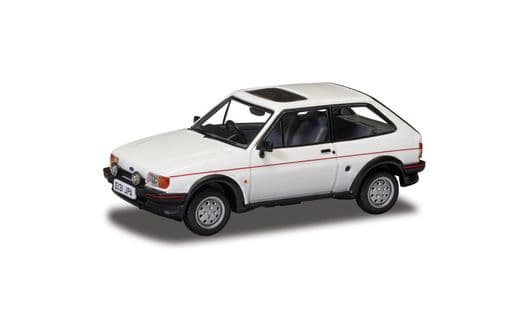
During our visit to the Heritage Centre, the team scanned both the Mk2 Fiestas you can see in the pictures, with the blue 1.1 Popular Plus being the second release from this new tooling (VA14402), and the beautiful Diamond White XR2 (VA14403) being the subject of this latest DCD update.
Even though as a model manufacturing company we’re only able to preserve motoring nostalgia in scale die-cast form, that’s definitely where the Vanguards range excels, producing beautifully crafted scale model representations of the cars we all used to know (and drive) so well. Even if our beloved four-wheeled runaround has long since gone to that MOT station in the sky, we can still remember it with great affection, only within our display cabinets, as opposed to being on our driveways. You never know, as the range continues to expand, we might even produce a model of a car you actually used to own yourself, because stranger things have happened in the world of Vanguards.
Our existing Ford Fiesta Mk.1 tooling has been one of the most popular models in the Vanguards range since release back in 2011, and serves to illustrate Ford’s dominance within the British popular motoring market in the post war years, with the production of stylish, affordable cars. A functional design produced specifically to sell in volume, there’s actually something quite aesthetically pleasing about the angular lines of this first incarnation of the Fiesta, one which actually enticed me to become a Ford owner myself.
A first DCD look at a production sample of the new Ford Fiesta Mk2 XR2, a model which is scheduled to be in our warehouse towards the end of next month.
Real versus Corgi Vanguards, this new XR2 is destined to be a popular addition to the range.
When the first generation Ford Fiesta was released in the UK at the beginning of 1977, it was the smallest car Ford had in their lineup at that time and indeed, was the smallest modern car they had ever produced – it also had the title of being Ford’s most costly car to develop to date. Cleverly leaked at several high-profile events by Ford’s marketing team, the car proved to be an instant success and was available in several different versions, each one offering different levels of trim and performance.
With Ford already having quite the reputation in motorsport success, the 1.3 SuperSport and stylish XR2 were unquestionably the most desirable models in the range, however, despite its popularity, the Fiesta was definitely ready for a facelift by 1982.
The second generation Ford Fiesta started appearing in showrooms the following year, building on the success of its predecessor, but introducing a more refined styling to the car, including a more rounded front profile and featuring deep, wrap around detailing. The new model also brought with it a host of interior and mechanical improvements which made this a worthy successor, however, there were those who held on to the previous model, feeling that the Fiesta Mk.2 lacked the charm of its predecessor. It was still effectively presented by Ford’s marketeers as the little car that thinks it’s a big car, a milestone model for them and a great advance in making a small car feel much larger and more refined. We also had the Ford Promise to reassure us, in that Ford gives us more! Just what that stood for is a matter open to discussion.
Having said all that, the Fiesta continued to be a success for Ford and the later arrival of the sporty XR2 with its distinctive new body styling kit soon started to win over those who were struggling to make the transition. In its best UK sales year in 1987, the Fiesta sold more than 150,000 cars in the UK alone, a figure which brought it in just behind the Ford Escort in overall sales numbers. Throughout its life, the Fiesta has continued to evolve, whilst keeping Britain motoring at the same time, with the final iteration being the seventh generation of this incredible series of cars.
VA14403 – Ford Fiesta Mk2 XR2 in Diamond White
Ford announced the comprehensively updated Fiesta Mk2 in August 1983, although the XR2 did not appear until 1984. It was worth the wait however, as it used the more advanced 1.6-litre overhead cam ‘CVH’ engine, first seen in the Escort XR3, plus a larger body-kit, rear spoiler, bigger brakes, a rear anti-roll bar, a five-speed gearbox and those now iconic ‘Pepperpot’ alloy wheels.
The XR2 modelled was first registered in April 1988 and was retained by Ford Marketing to be driven by a variety of guests at Fiesta-related events. During this time, it led a busy life, covering a high mileage, but remained in excellent condition as it was meticulously looked after by Ford. Once it was no longer relevant to the company’s current range, it was given to Ford’s Heritage Collection and, as an example of the archetypal eighties hot hatch, in one of the era’s most popular colours, it has been regularly requested by the media and has appeared in Auto Express, Autocar and many other publications.
In June 2013, it was featured in the studio filming for Series 20, episode one of the BBC’s Top Gear programme, parked alongside two period rivals, a Peugeot 205GTI and a Renault 5 GT Turbo.
It was loaned to the British Motor Museum, Gaydon, Warwickshire, for display between February 2024 and May 2025, and remains in immaculate condition despite it having covered almost 100,000 miles in its eventful life.
Sure to be a popular addition to the range, this latest Fiesta Mk2 XR2 release is expected to be available towards the end of November.
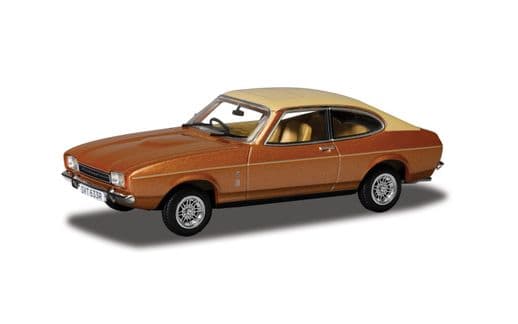
More new Vanguards image exclusives, this time featuring this beautiful Saturn Gold Capri Mk2 3.0 Ghia.
As we touched on when featuring the Fiesta Mk2 XR2 above, the subject of facelift styling for existing, successful models in any motor manufacturers range can be something of a sticky wicket and really does have to be handled with a great deal of care. It’s something of a human trait to be uncomfortable about change, and when you’re thinking of changing one of the best loved British muscle cars to have ever graced the nation’s roads, it must have left many Ford designers and marketing gurus suffering from sleepless nights.
Ford Capri project actually started life as an intended European equivalent of the hugely successful Mustang Mk.I introduced by the American parent company, and was first unveiled to the motoring world at the end of the 1960s. The spectacular success of the Mustang really did take Ford officials by surprise and clearly highlighted the public’s appetite for mass-market cars which offered something more than just functional motoring.
At that time here in the UK, Ford could only claim to have the Lotus Cortina as anything resembling a sportier model in their range, with the rest of the range being manufactured for the masses, dare we even suggest lacking in excitement somewhat.
The new US inspired model was intended to change all that, a purposeful, muscular looking car with a sporty image, but one which was within the reach of large sections of the motoring population. Just like the Mustang did in the US, the Capri utilised many existing components used in the production of other cars in the Ford range, but cleverly wrapped them all up in a beautifully stylish coupe bodyshell. You could say that by adopting this production ethos, the Capri was almost guaranteed to be a motoring success.
As a point of interest, Ford officials had planned to name their sporty new car ‘Colt’, but were beaten to the draw by Mitsubishi, something which resulted in a bit of a scramble to find a suitable new name. Capri may have been their second choice, but it would come to stand for a range of cars which unquestionably captured the hearts of the British motoring public and resulted in the introduction of arguably the best looking Police cars ever.
With an impressive combination of stunning good looks, clever marketing and keen pricing, the Capri became an instant motoring success, however, by February 1974, this modern classic was ready for its first major upgrade. The styling upgrade of the Capri arguably made it an even more suitable car for everyday motoring, as it featured changes such as a slightly shorter bonnet, a larger cabin and a more modern dashboard layout presentation.
Significantly, the Capri Mk2 also featured the adoption of a hatchback design, the first Ford model to do so. The Mk2 only served to continue the success of the Capri model range, further helping to establish the reputation of a car which is still seen as being sporty, refined and desirable to this day. Introducing models which were sporty, featuring high trim levels or both, the Capri was definitely a car to be seen in and if you lived through the Capri era, the sight of one to this day will still fill you with feelings of nostalgia and desire.
VA15406 – Ford Capri Mk2 3.0 Ghia in Saturn Gold
The Capri modelled here was built at Ford’s Cologne Plant in West Germany in January 1977, and then first registered on 2nd March 1977 as a dealer demonstrator by Ford main dealer, Cowies, Stoke, Staffordshire. Cowies sold it to Kathleen Emery in July 1977 for £4449, although she also part-exchanged her yellow 1974 Capri, which had covered 14,630 miles. Emery loved this car, which was a wedding present, and retained it until July 1995. It was then advertised in Classic and Sports Car magazine’s classifieds with an advert that said, ‘probably the finest original car of its type in existence, one lady owner from new, 26,000 miles, FSH, a beautiful original car in pristine condition’.
It was purchased by Yorkshire-based Capri enthusiast Andrew Richardson, who was so impressed with the car that he decided to meticulously detail it to concours condition. He rebuilt the suspension, replicating the factory’s spring-rate paint markings in the process, then had the wheels refurbished and fitted with new period-correct Pirelli CN36 tyres. He also had a small amount of paintwork done to eradicate some stone chips on the front and behind the rear wheel arches.
He kept a meticulous record of every job in a file and retained the car until May 2023. The resultant, perfect, as-new, 28,000-mile car was offered for sale by KGF Classic Cars and purchased in June 2024 by Greater Manchester-based Lee Davidson, a passionate Ford collector, who cherishes it.
Another Vanguards Ford classic, we also expect this stunning Mk2 3.0 Capri Ghia to be in our warehouse towards the end of November.
So, that’s it for yet another update. A trio of impending classic Corgi models and each one scheduled to arrive before we have to start thinking seriously about a certain day in December (it’s too early to mention it just yet). It would also be interesting to hear from Aviation Archive collectors if they would be interested in us considering earlier versions of the English Electric Lightning in 1/48th scale, or indeed if there is still an appetite for models released in the smaller 1/72nd scale. If you get five minutes over the weekend, would you mind dropping us a quick line, because we’d be really interested to hear your thoughts.
We couldn’t sign off without bringing you one final look at the new Lightning F.6 model – isn’t she a beaut!
I’m afraid that’s all we have for you this time around, but we’ll be back as usual in two weeks’ time with a further exclusive selection of the latest Corgi die-cast model updates. As ever, you could always drop us a line if you felt moved to do so, to comment on anything blog, collecting or Corgi model related, or even perhaps to suggest a topic you might like to see the team cover in a future edition. As always, our diecastdiaries@corgi.co.uk address is the one to use.
If you can’t wait for the next blog, you will find plenty of Corgi model collecting discussions taking place on our official social media channels, access to which can be obtained by clicking on the respective links at the foot of the Corgi website homepage.
Link access to Corgi social media sites.
Thank you for continuing to support your Corgi Die-cast Diaries blog. Our next edition is scheduled to be published on Friday 31st October, which will be a truly spooktastic edition - we look forward to seeing you all back here then.
Thank you for your continued support