
Welcome to the latest edition of Corgi Die-cast Diaries, your regular blog review of all the news, updates and topical stories from the captivating world of Corgi die-cast model collecting.
We begin this latest edition of our Corgi update blog with an apology for its late posting. There is just so much going on here at the moment that images of our subject models were not available by publication deadline time, however, rather than leave posting this update until the next scheduled edition, we have decided to post as soon as we received the images, so is now a case of 'better slightly late than never'. This time, we have three main subjects for our reader's update enjoyment, starting with the latest addition to our ever popular Aviation Archive range, and a subject aircraft which has always been a firm favourite since its first appearance back in 2006.
We will be following this up with a rare foray into the world of die-cast military vehicles and in particular, our model set collaboration with one of the most popular and immersive on-line games of the moment, World of Tanks. Our attendance at the recent Tankfest event at The Tank Museum left us in absolutely no doubt as to the popularity of these lovely little models and we are therefore please to confirm that the pair of 'Versus Pack' releases we only had available as sample display packs on our stand at this year's show are now in stock and available.
Finally, we are delighted to see that the second release from our 1/48th scale Eurofighter Typhoon tooling has been receiving so many rave reviews from collectors adding this beauty to their collections recently, however, we wanted to take this opportunity to answer an armament question some have been asking on various enthusiast social media sites. Hopefully allaying any fears of missing parts, but unfortunately also ending any hopes that you might have a 'special' production anomaly example in hand, we will be telling the research story behind the offensive configuration of the aircraft we chose to model with this release.
We know we are a little late this time, but what better way to start any new week than with a little bit of Corgi time!
An interesting development of the single seat fighter concept, the American Lockheed P-38 Lightning was fast and heavily armed, but also provided its pilot with the reassurance of two engines, something which must have been a comfort during operations over wide expanses of ocean.
As Europe had already been consumed by the flames of war for two long years by the time of the infamous Pearl Harbor attack, America's military neutrality did not mean that the nation had not been engaged in a feverish period of re-armament and expansion. If the US were going to be drawn into conflict, they were going to be prepared for that fight. In the field of aviation, having witnessed the introduction of advanced monoplane fighter designs across Europe and into the Pacific region, America was only too aware that their own Air and Naval Forces required further upgrade as a matter of urgency. To this end, an official requirement was issued in February 1937 for the production of a new pursuit fighter, an aircraft which would have to possess performance never previously seen on an American designed aircraft, and one which would lead the world.
The Lockheed Aircraft Company were one of six companies determined to satisfy this demanding requirement brief and entrusted the design of this radical new aircraft to talented designer Clarence 'Kelly' Johnson, a man who was basically given a free rein during its development. Almost immediately, he determined that a single engined aircraft could not satisfy these demanding specifications and started working on a twin engined design, one which featured twin booms to house the engines and superchargers, with a centrally positioned nacelle to house the cockpit, along with the fighter's heavy machine gun armament.
The new aircraft was an incredible looking machine and a radical departure from any fighter aircraft design which had gone before it, and Lockheed were duly awarded a contract to produce a prototype example. The XP38 was a thing of beauty and after just a short 38 minute maiden flight, everyone at Lockheed knew they had a winner on their hands. In fact, officials were so impressed with the aircraft's performance that they immediately decided to make an attempt on the US Transcontinental speed record to highlight its potential, an attempt which saw the XP38 shatter the existing record by an impressive 23 minutes.
Unfortunately, it transpired that officials on duty at the destination airport for the attempt were not expecting the arrival of this strange looking new fighter and subsequently kept it holding on landing request so long that it actually ran out of fuel and had to make an emergency landing on a local golf course. Nevertheless, the aircraft had shown its potential and the US Army Air Force ordered sixty-six aircraft, presenting America with their first 400 mph capable fighter.
The introduction of the P-38 Lightning was not without its problems, however, this was not surprising bearing in mind the aircraft's performance and configuration were so radically different to anything which had gone before it. Almost constant development would see the Lightning become a devastatingly effective high altitude interceptor and with engines which both drove outwardly rotating propellors, also eventually proved to be an incredibly stable aircraft for photo-reconnaissance purposes.
Ruling the skies of the Pacific
Flamboyantly presented, the pilots of the USAAF 475th Fighter Group's 'Satan's Angels' were confident in the abilities of their fighters in taking the fight to their Japanese adversaries.
Possessing impressive range and firepower, the Lightning would eventually be used to avenge the Pearl Harbor attack, when sixteen P-38s of the 339th Fighter Squadron intercepted a bomber carrying Admiral Isoroku Yamamoto, the mastermind of that infamous raid, and shot it down. The P-38 Lightning would go on to serve with distinction in both the Pacific and European theatres, one of the most capable and distinctive aircraft of the Second World War.
When the P-38 Lightning made it's Pacific combat debit, Japanese pilots were initially unconcerned by the arrival of the new American fighter, feeling that its size immediately placed it at a disadvantage. In fact, Japanese fighter pilots couldn't wait to introduce the big US fighter to their nimble Mitsubishi Zero and show them how to dogfight. Unfortunately for them, they had misjudged the qualities of the P-38 and whilst US pilots would definitely avoid being drawn into a turning, close contact engagement with the Mitsubishi fighter, they knew the Lightning gave them everything they needed to rule the skies in the Pacific - speed, reliability and firepower. An incredibly stable gun platform, Lightning pilots knew that if they could get their sights on a Zero, that aircraft would not be going home!
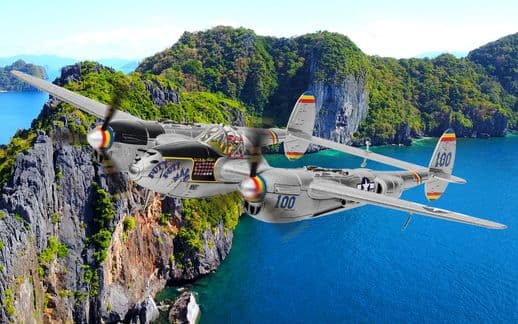
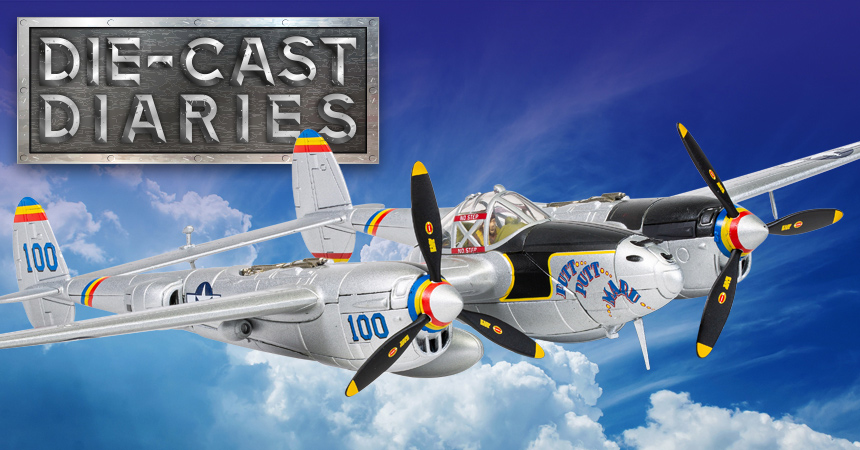
Our latest 1/72nd scale die-cast tribute to this magnificent aircraft is one of the P-38 Lightnings which helped to wrestle superiority of Pacific skies from the Japanese during the latter stages of the Second World War and was the mount of one of the most accomplished fighter pilots and leader of men in that theatre of operations.
Already available, this latest Lockheed P-38 Lightning release is without doubt one of the most attractive of this entire series.
For American fighter pilot Charles Henry 'Mac' MacDonald, the Japanese attack against Pearl Harbor on 7th December 1941 left him with an absolute determination to do his duty in ensuring this disastrous day for America would only result in their eventual victory. Joining the US Army Air Force and gaining his wings in May 1939, he would initially be assigned to the 55th Pursuit Group, and then on to the 18th Pursuit Group at Wheeler Field, Hawaii in early 1941 and was still there at the time of the Japanese surprize attack, arguably the darkest day in American military history.
His continued service would see him gaining ever more responsibility and new postings, first back home in the US to train new pilots, then on to the savage aerial fighting of the Pacific Theatre. By October 1943, he had attained the rank of Major and was posted as the Executive Officer of the 475th Fighter Group's 'Satan's Angels', flying P-38 Lightnings out of Dobodura, New Guinea, where his reputation as a fighter ace and effective leader of men would soon be forged. Often asking his men to fly long and dangerous missions in their Lightnings over vast expanses of ocean, MacDonald would often be the first aircraft into the air, leading from the front and inspiring those who flew with him.
Eventually rising to the rank of Colonel, MacDonald became the Commanding Officer of the 475th Fighter Group and during this time, would welcome the arrival of a rather famous civilian pilot to the unit, long range aviator and US national hero Charles Lindbergh, who had official clearance to fly with the unit as an advisor. During his time in the Pacific, Lindbergh would help the 475th unlock the awesome potential of the P-38, using his knowledge of long range engine management to alter the power and fuel settings of their aircraft, modifications which extended the range of the Lightning by an incredible 100%.
A stunning addition to the Aviation Archive range, P-38 Lightning 'PUTT PUTT MARU' is available now.
Now, 'Colonel Mac' and the pilots of the 475th could provide fighter cover for bombers attacking the distant Japanese oil refineries at Balikpapan in Borneo, with flight times of between twelve and fourteen hours often being flown. This and other long range raids would prove pivotal in turning the tide of the Pacific War and preparing American forces for the final push towards the Japanese home islands themselves.
Colonel 'Mac' MacDonald would end the war with an impressive 27 aerial victories, with several other enemy aircraft claimed as either damaged or probably destroyed, making him the third most successful fighter ace in the Pacific Theatre. All victories were scored using the Lockheed P-38 Lightning and whilst he would use several different machines, they were all named 'PUTT... PUTT... MARU'. It is not known for sure what this name refers to, but it is thought that it might be a reference to the Japanese supply barges the unit were often sent to destroy, vessels which were referred to as Marus, with their rather agricultural engines making a putt putt chugging sound as they went. Whatever the case, if they were in the sights of a 475th Fighter Group P-38 Lightning, they were definitely on borrowed time.
This beautifully presented Lockheed P-38 Lightning is a representation of one of 'Colonel Mac's' aircraft, flamboyantly presented as befitting an aviator of his lofty status. This fantastic model is available now.
Tabletop confrontation, we had an impressive display of die-cast armour on display at the recent Tankfest event at Bovington.
Armoured military vehicles from the past century or so have long provided subject inspiration for modellers and collectors over the years, with the Corgi range not being left behind in this regard and now boasting two distinctly different ranges - our Military Legends of limited edition display quality collectables, and our smaller Military Legends in Miniature/World of Tanks ranges, which are aimed more at the gaming and toy markets. As these armoured behemoths must have literally shaken the earth as they rumbled into battle, it seems somehow fitting that scale representations of them should be made in metal and possess the same robust qualities as the machines which inspired their scale recreation, a feature which has clearly helped these fantastic models become such a popular addition to the Corgi range.
Earlier this year, we were delighted to be invited to take a display of the latest Corgi models to this year's Tankfest show at Bovington and to allow military enthusiasts a rare opportunity to handle these beautifully produced models in the metal. This proved to be a really rewarding experience for our team, as we were able to speak with long-standing Military Legends collectors from all over the world and to introduce potential new collectors to the many impressive qualities of these stunning 1/50th scale models.
As part of our display, we also included a selection of our smaller Military Legends in Miniature and World of Tanks ranges, models which sell like hot cakes in the Tank Museum shop and consequently came in for particular attention over the weekend. With the main shop struggling to keep their shelves stocked over a busy sales weekend, the fact that we also had two new prototype model sets displayed on our stand ensured that we always had a healthy crowd of people around our stand, even though we were actually unable to give them what they wanted.
Over the course of the weekend, if we had been given a pound for every time we were asked if people could buy these prototype models, we would have been able to buy our very own 'Tiger 131', as these adversarial World of Tanks 'Versus Packs' really did seem to be what everyone was looking for. Created to allow players of the interactive and hugely immersive World of Tanks game to collect physical examples of the vehicles they either use of come across during their battles, the robust nature of these models make them perfect for surviving the rigors of play, but still look fantastic when returned to their position on their display shelf.
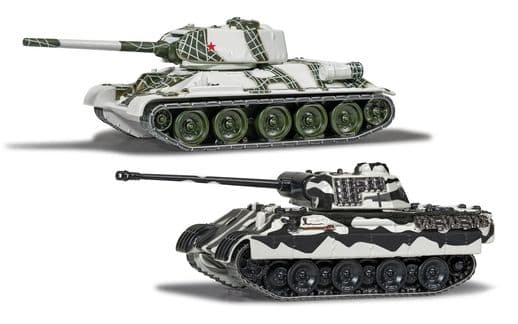
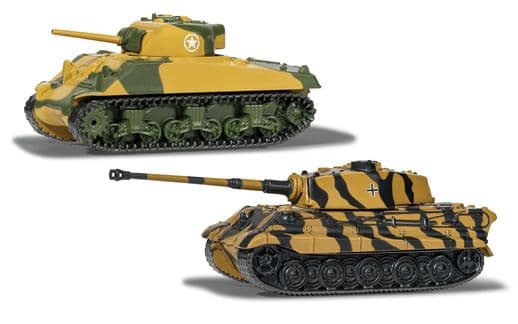
These new 'Tank versus Tank' presented releases bring two adversarial tanks together in the same packaging presentation, with some of the most famous armoured fighting vehicles of the Second World War currently featured in the range.
Marking two of the most immediately recognisable tank profiles of all time, this paring are clearly engaged in a winter struggle on the Eastern Front, a conflict which saw the emergence of the benefits of armoured quantity over quality. The rugged effectiveness of the Russian T-34 actually led to the development of the German Panther, one of the most famous tanks of the war, but one which was never available in enough serviceable quantities to challenge the columns of T-34s they were facing.
German Panther Tank
Although often overshadowed by the more famous Tiger tank, the Panther is generally regarded as Germany’s best tank of the Second World War. An effective combination of mobility, firepower and armoured protection, the Panther was originally developed to counter the success of the Soviet T-34 on the Eastern Front and despite initial problems associated with its rushed service introduction, it would go on to become one of the most feared armoured adversaries on the battlefields of Europe. Much cheaper to produce that a Tiger, Wehrmacht units could receive five of these highly effective tanks for the price of a single Tiger I.
Russian T-34 Tank
The Soviet T-34 has to be considered one of the most important tanks of the Second World War and for the Russian people, came to symbolise their defiance in the face of enemy aggression and determination to fight for total victory. During its impressive wartime production run, the T-34 would double the thickness of its armour, double the penetrating power of its gun and halve its initial production costs. Its combat effectiveness would also force the Germans to develop new, more powerful tanks to deal with it, with the Germans being more than happy to press captured T-34s into action against their former owners.
This time sporting a desert/Mediterranean scheme presentation, this pairing initially looks like being something of an armoured mismatch, as it pits arguably the ultimate tank of the Second World War against the ubiquitous Allied M4 Sherman. The King Tiger or Tiger II was intended to dominate the battlefield, destroying enemy armour at ranges greater than those where they could expect return fire. At around 70 tons, the King Tiger was almost twice the weight of the Sherman. In contrast to this, the Sherman was built in huge numbers, designed from the outset to be shipped around the world and was the perfect illustration of effective American mass production capability. If the two types did come into contact, the King Tiger would invariably be outnumbered by at least ten to one.
American Sherman Tank
Arguably the most famous Allied tank of the Second World War, the American built M4 Sherman medium tank was produced in vast quantities, with almost 50,000 being built by the end of WWII. Fast and extremely reliable, the Sherman featured innovations such as an automatic gearbox and gyro-stabilised gun elevation – it was also built for ease of transportation, with four hoist points at each corner of the tank, allowing it to be loaded to and from cargo ships with ease. The Sherman may not have been a match for the mighty German Tigers and Panthers they faced following D-Day, but numerical superiority ensured they would ultimately prevail.
German King Tiger
Germany’s heaviest operational tank of the Second World War, the mighty Tiger II or King Tiger weighed in at an astonishing 68 tons, even though it was still powered by the same 12 cylinder Maybach engine which powered the significantly lighter Tiger I. Built around a new long barrelled 88mm anti-tank gun, the Tiger II was perhaps the ultimate development of the tank during WWII and was superior to any Allied tank in service. Introduced just weeks after D-Day, these fearsome machines were never available in enough numbers to make a difference on the battlefield and for the cost of one King Tiger, the Allies could produce nine M4 Shermans. They also made for a juicy target for roaming Allied fighter bombers, especially the rocket firing Typhoons of the Royal Air Force.
These attractive little model sets are great for World of Tanks fans and anyone interested in famous military vehicles, and as we all start to think about a certain special date in December for perhaps the first time this year, these sets certainly make for ideal stocking filler gifts for the young 'Tanker' in your household.
Both of these double model sets are available now.
Already proving a hit with collectors, the second release from our 1/48th scale Eurofighter Typhoon tooling is a representation of an aircraft which mounted one of the first Royal Air Force strike operations using the Typhoon, during 'Operation Ellamy' in 2011.
The recent second release from our spectacular 1/48th scale Eurofighter Typhoon tooling presents this magnificent aircraft in operational markings and for the first time, with a full complement of offensive armament included, something which really does transform the look of the RAF's current multi-role combat jet. Initially intended as an airspace dominator, the Typhoon has been in service for around 20 years now and in that time, has proved itself more than capable of being adapted to take on additional roles, something this latest release reflects.
With the first release marking a display aircraft which spent the summer months of 2015 commemorating the 75th anniversary of the Battle of Britain, this second release marks an aircraft which took part in 'Operation Ellamy' and more specifically, one which marked the first combat mission of an RAF Typhoon in an operational environment. Initially tasked with enforcing a United Nations no-fly zone in the skies above Libya, once the complete suppression of the Libyan Air Force had been achieved, 'Operation Ellamy' allowed the RAF's Typhoons to be used in a more offensive strike role, something which has led to a number of questions being asked regarding the missile configuration represented on this model.
As a result of conducting exhaustive research into this subject our model has been presented as one of the aircraft taking part in these first RAF Typhoon strike operations and as such, has been completed with just a single AMRAAM missile installed. Whilst engaged in these tandem strike operations with RAF Tornados, the reduced air threat now facing 'Operation Ellamy' Typhoons often allowed them to carry a reduced number of air to air missiles, a weight saving measure which preserved fuel and shortened turnaround times, whilst the aircraft were hauling heavy precision guided munitions to use against ground targets. Often carrying just a single AMRAAM on the front port station, these aircraft would also carry up to four Paveway laser-guided bombs in what not only proved to be an effective show of force for coalition air power, but also clearly highlighted the continuing maturity of the RAF's Typhoon as one of the world's premier combat aircraft.
Just a single AMRAAM for this bird, but this is operationally correct for an aircraft taking part in these precision ground attack sorties.
In the ground attack role, Royal Air Force Typhoons would release 234 'Smart Bombs' on targets ranging from armoured vehicles to command and control installations, working seamlessly with the Tornado crews who were well versed in undertaking these types of missions. Clearly, this was a significant development in the operational capabilities of the Typhoon and one we wanted to commemorate with this release. Importantly, the single AMRAAM fit is accurate for this aircraft, confirmation which will hopefully ease concerns amongst some collectors checking over this recent addition to their growing 1/48th scale aircraft collections.
This magnificent new 1/48th scale Typhoon model is available now.
We're afraid that's all we have for you this time, however, we will be back as ever in two weeks' time, with a further selection of model project updates to inform you about. Between editions, we are always interested to hear your views on all things Corgi, so if you feel like dropping us a line to comment on anything blog, collecting or Corgi model related, or even to suggest a topic you might like to see us cover in a future edition, please do drop us a line at diecastdiaries@corgi.co.uk.
If you can’t wait for the next blog, you will find plenty of Corgi model collecting discussions taking place on our official social media channels, access to which can be obtained by clicking on the respective links at the foot of the Corgi website homepage.
Link access to Corgi social media sites.
Thank you for continuing to support our Die-cast Diaries blog. Our next edition is scheduled for publication on Friday 25th August.