

Welcome to the latest edition of Corgi Die-cast Diaries, your regular blog review of all the news, updates and topical stories from the captivating world of Corgi die-cast model collecting.
How on earth can we be approaching the end of another year already? It only seems like a few weeks ago that we were informing Die-cast Diaries readers about the impending announcement of our 2022 range and how things were going to be a little different this time, with three range launches throughout the year, as opposed to just the single launch at the beginning of the year. We know collectors has some initial reservations, particularly regarding the announcement of new tooling projects, however, with the several advanced notifications we have brought you this year, we hope those worries are now in the past. Before we go any further, this is perhaps the right time to thank our readers for their continued support and for sticking with us through this range format change - we knew it was the right thing for the Corgi brand, but we are grateful that you all gave us the time to show you what we had in mind. In addition to this, blog readership numbers have always been strong for Die-cast Diaries, but we have seen a significant increase during 2022, so thank you to everyone, whether you are a new joiner, or one of our seasoned veterans.
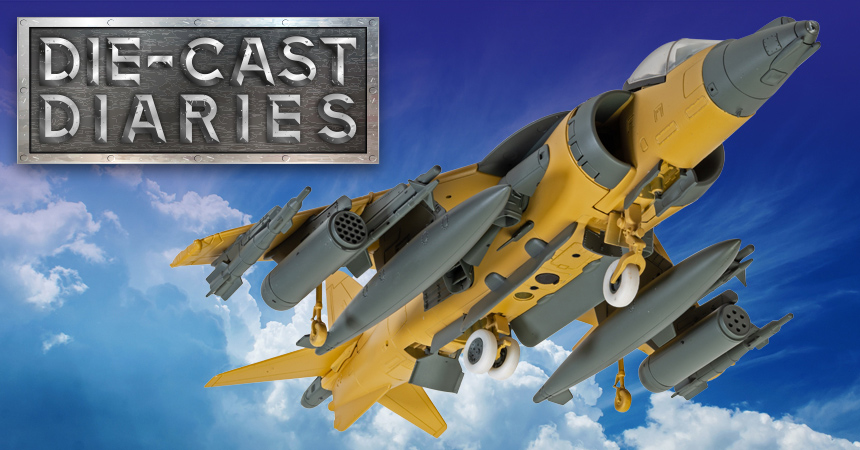
For this final update of the year, we wanted to end with something a little bit special, you could say something of a Corgi die-cast Christmas cracker! One of the significant new 1/48th scale tooling projects currently underway for Aviation Archive is our BAe/McDD Harrier II, a model which whilst still very much in its development phase, was announced to the collector world at the beginning of the year. We have already exclusively revealed to blog readers images of CAD screenshots and the prototype SLA sample produced from these files, but this time, we are in a position to move the project forward significantly, from a blog update perspective. For this final blog of the year, our die-cast star of the show is the metal engineering sample of the Harrier, a model which is so hot off the press that you will be seeing images of it before our research lead has had a chance to inspect it himself. As far as blog exclusives go, this really is a biggie, and all we would like to say is Merry Christmas from us all.
Looking like a real Harrier development aircraft, all the images we will be exclusively showcasing this week feature the engineering sample model produced from the new 1/48th scale Harrier II tooling and that being the case, they are shown for illustrative purposes only and may be subject to further change.
If there is one British aircraft type which could claim to be the jet powered equivalent of the famous Spitfire, that aircraft would surely be the Hawker Siddeley/British Aerospace Harrier, not perhaps as a direct aviation comparison, but certainly in the way it was adored by the British public. Just as the Spitfire is regarded as Britain's saviour during the dark days of the Second World War, the Harrier came to represent the very best of British engineering and manufacturing prowess, an aircraft which showed the rest of the world that Britain could make something work that everyone else was striving for, but nobody else could achieve, a technological marvel which was the envy of the aviation world and one which the nation were incredibly proud of.
As an Airshow performer, the Harrier was without equal and if one of these aviation marvels was on the display programme, you could be certain that it was standing room only on the crowd line during a Harrier performance. Able to display at the largest international events, or the smallest of grass airstrips, the Harrier wasn't like other aircraft, she was special. Able to blast around the sky at high subsonic speeds, then return to show centre in a much more sedate manner, to balance on a column of hot air from its mighty Rolls Royce Pegasus engine, almost appearing to be inspecting the gathered masses in the process. Its pièce de résistance was to perform a series of graceful bows, acknowledging its admirers, ensuring that everyone fell in love with the Harrier. Once it had worked its way into our affections yet again, it was back to conventional flight mode and off to its next display commitment and more legions of admirers.
With credentials such as these, the Harrier may have been out of British service for some twelve years now, but as the last official flypasts were performed in December 2010 almost to the day, what finer blog subject could we have to bring 2022 to a close than an update on our project to immortalise this aviation classic as a 1/48th scale die-cast model. As our 1/48th scale post war jet range continues to go from strength to strength, many collectors will no doubt be of the opinion that Harrier is perfect subject matter for Aviation Archive.
Marking a significant development in the history of this magnificent aircraft, the Harrier II may have shared many operational and visual similarities with its famous VSTOL predecessor, however, this was a very different aeroplane altogether and owed much to America's McDonnell Douglas Corporation. Essentially, this new generation of Harrier was a completely different aircraft, a much more capable aeroplane in every respect and a space age development on this now familiar VSTOL theme. The programme was intended to unlock the undoubted potential possessed by the original Harrier, address all of its operational shortcomings and turn it into arguably the most versatile attack aircraft in the world, one which could go anywhere and perform almost any offensive role. From a UK military perspective, the programme would eventually result in the introduction of the much more capable Harrier GR.5 in 1987, with additional successive upgrades over the next couple of decades ensuring the Harrier maintain its position as one of the world's foremost strike/attack aircraft. With a Harrier in your military inventory, operational flexibility came as standard.
A hugely impressive piece of kit, this is the first time that metal, plastic and clear parts have all come together, even though the clear parts have yet to benefit from the polishing process. Nevertheless, she has Aviation Archive classic written all over it!
With increased range, power and weapons delivery capabilities, this new generation of Harrier was intended to strike hard and fast, often at the outset of any military confrontation, before returning once refuelled and rearmed to support infantry units in their endeavours. Always on the shoulders of the troops and always in the thick of the action, is it any wonder why military personnel held the Harrier II in the same affection the public always have - this was their close air support sentinel.
Despite the incredible success of the original Harriers to enter squadron service, the aircraft did have some specific operational limitations and a joint US/UK project to find its successor was quickly underway. Despite its operational flexibility, the Harrier was quite a fuel hungry beast and therefore, there was always a trade-off between carrying fuel or weapons, a situation which had to be improved. The 'Super Harrier' would need to be powered by a larger, more powerful engine, with this larger unit dictating that the new aircraft would need to be bigger with larger wings and therefore more stores carrying/fuel carrying capability. With costs spiralling at a time of financial austerity, Britain left the joint program in 1975, with the Americans electing to end their own program the following year, but that was not the end of the Harrier upgrade story.
Both Britain and America continued with separate Harrier programs, each following different agendas. In the UK, British Aerospace were exploring the option of modifying existing Harrier airframes to use a new, larger wing, whilst in America, McDonnell Douglas were working on a completely new design, albeit one which shared many similarities with its predecessor. They were in a position to modify a British design by virtue of a licence agreement signed during the UK's acquisition of the Phantom and how the decision to modify this aircraft brought with it a reciprocal arrangement for Harrier.
The US program was showing great promise, however, progress was a little slow and the US Marine Corps were being put under extreme pressure by the US Navy to abandon the project and join them in the F-18 Hornet procurement program, something which would have hopefully brought with it some cost savings for them. Thankfully, before these discussions could gain any traction, an unlikely ally appeared in the form of the returning British, who having been impressed with the progress McDonnell Douglas had made, were keen to return to the project, not as a full project partner, but with BAe becoming a sub-contractor.
Two images which show the different engine nozzle positionings for hovering and standard flight modes, in addition to some of the many other components this impressive new model has within the tooling. Of particular note, even to material used to replicate the Harrier's tyres is a new compound, which has some play in it to give the impression of scale weight.
The first British variant of the Harrier II was the GR.5, a designation which highlighted its operational requirement to perform ground attack and reconnaissance duties. These aircraft were not only very different from their predecessors, but were also quite different from their US Marine Corps counterparts, with the British happy to use a majority of US supplied equipment, but insisting on the Anglicised aircraft using different avionics, armament and various equipment fits. Perhaps the most significant difference was the use of a stainless steel wing leading edge, which gave the wings of British Harriers IIs a very different flex characteristic. The new aircraft also made significant use of composite materials throughout its construction.
RAF No.1 Squadron were declared fully operational on the first British Harrier II (Harrier GR.5) in November 1989, with these aircraft signalling the start of an almost continual program of upgrades and improvements to endow this magnificent aircraft with ever better performance and greater operational effectiveness. With its greater range, more effective weapons fit and much greater survivability potential, Britain's 'BIG Harriers' were always stationed close to any potential action areas and in the case of conflict, were always in the thick of the action.
With its high metal content, the new Harrier is a stunning addition to our growing 1/48th scale post war jets range and a faithful scale representation of this famous fighting aeroplane.
It's a good job the Corgi development team love to take on a challenge or two! Asking them to take on one of the most iconic and instantly recognisable jets of the 20th Century and design a 1/48th scale die-cast collectable model representation of it might cause some to gracefully retire from the front lines, but not this lot, they are always up for the challenge. Thankfully, in this case, they did have the benefit of an incredibly detailed LIDAR scan file to reference, but nevertheless, what they have managed to achieve with their new Harrier II tooling is truly impressive. Incorporating all the latest design and manufacturing enhancements the die-cast industry has to offer, the new Harrier II tooling is a thing of beauty and even though we are still at a relatively early stage in its development, we have to say that we are delighted with how the Harrier is turning out so far.
The team are now at a significant stage in the development of this exciting new model and by way of our final new tooling update exclusive of the year and a little Christmas treat for Aviation Archive fans, we thought you might like to see a selection of images which feature the engineering sample model which recently arrived in our office. This model is the first time that the new Harrier II tooling design has been used to produce the actual metal, plastic and mixed media components replicated during the design phase and therefore marks an important stage in the development of the new model. This is the first time the development team have had to assess how the design files have been replicated and importantly, to produce their review document which will address any areas of concern.
Still at quite an early stage of development, the team will now be pouring over the engineering sample, assessing every aspect of its fit, finish, detail representation and shape accuracy, to check if everything has translated from design file to manufactured components as intended and indeed if any improvements or modifications are needed. Clearly, at this stage, the tooling is still in its development phase and as such, may well and usually is subject to future modification, so showing these images can always come with the risk of worrying collectors, but as most blog regulars are now fully conversant with this process, we think it's worth taking that risk, simply because we know you all love to see as much development detail as possible when it comes to adding a new model to the Aviation Archive range.
Time to get a little nosey. This next series of images show some of the nose options which will allow both British and US versions of the second generation Harrier to be modelled from this new tooling. Please note that not all tooling components were available to our photographer whilst taking these images, so they are something of hybrid Harriers. We will bring you more details when they become available.
To illustrate just where these images are positioned within the development cycle of the new Harrier II, if you look at the series of images we have included which feature some of the various nose options available across the tooling, most are actually held in place by a strategically positioned spot of white tack. Nevertheless, we know blog followers will be interested to see how the new Harrier is coming along and as such, what better way could there be to bring a year of blog exclusives to a close than with a little festive Harrier treat?
From a Corgi perspective, we are extremely pleased with how the new Harrier II tooling project is progressing and even at this early stage, we know we have something special on our hands. A real die-cast heavyweight of a model, the new Harrier is a stunning representation of this iconic aircraft and thanks to the LIDAR scanning of a beautifully preserved example, has managed to capture even the finest details in all their glory. More than this, due to clever design and the experience of our design engineers, the tooling includes a myriad of part options, allowing both RAF/Joint Force Harrier and US Marine Corps variants of this famous aircraft to be modelled, therefore serving to accurately tell the story of the Harrier II program in scale die-cast form.
Perhaps the most impressive feature of the new model is the sheer number of weapons and stores options the tooling includes, because as every Harrier fan knows, this is one of the reasons why we all love this aircraft. To see one of these relatively diminutive jets sporting full pylons at the start of its latest mission really did give these aircraft a 'don't mess with me' type of appearance and didn't they just look tremendous. Our project proposal document included a requirement for a huge selection of stores options and to our surprize, wasn't even challenged as it negotiated the authorisation stage - our Development Manager must be a closet Harrier fan himself!
Anyway, this is the current stage we find ourselves at with the new Harrier II tooling and as we stated already, blog readers are seeing these engineering sample images before our research lead has even had the opportunity to inspect the model himself - talk about a blog exclusive. The team are now fully engaged in completing their assessment of the model, with the next stage being either the production of a new, slightly modified engineering sample, or if the development team are happy to proceed in such a manner, advance to the production of a first, fully finished pre-production sample model in the first scheme we have selected for the Harrier. Exciting times for all concerned and whilst you can be sure that Die-cast Diaries will endeavour to bring you all those exclusive details whenever they become available, that is where we are going to leave this latest update and indeed all blog updates for the year.
A final series of images which clearly show us what we have to look forward to in 2023 when it comes to die-cast Harriers in 1/48th scale. Although still in the development phase, we can already see that this new model will be a spectacular addition to the Aviation Archive range.
On behalf of the entire Corgi team, may I please take this opportunity to thank each and every one of our readers for the incredible support you have all shown us throughout 2022, something which continues to humble us all and something we will never take for granted. We would also like to wish you all a very happy Christmas and subsequently, a peaceful and prosperous New Year, one where we can all again share in our love of all things die-cast collectables every fortnight. We look forward to seeing you again early in 2023, where we will be bringing you details of some of the exciting new Corgi models heading our way during the coming twelve months - we think we might just have something for every collector taste.
That's another year of Corgi Die-cast Diaries blogs all wrapped up, but we look forward to a brand new year of updates in just two weeks' time, when we will have a further selection of all the latest Corgi model developments, project updates and exclusive image reveals for your inspection. Between editions, we are always interested to hear your views on all things Corgi, so if you feel like dropping us a line to comment on anything blog or Corgi model related, or indeed to suggest a topic you would like us to include in a future edition, please feel free to do so at diecastdiaries@corgi.co.uk.
If you can’t wait for the next blog, you will find plenty of Corgi model collecting discussions taking place on our official social media channels, access to which can be obtained by clicking on the respective links at the foot of the Corgi website homepage.
Link access to Corgi social media sites.
Thank you for continuing to support our Die-cast Diaries blog. Our next edition is scheduled for publication on Friday 13th January 2023.