
Welcome to the latest edition of Corgi Die-cast Diaries, your regular blog review of all the news, updates and topical stories from the captivating world of Corgi die-cast model collecting.
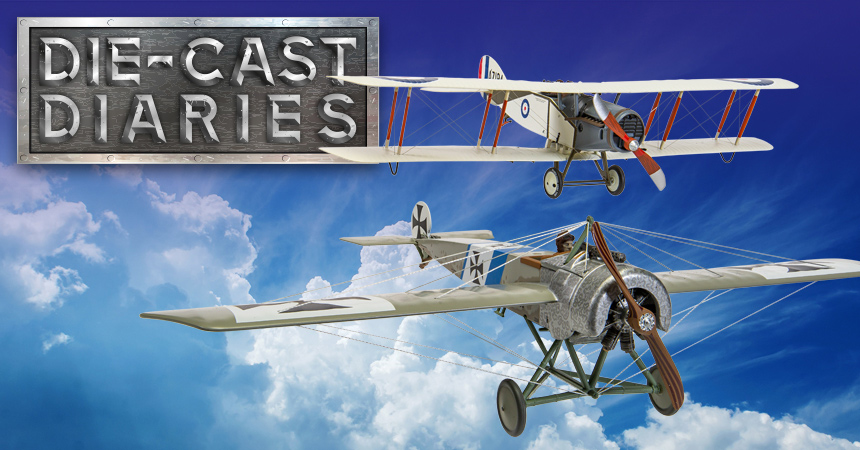
As we currently find ourselves on the cusp of the busiest period for Airshow events here in the UK, it seems somehow fitting that this latest development update should feature two of the latest additions to our Aviation Archive range, one which has just arrived in our warehouse, with the other not being all that far away. Marking historic aircraft from the dawn of aerial combat, our 1/48th scale Great War series continues to be an incredibly popular sub-range within the wider Aviation brand and this latest pairing will only serve to enhance their reputation within the hobby.
In addition to brining you exclusive images of production samples of both of the above new models, we will also be going a little 'heavy', as we continue to focus on Britain's summer event schedule, and a rare recent outing for our Military Legends range. Last weekend saw the fair county of Dorset hosting an event which attracted visitors from all over the world, each desperate to be present at the latest extravaganza of military vehicles which is Tankfest. In a first for Corgi, a small team exhibited a selection of our scale military vehicle models at the show, the first time Tankfest had been held over three consecutive days, and we were delighted to show our scale representations to the mighty machines which inspired their creation. We will be bringing you a selection of images from our display at the show, including confirmation that our latest release got to meet the enigmatic Tiger 131 in the metal for the very first time - it all proved to be rather emotional.
Please join us as we rumble through the very latest model developments from the world of Corgi.
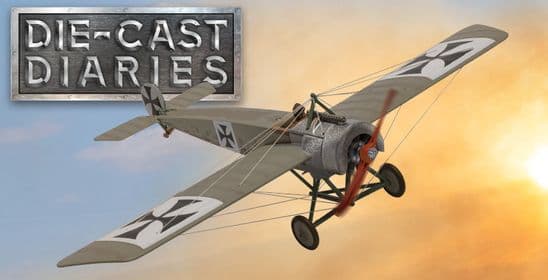
Although only making its combat introduction less than twelve years since the Wright Brothers had made their historic first sustained, controlled manned powered flight in a heavier than air aircraft, the Fokker Eindecker would have a profound impact on the history of aviation.
When we are all admiring our Great War aviation model collections, it can be quite sobering to accept the fact that the real aircraft which served as the inspiration for these 1/48th scale model representations, were battling for supremacy of the skies more than a century ago, the very first aeroplanes to be used in a military combat role. Of even greater significance, these aircraft, which went on to become familiar to so many people, were in combat with other aeroplanes less than twelve years since the Wright Brothers had made their historic first sustained, controlled manned powered flight in a heavier than air aircraft. Indeed, some of these early aircraft types still used the same wing warping method of control adopted by the Wright Brothers, however, the potential offered by aviation would ensure that the pace of development and the introduction of more capable aircraft, would only gather pace from that point.
Although there were a great many impressive aircraft types which took to the skies during the Great War, there is one which has a particularly significant place in the history of aviation, a still relatively primitive machine, but one which was intended from the outset to hunt other aeroplanes and dominate the sky, the Fokker Eindecker. Not only did the Eindecker introduce the world to this destructive new type of aircraft, it also heralded the age of the fighter pilot, celebrated airmen who would inspire not only their fellow pilots, but also the world's population, who were all captivated by the bravery and skill of these charismatic men. With these seemingly chivalrous one on one duels in the sky serving as a perfect distraction from the horrors taking place below them, is it any wonder that men like von Richthofen, Mannock, Immelmann and Ball would all become household names, even earning the respect of their enemy's population in the process.
Clearly, this tumultuous period for aviation continues to be an enduring source of fascination for many and over the years, model representations of these historic aircraft have sold in their millions, as we all attempt to create our own scale tributes to these early fighting aeroplanes. For this reason, when the first 1/48th scale Great War aircraft models joined the Aviation Archive range back in 2007, they immediately attracted the interest of collector's the world over and provided the range with some rich subject matter for the years to come. Today, this range has expanded to include many of the most famous aircraft types of the period, with ever improving design and production technique resulting in the release of ever more accurate representations of the machines which contested those very first aerial duels.
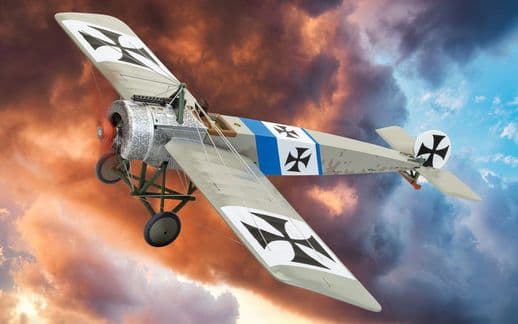
The latest additions to this range really are classic releases, both of which are only the third releases from their respective toolings and both surely destined for classic Aviation Archive release status. Continuing the 'Fokker Scourge' being played out on our display shelves, the latest Eindecker presents an aircraft which was the mount of celebrated ace Ernst Udet, a man who was the highest scoring German ace to survive the Great War, going on to help shape the Luftwaffe prior to the start of the Second World War.
The second release is our latest Bristol F.2B Fighter, wearing a scheme which could hardly be more different from the two which preceded it. Benefitting from an exclusive selection of images showing advanced production samples of each model, let's take a look at each one in a little more detail, to discover why we should all be making a little space in our displays for their imminent arrival.
As the savage fighting on the Western Front revealed its insatiable appetite for consuming the lives of young men from all nationalities, a new war being waged in the skies above was about to take a similarly sinister turn. With their understanding of the absolute necessity to gain a control of the air and the wider implications this would have for the future of the entire conflict, the German High Command instructed its aircraft manufacturers to develop a new kind of aeroplane, one which was intended to hunt other aeroplanes and claim superiority of the skies. The result of that search was the Fokker Eindecker, a mono wing fighter aircraft which represented the very pinnacle of aviation technology at that time, incorporating all the flight research data designers had managed to amass and utilising all the very latest technological advances in aviation. With the ability to fire its machine gun through the arc of the propeller by using a clever interrupter gear mechanism, all the pilot of an Eindecker had to do was to aim the nose of his aircraft in the direction of his target and fire, something of a revolutionary concept in aviation, but one which wasn't as simple as this description suggests.
It has to be remembered that the aeroplane was still in its relative infancy at that time and even though it was a technological marvel, the Eindecker was still rather primitive and relatively underpowered, making their pilots true pioneers in their craft. If they were competent enough to manoeuvre their aircraft into an attack position behind an enemy aircraft, the rudimentary wing warping flight control method could soon have them in trouble. If they let the thrill of combat overtake their judgement, a tight turn to stay on the tail of their intended victim could see them entering a dangerous spin, at best losing valuable altitude and the chance of gaining a victory and at worst, not stopping until the aircraft hit the ground. Early Eindecker pilots were effectively writing the rules of aerial combat as they attempted to control the skies and with each hunting unit only usually being allocated three or four of the new fighters, they were still quite an exclusive group of airmen. Armed with their capable new aircraft, they learned quickly and Allied aircrews soon began to feel like they were nothing more than airborne prey.
With its position as the first true fighter aircraft in the world, the Eindecker is widely regarded by historians as the most influential military aircraft in the history of flight and even though the period referred to by the Allies as the 'Fokker Scourge' only lasted for a relatively short period of the war, the Eindecker had already made its significant contribution to aviation history. Relegated to non-combat and reserve roles by 1917, the Fokker Eindecker would also be used by the first fighter pilots of the Austro-Hungarian and Turkish air forces during the Great War.
A first look at images of an advanced production sample of this third release from our 1/48th scale Fokker Eindecker tooling.
On your tail - the Eindecker was designed to dominate the sky and for a time during the Great War, it reigned supreme.
Growing up in Munich, a young Ernst Udet was fascinated by the subject of aviation from an early age and would spend much of his free time doing whatever jobs he could at the local aircraft manufacturing company, whilst also helping to establish the Munich Aero-club. He was finally able to make his first powered flight with a test pilot from the aerodrome where he used to help out, but not before he had almost killed himself attempting to fly a glider he and his friends had built themselves. Following the start of WWI, Udet applied to join the German Army, but standing just 5ft 3 ins tall was told that he didn't qualify. He would later use his motorcycle riding skills to gain a position in a military dispatch riding unit, but following an accident where he was thrown from the motorcycle as it ran over a shell crater, required a period of extensive recouperation.
During his return to health, Udet befriended some men who were assigned to a flying unit, who convinced him to apply for pilot training, but after a couple of disappointments, discovered that the only way to guarantee acceptance in the Imperial German Air Service was to hold a civilian pilots licence. Immediately returning home and to the aerodrome where he had spent so many happy hours in his youth, a test pilot there agreed to teach him, but at his own expense and on receipt of his licence, was finally successful with his application to join the Air Force. His initial posting was as pilot in a reconnaissance squadron, flying spotting and artillery ranging missions with his assigned observer and to say his service introduction was eventful would be something of an understatement. He would be awarded the Iron Cross 2nd class for flying his damaged aircraft back to his home airfield following the failure of a wing brace anchor and with his observer on the wing, holding the wing together, but was later placed under arrest for recklessly overloading his aircraft with fuel and bombs when attempting to attack the enemy. When asked to observe an early bombing mission on his return to duty, where bombs were simply thrown from the cockpit of attacking aircraft, Udet impressed his commander by basically flying aerobatics in one of these primitive military aircraft, in an attempt to dislodge a bomb stuck in the undercarriage of his aircraft. On landing, he was immediately recommended for retraining as a fighter pilot.
Airman extraordinaire, Ernst Udet was the highest scoring German ace to survive the war.
Available now, this stunning Eindecker is the latest 1/48th scale addition to the Aviation Archive range.
Udet's introduction as a fighter pilot proved to be just as eventful as his reconnaissance posting. Flying a Fokker Eindecker, he chose to ignore combat instructions and attack a French aircraft head on and as the two aircraft closed at speed, Udet inexplicably froze. The French airman did not miss his opportunity and fired on the German aircraft, with a bullet grazing Udet's cheek and shattering his flying goggles, but failing to score a decisive victory. Udet escaped this encounter relatively unscathed, but resolved to never give his opponent such a chance again and to always fly decisively and aggressively when in combat, perfecting his fighting style and to become an ace airman at the earliest opportunity. It is thought that Udet may have scored his first aerial victory whilst flying Fokker Eindecker E.III 105/15 in March 1916, the aircraft we have modelled here and on landing, he was immediately promoted to the rank of Vizefeldwebel.
Ernst Udet would quickly demonstrate his flying prowess and made good on the promise he made to himself. With his victory tally standing at 20, he was visited by a rather famous flying celebrity, a man who wanted him to join his celebrated Flying Circus, and when you are approached by a man such as Manfred von Richthofen, you definitely don't decline such an opportunity. Having witnessed Udet shooting down an Allied artillery spotter during their first combat sortie, interestingly by performing a frontal attack similar to the one where he was almost killed, von Richthofen immediately gave his new recruit command of his old squadron, Jasta 11 and would not regret the faith he showed in him. Udet would end the war with 62 confirmed victories, the most successful Great War air ace to survive the conflict and second only in number to the great von Richthofen himself.
With the aeroplane becoming such a vital weapon during the Great War and with the Royal Flying Corps' Royal Aircraft Factory BE2c reconnaissance aircraft suffering so badly at the hands of the German Fokker Eindecker, an effective replacement in the armed reconnaissance/fighter role was desperately needed. At the Bristol Aeroplane Company, Chief Designer Frank Barnwell was determined that he was going to produce such an aircraft and he was uniquely qualified to deliver on his promise. A qualified Royal Flying Corps pilot with combat flying experience over the Western Front, he knew what qualities the new aircraft must possess and perhaps of even greater importance, what RFC crews would need from it. The new aircraft must be capable of effectively defending itself from enemy attack, but also to possess the ability to turn the tables in such circumstances and make any Luftstreitkräfte pilot regret their decision to tangle with the new British aircraft.
The prototype Bristol Type 12 (F.2A) made its maiden flight on 9th September 1916 and powered by the new 190hp Rolls Royce Falcon I engine, posted impressive performance from the start. A relatively large and purposeful aircraft, suitably impressed War Office officials placed an order for further development aircraft and 50 production aircraft for RFC training units, all of which would eventually be assigned to No.48 Squadron. Following training in the UK, this unit would take their Bristol Fighters across the Channel and make their combat debut in April 1917 at the Battle of Arras.
The new Bristol Fighter, or Brisfit (as it would be referred to by everyone in the Royal Flying Corps) underwent early improvement and modification and would quickly lead to the production of the most capable and ubiquitous version of the aircraft, the F.2B variant. This latest version featured the new, more powerful Rolls Royce Falcon III engine, a 285hp unit which gave the Bristol Fighter and impressive top speed of 123 mph and significantly greater climbing capability, making this an exceptionally capable fighting aeroplane. It would go on to make a significant contribution towards wrestling superiority of the air from the Germans and would remain a competitive combat aircraft for the remainder of the war. A relatively large aeroplane when compared with such enemy types as the Albatros series and Fokker Dr.1, the Bristol F.2B Fighter was surprisingly nimble for its size, possessing both the speed and heavy armament needed to claim a significant number of aerial victories for its crews. With well trained and experienced F.2B crews working as one, this nimble gunship could keep its guns pointed at an enemy aircraft during any engagement, resulting in many an unwary Luftstreitkräfte pilot quickly finding themselves starting as the hunter, only to quickly become the hunted. Rather than adopting effective defensive tactics, the Bristol Fighter was so good that RFC pilots actively went looking to tangle with the enemy.
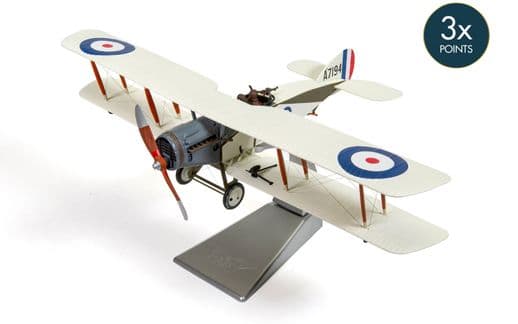
This next series of images show an advanced production sample of this latest Bristol F.2B Fighter model, one which could hardly look more different from the two models which preceded it.
By November 1918, orders had been placed for over 5,500 Bristol Fighters, and whilst some of this number would eventually be cancelled due to the end of hostilities, by the time the production lines were finally closed in September 1919, no fewer than 4,747 aircraft had been produced. Bristol Fighters would serve on many fronts during the Great War and in a variety of operational roles, from training and reconnaissance to day and night fighter, with the last examples remaining in RAF service until the early 1930s. One of the most important Allied aircraft of the early twentieth century, the Bristol F.2B Fighter effectively proved the concept of the multi-role aircraft, one which excelled in several different operational situations.
When Turkey declared war against Britain and France on 5th November 1914, the integrity of the Suez Canal, a vital trade route for Britain, was placed in some jeopardy and resulted in the Royal Flying Corps sending a small defending force of aircraft to the region. Initially, this force was made up of a motley collection of ageing aircraft types, however, the importance of this region to the British Empire soon dictated that more modern types would be sent to ensure the Central Powers could not threaten this vital trade route. The arrival of the newly formed No.111 Squadron RFC and their Bristol F.2B fighters in August 1917 was a significant development for forces in the Middle East, who now had access to aircraft which possessed all the attributes to secure mastery of the skies and therefore, maintain the balance of power in the region.
One of the most successful individual aircraft in these desert duals was No.111 Squadron's Bristol F.2B Fighter A7194, an aircraft which would have at least five aerial victories to its name and possibly several more. In the hands of pilot Captain Arthur Hicks Peck and his Observer/Gunner Captain John Lloyd Williams, A7194 would be used to destroy three enemy aircraft between 30th October and 8th November 1917, however for Gunner Williams, this spree would actually bring his personal victory total to five enemy aircraft, as he had claimed a further two earlier in October whilst flying with a different pilot. Captain Arthur Hicks Peck would remain with No.111 Squadron when they converted to SE5a single seat fighters by the end of the year and he would score a further five aerial victories in the Middle East, earning the coveted status of 'Ace'. Bristol F.2B Fighter A7194 would later be transferred to No.1 Squadron Australian Flying Corps, who continued to maintain Allied air supremacy in the Middle Eastern Theatre.
A model of distinction, this latest Bristol F.2B Fighter really is a stunner and is scheduled to be available by the middle of next month, perhaps in time for a RIAT debut!
This beautifully presented aircraft sports distinctive (slightly off) white painted upper surfaces over the standard Protective Covering Number 10 dope finish (olive green shade), a scheme it received during its time serving with No.111 Squadron RFC in the Middle East. Several of the unit's aircraft were presented in this manner and whilst there didn't appear to be any officially documented reason for the markings, several theories have been suggested over the years. It could have been to make the aircraft visible to other Allied units during combat, or to confuse the enemy with such a radically different presentation of the feared Bristol Fighter. Other theories centre around the fact that it may have simply been an attempt to combat the heat of the desert sun, or even the fact that with air superiority secured, there was more possibility of losing an aircraft due to a technical issue than during combat and should a crew have to set their Brisfit down in the desert, this scheme would make the aircraft more visible from the air to those sent to rescue them. Whatever the reason, Bristol F.2B Fighter A7194 was a particularly attractive aircraft and when combined with its air combat successes, must have been one of the most popular aircraft on the Squadron at that time.
We hope you will agree that both of these new models will make for spectacular additions to any Aviation Archive model collection, and we are pleased to confirm that the Eindecker is available now, with the Bristol Fighter scheduled to follow on by the middle of next month. Strangely, these early aerial warfare pioneers look great displayed next to the Phantoms, Lightnings and Typhoons we also produce in this scale, helping to highlight the astonishing pace of development within the world of aviation during the 20th century.
Tankfest in miniature - the Corgi model display at this year's show. Come and feel the weight!
There’s a saying down in a certain rural part of Dorset that goes something like this - If you go down to the woods today, you're sure of a great surprise ..... lots of massive TANKS! Having spent last weekend at the Tank Museum at Bovington, we can certainly attest to the validity of that saying and if a Challenger II is not crossing the road to get from one forest clearing to the next during a training sortie, then carrying on to the Tank Museum itself will reveal arguably the most impressive collection of tanks and military vehicles to be found anywhere in the world.
The reason for our visit was to join the throngs of people attending this year's Tankfest event, an annual gathering of some of the most iconic tanks and military vehicles which are all in running order, with examples from both the museum's collection and a healthy sprinkling of guest vehicles, many of which are displaying in the UK for the first time. This event is a real celebration of the tank, with themed displays effectively charting the development of the tank, all expertly narrated by the museum's knowledgeable and engaging staff - Tankfest is a real assault on our senses, but definitely in a good way!
This year's show marked the first time that Tankfest had been spread over three consecutive days, offering more people the opportunity to experience the event and with good weather forecast over all three days, expectant sell-out crowds turned up each day to enjoy some good old fashioned heavy metal action, with firing field guns and combat re-enactments thrown in for good measure.
All this seemed to offer the ideal opportunity for us to show off our fabulous 1/50th scale Military Legends, smaller Military Legends in Miniature and World of Tanks collections to this armour orientated audience, so we dispatched a small team down to the Tank Museum for that very purpose. With the Museum open to the public on the day prior to the event and with our position being within one of the impressive display halls, it was going to be three very long days for the team, although we did have the reward of being sited between a fantastic collection of preserved armour and the honour of showing our models to armour fans from all over the world.
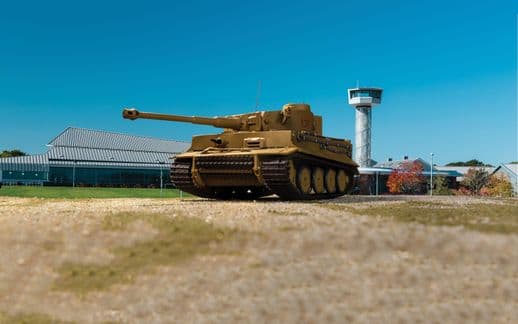
As we have just released our ‘Tiger 131’ - Tank Museum Edition model, this was clearly going to be of specific interest over the weekend and even though we were only displaying, we were able to allow visitors the opportunity not only to see this splendid new model, but also to pick it up! As tanks usually weight in the region of 30 tons upwards, your model representations of one really should have a bit of weight to them and these beauties certainly do. By the reaction of people who were experiencing these models for the first time, we think we might have set one or two down the collecting path, with the enigmatic Tiger 131 being the first model in their collection.
Clash of armour, Tiger 131 style. Our latest 1/50th scale Tiger 131 'The Tank Museum' edition meets the incredibly famous machine which inspired her creation - we have to say, the two seemed to get on rather well. This trio of images were all taken by our Head of Brand, David Mather.
So many people picked the Tiger up and immediately attempted to buy one over the weekend, but unfortunately, as we were only exhibiting, we had to direct them to either the museum shop, or to the Corgi website to secure their example. Unfortunately, even the display models in the museum shop had been sold by the end of the Saturday show, so the tills most definitely must have been ringing during this year's Tankfest.
Clearly, Tiger 131 is one of the major attractions at the Tank Museum and if I had been given a pound for everyone who asked me if I knew where Tiger 131 was, I would be a very rich man now. Thankfully, this armoured celebrity was waiting to greet her adoring public only a few metres away from our display position and one of the joys of attending this event was going to wish her a good morning each day and give her a little pat, as we arrived prior to the visitor gates being opened. It really is quite strange how this massive tank continues to command such affection amongst so many people and how getting close to her is still a treat, no matter how many times you may have done so previously. Even though she's basically a 50 ton armoured behemoth, she really is quite the cutie.
Obviously for the Corgi team, this trip also offered the opportunity for us to introduce our scale die-cast representation of Tiger 131 to the incredibly famous machine which inspired its inclusion in the range and I have to say, it actually proved to be quite a special moment. When you spend each and every day representing this brand to the very best of your ability, it's moments like these that you will remember when posting blogs and writing articles are a thing of the past.
We would like to thank the Tank Museum for hosting us over Tankfest weekend, and particularly all the people who dropped by to talk die-cast model collecting for a while - you all helped to make this a very special weekend indeed.
We are afraid that's all we have for you in this latest edition of Corgi Die-cast Diaries but we will be back as usual in two weeks' time with a further selection of model project updates. Between editions, we are always interested to hear your views on all things Corgi, so if you feel like dropping us a line to comment on anything blog or Corgi model related, or indeed to suggest a topic you would like us to include in a future edition, please feel free to do so at diecastdiaries@corgi.co.uk.
If you can’t wait for the next blog, you will find plenty of Corgi model collecting discussions taking place on our official social media channels, access to which can be obtained by clicking on the respective links at the foot of the Corgi website homepage.
Link access to Corgi social media sites.
Thank you for continuing to support our Die-cast Diaries blog. Our next edition is scheduled for publication on Friday 14th July.