

Welcome to the latest edition of Corgi Die-cast Diaries, your regular blog review of all the news, updates and topical stories from the captivating world of Corgi die-cast model collecting.
The focus of our attention for the latest edition of Corgi Die-cast Diaries is an undisputed Aviation Archive heavyweight champion, or should we say our latest release example of it. As this particular model has so far avoided our DCD radar and has arrived in our warehouse a little ahead of schedule, it more or less demanded it be our main subject for this latest edition, and we had to oblige.
We know that each member of the Aviation Archive collector fraternity will have their own opinions on which models have proved to be the most significant over the 26 year heritage of our popular aircraft range, however, we think few will disagree with the opinion that the 1/72nd scale Avro Lancaster tooling should be right up at the head of any list produced. As we welcome the latest addition to the ‘Lancaster Club’ to the current range, we’re going to be taking this opportunity to not only look at the details behind this latest release, but also to look a little more deeply into the history of the tooling itself and why it continues to occupy such a significant position in the history of the Aviation Archive range.
In an intentionally aviation-centric edition of our blog, we will end by looking at a pair of ‘Black Beauties’ which are each now down to less than 20 models available in our warehouse and as such, may well be about to disappear from the Corgi website for good. Now might be a good time to check if either are missing from your own collection.
We’re in the company of die-cast aviation greatness this weekend, as our 1/72nd scale Avro Lancaster takes star billing.
A die-cast aviation phenomenon, Corgi’s 1/72nd scale Avro Lancaster is unquestionably one of the most significant models in the hobby.
We’re certain that many Die-cast Diaries readers will have been on their own Aviation Archive collector journeys right from the start of this die-cast phenomenon, from when the first of these fully assembled and decorated metal models appeared on the market back in 1998. They will also be fully aware that as one of the most famous aircraft in British aviation history, the Avro Lancaster was selected as one of the initial wave of tooling releases in the range, effectively ensuring the success of this range of new 1/144th scale models right from the start.
If you managed to resist becoming captivated by these beautiful little models in those early stages, a development which took place just two years later would probably have had you rushing to your local model store to re-evaluate that position. Although many of us would have been aware of the Aviation Archive range from Corgi by then, most of us can probably trace our real connection to the range back to the year 2000 and a series if interesting adverts which appeared in several aviation enthusiast magazines at that time. As we turned the pages on the latest developments in the world of historic aviation, we were attracted by a new advert from Corgi, one which was showcasing a new range of 1/72nd scale models.
The initial model releases were produced to commemorate that summer’s 60th anniversary of the Battle of Britain, and included a Spitfire, Hurricane and Messerschmitt Bf 109E, all in 1/72nd scale and all beautifully finished in die-cast metal. With memories of the old Dinky Spitfires in our minds, most of us probably shared the same sentiment that the new models would probably be more toy-like than collectables, however, the advert images were appealing enough to ensure that we had to check them out in the metal, just to see what they were all about. A trip to the model shop was needed at the earliest available opportunity.
If that first meeting between model and collector took place at this point, there was absolutely nothing we could do about it – these little models were about to secure an indelible place in our hearts, and we were about to become die-cast aircraft model collectors.
Lancaster production, Corgi style. This image illustrates just how manual a process the production of these models actually is.
One of the tooling components produced in support of the 1/72nd scale Avro Lancaster model project.
We know we’re taking a few liberties and assumptions here, but for many of us, we think that our formative years are where our love of aviation began and most likely included Airfix model kits and discovering the joys of modelling. This simple pastime pleasure also supported our thirst for knowledge and encouraged us to find out a little more about the aircraft we were building, their histories and significantly, the colours they were presented in. Those years left us with a passion for aeroplanes and aviation history which will probably remain with us until our last breath.
Unfortunately, as life, careers and responsibilities took priority, this healthy infatuation had to give way to more mundane matters and whilst our kit stashes may have continued to grow as we always promised ourselves a return to modelling at some stage, the actual time spent modelling became just a fading memory. With that being the case and with a return to regular modelling not being an option for many, had Corgi just come to our rescue and could our display shelves once again revel in a magnificent collection of scale model aircraft, models we didn’t have to build?
If we had been expecting to find clunky models which were for our children to play with, and something of a disappointment to us, we were in for a very pleasant surprise, because those 1/72nd scale models were stunning. Beautifully finished and fully assembled, these models not only looked like the accurate scale kits we used to build in our modelling days, but they also possessed that oh-so appealing weight of die-cast – we were back in the aviation model collecting game. From that point forward, we all knew that we were going to be spending a lot more time in our local model stores. It’s also interesting to note that whilst current model production runs are usually around the 1000 piece mark, back then, it wasn’t uncommon to find a limited edition collector card to show production figures of over 5000 models.
By this point, Corgi had us and we had all become committed Aviation Archive collectors almost overnight, but they hadn’t finished with us yet and were already working on a model which would both blow our minds and break new ground in the world of die-cast model production at the same time.
The tampo printing process of painting model detail is a truly fascinating one to watch and relies much on the ingenuity and dexterity of the factory technicians.
Not Chadderton, but Guangdong Province, this is Avro Lancaster production Chinese style.
In the year which followed the release of the Battle of Britain trio of models, a further series of adverts carried by the enthusiast press brought us details of an exciting new addition to the range, one which really grabbed our attention. Although Corgi had been quite active over the previous few months in announcing newly tooled models of the P-51D Mustang, English Electric Lightning and de Havilland Mosquito, their next addition was a different proposition altogether, the Avro Lancaster. Surely this would be too large a model to produce in metal and even if they did manage it, would it be able to match the previous releases for detail and finesse?
As we all scoured the internet for the first reports from collectors who had secured one of the models, we could contain our curiosity no more and headed to our nearest model shop, or latest toy fair to see the new Corgi Lancaster for ourselves and when we did, it was like Christmas and birthdays all rolled into one! Although the team who brought us that industry defining model are no longer linked to the brand, they have to be commended for producing what is arguably the finest die-cast tooling that has ever been conceived, a stunning model which is still gracing the Aviation Archive range to this day.
For an aircraft which has always meant so much to enthusiasts and occupies such a significant position within British aviation history, surely a die-cast Lancaster model in this scale couldn't live up to our expectations and would just be a huge anti-climax once we had the chance to inspect one. To our absolute delight, the exact opposite proved to be the case and once we had seen one in the metal, we simply had to have it. Even more than that, even though we have no empirical evidence to back this up, our 1/72nd scale Lancaster probably set more people off on their die-cast aviation collecting journey than any other single model, it really was that good.
Since that impactful first release, the Corgi 1/72nd scale Lancaster has proved to be one of the most popular models in the entire Aviation Archive range and you can be sure that any range which includes a Lancaster will still be attracting plenty of collector attention. We’re delighted to confirm that the current Corgi range can now boast the arrival of the latest model from this tooling, and it really is a cracker!
Before we go on to look at the details behind our latest Avro Lancaster release, several of the images used to illustrate this feature were taken during a factory visit almost twenty years ago, but formed part of a dual blog review back in 2018. If you would like to take a look back at those previously released editions of Die-cast Diaries, please use these Lancaster 1 and Lancaster 2 links for access.
Historically regarded as the most effective four engined heavy bomber of the Second World War, the Avro Lancaster would be the third aircraft of this classification to enter Royal Air Force service, after the Short Stirling and Handley Page Halifax bombers which preceded it. The Lancaster was a development of the earlier Avro Manchester, an advanced twin engined design which is often regarded as a failure as an operational aircraft, but one which was essentially an excellent aeroplane powered by engine technology which was just too advanced for the time. With the troublesome Rolls Royce Vulture engines never allowing the Manchester to achieve its operational potential, Avro designers took what was already an excellent design and adapted it to be powered by four of the tried and trusted, readily available Rolls Royce Merlin engines.
The new aircraft was initially referred to as the Manchester III and when it made its first flight from Ringway Aerodrome on 9th January 1941, it immediately showed itself to be a promising performer, a significant improvement over its twin engined predecessor in performance terms. Interestingly, that first flight of this much improved bomber actually took place before the Avro Manchester had completed its first operational sortie in RAF service.
With its increased wing length and use of four Merlin engines as opposed to the two Vultures of its predecessor, the new Manchester III immediately underlined the strength of the initial Avro design, transforming the reputation of what was regarded as an extremely disappointing aircraft into one which would become the most capable bomber of the entire Second World War. Almost as soon as the first flight of the prototype had been completed, the name of the aircraft was changed to Avro Lancaster and whilst they didn’t know it at the time, they had just witnessed the birth of an aviation classic.
A classic view of this beautiful model. All the images posted in this review feature a production sample of this latest Lancaster release.
The performance improvement the new aircraft posted was so impressive that it immediately attracted a significant order from the Air Ministry, one which resulted in partially constructed Avro Manchester airframes already on the production line being converted to Lancasters, so desperate were they to get this impressive new bomber into squadron service. As the last of the Avro Manchester twin engined bombers to be assembled were delivered to RAF Squadrons around the UK, these troubled aircraft were being sent on their first bombing raids over enemy territory.
Unfortunately for the Avro Manchester, despite the many impressive qualities which were undoubtedly incorporated into its design, this bomber would be completely overshadowed by the incredible aircraft which superseded it and to all but the most committed of aviation enthusiasts, has become a relatively unknown, almost anonymous chapter from the annals of Bomber Command operations during the Second World War.
The first Lancaster Mk.I bombers were delivered to RAF No.44 (Rhodesia) Squadron at Waddington at the end of 1941, with the Squadron subsequently taking the honour of becoming the first unit to completely convert to the new heavy bomber. The first operation for a No.44 Squadron Lancaster took place on 3rd March 1944, when a Lancaster conducted a mine laying operation in the Heligoland Bight, off the North German Coast, and just a week later, three Lancasters took part in a major raid targeting Essen. This was just the beginning for the Lancaster and Bomber Command now had the aircraft with which to carry out their bombing campaign against Germany.
One of the design features which made the Lancaster such a successful design was its huge, unobstructed bomb bay, a cavernous area measuring 33ft by 10 ft, made possible by repositioning the aircraft’s main load-bearing wing spar. This may have made crew access to the front of the aircraft much more difficult, but it also made the offensive weapon carrying capability of the Lancaster second to none – the impressive performance of the aircraft allowed a Lancaster to carry almost its own weight again in fuel and bombs, enabling them to strike deep into the heart of Germany with a devastating payload of offensive ordnance.
The image graphic produced to grace the box presentation of this magnificent new Lancaster release.
With its huge, unobstructed bomb bay, the Lancaster was capable of carrying the huge Tallboy bomb, a weapon which was capable of destroying its target by the shock wave it caused.
The Lancaster could carry everything from standard 500lb and 1000lb bombs and incendiaries, to larger, more specialised weapons, including those developed by celebrated designer and inventor Barnes Wallis. The most famous of these were the ‘Upkeep’ mines used against the mighty German dams during Operation Chastise, but following the success of this raid, Wallis was tasked with developing more specialist weapons. His 12,000lb ‘Tallboy’ bomb was a precision delivered earthquake bomb, designed to be used against strategic targets, with its 5,200lb of Torpex D1 explosive intended to detonate below ground and literally shake its target to destruction.
Able to penetrate heavily fortified structures which conventional bombing attacks couldn’t hope to damage, these mighty bombs were dropped from a height of around 25,000 ft and were carried by specially modified Lancasters which were equipped with new bulged bomb bay doors, able to close over the wider girth of the Tallboy bombs.
After their success against the great Ruhr dams, the skills of the recently created RAF No.617 Squadron were retained as a special operations squadron and they would go on to deliver many of the Tallboy bombs dropped during the latter stages of the war, the first being on 8th June 1944. Their target on that occasion was the Saumur Railway Tunnel, a vital artery for the Germans in rushing arms and supplies to the areas around the Allied landing beaches following D-Day. Other specialist targets would be E-boat bases, U-boat pens and V-weapon sites, but also a particularly infamous floating target which would attract no fewer than 76 Tallboy bombs over time.
The threat the mighty German battleship Tirpitz posed to Allied shipping ensured that the warship was continually targeted by the Royal Air Force, so when she was redeployed to Norwegian waters in early 1942, it didn’t take long for RAF bombers to catch up with her. The destruction of Tirpitz by whatever means, was always high on the British military’s list of priority targets and an incredible amount of resource was directed towards this aim.
Several unsuccessful raids using conventional bombs had failed to remove the threat posed by Tirpitz, however, with the availability of the new Tallboy 12,000lb bombs and the modified Lancasters capable of carrying them, the RAF now had the means with which to bring about its destruction. Operation Paravane on 15th September 1944 almost brought about the success they craved, when a Tallboy detonated near the bow of the battleship and although the vessel suffered significant damage and would require months in repair, she was still afloat and therefore still a threat – the Lancasters had to go back.
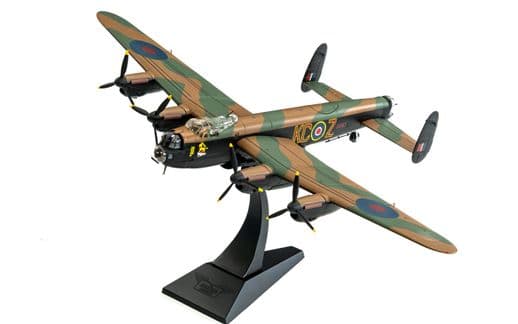
Although this latest Lancaster release is a representation of an aircraft which was sent to destroy the German battleship Tirpitz, it also happened to be one of the original aircraft allocated to RAF No.617 Squadron the ‘Dambusters’.
On 29th October, Operation Obviate was mounted with the intention of finishing off the pride of the German Navy, however, poor weather over the target and the warship’s effective smoke screen resulted in 32 Tallboy bombs being dropped without any visual references, with the bombers once more returning to their bases without achieving the success they craved.
Operation Catechism on 12th November 1944 would see another concerted effort by the Royal Air Force to destroy this mighty warship, with 18 Lancasters from No.617 Squadron and a further 13 from No.IX Squadron taking off from their temporary bases at Lossiemouth and Milltown in northern Scotland heading for Tromso Fjord in Norway. All the aircraft would be carrying more than a maximum fuel load for a Lancaster and were again loaded with Tallboy bombs, but this time, their modified flightpath would be skirting Swedish airspace, attacking Tirpitz from the opposite direction, in the hope that they would catch the German defenders by surprise.
As the Lancasters began their run in towards the target, they could clearly see Tirpitz from as far as 20 miles away and significantly, there were no Luftwaffe fighters to be seen. Despite attracting the attentions of heavy defensive fire from the battleship and her shore batteries, the bombers pressed home their attack, with the first Tallboy being released at approximately 08.40 in the morning. Over the course of the next few frantic minutes, Tirpitz was subjected to an almost constant stream of these devastating bombs, with at least two scoring direct hits, and others detonating close enough to cause the ship further significant damage.
Just minutes after the first bomb was released, Tirpitz was seen to start listing to port, initially appearing to settle at an angle of around 35 degrees. As water flooded into the interior of the ship, her roll slowly continued until at 08.51, a tremendous explosion saw one of the warship’s turrets flung high into the air as if it were made of plastic, as her ammunition store ignited. Her fate was sealed – the ship immediately capsized and the Lancasters turned for home.
Tragically, a great many German sailors were to lose their lives as a result of the final destruction of Tirpitz, however, from an Allied perspective, they were certain that this was just a fraction of the lives which would have been lost, had this fearsome warship been allowed to slip away and raid Allied shipping in whichever ocean she was operating. Almost all the Operation Catechism Lancasters made it back to their temporary bases in Scotland, but only after having been in the air for more than 12 hours and having completed a round trip of some 2,200 miles. Indeed, two modified Lancasters with additional fuel tanks in their bomb bays sent to record the results of the raid made it back to RAF Waddington after having been in the air for an incredible 14 hours.
There’s nothing like a nice bit of artwork on an appealing Lancaster model release.
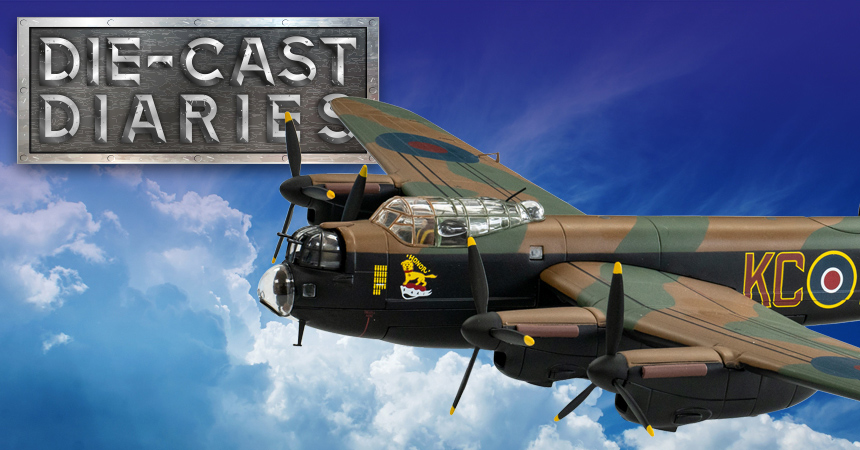
RAF No.617 Squadron’s Lancaster B.III ED763 KC-Z ‘Honor’ was one of the aircraft which took part in this final, devastatingly effective Tirpitz raid and was an aircraft which served as the subject for a series of publicity pictures taken at the time, images which show the aircraft being ‘bombed up’ with a 12,000lb Tallboy bomb. Flown by Flt Lt Stuart Anning and his crew during the Operation Catechism raid, this is actually rather a noteworthy Lancaster, not only because of her distinctive nose artwork, but also because she was one of the founding aircraft of No.617 Squadron, delivered to RAF Scampton as a standard Lancaster.
Prior to the new squadron receiving their purpose built Type 464 Provisioning Lancasters, they ‘borrowed’ ten standard Lancasters from various units across No.5 (Bomber) Group, so that the crews selected for No.617 Squadron could begin their low level training flights straight away. Lancaster ED763 was one of those ten aircraft and is therefore considered one of the founding Lancasters of 617 Squadron.
Used operationally for the first time as a ‘Dambuster trainer’, this Lancaster flew her first dams raid training sortie on 2nd April 1943 and as ‘Upkeep’ configured Lancasters were still top secret at that time, found herself featuring in several base photographs taken as this new unit prepared to embark on this historic raid. We can therefore see that by the time she took part in Operation Catechism in November the following year, and the subsequent destruction of Tirpitz, Lancaster ED763 ‘Honor’ was actually quite the veteran airframe, but one which had quite a story to tell.
You need to use your imagination with this image and pretend the Hurricane nightfighter has left this black aircraft formation.
By way of an Aviation Archive public service, from time to time, we like to draw blog reader’s attention to models which have proved popular with collectors, but are now in extremely short supply and soon to disappear from the Corgi website altogether. This time, we have selected a pair of aircraft which span 66 years of aviation development between them, but both have two things in common – both are presented wearing smart black liveries and both are now down to less than twenty models left available.
As one weekend of ordering activity will see both of these models consigned to the Aviation Archive history books for good, we wanted to give Die-cast Diaries readers one final head’s up before that happened, just in case you had been thinking of adding either to your collection. We’re going to feature them in reverse chronological order, even though both are classic aeroplanes in their own right, with the Rolls Royce jet powered aircraft first, followed by a Mercedes powered machine from the very early days of military flying.
For an aircraft type the Royal Air Force were initially not particularly keen to take, the Blackburn Buccaneer would go on to prove an exceptionally capable machine in RAF service and by the time it was eventually scheduled for retirement, they were extremely reluctant to let it go. Although ultimately operating a naval aircraft they had originally dismissed, it didn’t take long before the camouflaged Buccaneers of the RAF showed why this was definitely no second choice aircraft type. During the impressive 32 year service history of Britain’s Blackburn Buccaneer force, surely there can have been no finer looking aircraft than S.2B XT279 in her stunning black livery, even though the decision to present her in this manner was not without some controversy.
The story behind this stunning scheme is that during the early 1980s, one of RAF No.16 Squadron’s Buccaneers was finished in a smart all black finish, with a yellow ‘Saint’ stick man on either side of the tail and yellow codes, making her undoubtedly the most distinctive jet in Germany at that time. The only problem with this is that the scheme was applied whilst the Squadron Commander was away from duty and the scheme fell squarely into the ‘unofficial’ category.
The aircraft would later take part in a formation flypast over RAF Germany HQ, but by the time she landed back at RAF Laarbruch, the ‘Top Brass’ had spotted the scheme, and all hell had broken loose! The Buccaneer was immediately tucked away in a hangar with crews ordered to immediately remove the scheme - in addition to this, all photographic evidence of the unofficial scheme was ordered to be destroyed. Thankfully, a small number of images did survive the cull and ever since, modellers and enthusiasts have been fascinated by the story of RAF Germany’s stunning black Buccaneer.
From an Aviation Archive perspective, the range can now boast no fewer than three of RAF No.16 Squadron’s distinctive black jets, with this beautiful short-lived Buccaneer scheme joining previously released Tornado GR.1 AA33622 and Jaguar GR.1A AA35411. Could there possibly be a more enigmatic line-up of post war Royal Air Force jet types?
A proud Bavarian, Otto Kissenberth trained as a mechanical engineer in the years prior to the outbreak of the First World War, but as the world descended into conflict, followed his interest in flying and joined the German Air Service. Initially serving as a reconnaissance pilot, he would later transfer to a new single seat fighter unit, where he would earn his first three combat victories. During an Allied bombing attack against the Mauser rifle factory in southern Germany, Kissenberth flew his fighter aggressively against the raiders, blunting the attack and dispatching three enemy aircraft in the process. This early fighter unit would later be used as the nucleus of the new Royal Bavarian Jagdstaffel 16, where Kissenberth’s personal victory tally would continue to increase.
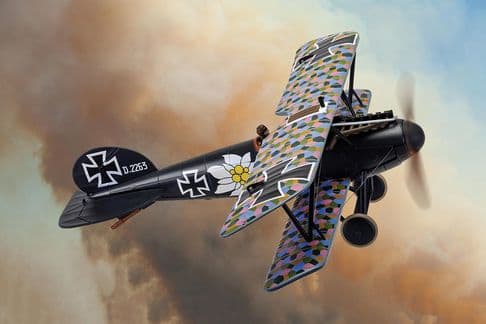
Otto Kissenberth has been described as being something of a character, brave and tenacious in the air, but a fighter pilot with a rather unusual trait - he flew combat missions whilst wearing his spectacles, something only two other Luftstreitkräfte fighter aces were known to have done. Given command of Royal Bavarian Jasta 23 at the beginning of August 1917, Kissenberth would continue his association with the Albatros D series of fighters and in particular, aircraft serial number D2263/17, a machine in which it is thought he would go on to score the majority of his 20 aerial victories.
As his personal aircraft, it was distinctive by virtue of its smart black fuselage and the large yellow and white Edelweiss emblem it sported on either side of the fuselage, just behind the cockpit. Further adding to the fascinating story of this Great War Albatros ace, Kissenberth claimed a British RNAS Sopwith Camel for himself, an aircraft which had been forced down intact by another one of his unit’s pilots. Overpainting the aircraft’s British insignia with new German markings (for obvious reasons), he apparently flew the aircraft on many occasions and incredibly, used this captured aircraft to score the last of his 20 victories on 16th May 1918, when he used it to bring down a British SE5a fighter near the town of Tilly-Neuville.
As mentioned previously, both these models can now be classified as rare birds from an availability perspective and may soon be relinquishing their positions on the Corgi website. If either could find a home it your collection, you need to place them in your acquisition crosshairs now – don’t forget to use all those accumulated reward points.
That's all we have for you in this latest edition, however, please join us again next time for another exclusive insight into the wonderful world of Corgi model collecting. Between editions, we are always interested to hear your views on all things Corgi, so if you feel like dropping us a line to comment on anything blog, collecting or Corgi model related, or perhaps to suggest a topic you might like to see us cover in a future edition, please do get in touch at diecastdiaries@corgi.co.uk.
If you can’t wait for the next blog, you will find plenty of Corgi model collecting discussions taking place on our official social media channels, access to which can be obtained by clicking on the respective links at the foot of the Corgi website homepage.
Link access to Corgi social media sites.
Thank you for continuing to support your Die-cast Diaries blog. Our next edition is scheduled to be published on Friday 18th October, and we look forward to seeing you back here then.