Welcome to our latest edition of CORGI Die-cast Diaries, your fortnightly blog review bringing collectors all the news, updates and topical stories from the captivating world of CORGI die-cast model collecting.
Since its introduction back in 1998, the CORGI Aviation Archive range has proudly helped to commemorate some of the most significant aircraft in the history of aviation, along with the exploits of their brave pilots and crews. During that time, some releases have included multiple models, or single releases linked by actions of the aircrews involved, helping to preserve and even bring aviation history to life, in a way that scale die-cast model collecting manages to do in such an appealing way.
In this latest edition of Die-cast Diaries, we will be featuring the latest multi-model release tribute to a famous wartime pilot, a man who would fly several different aircraft types during an impressive service career, and a man who would become one of only a handful of celebrated pilots to attain the coveted status of ‘Ace’ during the Second World War, and the Korean War which followed it. We will also see how his aircraft connections extend beyond this latest Aviation Archive pairing, and have connections to other 1/72nd scale die-cast model aircraft which many DCD readers will already have amongst their collections.
With our usual impressive selection of exclusive model imagery, please join us as we climb aboard the two North American produced fighter mounts that helped William T. Whisner become an ‘Ace’ pilot in two different wars.
Aviation Archive is the star of the blog show this time around, with the aircraft of US pilot Bill Whisner taking centre stage.
The incredible success of the Aviation Archive range can probably be explained by the fact that history continues to be a source of fascination for millions of people all over the world, not just in relation to the aircraft which have graced the skies over the past 122 years, but also the personalities who created that history. In addition to this, aeroplanes really must be regarded as the most fascinating and exciting machines ever created by man, with the marriage of these two factors creating a heady mix which has inspired and enthralled people for decades.
During our formative years, books and television programs provided the aviation history details we all found so engaging, helping to feed our insatiable thirst for information and the stories of aviation personalities, however, no matter how engaging these undoubtedly were, there was another medium which served to fuel our passion even more effectively, scale modelling. Plastic model kits have been accessing the world of aviation history for subject inspiration for over 70 years, and whilst this continues to appeal to millions of hobbyists, was there a more effective way that the world’s most famous aircraft could be represented in scale form?
That answer appeared with some gravitas following the introduction of the CORGI Aviation Archive range, beautifully crafted and fully finished models produced with the appealing weight of die-cast metal, models which didn’t require any assembly or painting, and could be admired and enjoyed the second they were removed from their protective packaging. Produced in limited quantities and appealing to aviation enthusiasts of all hobby persuasions, these hugely appealing models took aviation history and gave it physical form, providing a much more impactful representation of the information than any book entry of magazine article ever could.
There’s nothing like a linked model release to add real interest to any Aviation Archive collection.
Within its relatively short history, the Aviation Archive range has taken our fascination for aeroplanes and encompassed every facet of aviation history within its ever expanding tooling bank, and with each new model addition having its own story to tell. That story might relate to an individual aircraft, perhaps a famous bomber completing a noteworthy number of operational missions, or a fighter flown by a particularly successful ‘Ace’ pilot, but whatever those details behind the real aircraft might be, its die-cast representation was beautifully produced, was highly collectable and possessed that oh so appealing weight of die-cast metal.
In some cases, these model releases chart the careers of particularly famous pilots and the aircraft they flew, or in the case of our update subjects for this edition, feature aircraft flown by a successful pilot who is certainly deserving of much greater recognition than he has historically received – the Aviation Archive range is hopefully about to put that right.
Born and raised in the US city of Shreveport, Louisiana, William T. Whisner Jr was always keen on military related pursuits, and during his formative years, became an active member of the Boy Scouts of America and joined his school’s Junior Reserve Officer’s Training Corps as soon as he was old enough to do so. On graduating from High School, Whisner applied to join the United States Army Air Corps via its cadet program, starting his training in April 1942, and after successfully completing his primary, basic combat and advanced flying training, was commissioned as a Second Lieutenant in the February of 1942.
His first Air Corps assignment was to learn how to fly the mighty Republic P-47 Thunderbolt at Westover Field, before joining the 34th Fighter Squadron at LaGuardia Field in New York. In advance of this unit’s deployment to the European Theatre, his unit was re-designated as the 487th Fighter Squadron, 352nd Fighter Group, with Whisner and his squadron mates sailing for England aboard the RMS Queen Elizabeth in June 1943. Their ultimate destination was USAAF Station 141, the former RAF Bodney airfield in Norfolk, a location with which they would become extremely familiar over the coming months.
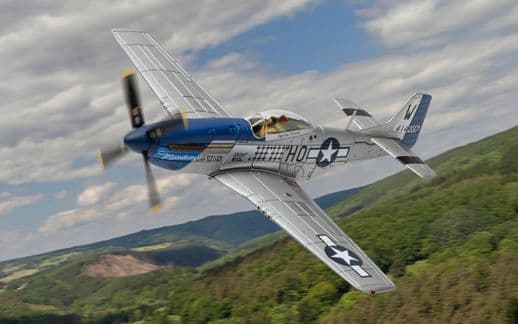
An ace in two wars. Bill Whisner used North American aircraft types using different methods of propulsion to score victories in both the European Theatre during WWII and the Korean War.
Although the unit’s pilots were already experienced in flying their Republic P-47 Thunderbolts, they weren’t used to flying them over the unfamiliar landscape of East Anglia, so embarked on an intense period of training and familiarisation flying, in an attempt to quickly acclimatise to their new surroundings. They would finally be released for combat operations from the 9th September 1943, free to play their part in securing Allied air superiority in the skies above enemy occupied Europe.
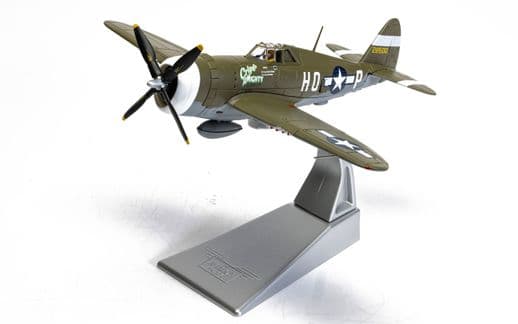
Bill Whisner would score his first victory over a Luftwaffe fighter whilst flying a bomber escort mission over northern Europe, a mission where he was flying as wingman to another future USAAF ‘Ace’ pilot, Captain George E Preddy, who would go on to become the leading Mustang ace in the European Theatre. Preddy’s Republic P-47 Thunderbolt has recently taken its place as part of the Aviation Archive range and is therefore another model release possessing links to Bill Whisner during his celebrated combat flying career.
With his position as the European Theatre’s leading Mustang ‘Ace’ of WWII, George E Preddy Jr. will always be associated with this exceptional fighting aeroplane, however, his combat introduction was made in two very different fighter types and initially at least, on the other side of the world. Preddy was initially posted to Australia with the 49th Fighter Group for the defence of Darwin, but suffered serious injury when his P-40 collided with another fighter during a training exercise. Following a lengthy recovery, Preddy was later sent to England and assigned to the 352nd Fighter Group, where he would fly the mighty P-47 Thunderbolt. On 29th January 1944, Preddy would score his third aerial victory in the Thunderbolt, but would end the day floating in the English Channel, hoping to be rescued.
Heading back to his home airfield at Bodney in Norfolk after scoring his latest victory, this time over a Luftwaffe Focke Wulf Fw190, Preddy’s P-47 was hit by enemy flak whilst crossing the French coastline, with his wingman reporting seeing Preddy’s fighter smoking badly, and the pilot taking to his parachute. His wingman, Lt. William ‘Bill’ Whisner, risked his own aircraft running out of fuel by remaining with his ditched squadron mate, circling the position until an accurate location fix could be obtained by his controllers, and a rescue aircraft dispatched. When the amphibious Supermarine Walrus aircraft did arrive, the sea was so rough that it lost a wing float when landing, and whilst the aircraft was able to rescue Preddy, it had to be towed back to shore by an RAF rescue launch.
All of George Preddy’s fighters in the European Theatre carried the name ‘Cripes A’ MIGHTY’, a term the pilot overheard people using for luck whilst playing the dice game craps. He was so taken with the saying that he had it painted on the fuselage of his Thunderbolt, and subsequently on his future Mustangs. Not long after Preddy’s North Sea soaking, the 352nd began converting from P-47s to North American P-51B Mustangs, and the rest, as they say, is the stuff of USAAF ace pilot history.
Only weeks after this incident had taken place, Whisner and the 352nd exchanged their Thunderbolts for P-51B Mustangs, and aircraft type (albeit in upgraded variant form) in which Whisner would score the majority of his aerial victories. Whilst the next model in our review of linked Whisner aircraft releases wasn’t actually made by CORGI, it will be part of many a die-cast aircraft collection, and as such, is still worthy of note here, as it might have to be displayed with the trio of Aviation Archive releases featured in this latest update.
With a British Royal Family visit to the USAAF Station at Bodney imminent, base officials wanted to make a P-51B Mustang nose artwork tribute to the young Princess Elizabeth, the future Queen of Great Britain and her Commonwealth. Unfortunately, most of the aircraft at the airfield had already been adorned with artwork embellishments of one form or another, however, the aircraft assigned to pilot Bill Whisner was still only resplendent in the distinctive blue nose of the 352nd Fighter Group.
Whisner’s crew chief arranged for the fighter to have the name ‘Princess Elizabeth’ painted on the port side cowling of the aircraft, something which might have met with the approval of the Royal party during their visit, but made bill Whisner furious when he clapped eyes on it. Appearing overnight, he was apparently livid when he saw the new ‘unauthorised’ (by him, at least) artwork addition to his fighter, particularly as it now had the nation’s press gathered around it, and would effectively be in the national gaze from that point forward.
As he had little involvement in the naming of his aircraft, he was presumably rather pleased when the 352nd upgraded their fighters for the new P-51D ‘bubbletop’ variant of the Mustang, particularly as Princess Elizabeth would later be destroyed by enemy flak whilst being flown by another pilot on D-Day.
Regarded by many as the finest fighting aeroplane of the Second World War, the ‘D’ variant of the Mustang was the most heavily produced version of this famous fighter, one which addressed most of the perceived shortcomings associated with earlier versions of the aircraft. Despite the fact that razorback B and C model Mustangs were excellent fighting aeroplanes in their own right, they did have issues with compromised visibility from their birdcage canopy, and were equipped with guns which had a tendency to lock-up during combat. Both of these issues hampered the performance of an aeroplane which was already showing itself to be generally superb.
The ‘D’ model addressed both of these issues, altering the rear fuselage to allow the adoption of a large, single piece Plexiglas teardrop canopy which offered excellent all-round visibility, and the introduction of a redesigned wing which housed six .50 calibre machine-guns, which were now mounted in an upright configuration, virtually eliminating the earlier feed jamming issue. The improvements also included the addition of an incredibly effective gunsight, one which would prove to be one of the most effective fitted to any WWII fighter, and part of an upgrade combination which made the already impressive Mustang almost unbeatable.
The ‘D’ variant of the Mustang started to appear on airfields across England from the summer of 1944, allowing the Mustang to continue to build on earlier operational successes, providing pilots with a fighter that was now literally capable of hunting the Luftwaffe to destruction. Mustang pilots interviewed after the war described how they knew the Mustang was a special aeroplane as soon as they sat behind the controls of one – ‘it just felt right’. With its engine now benefitting from a two stage, twin speed supercharger, the Mustang was equally at home defending USAAF bombers at high altitude, as it was down on the deck looking for Luftwaffe targets of opportunity.
For the great many people who have always been fascinated by the exploits of the most successful fighter aces of the Second World War, it’s often difficult to comprehend the extraordinary feats performed by men who considered themselves to be ordinary, and simply performing their duty. One such man was William T. ‘Bill’ Whisner, a fighter pilot who had previously been the regular wingman of famous fellow US ‘Ace’ pilot George Preddy, but had now become a respected ace in his own right.
His most successful day came on 21st November 1944 when he shot down five Focke Wulf Fw190 fighters on the same mission, whilst protecting bombers sent to attack the synthetic oil refineries at Merseburg. He would also be credited with a further two enemy aircraft probably destroyed, and all in a frantic 20 minutes of combat. He would be awarded the Distinguished Service Cross for this incredible feat of airmanship.
Whisner would be awarded a second DSC on New Year’s Day 1945 when the Allied airfield Y-29 at Asch in Belgium came under attack from 65 Luftwaffe fighters during their famous ‘Operation Bodenplatte’ raid. Whilst in the process of taking off from the airfield in his usual Mustang ‘Moonbeam McSWINE’, Whisner noticed multiple enemy aircraft approaching the airfield at low altitude and at speed, and as soon as his undercarriage had retracted, found himself firing his guns at a Focke Wulf Fw190.
As the enemy fighter hit the ground, Whisner could feel the impact of enemy cannon shells striking his fighter, so immediately took evasive action to avoid taking further hits. Despite suffering damage to his aircraft, he stayed with his Mustang to claim a second Focke Wulf and two Messerschmitt Bf 109’s destroyed, bringing his score to four for the day and total victory tally to 15.5 enemy aircraft.
These would be Whisner’s final victories of the Second World War, however, he would go on to be one of just seven USAF airmen to also attain the coveted ‘Ace’ status during the Korean War, this time whilst flying the North American F-86 Sabre jet.
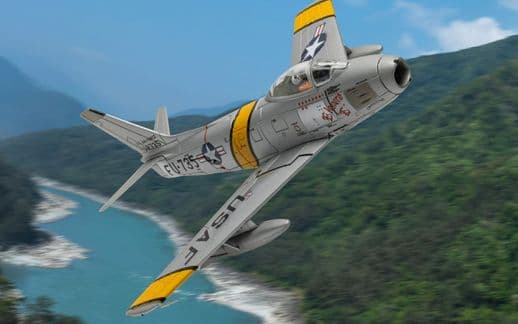
This may have been a later example of North American’s aircraft design prowess, but it was flown by the same ‘Ace’ pilot.
As one of the most effective fighting aeroplanes of the Second World War, it will come as no surprise to learn that as the world of aviation was propelled into the jet era, the North American company were at the forefront of this development. With the stellar performance of the Mustang as their blueprint, the design team at North American Aviation wasted little time in turning their attention to the production a new jet powered fighter even before the Second World War had ended.
That first design was very much based on the Mustang and featured straight wings, the same high mounted bubble canopy, but a slightly portly fuselage to house the Allison J35 turbojet engine. That aircraft was the North American FJ-1 Fury produced for the US Navy, an aircraft which would earn the distinction of being the first US Navy jet type to serve onboard a carrier at sea, under operational conditions.
Only thirty-three of these distinctive little fighters were eventually build, primarily because the design team at North American had been given access to captured German high speed flight research data by then, and they were incorporating this into a radical new design. Their new fighter featured wings and horizontal stabilizers which were swept back at an angle of 35 degrees as they searched for ever greater speeds, with the German flight data highlighting how this helped an aircraft overcome the effects of compressibility, something experienced by aircraft capable of attaining higher speeds.
The Sabre possessed the same legendary air fighting qualities possessed by its WWII predecessor, the P-51D Mustang.
With greater speed being an important consideration for their new fighter, their design incorporated a beautifully streamlined fuselage which retained the exceptional all-round pilot visibility first introduced on the bubble top ‘D’ variant of the successful Mustang. With three nose mounted .50 calibre machine guns positioned on either side of the aircraft’s beautifully sculpted forward fuselage, the new North American F-86 Sabre shared much of the design philosophies first seen on its famous piston powered predecessor, and whilst it was undoubtedly a beautiful aeroplane to look at, make no mistake, this was a ruthlessly effective fighting aeroplane at its heart.
Immediately earning a reputation as one of the world’s foremost early jet powered fighters, the Sabre would go on to set an impressive new world airspeed record of 670.84 mph, using what was to all intents and purposes a production aircraft, with a full operational loading, something which was quite the achievement. It would ultimately be combat operations which would earn the Sabre its most significant accolades, as during the Korean War, the aircraft would face greater odds against it that any other front-line combat aircraft had in the history of aviation, however despite this, would post an incredible combat success record of 14:1, from pilot accounts at the time.
The years which followed the end of the Second World War saw the victorious Allied nations having access to captured German jet research technology to advance their own jet powered capabilities significantly, with both the US and the Soviet Union introducing swept wing, advanced jet types. Tensions in the Korean peninsula would result in the first international conflict of the Cold War era and three years of hostilities which would see the meeting of the world’s leading jet fighters, the American F-86 Sabre and the Soviet MiG-15.
The US Air Force could not only rely on the excellent Sabre, which was a true pilot’s aeroplane, but also a handful of pilots who had been air aces during the Second World War, accomplished airmen who were well versed in the art of aerial combat. One such pilot was William T. Whisner, a 15.5 ace from the European Theatre in WWII who quickly increased his score in Korea, flying North American’s latest fighter. He would claim 2 enemy aircraft destroyed in the F-86A variant of this jet fighter, and a further 3 flying the later F-86E, with several other enemy aircraft credited as either shared destroyed or damaged.
Significantly, Bill Whisner would be one of only seven American airmen to become ‘Ace’ pilots in two wars, and the only one of this celebrated group to have been awarded THREE Distinguished Flying Crosses during his stellar service career. During a 32 month period in the Korean conflict, Allied airmen managed to shoot down over 800 of the diminutive Soviet made MiG-15 jet fighters, with the incredible North American F-86 Sabre accounting for no fewer than 792 of them.
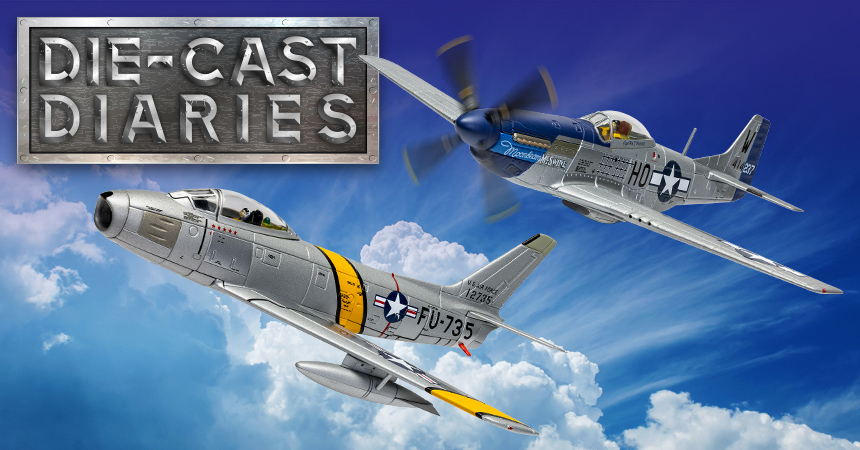
We are delighted to say that we will soon be able to add models of these two classic North American manufactured fighters to the Aviation Archive range, one arguably the most effective piston powered fighter aircraft of the Second World War, with the other being the most accomplished of the early jet fighters. Both aircraft were the mount of the same accomplished fighter pilot, and both were used to help him attain ‘Ace’ status in two different wars, which was quite the achievement.
The Aviation Archive range has always attempted to preserve aviation history in scale diecast form, and when it comes to interesting additions to any collection of die-cast model aircraft, could the aircraft with links to WWII and Korean War ‘Ace’ William T. ‘Bill’ Whisner Jr possibly have more interesting stories to tell.
Both Whisner’s Mustang and Sabre are scheduled for release next month, but the P-47 Thunderbolt ‘Cripes A Mighty’ flown by George Preddy, who Whisner flew as wingman for, is currently still available.
What a fantastic trio of related models to grace any collection.
Such appealing impending additions to the Aviation Archive range, this Mustang and Sabre were both flown by the same ace pilot, William T. ‘Bill’ Whisner Jr.
That’s all we have for you this time around, and due to annual leave and a well-earned break, it’s going to be four weeks until the next edition of our Die-cast Diaries blog. Even though that’s the case, should you wish to drop us a line to comment on anything CORGI model related, or to suggest a future blog topic you’d like to see covered here in DCD, you’d be more than welcome, and we’re always happy to hear your views.
As ever, our diecastdiaries@corgi.co.uk address is always the one to use.
If you can’t wait for the next blog, you will find plenty of CORGI model collecting discussions taking place on our official social media channels, access to which can be obtained by clicking on the respective links at the foot of the CORGI website homepage.
Link access to CORGI social media sites.
Thank you for continuing to support your CORGI Die-cast Diaries blog, as we head into our eleventh year of production. Our next edition is scheduled for publication on Friday 3rd July.
Until next time, once again, thank you for your continued support.