

Welcome to the latest edition of Corgi Die-cast Diaries, your regular blog review of all the news, updates and topical stories from the captivating world of Corgi die-cast model collecting.
There’s nothing quite like starting an edition of Die-cast Diaries with a host of exclusive new model imagery to share with our loyal readers, and we’re delighted to say that’s exactly what we have for you this time around. With our new Vanguards Ford Fiesta Mk2 tooling project now advancing at pace, we’re delighted to be in a position to bring you a major update from this project, with new imagery in both Engineering Sample, and digital design versions.
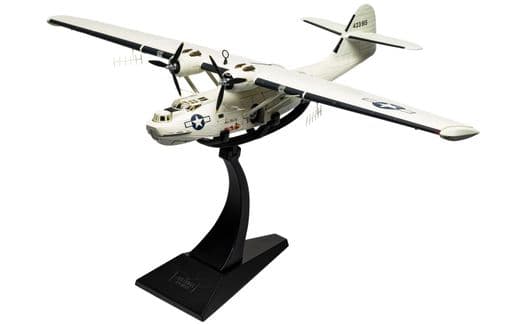
We follow this with an impending addition to the Aviation Archive range, our scale tribute to an aircraft which had only a relatively modest, if rather eventful wartime service career, but has since been commemorated in some style by an organisation operating one of the largest multi-engined classic aircraft on the current UK Airshow scene. Operating out of Halesworth Airfield (US Station 365) in Suffolk, the US 5th Emergency Rescue Squadron flew the OA-10A Catalina flying boat in support of Allied air operations into enemy occupied Europe, coming to the aid of airmen forced to ditch in the North Sea. A beautiful addition to the range and a model with an interesting story to tell, we have a selection of production sample images to share with you in this edition.
Finally, after such an important week for our friends at Aardman, it would be remiss of us if we didn’t acknowledge their achievements in the blog which immediately followed their incredible success, so that’s exactly what we intend to do.
Right then, let’s spend some time with a feisty little Ford.
The first in a series of exclusive development images all featuring our new Vanguards Ford Fiesta Mk2.
A much requested addition to our Vanguards model range, our new Ford Fiesta Mk2 tooling project was confirmed to collectors last year, and whilst we haven’t provided to much of an update for DCD readers to this point, that’s all about to change. A significant addition to the range, and one which will fill a little car that thinks it’s much bigger sized hole in the Vanguards range, the new Fiesta Mk2 project has been speeding along nicely in the background and now finds itself in the latter stages of its development.
The British motoring public have developed something of an obsession with smaller cars over the years, particularly those which occupy a classification we have come to know as ‘Superminis’. This is probably because these cars were produced with economy and practicability at their heart, but as they were also some of the most affordable cars on our roads, tended to touch the lives of more people than most other vehicle types.
These popular little cars were all about getting the nation moving, allowing us all to go about our daily lives, whether that be work, or leisure related. In some ways, these little cars actually became part of our families, but as they were always there to get us from A to B with a minimum of fuss, rarely received the care and attention our reliance on them probably deserved. Well loved and well used, it was rare for these cars to survive more than a decade or two and indeed, it’s rare to find examples which have been preserved in pristine condition, but when we do see one, we not only marvel at how much the motoring world has advanced over the past few years, but also how much these little cars meant to us back in the day.
CAD rendered images created using the Fiesta Mk2 design files.
Although we are only able to provide that motoring nostalgia in scale die-cast form, that’s definitely where the Vanguards range comes to the fore, producing a collection of beautifully crafted scale model representations of the cars we all used to know so well. Even if our beloved four-wheeled runaround has long since gone to that MOT station in the sky, we can still remember it with fondness, just within our display cabinets, rather than still on our driveways. You never know, as the range continues to expand, we might even produce a model of a car you actually used to own yourself, stranger things have happened.
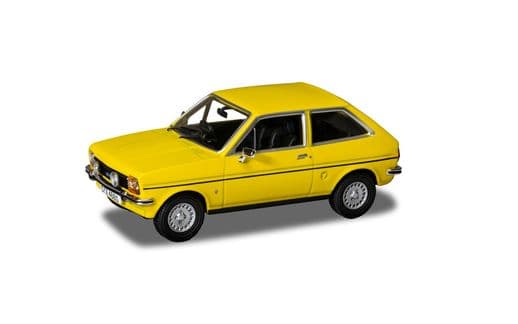
Our existing Ford Fiesta Mk.1 tooling has been one of the most popular models in the Vanguards range since its release back in 2011, and serves to illustrate Ford’s dominance within British popular motoring in the post war years, with the production of stylish, affordable cars. A functional design produced specifically to sell in volume, there’s actually something quite aesthetically pleasing about the angular lines of this first incarnation of the Fiesta, one which actually enticed me to become a Ford owner, as the first car I bought myself was a silver Fiesta Mk.1 XR2.
When the first generation Ford Fiesta was released in the UK at the beginning of 1977, it was the smallest car Ford had in their lineup at that time and indeed, was the smallest modern car they had ever produced – it also had the title of being Ford’s most costly car to develop to date. Cleverly leaked at several high-profile events by Ford’s marketing team, the car proved to be an instant success and was available in several different versions, each one offering different levels of trim and performance.
With Ford already having quite the reputation in motorsport success, the 1.3 SuperSport and stylish XR2 were unquestionably the most desirable models in the range, however, despite its popularity, the Fiesta was definitely ready for a facelift by 1982.
More CAD delights straight from our Development Manager’s computer, this time showing some of the model options included in the new Ford Fiesta Mk2 tooling.
The second generation Ford Fiesta started appearing in showrooms the following year, building on the success of its predecessor, but introducing a more refined styling to the car, including a more rounded front profile and featuring deep, wrap around detailing. The new model also brought with it a host of interior and mechanical improvements which made this a worthy successor, however, there were those who held on to the previous model, feeling that the Fiesta Mk.2 lacked the charm of its predecessor. It was still effectively presented by Ford’s marketeers as the little car that thinks it’s a big car, a milestone model for them and a great advance in making a small car feel much larger and more refined. We also had the Ford Promise to reassure us, in that Ford gives us more! Just what that stood for is a matter open to discussion.
Having said all that, the Fiesta continued to be a success for Ford and the later arrival of the sporty XR2 with its distinctive new body styling kit soon started to win over those who were struggling to make the transition. In its best UK sales year in 1987, the Fiesta sold more than 150,000 cars in the UK alone, a figure which brought it in just behind the Ford Escort in overall sales numbers. Throughout its life, the Fiesta has continued to evolve, whilst keeping Britain motoring at the same time, with the final iteration being the seventh generation of this incredible series of cars.
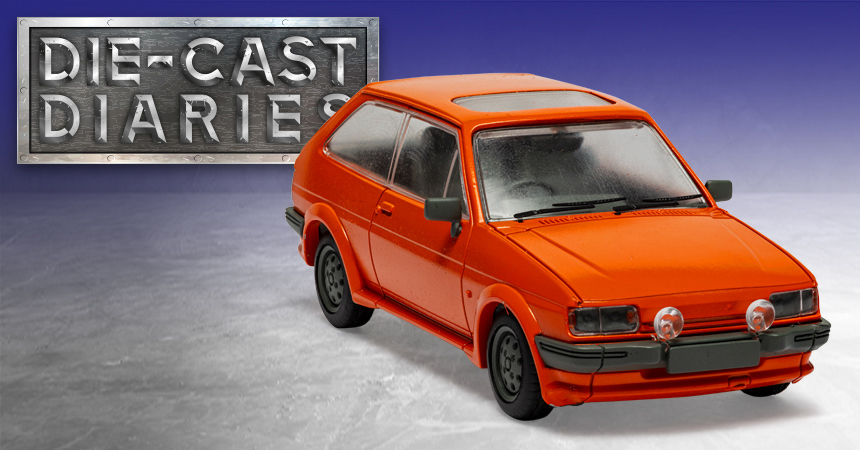
An exclusive first look at the XR2 engineering sample produced from the new Mk2 tooling, but why did it come in orange?
As rather a significant model omission from the Vanguards range to date, both the development team and our loyal collectors will be looking forward to seeing the project images we are about to exclusively show here, putting us on standby that it won’t be too long before we can consider adding several to our model collections. Historically, we announced the existence of this project back at the beginning of last year, even including an image taken during our scan day visit to the Ford Heritage Centre in that first catalogue of 2024. Things have moved on significantly since then, and it won’t be too long before this Fiesta Mk2 shaped hole in the Vanguards range can be shored up.
The selection of images we have to share this time include CAD renders produced from the new model’s design files, and an interesting selection of CAD screenshots showing some of the design/model variations incorporated into the Mk2 Fiesta tooling. By inspecting these, you can see we have the XR2, the popular and L models, a Fiesta van and Police variants of the Mk2 Fiesta available, so we intend to present this Ford classic in many of its release guises over the coming years.
The orange coloured model images all feature engineering samples of the new model in four different configurations, but all intended to allow our development team to assess the accuracy and production quality the new tooling produces, before it can advance any further. You will note that at this stage, features such as the wheels, tyres and glazed areas all appear unfinished, however, this is intentional, as we only need to check the overall accuracy of the tooling itself at the moment – significantly, this is not a pre-production model.
This next series of images all show the recently received Ford Fiesta Mk2 engineering samples in various guises, starting with this image of all four models lined up in a similar manner to the CAD images shown earlier.
XR2 again.
Is this the Popular Plus?
An arresting little number.
A Mk2 Fiesta with commercial matters in mind.
Looking good from any angle, the XR2 makes an appearance once more.
As to why the samples turned up resplendent in orange paint, well your guess is as good as ours, because we were expecting them to arrive in bare metal as is usually the case, but the world of die-cast model production can be a funny place and we all like the odd surprise or two, don’t we! Nevertheless, this represents a significant stage in the development of our new 1/43rd scale Ford Fiesta Mk2 model and as such, we thought you might like to see these images.
As always, we have to include our project caveat that these images represent models which are still very much in the development phase, and likely will change before you see them next, however, we now find ourselves speeding headlong towards initial release, so you can expect our next update to be published in the not too distant future. As a car that will be familiar to a great many Vanguards collectors, we look forward to adding the Fiesta Mk2 to our range and to giving the first release its own web page and therefore, the ability to pre-order our models, but before we get too far ahead of ourselves, we hope this project update has been of some interest to you.
We know we have been featuring the various iconic craft operated by International Rescue over previous blog editions, but before Thunderbirds, there were the Catalinas of the 5th Emergency Rescue Squadron coming to the aid of those in peril. I know this is something of a tenuous link, however, there is no doubting the affection in which our Catalina tooling is held within the collector community, as it’s unquestionably one of the best loved and most impressive toolings in the entire Aviation Archive range.
Making its release debut in 2006, our Catalina tooling is a real triumph of die-cast tooling engineering, a model which possesses huge appeal and produces one of the most interesting models in the Aviation Archive range. Benefitting from high metal content and featuring plenty of fine detail, each and every Catalina release has been met with great collector support, with previous releases only now obtainable by prizing one from the grasp of a fellow collector. Thankfully, we’re about to have another model release for us to consider, an extremely appealing release which commemorates the late Second World War work of the men and machines of the USAAF 5th Emergency Rescue Squadron, and one aircraft in particular, a Catalina known as ‘Miss Pick Up’.
Within the UK Airshow enthusiast community, any mention of the name ‘Miss Pick Up’ and we immediately know the aircraft which people are referring to, one of the largest airworthy historic aircraft types currently flying in Europe and a hugely popular display item on the Airshow circuit. An example of the famous amphibious flying boat from the Second World War, G-PBYA is actually a Canadian built Canso A variant produced for the Royal Canadian Air Force, equivalent to the Consolidated PBY-5A which saw service with the US Navy. She arrived in the UK during 2004, and having made the long flight from Canada via several US states, the Catalina took up residence at IWM Duxford, where she quickly become a favourite with Airshow enthusiasts, as she wasted no time in taking her place on the display circuit.
At that time, and for the first few months of operation, she displayed at events both in the UK and in Europe, the aircraft retained the rather garish yellow, red and green markings, the ones applied during her career as a water bomber in Canada. Before long however, her owners planned an exciting scheme change, one which had links to a USAAF Catalina which operated from Halesworth in Suffolk during the latter stages of the Second World War, and a persona which would endear her to an army of enthusiasts the world over.
The Consolidated Catalina was a highly successful US flying boat/amphibious aircraft which served throughout WWII in many theatres of operation. Used by the US Navy, USAAF, Royal and Commonwealth Air Forces, the Catalina proved to be such an effective design that aircraft were still in service around the world many years after the end of the war, with around 3,300 aircraft eventually being built. As a long-range maritime patrol aircraft, the Catalina was an essential asset in a number of critical areas, including general naval patrols, anti-submarine operations, night intruder and autonomous shipping raider.
Perhaps the most significant role undertaken by Catalina’s and the one in which it was held in such high regard, was that of rescuing airmen forced to ditch their aircraft in the sea – quite literally, their saviours from the air. As Allied air operations against Germany and enemy occupied Europe intensified, the potential for large numbers of Allied airmen to be lost in the English Channel, or in the vast expanses of the North Sea greatly increased. Although the RAF and Royal Navy provided a highly efficient search and rescue service for Allied airmen of all nations, D-Day preparations brought about discussions between the British and Americans on future plans. It was decided at that meeting that the US Eighth Air Force would immediately establish their own autonomous Search and Rescue capability, covering the seas off the East Coast of Britain.
All the images shown here feature an advance production sample of this latest impending Catalina release.
Initially, this essential task was performed by a collection of war weary Republic P-47 Thunderbolt fighters operating from Boxted airfield, aircraft which were adapted to carry dinghy packs and sea marking equipment, and were charged with locating downed aircraft and their crews, before directing other rescue services to them. Eventually, these aircraft were superseded by much more suitable Consolidated OA-10A Catalinas, aircraft which would be operated by the 5th Emergency Rescue Squadron, from their base at Halesworth in Suffolk. The Halesworth based Catalinas would only see service during the final months of the Second World War, but still managed to see plenty of action in the unforgiving waters of the North Sea, whilst rescuing 938 downed airmen.
The new scheme which inspired the Plane Sailing team when it came to repainting their restored, airworthy Catalina was one of the aircraft which operated out of Halesworth with the 5th Emergency Rescue Squadron, a very specific aircraft which was involved in a rescue mission on 30th March 1945, one which would ultimately lead to its destruction at sea.
Operating from its home base at Halesworth, Consolidated OA-10A Catalina 44-33915 named ‘Miss Pick Up’ was scrambled to assist another Catalina which had been sent to rescue the crew of a downed B-24 Liberator in the North Sea, an aircraft which itself had found itself in difficulties having landed on extremely rough seas. Managing to locate the other Catalina, ‘Miss Pick Up’ flew over the aircraft several times, sending back location coordinates to other units, before being relieved by other aircraft. She was then directed to try and locate the position of a North American P-51D Mustang pilot who had been reported as ditching in the sea off the coast of the Dutch Island of Schiermonnikoog.
With light now fading and the American airman drifting ever closer to the enemy coastline, the Catalina’s crew sighted distress flares fired by the pilot and landed on the still heavy seas as close to him as it was safe to do. With daylight now almost gone, the crew lost sight of the downed airmen in the gloom and were unable to extend their search for him, because the starboard engine of the aircraft had completely seized. They and their aircraft were now adrift on heavy seas and perilously close to enemy occupied territory.
The first time we’ve ever shown a full Aviation Archive box artwork presentation here in DCD.
They dropped the Catalina’s sea anchor, checked the hull for signs of damage and leeks, before settling down for an uncomfortable night and the long wait to be rescued themselves. As for the unfortunate Mustang pilot, well, he would later be washed up on a nearby beach, and immediately taken into captivity by patrolling German troops.
Early the next morning, the crew sighted several Allied aircraft overhead and launched their own distress flares to alert them of their predicament and for the rest of the morning, they were reassured by the presence of some friendly fighter protection above. At around midday, with their fuel running low, the fighters left station and made for home, with others due to replace them soon, however, during that brief period without air cover, the damaged Catalina was unfortunate enough to come under attack from a pair of Messerschmitt Me 262 jet fighters from Jagdgeschwader 7.
The German jets made two devastating cannon strafing passes on the mighty amphibian, attacking out of the sun to mask their approach. These attacks inflicting significant damage on the Catalina, which immediately began to take on water and started to list heavily, but thankfully, disaster for the crew was averted, as a flight of Mustangs arrived in the nick of time and forced the Messerschmitts to break off their attack, a timely intervention which enabled the crew of ‘Miss Pick Up’ to avoid sustaining serious injury themselves. They quickly gathered anything important, before abandoning their fast-sinking amphibian, and taking to their dinghies.
The crew of ‘Miss Pick Up’ reported that they could see a large tower on the shoreline in the distance when they were moored, and felt that they must have been around six or seven miles from the enemy coastline They also reported the tower as unleashing sporadic fire in their direction, which didn’t make for a particularly pleasant situation for them. Eventually, a B-17 Flying Fortress from their home 5th Emergency Rescue Squadron base dropped a Higgins Airborne Lifeboat for the crew clinging to their dinghies, which was a much more substantial craft and allowed them to finally set a course for home.
They would eventually be picked up by a Royal Navy torpedo boat, however, despite the positive outcome for the crew, they had been forced to endure rather a traumatic experience in the icy waters of the North Sea, not to mention having survived an enemy attack by a pair of the most devastating jet fighters in the world at that time. The aviation gods were definitely watching over them that day.
As for ‘Miss Pick Up’, unfortunately the Messerschmitt Me 262s had done their work and she quickly settled onto a watery resting place on the bottom of the North Sea. Her work, and the incredible details of this particular mission, however, are commemorated by the current scheme worn by a restored Catalina on the UK Airshow circuit, an aircraft which is simply referred to as ‘Miss Pick Up’, by virtue of the fuselage artwork she wears. You can visit their website to discover her story, the inspiration behind this model release, and check where she will be displaying in the months ahead – you can find it using this Catalina Society website link.
The images featured above all show an advanced production sample example of this impressive new model, with the Catalina scheduled to arrive in our warehouse during early March. Please keep an eye on the ‘Miss Pick Up’ product page on the Corgi website for the latest availability information.
That pesky Feathers McGraw has been leading Wallace & Gromit to even more accolades.
We couldn’t end this latest Corgi update without sending hearty congratulations to our friends at Aardman Animations on scooping two new prestigious awards at the recent British Academy Film awards. Their beloved characters and distinctive comedic films which always bring families together, received further accolades at the BAFTAs, as their latest stop motion delight ‘Vengeance Most Fowl’ was voted best Animated Film and best Children’s & Family Film at the awards.
The film sees the return of one of the most heinous villains to have ever appeared on our TV screens, Feathers McGraw, as he executes a dastardly plan to gain revenge over our heroic duo and to get his wings on the Blue Diamond he covets so badly. The scene is set for mayhem and hilarity, and a film which proved to be the highlight of family viewing over the recent Christmas holidays and rightly steering the Aardman team to more industry acclaim. With our own model tributes to Wallace & Gromit being such popular collectables in whichever Corgi range they appear, the entire team here would like to congratulate Aardman on this latest achievement, and of course to Wallace & Gromit for just being so great.
Onwards and upwards for our dynamic duo and if they can keep that damned Feathers in check, it’s surely nothing short of world domination for Wallace & Gromit in their next adventure!
I’m afraid that's all we have for you this time around, however, we’ll be back as usual in two weeks’ time with a further exclusive selection of the latest Corgi model updates. As ever, you could always drop us a line if you felt moved to do so, to comment on anything blog, collecting or Corgi model related, or even perhaps to suggest a topic you might like to see the team cover in a future edition. As always, our diecastdiaries@corgi.co.uk address is the one to use.
If you can’t wait for the next blog, you will find plenty of Corgi model collecting discussions taking place on our official social media channels, access to which can be obtained by clicking on the respective links at the foot of the Corgi website homepage.
Link access to Corgi social media sites.
Thank you for continuing to support your Corgi Die-cast Diaries blog. Our next edition is scheduled to be published on Friday 7th March - we look forward to seeing you all back here then.