
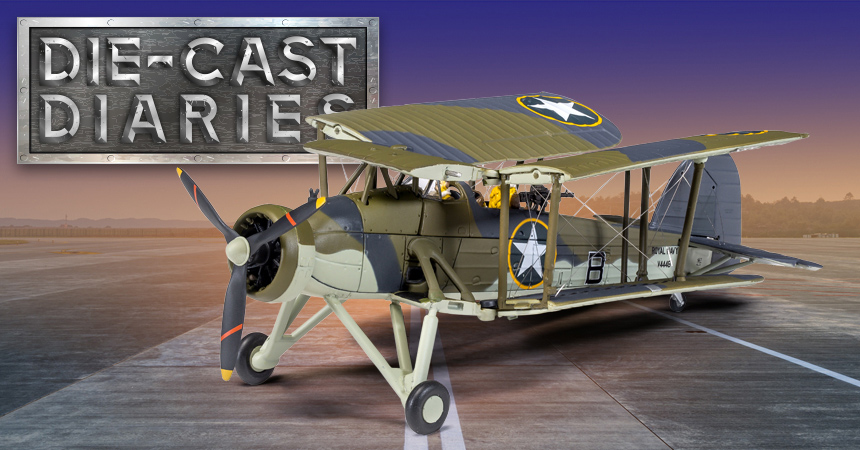
Welcome to the latest edition of Corgi Die-cast Diaries, your regular blog review of all the news, updates and topical stories from the captivating world of Corgi die-cast model collecting.
We begin this latest update overview by featuring a model which is the latest impending addition to the Aviation Archive range, a model which in its own right must be viewed as something of a classic in terms of the wider die-cast aircraft collecting hobby, the venerable old ‘Stringbag’. Serving throughout the Second World War despite being classed as obsolete at its outset, our scale tribute to the Fairey Swordfish possesses an equally impressive pedigree, something we intend to explore fully in this edition. Remaining with the subject of flying machines, the Swordfish will be sharing flightdeck space with an aircraft from a much later era, one which can do even more than the Stringbag could, because this one can also operate under water.
Illustrated with the latest exclusive model development imagery throughout, we will be ending this latest edition by featuring the displaying and photography talents of an avid Vanguards model collector, a man who prefers not to leave his models packed away in his loft, or sitting in their presentation boxes. Instead, he uses his photographic skills to do something really artistic with them, bringing them to life in a most appealing manner.
It's Corgi blog weekend once again and we have a selection of model features to bring you which will include impending, future and existing Corgi die-cast models in all their collectable glory.
It’s been ten long years since a new Aviation Archive collection Fairey Swordfish model has graced our display shelves, but that’s all just about to change.
If there was ever such a thing as an Aviation Archive convention arranged for the devoted masses who have followed this collection of models over the past 25 years or so, when sharing our opinions on the subject, we may fail to find consensus on which is the best model ever released, but we would surely agree on which models were the most influential. With the early 1/144th scale models serving to attract everybody’s attention, the arrival of the first 1/72nd scale aircraft just a couple of years later raised the profile of the range immeasurably, with the Avro Lancaster ‘S for Sugar’ release in 2001 setting the bar so high that the range never looked back.
With the Lancaster setting a standard by which all other die-cast aircraft models would be judged, the Aviation Archive range continued to innovate, whilst at the same time allowing more of the world’s most famous aircraft to join the collectable pioneers which had gone before them. The next influential releases came in the form of the Gloster Gladiator and Fairey Swordfish models in 2006 and for the first time in die-cast, the Corgi engineers had developed a process by which these magnificent models benefitted from the inclusion of full wire rigging. Quite literally extending the boundaries of what was possible in the industry at that time, more rigged biplane model releases were to follow, however, it was the original pairing of the Gladiator and Swordfish which will be remembered as being the Aviation Archive pioneers.
Although we did see a Gladiator released to commemorate the 80th anniversary of the Battle of Britain in 2020, it has been more than ten years since a new Fairey Swordfish model has graced our display cabinets, however, things are about to change very soon. Many collectors thought this model tooling lost or irreparably damaged in a Far Eastern storage facility, but thanks to the investigative powers and diligent efforts of our development team, the Corgi Fairey Swordfish is about to be unleashed once more.
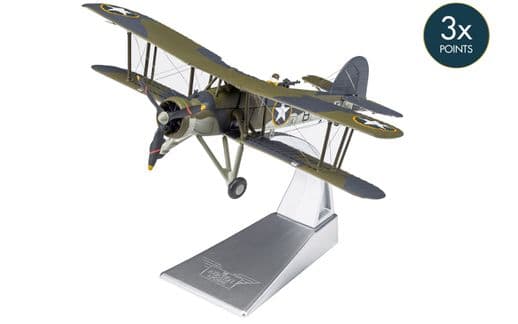
This latest release marks an aircraft which took part in Operation Torch towards the end of 1942 and wears the very distinctive markings of a Fleet Air Arm aircraft sporting modified national insignia, in an attempt to avoid friendly fire incidents blighting this US led, Allied amphibious landing. We are delighted to be in a position to share the latest advanced production sample model images of the Swordfish with you now, as we confirm that the Swordfish model is almost back with us.
Let’s also take a look at why this particular scheme was selected for range inclusion.
Having first taken to the air in 1934, the venerable Fairey Swordfish may have had the appearance of an aircraft from an earlier era of aviation, however, it would go on to serve throughout the Second World War and more than this, prove to be a critical component in Britain’s naval strike capabilities in the process. Interestingly, the Swordfish was originally referred to by its internal company designation, T.S.R.1 (Torpedo, Spotter, Reconnaissance 1), which were the roles for which this capable new aircraft was intended. When a second, slightly improved version aircraft was subsequently constructed, this received the designation T.S.R.2, something which would later turn out to be another famous British aviation acronym, but one linked to an advanced strike jet which was famously cancelled in 1965.
Belying its slightly ungainly appearance, the Fairey Swordfish would prove itself to be an exceptionally robust and adaptable aircraft, earning a reputation as one of the most famous naval aircraft of the Second World War. It’s nickname ‘Stringbag’ is thought to be both a reference to its ageing appearance and the fact that its docile handling characteristics would allow it to be flown in almost any conditions by a competent pilot. More colloquially, to Swordfish crews, it appeared as if no matter what size or shape of offensive ordnance the aircraft was required to carry, the Swordfish simply accepted the challenge and got on with the task at hand - just like a string shopping bag did back in those days, only in carrying groceries instead of bombs and rockets!
Proving crucial to Britain’s war effort during WWII, most of the 2,400 Swordfish built were constructed by Blackburn Aircraft Limited at their Sherburn-in-Elmet facility in North Yorkshire, with the final aircraft only delivered as late as 18th August 1944. Not bad for a biplane with a top speed of just 140 mph which had made its first flight ten years earlier.
All the model images being shown here are an exclusive first look at an advanced production sample model of this much anticipated new Fairey Swordfish model.
In the hands of an experienced crew, the Swordfish could be devastatingly effective against enemy shipping and submarines, using its slow speed and manoeuvrability to bring about a successful attack. For the inexperienced pilot, the Swordfish also proved to be rather forgiving, with its low take-off and landing speeds helping to make this notoriously dangerous phase of flight much less challenging for them. An extremely rugged aeroplane, the Swordfish excelled in the often harsh environments in which it was required to operate, however, when pressing home their attacks, crews might have to endure a hail of defensive fire from their intended target, or when under attack themselves from enemy fighter aircraft, with little in the way of protection for themselves. These famous old biplanes were flown by a special breed of airmen, every one of them a hero.
With America now in the war following the infamous Pearl Harbour attack, and with Britain keen to use their powerful new ally to initiate the opening of the long hoped for ‘Second Front’, the Anglo-American invasion of French North Africa offered many potential strategic benefits, not least of which was the pressure it would relieve from beleaguered Soviet forces fighting the Germans in the East. The proposed ‘Operation Torch’ was the most ambitious naval operation yet undertaken in the European or African theatres, and the first large scale Allied amphibious operation of WWII.
With the territory to be assaulted occupied by Vichy France forces, the hopes were that the operation could take place without too much opposition, particularly as this was being positioned as an American led operation. Political discussions had reaffirmed their intention not to fire upon the French unless fired upon themselves.
Desperate to avoid antagonising the French forces they were about to face and therefore increasing their fighting resolve, the operation was positioned as being US led with support from British naval and air power, intentionally downplaying the fact that British troops would effectively be invading French held territory. The plan called for strong naval forces to support landings in three sectors, with the Americans making up a Western Task Force (Atlantic flank) and landing at Casablanca, with the British forming the central and eastern attack forces (in the Mediterranean), landing at Oran and Algiers respectively. A third British naval Task Force would cover the Mediterranean flank against U-boat and any potential Italian intervention.
The first time Swordfish artwork files have been produced in over ten years.
A Swordfish configured for below deck storage on one of Britain’s wartime aircraft carriers.
The Swordfish aircraft used during Operation Torch were assigned to provide vital anti-submarine patrols to protect the invasion force vessels, with patrol operations commencing on 30th October whilst the task force was approaching Gibraltar. An extremely busy period then followed for Swordfish crews, however, not everything went to plan during this time, with British Escort Carrier HMS Biter losing three of its Swordfish to landing accidents in just a few days, whilst aircraft were attempting deck recoveries in rough seas. Indeed, two of these aircraft were so badly damaged that they were unceremoniously pushed over the side of the vessel into the angry seas which were responsible their demise.
On 7th November 1942, the Swordfish of both 'A' and 'B' flights No 833 Squadron Fleet Air Arm put ashore at Gibraltar and commenced anti-submarine patrol operations from the Island, as the work to finalise the huge assault groups began in earnest. HMS Biter was assigned to the Central Naval Task Force aimed at Oran, and whilst her Swordfish continued to protect force vessels from U-boat attack, her complement of Sea Hurricanes would be required to provide fighter cover for other fighter attack aircraft tasked with taking out Axis airfields following the commencement of operations.
Although enemy submarine activity posed a very real threat to the sizeable Allied assault force, the effectiveness of the Swordfish screen and the sheer size of the Allied force assigned to the operation deterred any futile attacks by enemy units, even though at least one U-boat was detected by the Swordfish in the days leading up to the main assault.
One of the most interesting aspects of the air operations during, and in the lead up to Operation Torch, was the subject of Allied air recognition markings applied to aircraft. With the potential for British, American, Vichy French, Italian and German aircraft to be in the sky at the same time, attempts had to be made to mitigate the possibility of friendly fire incidents and with many units reporting misidentification incidences during work up exercises, a solution had to be found and quickly. With the RAF roundel looking so similar to the Vichy French Air Force equivalent and the consensus being that French forces would be less aggressive towards American military intervention, it was therefore decided to give the visual impression that this was an entirely US led operation.
A real triumph for the Aviation Archive range, it’s so good to be able to welcome the Fairey Swordfish back after such a long absence.
British aircraft had a large white ‘US star’ painted in their national insignia roundels, overpainting the red and white centre sections completely. Most did retain their thin yellow outer band in all positions, but not exclusively and there are photographs showing some variations which can prove rather confusing when researching Operation Torch aviation subjects.
As for American aircraft, many sported slightly thicker yellow borders to their traditional national insignia, but again, there appeared to be quite a wide variation in how this instruction was interpreted at unit level. It seems as if only fuselage markings had to have the yellow disk added for recognition purposes, with wing roundels left untouched, however, so many deviations from this interpretation appeared to exist that it was probably just as well that Torch air combat operations lasted a matter of days.
In the years which followed the end of the Second World War, historians have continued to argue that despite 'Operation Torch' largely failing to gain much popular recognition as a significant Allied military success, it arguably marked an important beginning of the end for Axis forces. Significantly, many aspects of this operation would later be reviewed and adapted for the much more famous D-Day landings, which followed less than two years later.
As Aviation Archive fans ourselves, we have to say that we’re delighted to have the Swordfish back in the range and eagerly await the model’s imminent arrival in our warehouse.
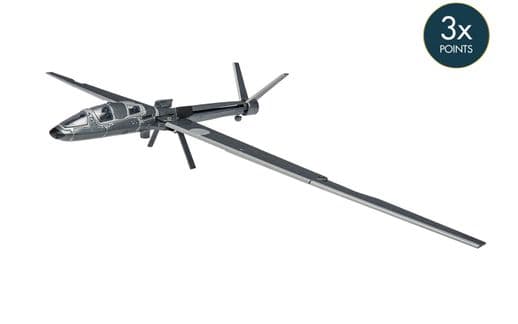
Looking like a huge metal Pterodactyl, the new Q-Glider tooling is a really interesting addition to our popular James Bond 007 model range.
One of the most significant and enduring associations the Corgi model range has been proud to nurture over the years is our link to the world’s most famous secret agent and many of the interesting vehicles and craft he used during his exciting adventures. Suave, debonaire and deadly, there is much to admire about James Bond 007 as he investigates the latest threat to humanity and even though we watch him deal with baddie after villainous fiend, you can’t help thinking that he even does that with no little style.
The latest new tooling addition to this hugely successful range presents one of the amazing craft designed and developed by Q Branch and used by 007 during his adventures in the film No Time to Die. Designed for air-launched infiltration missions, the distinctive two-seat folding wing glider developed by Q-Branch was used by Agent Nomi and James Bond to storm The Poisoned Garden, the Island base of the villainous Safin.
Located in the Sea of Japan, any Island assault for Bond would require a rapid, yet stealthy approach, one which only this high-tech new glider was capable of successfully achieving. Dropped from the cargo hold of a Royal Air Force Boeing C-17A Globemaster in a compact form, once exited from the aircraft, the glider’s wings immediately spring open into a deployed flight configuration, folding out like some huge metal Pterodactyl. Once close to the surface of the ocean, the craft transforms once again, retracting its wings and preparing for underwater operation – they’re really are clever, those people at Q-Branch.
All these images are designer’s CAD screenshots and serve as fascinating model design reference for this latest new tooling addition to our hugely successful James Bond 007 range.
Whilst not based on a real aircraft, the Q Glider was created as a full-size physical prop with an opening canopy by the No Time To Die production team for use on set, something which really benefitted those scenes in the movie. The glider prop was used onboard a real Royal Air Force C-17A Globemaster at RAF Brize Norton, and in a water tank set constructed at Pinewood Studios to create the interior submarine pen at The Poisoned Garden. Visuals of the glider deploying from the Globemaster were created using Computer Generated Imagery (CGI), with everything being right up there with the best Bond arrivals.
From a Corgi design and development perspective, our new Q Glider is a significant achievement for our team and whilst the model fits snugly within our existing 007 series high quality black and gold presentation packaging, it's actually the largest model we have ever released into our James Bond model range. When the model is displayed in flight configuration mode, the wings snap into position, where this impressive model sports a wingspan which is only slightly shorter than the 1/72nd scale Avro Lancaster model we mentioned earlier. When required for underwater action, the wings reposition to hug the body of the craft once more, therefore allowing it to slip through the water in an aerodynamically efficient manner, a configuration which also conveniently allows it to fit in our presentation box.
A really interesting looking craft which is bound to be a conversation starter, this newly tooled model is right up there with the best Bond related models Corgi have released over the years, and no collection of Corgi James Bond 007 models can call itself complete without one.
Vanguards collectors are in for a diorama treat when Dave Allen tells us the story behind the appealing way he likes to photograph his models.
We end this latest edition with something a little bit special not only for Vanguards collectors, but for anyone who likes to display their Corgi models within a diorama display. It has actually turned out a little differently than we initially anticipated, and this will now be serving as something of a holding feature, or if you like, a Vanguards diorama aperitif.
When we saw pictures of Dave Allen’s fantastic dioramas on social media recently, we were amazed how they made the models we’re so proud of producing here at Corgi look even more interesting than they already do and how the diorama scenes he creates are just so varied. When we had the chance to speak with Dave this week, the story behind these beautifully presented scenes proved just too good not to document fully, so therefore, we’ve decided to entice you all with a couple of image sweeteners, before posting a robust feature on the subject in our next edition.
If you would like to find out how Dave produces these fantastic images and a little more about his own Vanguards collection, please be sure to check out the next edition of Die-cast Diaries.
Hands up who spotted the discarded office chair before noticing the church?
That's all we have for you this time, however, please join us again in two weeks’ time for another exclusive insight into the wonderful world of Corgi. Between editions, we are always interested to hear your views on all things Corgi, so if you feel like dropping us a line to comment on anything blog, collecting or Corgi model related, or perhaps to suggest a topic you might like to see us cover in a future edition, please do get in touch at diecastdiaries@corgi.co.uk.
If you can’t wait for the next blog, you will find plenty of Corgi model collecting discussions taking place on our official social media channels, access to which can be obtained by clicking on the respective links at the foot of the Corgi website homepage.
Link access to Corgi social media sites.
Thank you for continuing to support your Die-cast Diaries blog. Our next edition is scheduled for publication on Friday 23rd February.