
Welcome to this latest edition of Corgi Diecast Diaries, your regular blog review of all the news, updates and topical stories from the captivating world of Corgi die-cast model collecting.
As this will be our final Die-cast Diaries blog update for 2021, we would like to start by taking this opportunity to wish each and every one of our readers a safe, happy and peaceful Christmas and New Year holiday period and to thank you once again for the unbelievably loyal support you continued to give us over the past twelve months. Despite the ongoing challenges we all faced during 2021, our on-line Corgi community has used Die-cast Diaries as a blog medium for a little Corgi collecting escapism, and you have allowed us access to computer, tablet and mobile phone screens all over the world to bring you all the latest updates from our busy development schedule. This is a privilege we will never take for granted and we look forward to bringing you even more interesting content throughout 2022, only next year adopting our new fortnightly publication format.
Before we embark on what will be a seventh year of Die-cast Diaries blogs, we will be taking a little break over Christmas and the New Year, as we know most people will have better things to do over this period, like sneaky hour or two rearranging our display cabinets to make room for all the new models Santa brought us. We will be back with a bang on Friday 14th January, a month where we never have a shortage of new model information to bring you, so we look forward to seeing you all well rested and full of mince pies then.
Before we all start thinking about the New Year, we have one final blog update to bring you and it just happens to be a pretty spectacular one. Your early blog Christmas present from us all here at Corgi is an exclusive first look at the latest engineering sample model produced from our new 1/48th scale Eurofighter Typhoon tooling, a model which has a huge part to play in the immediate future of our Aviation Archive range. Our readers will be the first people outside the company to inspect this metal model sample and see the current status of a project which has attracted so much interest since it was first announced earlier this year. We will follow this with pictures of an advanced sample model produced from a classic Aviation Archive tooling, one which is already certain of sell-out status as soon as it is released, our Moonbeam McSwine Mosquito. Without further ado, let’s engage afterburners and head for Typhoon heaven!
An exclusive first look at the latest metal engineering sample which has been produced in support of our exciting new 1/48th scale Eurofighter Typhoon. Things are looking very promising indeed.
Perhaps more than any other aircraft type in history, the air defence fighter has managed to capture the imagination of generations of people all over the world, inspiring many to take up flying for themselves, but for everyone else, simply being an enduring source of fascination. From the Zeppelin intercepting Sopwith Camels of the Great War, to the Spitfires and Hurricanes of the Battle of Britain, these aircraft represented the very pinnacle of aviation design technology and the fastest machines which could be flown by man, machines which were the preserve of only the most capable airmen in the country. It was basically a case of Britain’s most capable people flying our most capable fighting aeroplanes in the defence of our airspace, no wonder both men and their machines have been revered over the years.
The aircraft which is currently charged with protecting Britain’s airspace from unwanted incursion is the Eurofighter Typhoon, a highly capable aircraft which was born from an international design collaboration looking to produce an agile air defence fighter for service with several European air forces. At the time this aircraft was being developed, British airspace was being policed by such aircraft as the McDonnell Douglas Phantom and the Tornado F.3, the air defence variant of the RAF’s impressive strike jet and whilst both were classic aircraft in their own right, neither could really describe themselves as being ‘agile’. With the USAF able to boast such aircraft as the F-16 Falcon and F-15 Eagle, the Eurofighter consortium was looking to develop their own agile fighter, one which was much better suited to the modern air combat arena.
On a personal Typhoon note, I remember being desperate to catch my first glimpse of the RAF’s spectacular new fighter in the metal (so to speak) and whilst my first love was definitely piston engined aircraft of the WWII era, I couldn’t wait to see what this much heralded jet fighter was all about. I had already seen the impressive, if slightly stocky EAP technology demonstrator display at a couple of Airshows, however, my first display from an RAF production machine was going to be something a little bit special. That date and venue turned out to be 12th June 2005 at the Cosford Airshow and as I took my place amongst a huge crowd on the airfield under typically grey skies, the sense of excitement was palpable - we were about to witness British Airshow history.
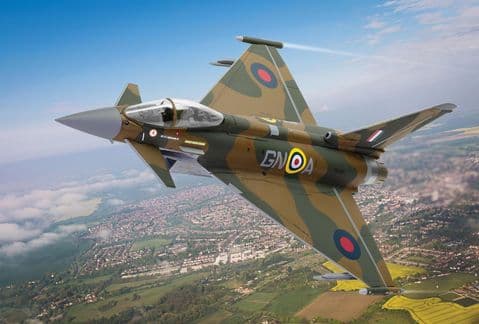
A thing of aviation beauty. The first scheme our new model will be presented in is this stunning interpretation of a Battle of Britain Hawker Hurricane, in the markings of James Brindley Nicolson, the only Fighter Command VC recipient of the Second World War.
As the allotted display time approached, thousands of people were lining the entire length of a particularly deep crowdline, everyone desperate to secure the best vantage point from which to witness the aviation spectacle to come. As everyone scoured the sky to our left, we finally noticed a flashing nav light in the distance and seconds later, Eurofighter Typhoon T.1 ZJ807 blasted into the display circuit and into its first high energy manoeuvre - we had officially entered the era of the Typhoon.
Over the course of the next few dynamic minutes, this early Typhoon T.1 proceeded to do things that an 11 ton aeroplane really shouldn’t be able to do, cartwheeling across the sky at the whim of its pilot, keeping his display routine within the confines of a relatively small imaginary box above the airfield. What I remember being most astonishing was the speed at which the aircraft’s afterburners seemed to engage, then disengage just as quickly, with the dark skies making the rear of the aircraft appear as if it housed a pair of powerful torches which kept flicking on and off. Finishing with a spirited high speed pass and pull up into the clouds, the Typhoon made quite an impression on the crowd, who bust into spontaneous applause, with each one of us already totally hooked and looking forward to our next Typhoon experience.
Since that date, the Eurofighter Typhoon has matured into a deadly multi-role combat aircraft and one which has to be regarded as one of the most capable military aircraft to be found anywhere in the world, still performing its vital air defence role, but now also adding new roles and responsibilities to its growing list of attributes. Already having fifteen years of Royal Air Force service behind it, the Typhoon can probably look towards a further twenty years of service to come, by which time it will surely have cemented its legacy as being one of the most important British/European aircraft of the post war era.
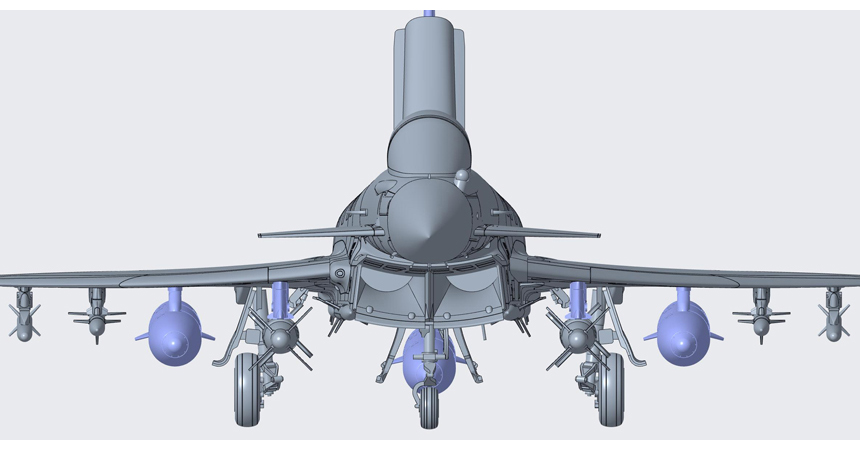
Just a small selection of the impressive stores options which have been produced as part of our new Typhoon tooling project. Our Typhoon will be ready for anything!
In terms of the Aviation Archive range, the Eurofighter Typhoon has long been a popular component of the range, ever since the first 1/72nd scale die-cast model was released in 2007. As our post war jet range moved into a new and hugely impressive 1/48th scale, it didn’t take long before talk of a new Typhoon in this scale started to be discussed, both amongst the Corgi development team and within the collector community at large. Even though the Lightning F.6 and Spey engined McDonnell Douglas Phantom were seen as being the right models with which to establish this range, the Typhoon was always waiting ominously in the wings for die-cast consideration.
With regard to the Aviation Archive range, we can hardly emphasise enough just how significant a development the inclusion of the new Typhoon in the 2021 range actually was. The announcement represented not only continued significant investment in a range which has long been one of the most popular in our 65 year history, but also highlighted the fact that our new 1/48th scale post war jets were definitely here to stay. A hugely expensive project for us to undertake, our new Typhoon has challenged our design teams to excel still further, requiring not only every ounce of their skill and experience to be brought to bear, but also asking questions of the manufacturing process as well, as we were determined to produce an accurate and highly detailed scale representation of this modern aviation classic.
With the aim of producing a collector’s model possessing real display presence and stature, our new Eurofighter Typhoon will have never looked so good in scale diecast form and if modern combat aircraft are your thing, this is definitely going to be the model for you.
Having said all that, despite the fact that our Typhoon project has been moving forward at a healthy pace over the past few months and how many design hurdles have already been successfully negotiated, there is still much work to do before we can release this model for final production. The images we are exclusively showing here feature the latest metal engineering sample model produced from the 1/48th scale Eurofighter Typhoon tooling, one which is used to assess everything about the tooling to date, from casting accuracy, fit of parts and overall presentation, quite a complex task for our development team to undertake. Having already poured over the new model for many hours, an inspection review document has now been completed and sent to the manufacturing facility, so design improvements and alterations can be worked. In essence, what you are actually looking at here is already out of date.
This next selection of images show pictures of our new Eurofighter Typhoon model captured from various angles. We do have to stress that no matter how impressive the model looks, this is still an engineering sample and such, is still subject to significant change. Having said that, we are really rather pleased with how the model is turning out.
To position these images within the actual development context of this exciting new model, this is a metal pre-production engineering sample model produced from the Typhoon tooling, a model which has simply benefitted from a coat of grey primer in order to allow fit and detail features to be better assessed. The model has been supplied with a complete set of accessory parts, including the alternative engine exhaust petal arrangements, all undercarriage and pylon parts, a full weapons suite and cockpit detail and pilot figure. You will also note that this test model features an early representation of the model’s clear canopy parts, which in truth at this stage are anything but clear. Clear parts need a tooling block all of their own and at this stage, just to check the validity of the overall tooling, these particular components resemble parts which have been produced by a 3D printer.
We are sure that you will probably have been expecting us to include this caveat, but in the hope of fending off a few e-mails expressing slight disappointment at what you are seeing, we do still have to stress that this is a development sample model and as such, will definitely be subjected to further improvement and alteration before the first release from this tooling will be taking its place on our display shelves. We know most of you don’t even need to be reminded of this fact, however, the new Typhoon is going to have such wide appeal and extend beyond our existing collector base that we need to make sure that if this applies to you, that you are fully aware of what you are actually looking at.
We really do know how to spoil our readers - more Typhoon engineering sample images for your enjoyment.
Assessing the new model purely from a fellow collector’s perspective, it is already looking mightily impressive and has managed to replicate the distinctive lines of the Eurofighter Typhoon, capturing lots of appealing detail in the process. The model benefits from a high metal content and has been produced with many optional parts, including an array of stores and weapons which will allow several different mission configurations to be represented, giving plenty of scope for future releases. Even at this stage, we know we have a real winner on our hands and when collectors finally have the opportunity to add one to their collections, we think this beauty will be taking pride of place at the head of many a display.
As work to perfect the tooling carries on apace, we are hoping to be in a position to bring you pictures of the final engineering sample and the first fully decorated pre-production sample model early in the New Year and from that point, it shouldn’t be too long before we have a confirmed release date for you. We are already confident that this new model will be a stunning companion release for the existing Lightning F.6 and Phantom FG.1 releases, bringing our 1/48th scale collection of post war jets right up to date. As we head into a new year, as far as the Corgi Aviation Archive range is concerned, we are almost on Typhoon time!
Let’s take this opportunity to reacquaint ourselves with the details behind the stunning scheme which will be gracing the initial release from this impressive new model tooling.
Since stories of the air battles of the First World War began to captivate the British public, fighter pilots and the nation’s latest front line fighter aircraft have been a source of constant fascination and the main reason why so many young people dreamt about a career serving in the Royal Air Force. Over the past century, aircraft types such as the Sopwith Camel, Supermarine Spitfire and English Electric Lightning have not only protected the nation from potentially hostile air incursions, but also represented the most exciting machines produced by the British aviation industry, aircraft that anybody would love to have the opportunity fly.
As the latest incarnation of these classic air defence fighters, the Eurofighter Typhoon is an incredibly capable fourth generation combat aircraft and one which is the product of a collaborative programme between the UK, Germany Italy and Spain, with the Royal Air Force currently having around 150 examples of the aircraft in service. An aircraft which is continually upgrading its list of impressive capabilities, the Typhoon has matured into a true multi-role combat aircraft and one which is likely to be in service for at least another 20 years, by which time it will have been wearing the roundel of the Royal Air Force for almost 40 years. An extremely agile aircraft, the Typhoon is the country’s current ‘Spitfire’ and as such, is probably the aircraft type most familiar to the majority of the British public.
As Britain prepared to mark the 75th Anniversary of the Battle of Britain in the early summer of 2015, the RAF were determined that their tribute would be a particularly impressive one. Produced under a cloak of relative secrecy, as soon as Eurofighter Typhoon FGR.4 ZK349 emerged from Coningsby’s paint shops wearing very different markings to the standard grey scheme worn by Britain’s current air superiority fighter, it immediately attracted the attention of every aviation enthusiast in the country. Looking completely different to any other Typhoon on the Coningsby ramp, their commemorative display aircraft for this significant anniversary year was finished in a representation of a 1940 Battle of Britain Hurricane fighter scheme. Royal Air Force officials were also quick to announce the news that this beautiful Typhoon would also be performing a synchro pair display routine at several Airshows that summer, in conjunction with one of the Battle of Britain Memorial Flight’s Spitfires - what a treat was awaiting enthusiasts.
Can you imagine how good this model is going to look when it has been finished in the striking colours of the 2015 RAF Display Typhoon?
The markings were a representation of the scheme worn by Hawker Hurricane Mk.I P3576 of No.249 Squadron, an aircraft which was the mount of Flight Lieutenant James Brindley Nicolson. On August 16th 1940, Nicolson would display exceptional and selfless valour in the face of the enemy, as he climbed back inside the cockpit of the burning Hurricane fighter he was flying, because he saw an enemy fighter about to pass through his aircraft’s gunsight. Firing on the Messerschmitt until the flames finally forced him to take to his parachute, Nicolson would later be awarded the Victoria Cross for his actions that day, Fighter Command’s only Victoria Cross of the Second World War.
Wearing the same GN-A fuselage codes as those displayed on Nicholson’s Hurricane during his VC winning combat on that fateful day and also featuring the WWII pilot’s personal ‘Red Devil’ emblem under the cockpit canopy, this stunningly presented RAF Typhoon FGR.4 immediately became something of an Airshow phenomenon and was simply referred to as ‘GINA’ by Britain’s army of besotted aviation enthusiasts. Doing a great job for RAF public relations and force recruitment numbers, this beautiful Typhoon became the most popular individual RAF aircraft of the modern era and looked absolutely stunning when photographed at Airshow events.
Destined to be a hugely popular addition to the Aviation Archive range, please keep checking Die-cast Diaries early in the new year, as we bring you further updates on this new model, as it speeds headlong towards its eventual release.
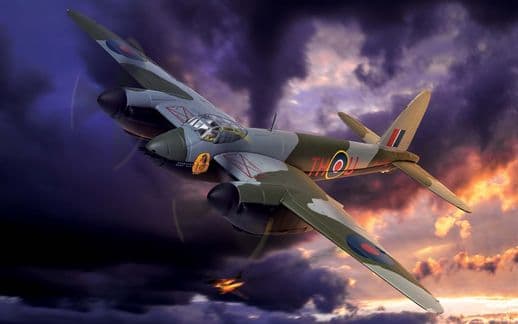
Presented in our striking Night Air War packaging, this beautiful new Mosquito intruder model has captured the imagination of Aviation Archive collectors and seems destined to be a sell through on release.
The die-cast honour of bringing the curtain down on another year of Corgi update blogs falls to the latest release from our 1/72nd scale de Havilland Mosquito tooling, releases from which have appeared all too infrequently during the six years of producing our blog. Another aircraft type which definitely qualifies for the title of British aviation classic, the Mosquito was probably the aircraft the Luftwaffe hated and coveted most in equal measure, one which was manufactured using non-strategic materials and one which could out-perform anything else in the sky, in a variety of crucial strategic roles. The latest release in this model series marks a Mosquito which conducted night intruder operations over enemy territory, an attempt to support Bomber Command’s night bombing campaign. Their targets were Luftwaffe nightfighters and whether they destroyed them as they took off from their home bases, or en-route to the attacking bomber streams, the campaign was designed to cause mayhem and confusion amongst German fighter crews, reducing their effectiveness and allowing more British bombers to get back home unscathed.
Our final blog exclusive for 2021 features images of an advanced production sample of the ‘Moonbeam McSwine’ nocturnal hunting Mosquito, confirming that this beautiful model will be available early in the new year, a fabulous way for us to start our collecting journey in 2022. The details which served as the inspiration behind this scale representation are as follows:
You can never have too many Mosquitos in your collection and this one is an absolute stunner. Sight of this advanced production sample model means that it won’t be too long before we can add this beautiful model to our collections.
Encouraged to join the Royal Canadian Air Force following a chance meeting with a serving RCAF pilot, American James Forrest ‘Lou’ Luma successfully negotiated his pilot training and was posted to fly the de Havilland Mosquito in England, even though he didn’t even know what one looked like at that point. Arriving in England in the summer of 1943, he was assigned to No.418 squadron to fly night intruder missions and was given the luxury of just a single flight observing a flight instructor (from the navigator’s seat), before making his first Mosquito solo. Re-assigned to the USAAF in July 1943, Luma was allowed to remain flying with the RCAF as they didn’t want to break up his successful partnership with friend and navigator since training, Colin Finlayson, a man with whom he would go on to fly thirty operational missions.
The Mosquito fighter the pair normally flew was quite unusual in that it sported distinctive nose artwork, something which was the exception rather than the norm on Royal Air Force fighters. Known as ‘Moonbeam McSwine’, the nose art featured a pipe smoking, gun toting Hillbilly girl of the same name, a character from the ‘Li’l Abner’ comic strip which was popular at the time. The pair scored their first victory when shooting down a Messerschmitt Me 410 nightfighter near Wunstorf on the night of 21st/22nd January 1944, an aircraft which had shot down a British bomber earlier that same night and had returned to base to re-fuel and re-arm. On taking off for this second sortie, the Luftwaffe pilot forgot to turn off his lights, making the German fighter relatively easy prey for Luma in his prowling Mosquito intruder.
Following the end of the Battle of Britain, the Luftwaffe became proficient in mounting effective night intruder raids into British airspace, both to attack RAF airfields and to disrupt Bomber Command operations around the country. The Royal Air Force did not commence serious intruder operations of their own until May 1942, when black painted Hurricane fighters started harassing Luftwaffe airfields in occupied Europe, as they attempted to relieve the pressure of crippling nightfighter losses being endured by Bomber Command at that time. These operations were given a significant boost during 1943 when intruder units started receiving the Mosquito FB.IV fighter, an aircraft which possessed both the range and firepower to make a real contribution to the war effort.
Armed with four nose mounted 20mm cannon and an additional four .303 machine guns, the Mosquito packed a real offensive punch and with the pilot firing in his line of sight, any Luftwaffe aircraft which attracted the attention of a Mosquito intruder was unlikely to survive the encounter unscathed. Relying on the excellent eyesight of crews, intruder missions would often begin with a low level transit to the continent, avoiding German radar detection, but once in their patrol area, they were free to select targets as they presented themselves. Although often referring to their aircraft as ‘Flying Furniture’ due to its wooden construction, they loved the unique fighting attributes of the de Havilland Mosquito, which was undoubtedly one of the finest aircraft of the Second World War.
Well, that’s it for another year of Corgi Die-cast Diaries model project update blogs, now it’s time for a well earned break. The entire Corgi team would like to take this final opportunity to wish all our readers a safe and happy Christmas and New Year holiday and to thank each and every one of you for your fantastic support throughout the year. We look forward to seeing everyone back here on Friday 14th January when we will embark on another year of modelling news and exclusive updates from the wonderful world of Corgi die-cast model collecting.
If you do have any time to yourselves over the coming holiday period, please do spend a moment to let us have your comments about all things Die-cast Diaries, or perhaps suggest a subject you would like to see covered in a future edition of the blog. As always, please use our diecastdiaries@corgi.co.uk email address for all correspondence.
If you can’t wait for the next blog, you will find plenty of Corgi model collecting discussions taking place on our official social media channels, access to which can be obtained by clicking on the respective links at the foot of the Corgi website homepage.
We hope you all have a great Christmas and that Santa remembers to bring all those Corgi models you have been hoping for!
Our next blog is scheduled for publication on Friday 14th January.