
Welcome to the latest edition of Corgi Die-cast Diaries, your regular blog review of all the news, updates and topical stories from the captivating world of Corgi die-cast model collecting.
As we once again find ourselves at blog Friday, it must therefore be time to discuss a little more Corgi business. In this latest edition of Die-cast Diaries, we mark the impending release of several impressive new models by bringing readers our latest series of exclusive images, each one featuring final sample models which were delivered to our Head Office over the past few days. In addition to this, we will also be looking at the fascinating stories behind the ‘full size’ machines which inspired their inclusion in the Corgi range and why these stories make them such appealing, collectable items. Bringing you another comprehensive round up of new model information, we have aircraft, armour and a model delivery of ‘The Great National Temperance Beverage’ to share with our readers this time.
We begin by looking at the latest release from our new North American P-51D tooling and arguably our most attractive subject to date, an aircraft which was the mount of a USAAF ace and one of the few to have multiple Luftwaffe jet victories to his name. This will be followed by our continuing modelling tribute to one of the most fascinating military stories of the Second World War and Britain’s desperate attempt to capture an example of the Wehrmacht’s latest, all conquering Tiger Tank and in the end, how one actually came into their possession almost by chance. With a trio of new tank releases to bring you, we will also be looking at our latest die-cast tribute to the ubiquitous American M4 Sherman, but this time in a unique ‘under new management’ presentation. Your new model updates await, so without further ado, let’s make a start.
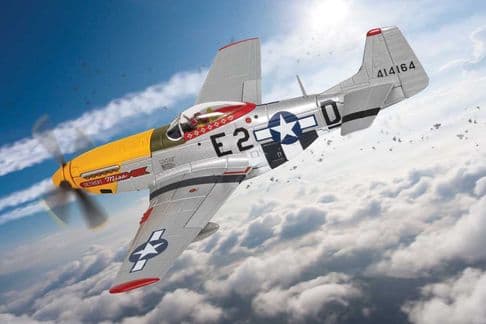
One of the most colourful Allied fighter aircraft of the Second World War, ‘Detroit Miss’ was the personal aircraft of Lt. Urban L Drew, a US pilot who had the distinction of shooting down two German Me262 jet fighters within seconds of each other.
Although we Brits have an understandable loyalty to the historic significance of the Supermarine Spitfire, even we have to concede the fact that the fighter aircraft which arguably had the most significant impact on the European Air War was a product of the North American Aviation company, their magnificent Mustang. Taking this one stage further still, the ‘D’ variant of this aircraft is considered by many military historians to be the finest fighting aeroplane of WWII, the most heavily produced version of the aircraft and one which addressed many of the operational shortcomings of earlier versions.
Although the earlier B and C razorback variants of the Mustang were undoubtedly excellent fighter aircraft, they did have some issues, with poor rearward visibility and machine-guns which could be unreliable, both factors which hampered its operational effectiveness. The ‘D’ model addressed both of these issues by introducing a Plexiglas teardrop canopy, offering excellent all-round visibility and six .50 calibre machine-guns mounted upright in the wings, a development which greatly minimized the gun jamming issue. In addition to this, equipping the fighter with one of the most advanced gun-sights to be used on any WWII fighter and the P-51D Mustang was now very much ready for action and on the hunt for Luftwaffe opponents.
The ‘D’ variant of the Mustang starting to appear in the skies over Europe from the summer of 1944 and would enable the Mustang to enhance the already successful reputation of this fighter, equipping its pilots with an aircraft which could now hunt the Luftwaffe to destruction. Mustang pilots interviewed in the years following the end of the war described how they knew the Mustang was a special aeroplane as soon as they sat inside one – it just felt right to them. With a two stage, twin speed supercharger, it was equally at home at altitude defending the bombers, or down on the deck looking for targets of opportunity - famous USAAF ace Bud Anderson said that best of all, “It went like hell”. From a German perspective, it has been widely stated that Hermann Goering reputedly proclaimed that he knew the war was lost when he saw American Mustangs flying low over Berlin, and there can be absolutely no denying that Luftwaffe pilots had huge respect for the hard-hitting Mustang and the pilots who flew them.
From the perspective of the Aviation Archive collector, we have been able to boast a 1/72nd scale die-cast example of the Mustang in our collections since 2000 and even though this tooling was well loved and produced some stunning releases in recent years, it was definitely in need of some modernisation. For an aircraft of this pedigree, gaining company authority to design a new tooling of this American classic was no problem whatsoever and in 2015, we announced the first release from our new 1/72nd scale P-51D Mustang tooling. Bringing this story right up to date, we are about to release the seventh model produced from this new tooling and we have to say, it’s a bit of a cracker!
Already an ‘Ace’ pilot by the time he was asked to lead a fighter protection flight covering a deep penetration bombing raid into Germany on 7th October 1944, Urban L. Drew was also one of only three USAAF pilots to have encountered the new Messerschmitt Me262 jet fighter during a combat mission over enemy territory. As this was to be a ‘Ramrod’ mission, once the fighters had protected the bombers through the target area, they were free to go ‘hunting’ for targets of opportunity and as an expert low altitude flyer, Drew was hoping that he and his personal P-51D Mustang ‘Detroit Miss’ would encounter one of the Luftwaffe jet fighters again.
With the bombers heading for home and the Mustangs of the 375th Fighter Squadron over Osnabrück, the same area where Drew had seen one of the German jets during a previous mission, he noticed two of the unusual aircraft moving on the airfield at Achmer far below. Immediately placing his Mustang into a steep dive and pushing the throttle to maximum, he knew he would only have one chance to fire on the jets, because once they got into the air, not even a Mustang at full power could hope to catch one. As he raced towards the airfield at almost 450mph and at treetop height, the lead jet was already in the air and the second aircraft had started its take-off run - was he already too late?
Determined not to miss this opportunity, Drew flew straight along the line of the runway at Achmer and waited until this second jet filled his gunsight before firing all six of his 0.50 calibre machine guns into its fuselage. The Messerschmitt did not take evasive action and exploded in a ball of flame, showering ‘Detroit Miss’ with debris, as Drew’s Mustang had no option but to fly straight through the explosion, calling on all his skill and experience to maintain control. With his aircraft still responsive, he immediately looked for the lead jet, which by now must have been building up speed and could already be out of range. Spotting it in the distance, he gave chase, but it was already beginning to outpace his Mustang - he was going to need some luck.
Inexplicably, the Messerschmitt pilot gave up his speed advantage and started to turn, possibly attempting to face his attacker, or simply just making a fatal error of judgement. Despite the range and whilst pulling a high G inducing turn, Drew fired a perfect deflection shot with all guns blazing, aiming well ahead of the Luftwaffe jet, which flew into the hail of bullets. The jet’s canopy came off as the pilot attempted to escape, it flipped onto its back and careered into the ground - Ben Drew and his ‘Detroit Miss’ had just destroyed two of the Luftwaffe’s incredible new jet fighters in a matter of seconds.
Featuring the advanced production sample of this stunning release, we think this might be our finest Mustang release to date - what do you think?
By this time, the anti-aircraft gunners at Achmer airfield had sprung into action and they were extremely proficient at their job. With their well-trained guns now targeting Drew’s yellow nosed Mustang, it was time to get as far away as possible, as quickly as possible. Remaining at low altitude and using the trees for cover, Drew maintained full power and tried to place as much distance between his Mustang and the scene of his famous double jet victory.
By the time he arrived back at base, news of his double success had already begun to circulate and there was quite a crowd around 'Detroit Miss’ revetment area as she taxied in. At that time, the 8th Air Force had started to introduce the use of colour film in fighter gun cameras, but its use had been proving somewhat problematic. The new colour film had been in use for this mission, but as Drew’s crew chief removed the film canister from Detroit Miss, hoping that the day’s events would yield some unique images for the US publicity department, they were to be disappointed - the film had jammed yet again and no film had been exposed. In actual fact, none of the fighters loaded with colour film for that mission came back with exposed film.
With the incident clearly being of huge interest to military planners, Drew’s account of the mission was thoroughly studied and just a few days later, the victories were confirmed on the direct orders of General Jimmy Doolittle himself. Without the gun camera film evidence, Drew never really knew if this confirmation was simply for Eighth Air Force morale purposes, or if the General was privy to top secret information, but whichever was the case, he was happy to be one of the few Allied pilots of the war to achieve victories over the new German Jet fighter and one of only two USAAF pilots to score a jet double on a single mission.
Providing a fascinating conclusion to this story, many years later, a military historian was looking into the details behind this double jet victory and decided to try and corroborate the information within the combat victory claim. Contacting officials in the German War Records Office, she was hoping to locate any former Luftwaffe personnel who may have been at Achmer airfield on the day Urban Drew and his Detroit Miss made their attack and incredibly, her luck was in. Seventy-eight victory ace pilot Oberleutnant Georg-Peter Eder was flying Messerschmitt Me 262 jets with Kommando Nowotney at Achmer on the day of the attack and was able to give a German perspective of events.
The striking scheme worn by this Mustang belies the fact that this was a ruthlessly effective fighting machine, one which had two victories over German jet fighters to its name.
With the new German jets proving to be a technological revelation, it was nevertheless also proving to be something of a challenge introducing this new technology at that stage of the war, with all flight testing and pilot training operations coming under almost constant enemy air attacks. Despite this, the 7th October was scheduled to be a significant day for the Luftwaffe and their Messerschmitt Me 262 jet fighter, as on this day, Kommando Nowotney were finally hoping to commit the new jet aircraft against the enemy in something approaching unit strength for the first time.
Ace pilot Eder was due to take part in this maximum effort attack against the latest USAAF bombing raid over Germany, but as he taxied his aircraft out to the runway, it developed a technical issue and he was forced to return to the hangar to have the problem checked. Standing on the wing of his fighter talking to his crew chief, they were both alerted to the sound of an American Mustang fighter screaming in low over the airfield boundary and firing at the jets which were on the runway and taking off. Eder was able to confirm that two of his comrades were shot down by the aggressively flown Mustang and whilst he could not definitively confirm the identity of the American fighter, he did confirm that it was a Mustang with a full yellow nose.
This new information, combined with Drew’s combat debrief report submitted at the time of the incident, was enough to convince US Military officials that the double jet kill claimed by Drew on 7th October 1944 was valid and finally officially confirmed the victories. In May 1983, Urban L. Drew was awarded the Air Force Cross, in recognition of his wartime service and status as an air ‘Ace’ and with two victories against German jets within that number.
One of the most attractively presented Mustangs ever to go to war, this, allied to the incredible story behind the actual aircraft which inspired this release, will surely see ‘Detroit Miss’ taking pride of place in many an Aviation Archive collection in the coming weeks.
Wearing the iconic branding of this famous beverage, our latest 1/50th scale truck release is a real head turner and one which has been produced as a highly limited edition collectable.
Towards the end of last year, our Die-cast Diaries blog brought readers details of a rather festive and hugely collectable special model release, one which took inspiration from some of the most recognisable marketing campaigns of the past few years and one which allied itself to arguably the world’s most iconic brand. As you may well imagine, the seasonal timing of this announcement resulted in these models being in great demand and because their highly limited run size was purposely kept quite small, they disappeared almost as soon as they appeared on our website.
We are delighted to now be in a position to bring you details of a second highly limited Coca-Cola branded truck release, one which is now already in our warehouse and scheduled for imminent release. Obviously shedding its previous festive livery, this new truck sports an alternative version of the iconic Coca-Cola branding, but is just as collectable as its immediate predecessor.
When it came to selecting a truck type with which to associate the iconic Coca-Cola brand for this ongoing series of strikingly presented models, there really could only be one option, the hugely popular Scania T-cab. In the eyes of many truck enthusiasts, the Scania T-cab is quite simply the most eye-catching, attention-grabbing truck ever produced and if you are going to align any iconic brand with a truck, it simply has to be a T-cab. Scania actually stopped production of these beasts back in late 2005, however, their status as one of the world’s most appealing trucks has stood the test of time and even hard working hauliers will admit to still having a sizeable soft spot for this good-looking Scandinavian. Still a head turner if you are ever lucky enough to see one at a truck rally, many are still hard at work doing what they were designed to do, hauling freight, it’s just that the T-cab does it with a little bit more style than other trucks. Indeed, if these trucks are still on the road, they will probably have several hundred thousand miles under their belts, but can count on receiving plenty of TLC from their proud owners.
Part of our growing Coca-Cola range, this new truck is now in our warehouse and scheduled for imminent release.
This impressive new 1:50th scale Coca-Cola truck release is just one of a series of models in our range to mark Corgi’s association with this iconic global brand. We are extremely proud to be working with Coca-Cola to bring this range of the highest-quality die-cast models to the Coca-Cola and model collectables markets, taking some of the world’s most famous modes of transport and giving them an appealing Coca-Cola livery twist. The schemes selected reflect wording and graphics used in conjunction with this instantly recognisable brand over a century or more of its successful history.
The copy file produced in support of this release reads as follows:
Featuring striking branding that is recognisable the World over this iconic Coca-Cola truck is ready to refresh your collection! This highly detailed model is scaled at 1:50 and measures over 30 centimetres long, featuring moving parts and removable mirrors and aerials. Corgi is proud to work with Coca-Cola to bring a range of the highest-quality die-cast models to the Coca-Cola and model collectables market. This range of models, all iconic in their own right, are liveried in symbols of this world-famous brand from over a century of its history.
For more details of our Coca-Cola model range, please use this link to be taken to the relevant section of the Corgi website.
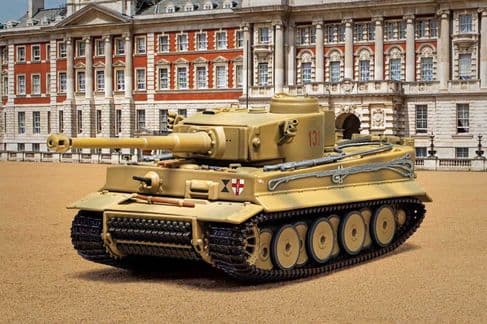
A historic pairing for our Military Legends range, the previously released German Tiger 131 as captured at Point 174 Gueriat el Atach on 24th April 1943 and now a model of the same tank after it had been transported back to the UK and placed on display at Horse Guards Parade.
In what has to be considered a significant development for our 1/50th scale Military Legends range, last year saw the release of a new model which immortalised the most famous tank the world has ever seen as a die-cast model collectable, our tribute to Tiger 131 and her capture on the battlefields of Tunisia in April 1943. This model has been of huge interest to military collectors, with most already finding homes amongst collections all over the world, but what we couldn’t tell people at the time of this model’s launch was that it was just the first in a trio of model releases intended to tell the fascinating story of this most famous tank and how it ended up back in the UK. We are delighted to be in a position not only to do that now, but to also bring you the continuing story of Tiger 131, its capture and how it ended up as a much loved museum exhibit at Britain’s Tank Museum. Using the very latest product imagery featuring the final advanced production samples of the two new models to illustrate this section, we are about to put that situation right now.
Having somehow managed to find an intact example of the German’s feared new 57 ton Tiger Tank in heroic actions involving small arms and the use of a captured enemy anti-tank gun, all the men of 2nd Battalion, Sherwood Foresters had to do now was to prevent it being re-taken or destroyed by its former owners during a series of relentless counter attacks. Even after the fighting had subsided, the area was subjected to regular German shelling, as they were presumably still attempting to destroy the Tiger and it would not be until the first week in May that it was safe to attempt a recovery operation. Towed from the battlefield by a D6 Tractor of the 104th Army Tank Workshops, once it was a safe distance behind British lines, it was discovered that despite the turret being jammed, the tank was in excellent running order and would almost immediately be used as the star of a recognition film produced for Allied forces entitled ‘The Tiger’.
The tank was a highly prized asset and the unit were ordered to keep it in running order, secure as many spares as possible and prepare it for transportation back to the UK for full evaluation, but not before it was to be presented to senior military officials, Winston Churchill and King George VI himself, in the centre of Tunis. Almost exactly in the same condition as when the Tiger had been captured days earlier, the only identifying features which highlighted the tank’s new ownership were a 1st Army shield painted on the port-side front hull and rear track guard of the tank, as well as a 21st Army Tank Brigade diabolo painted next to the front shield.
Exclusive images of the final production sample of this beautiful new model, one which takes its place as part of a trio of releases to mark the incredible story of this famous tank.
Tiger 131 started its epic journey from the battlefields of North Africa back to the British mainland at the beginning of August 1943, being driven under its own power to the harbour at La Goulette, where she was loaded onto a tank landing craft for a short onward journey to the port of Bizerte. There, she was loaded onto a merchant ship for transportation to Bone in Algeria where on arrival, was transferred to the hold of the SS Ocean Strength, with a cargo of iron ore bound for Glasgow. Finally arriving on the Clyde on 8th October, the Tiger was met by a Pickford’s heavy haulage Scammell and trailer, which was waiting to transport her down to the Department of Tank Design at Chobham in Surrey, where this much vaunted new German tank was expected to give up all its technological and manufacturing secrets, in an attempt to aid Allied forces in overcoming these battlefield behemoths.
Later that year, Tiger 131 began her unique relationship with an infatuated British public, when she was displayed on Horse Guards Parade in London, a high-profile war trophy gift made by the British First Army to Prime Minister Winston Churchill. With the end of the war, this historic tank was in very real danger of being lost to the nation, as the country wanted to put the conflict behind them and their were little funds available for the preservation and storage of enemy weapons of war.
Thankfully, when its semi-dismantled hull was presented to the Tank Museum at Bovington in September 1951, its immediate future appeared to be much more positive and with the tank later becoming the subject of a painstaking restoration programme, she was destined to continue her relationship with the British public. These works were intended to return Tiger 131 to as close to her April 1943 configuration as possible, and in what turned out to be a real coup for the museum, they actually managed to return her to running condition and as such, becoming the only working Tiger Tank in the world. Now a star attraction at the Tank Museum, Tiger 131 has a genuine claim to being the most famous tank in the world and regularly attracts visitors from all over the world, with many thousands of people desperate for the opportunity to see this unique link to the tank battles of WWII, an armoured celebrity almost 80 years after unexpectedly coming into British hands.
Following months of intense training in the remote Suffolk countryside, the tank crews which made up the majority of the 48th Battalion Royal Tank Regiment and their newly arrived Churchill tanks made the significant move to Ayrshire to undergo what would be the final stages of their pre-deployment workup. The preparations in Scotland confirmed they were to be deployed as an effective armoured striking force, but where would their destination be? By the middle of March 1943 they had their answer - North Africa and the Allied offensive to finally push the Afrika Korps out of the continent.
Loading aboard ships at the port of Glasgow, they were bound for the port town of Bone (Annaba) on the north-eastern corner of Algeria and close to the fighting in Tunisia, where they would be sent to bolster Allied units pushing towards the ultimate prize of Tunis. Extremely confident in the capabilities of their Churchill tanks, this confidence was shaken somewhat during their final combat preparations in the town of Ghardimaou in western Tunisia. Close to where they had been stationed, a military dump containing the charred and battered hulls of destroyed Churchill tanks served as morbid fascination for the newly arrived crews and worryingly, the large number of enemy shell holes many of the tanks appeared to exhibit. The long months of training was now behind them and they were about to be thrust into the melee of battle.
With the success of Operation Torch and the Allied landings in French North Africa, the German Afrika Korps were now being threatened by the British Eighth Army advancing from El Alamein and the Torch forces coming at them through Algeria. Hitler was determined to reverse this desperate situation and sent significant reinforcements through the port city of Tunis, including around 20 of the powerful new 56 ton Tiger I tanks. These fearsome machines were significantly superior to anything the Allies had available in North Africa, but the battle situation was by now very much against them and there simply were not enough Tigers available to arrest the deteriorating situation.
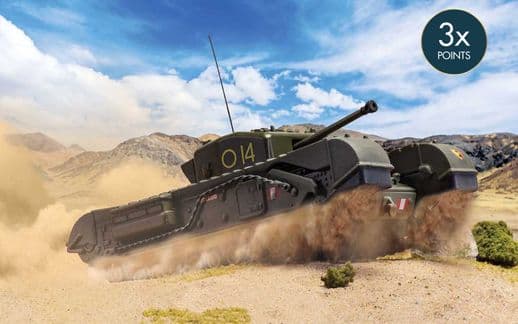
Although evidence does not exist to confirm which individual tanks were directly involved in actions which resulted in the capture of Tiger 131, we know TOLEDO was in the vicinity at that time and may well have taken part in the operation which resulted in the securing of such a significant military prize.
Elements of the 48th Royal Tank Regiment were the first Allied units to come up against the German Tigers and it would not be long before their Churchills started to fall victim to the 88mm guns of the new German tank - Allied military planners were desperate to get their hands on a Tiger and they wouldn’t have to wait long. Following heroic actions by troops of the 2nd Battalion, Sherwood Foresters, a Tiger had its turret disabled during fighting at Guriat el Atach and was abandoned almost intact by its crew. The Foresters had to repel numerous enemy counterattacks over the next couple of days, but were determined to hold on to their armoured trophy. Relieved by strong reinforcements two days later, they had presented the British with a most valuable prize, the first complete example of a mighty German Tiger tank.
Making for a rather enigmatic trio of linked 1/50th scale armoured releases, these latest models in our Military Legends range help to tell the fascinating story of Tiger 131, her capture and eventual transportation to the Britain, where unbelievably, she can still be marvelled at to this day. If you have yet to discover the delights of our 1/50th scale military vehicle range, this enigmatic Limited Edition trio might just be the ones to tempt you and we know you won’t be disappointed.
We end this trio of Military Legends updates by bringing you images of the latest advanced production sample model featuring our next M4 Sherman tank release, a model which looks unlike any other Sherman which has gone before it. Produced in vast quantities during the Second World War, the Sherman is undoubtedly the most famous Allied tank of the WWII and one which was tasked with blunting Axis ground operations in every theatre of operation. Highlighting the effectiveness of America’s industrial military might, almost 50,000 M4s of various marks and configurations were eventually produced, with each one specifically manufactured for ease of transportation to the world’s conflict zones.
With so many Shermans produced during the war, there really should be no shortage of scheme inspiration for our research team to access, however, the one we decided to make our next release was truly unique and commemorates a captured machine the Germans were desperate to send back to Germany for evaluation, but needed to make sure it did so intact.
The German Army had first encountered the American built Sherman Tank whilst fighting the British at the Second Battle of El Alamein in October 1942, but at that time, could hardly have envisaged how significant its combat arrival would prove to be. With the first examples falling into their hands and sent for evaluation following the Allied landings in French North Africa just a few weeks later, the Germans could not fail to have been impressed by the quality of a tank which represented the very embodiment of American mass production techniques and ultimately illustrated how the might of US industrial capacity would influence the outcome of the Second World War.
Comparing it against the prowess of their own mighty Tiger Tank, they would have been more than confident that they held the technological advantage, however, the Americans were clever in understanding that their new tank would have to be transported to combat zones all around the world, often to ports and staging depots which had rather basic facilities. Larger tanks would have created an even greater logistical challenge than the significant one they already faced and as their Sherman would be used by all the armies of the Allied nations, the greater availability of M4 tanks would prove crucial in the outcome of the ground war. Eventually, over 50,000 Sherman Tanks of all types would be produced, making this the second most produced tank of the Second World War and an essential war winner.
Having the opportunity to capture a fully working example of your enemy’s latest battle tank is a situation which was highly prized by all the combatant nations during the Second World War, allowing their capabilities to be assessed and to ascertain the most effective ways of destroying them. This detailed evaluation would usually be carried out by a specialist Military High Command unit well behind the front lines, but getting your war prize back there during the heat of battle could be a challenging process. This particular early Sherman tank was captured by 1st Company, 501st Heavy Tank Battalion in Tunisia, during operations to counter the Anglo-American invasion of French North Africa in late 1942 and must have looked rather conspicuous parked amongst the German Tiger 1 and Panzer III tanks which were heading towards the fighting.
A Sherman, but not as we know it. This distinctive machine was captured by the Germans in Tunisia and prepared to send back to Germany for detailed evaluation. The only problem was that they needed it to arrive there in complete condition and therefore painted this warning on the side of the hull to instruct their own troops not to take war trophies from the tank. We have also replicated the faded Allied star and roughly applied German insignia on both sides of the Sherman’s turret. This particular Sherman is now under new management.
The fascinating hand painted warning on the side of the Sherman is basically warning German troops not to remove any items from the enemy tank, as it has been commandeered by German Military High Command and was destined to be sent back to Germany for test and evaluation. In addition to the rather crudely applied Balkenkreuz markings on the turret of the Sherman, the unit responsible for securing such a significant trophy also ensured their details were included in the hand painted warning on the hull sides of the tank, presumably knowing that the message would be seen by thousands of military personnel during its journey back to Germany and wanting their achievement recognised.
This stunning new model not only shows a Sherman tank in unique presentation form, but it also incorporates lots of additional detail which made this tank such an interesting subject. This latest production sample image shows how we have represented the faded and overpainted Allied star on the turret of the tank, in addition to the rather crude, field applied German insignia and warning to their own troops which highlights the Sherman’s recent change of ownership. This superb impending release is currently available for pre-order and should be in model stores in early April.
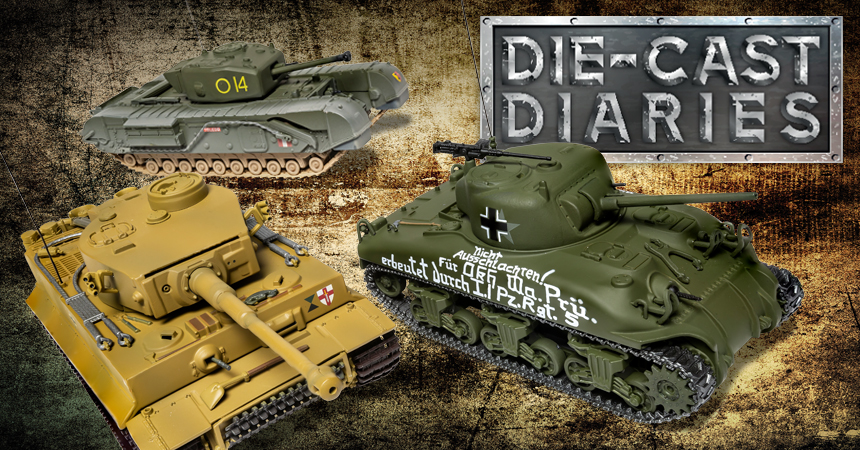
This final pictures shows all three of the latest Military Legends models grouped together, the same picture which was used to create this weeks’ blog image header.
That’s all we have for you in this latest edition of Die-cast Diaries, but we will be back again in two weeks’ time with more Corgi model exclusives and would be delighted if you could join us then.
In the meantime, we are always interested to hear your Corgi related views, so if you would like to drop us a line to comment on anything blog related or to suggest a topic you would like to see covered in a future edition of the blog, could we ask if you would use our diecastdiaries@corgi.co.uk email for all correspondence.
If you can’t wait for the next blog, you will find plenty of Corgi model collecting discussions taking place on our official social media channels, access to which can be obtained by clicking on the respective links at the foot of the Corgi website homepage.
Thank you for continuing to support our Die-cast Diaries blog.
Our next edition is scheduled for publication on Friday 11th March.