
Welcome to our latest edition of CORGI Die-cast Diaries, your fortnightly blog review bringing collectors all the news, updates and topical stories from the captivating world of CORGI die-cast model collecting.
Our title for this latest blog highlights the fact that our subjects for this week provide updates on new models from both our Vanguards and Aviation Archive ranges, each one possessing great appeal to the die-cast model collector, and each one with a great story to tell. We begin by looking at our model association with Somerset’s County Classics Motor Museum and our scale tributes to two of the beautiful cars currently under their care.
We will be following this with a pair of Messerschmitt fighter aircraft which served during the latter stages of the Second World War, both the mounts for famous Luftwaffe ‘Ace’ pilots, but with both looking very different from each other, despite both types having jumped from the same manufacturer’s design drawing boards.
Our latest CORGI weekend showcases classic new model releases on both three and four wheels, two from Taunton and two from the war-torn skies over Germany.
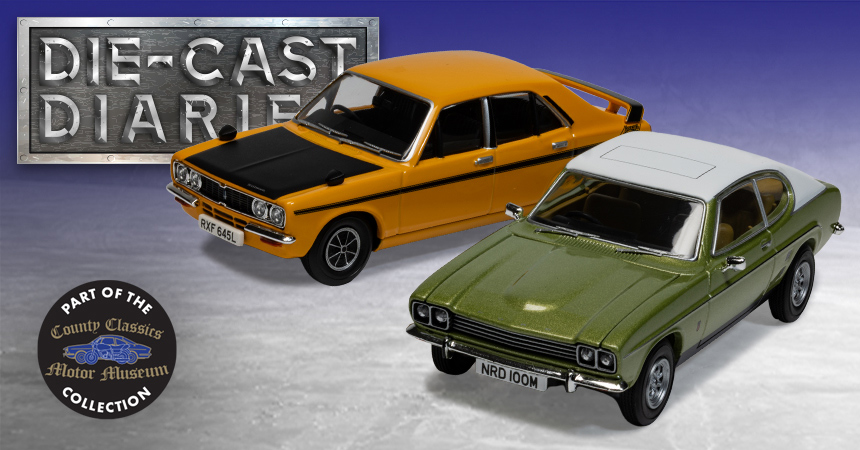
Just two of the beautiful cars within the collection of the County Classics Motor Museum, vehicles which will both be taking their places in the Vanguards model range.
When planning to visit any of the nation’s many motor museums up and down the country, we would probably be expecting to see an impressive collection of rare and expensive prestige cars, vehicles which are familiar to the vast majority of us, but cars most of us could only ever dream of owning ourselves. Whilst that is something most people would very much look forward to experiencing, is this the only way of presenting classic motoring heritage to the masses?
With its reputation as Britain’s youngest motor museum, Taunton’s County Classics Motor Museum is a delightful place to visit, situated in a historic old department store in the centre of the town, and crammed full of fascinating and historic motoring exhibits. With everything immaculately presented, this museum offers something just that little bit different for visitors, because the majority of the cars under its care are vehicles most families will remember owning themselves, or will have certainly known friends, relatives and neighbours who did. Cars which allowed families to go about their daily business with a minimum of fuss, they may well have been treated as something of an automotive facilitator at the time, but how the sight of one now brings back pleasant memories of motoring nostalgia and happy family times.
With just 400 cars produced, the Hillman Avenger Tiger II was only ever available in Sundance Yellow, or Wardance Red.
Clearly vehicles which are still classic in their own right, but a genre of motoring history which possesses incredible appeal for millions of people, these are the cars that the staff and volunteers at County Classics Motor Museum wanted to display for their visitors, providing a nostalgic motoring journey through time via their exquisite collection of classic vehicles. They want people to look at their collection and remember how these cars played a part in their own lives, raising a smile when remembering how Uncle John used to take them to football in his Vauxhall, or that annoying neighbour who had that beautiful Capri they would have loved to have had on their own driveway.
In addition to preparing the perfect day out for all their many visitors, museum staff should be commended for the impressive way in which they have reached out to local communities, keeping them informed of all the events taking place at County Classics, reminding them that its not just the tourist market they are hoping to appeal to, and how the collection is very much part of their own community. Events inviting younger members of the community are also becoming increasingly popular, proving that not every museum needs to be full of supercars to have appeal.
That being said, they do also have a handsome collection of ‘special’ and celebrity cars on display, many of which possess strong links to the beautiful county the museum calls home. Now, they can also boast an association with CORGI and the expectation that several of their cars will hopefully be joining the Vanguards range in the years to come.
A future Vanguards classic, this stunning Ford Capri Mk1 3.0 GXL in Fern Green is also part of the collection of the County Classics Motor Museum.
Part of our ongoing diversification of the Vanguards range is the introduction of Special Edition models in association with notable motor museums around the UK. The first museum to launch was the first one we had discussions with – the County Classics Motor Museum based in the centre of Taunton.
This extraordinary space is based in the former County Stores department store on the high street, and is filled with over one hundred cars and one hundred and forty motorcycles. The museum was created by the late and much missed Patrick Hawkins, with numerous cars coming from his personal collection. The range of vehicles on display encompasses a mix of every day historic and classic cars and motorcycles up until the 1990s.
We discussed the plan for this range over a long phone call with Pat in the months before he passed away in August 2025, and decided to proceed with the collection with the blessing of his team at County Classics. As such, more models are planned to debut in the years ahead, jump started by the surprise popularity of the first model – the Hillman Avenger Tiger II that is on display in the Museum.
This model was always intended to be a Special Edition release, but an administrative error had it issued as a Limited Edition in January this year. As such, and considering that the surprise popularity of the release meant that County Classics weren’t able to secure models for their own gift shop(!), we have reissued the model in the Special Edition packaging it was originally intended to be released in.
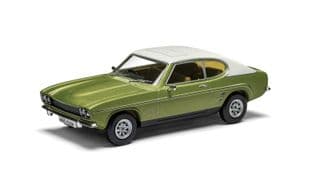
We are delighted to be confirming that arriving alongside this popular re-issue, we will be introducing the second car model in this new collection series, this beautiful Ford Capri Mk.I 3.0 GXL.
VA10410A – Hillman Avenger Tiger II in Sundance Yellow
The Avenger modelled here was first registered on 15th February 1973, by Phil Read Ltd, Borough Garage, St Marychurch Road, Plainmoor, Torquay. They were then a Chrysler main dealer and had been trading in the area since before the Second World War when they represented Thornycroft commercial vehicles. The first owner, Mr T. A. Elliot, paid £1,453.27 for the car, which included £11.50 for seatbelts and £4.50 for number plates, both of which were legal requirements. He looked after it scrupulously and retained it until 2005, by which time it had covered 30,687 miles. It was then purchased by local collector Nick Davidson, who carefully dry stored it but never registered it for road use.
In 2016 it was purchased by enthusiast Pat Hawkins who recommissioned it, removing the engine so it could be refreshed and repainting the engine bay while it was accessible. He also fitted a new clutch and re-chromed the front bumpers. Pat has worked in the motor trade all his life and kept the Avenger in his personal collection because it is such a rare and original example, which has still only covered 31,453 miles. In November 2023, he created the County Classics Car Museum in the centre of Taunton, which was opened by well-known TV personality, Richard Hammond. The Avenger Tiger II was driven to the museum to be exhibited and has proven to be one of its most popular cars.
The Hillman Avenger Tiger II is a really stunning looking car, introduced during 1972 as a racing and rallying rival to Ford’s famous Escort Mexico. They are now extremely rare cars, with only around 400 being produced during a very short production run. They were also only ever available in two colours – Sundance Yellow, or Wardance Red, but with both benefiting from smart sports detailing.
VA13321 – Ford Capri Mk1 3.0 GXL in Fern Green
The Capri modelled here is a remarkably original survivor, and one of the most admired exhibits in the County Classics Motor Museum, Taunton, Somerset. It was ordered from Ford main dealers Frank H. Jenkins and Son, Wallingford, Oxfordshire by Mr Brian Kent. He specified many extras including metallic paint, a white vinyl roof, an 8-track cartridge player and radio, a sliding sunroof and uprated headlights. He collected the car on 7th September 1973 and initially registered it and insured it through his father as he was then still a young man. He used the Capri sparingly, however, almost exclusively for leisure activities as he had a company car provided for his work as a computer engineer.
Mr Kent maintained the Capri scrupulously, and it was carefully stored in his parent’s garage between 1995 and 2006 while he lived in the USA. He recommissioned the car when he returned to the UK, and it was inspected by the Capri Mk1 Owners Club in 2009 who declared it to be, “an especially unique example of the Capri Mk1 facelift”, because of its amazing original condition, unusual specification and perfect Tan Trim vinyl interior. He offered it for sale, with obvious regret, in 2015 when it had still only covered 49,000 miles. It was purchased by collector and Capri lover Patrick Hawkins, who would go on to create the County Classics Motor Museum in 2023, which continues to showcase his fantastic collection.
CORGI are also hard at work on models from the second Museum partnership – the British Motor Museum based at Gaydon. This spectacular open site is in many ways the opposite of the County Classics Museum, with historic vehicles from legendary British marques filling the space, alongside the dedicated Jaguar Daimler Heritage Trust collections centre next door. Instead of the beloved everyday cars at the County Classics Museum, many cars on display at Gaydon are the first and last of the line of their types, as well as others owned and operated by the Royal Family, notable names such as Colin Chapman, classic Rally vehicles, and vehicular stars of film and television.
The first release in partnership with the British Motor Museum is the first model using our new Range Rover Classic tooling, replicating the first production vehicle off the line. We are also in active development on three other models in the collection for 2027 release, along with many more in the years ahead.
We Vanguards collectors have much to look forward to in the years ahead.
Like many people born during the 1960s, learning about the Second World War provided me with a source of absolute fascination that lasted throughout my formative years. Of course, as is human nature, my interest tended to overlook the horrors which befell millions of people during six years of conflict, and concentrated more on the ordinary people who did extraordinary things during the course of their wartime service, and when focusing on this, found an interest which has stayed with me to this day.
Without doubt, one of the subjects I found most enthralling was the air war, and the incredible exploits of the most accomplished fighter pilots of the Second World War, airmen who dominated the skies whilst flying some of the most powerful machines ever created by man. Clearly, as we’re all taught to be proud of our nations most celebrated sons and daughters, names like Pat Pattle, Johnnie Johnson and Douglas Bader definitely inspired me as a youth, but when widening my search for information, could hardly believe some of the numbers I was coming across.
From an Allied perspective, it quickly became clear that our own Aces were not the most successful at shooting down enemy aircraft, with pilots of the Red Air Force taking that accolade, and pilots from America making a significant contribution over both land and sea, but what about the numbers posted by Luftwaffe pilots, they were simply incredible!
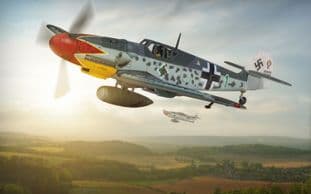
Ace pilot Hermann Graf’s Messerschmitt Bf 109G-6 was one of the most distinctive fighting aeroplanes of the Second World War.
As the years progressed, age and experience teaches you to look beyond the headlines and to conduct further, detailed research aiming to corroborate the information that many others simply take as read. This does throw up the anomalies of ‘over-claiming’ and the keeping of accurate records during times of war, however, many of the famous names from that conflict in the clouds continued to maintain their places, and continued to be a source of fascination.
When looking at some of the figures posted by the Luftwaffe’s most successful fighter aces, it often looked on paper that Allied airmen must have been mad to go up against them, and how it’s surprising that any of them survived long enough to become aces themselves. As we all know however, wars aren’t fought on paper, and there are a great many factors to be considered in any wartime story.
Nevertheless, the numbers associated with the performance of the Luftwaffe’s fighters aces of the Second World War are simply astonishing. Over 2,500 German pilots were thought to have achieved ace status during WWII, with an incredible 107 of them credited with 100 aerial victories or more. The top 119 air aces all flew with the Luftwaffe, and the two most successful Luftwaffe ‘Experten’ both claimed over 300 victories each.
One of the celebrated airmen amongst this number of successful Luftwaffe Experten, Hermann Graf has two passions in life during his formative years, which were playing goalkeeper for his local football team (he was an extremely talented footballer) and his fascination with flight, specifically competition gliding. Spending most of his free time in pursuit of one or the other, his local gliding club encouraged him to actually build his own glider, an aircraft he would fly in regularly once completed, but a machine which would almost claim his life sometime later.
When the political situation in Germany changed, Graf saw his opportunity to join the Luftwaffe and was immediately accepted, mainly due to his extensive previous flying experience, albeit of the unpowered variety. As one of the oldest students amongst his contemporaries, he was initially streamed to fly transport aircraft, but applied for fighter training school, as the gathering clouds of war presented him with yet another opportunity.
Having not been trained to fly a modern fighter aircraft to that point, Graf’s first flight in a Messerschmitt Bf 109 proved to be a sobering experience for him to say the least, ending in the ignominy of a crash landing, however, this particular airman was destined to achieve air combat greatness in the years to come, and this was just the start of his Luftwaffe story.
Although the early months of his Luftwaffe combat career proved to be relatively uneventful, a posting to the Eastern Front would prove significant for Hermann Graf, allowing him to hone his fighting skills and to steadily increase his victory tally. Already an ace by the time he and the rest of 9./JG52 moved East, the savage fighting in Soviet skies and flying almost daily combat sorties, would claim the lives of many pilots on both sides, but would see Hermann Graf relentlessly increasing his victory tally. By the end of May 1942, his aerial victory tally was already standing at an impressive 108 enemy aircraft destroyed, and him coming to the attention of senior military officials both in theatre and back home in Germany.
Following a brief period of leave and some well-earned rest and recouperation back in Germany, he returned to the fighting in Russia once more, taking his place in a highly publicised propaganda race to become the highest scoring Luftwaffe ace of the war. During the month of September 1942, Graf would shoot down no fewer than 62 Soviet aircraft, during which time he became only the second pilot in history to achieve more than 150 aerial victories.
With the pace of aerial combat now at fever pitch, this month would also see Graf secure the coveted title of the Luftwaffe’s ‘fastest scoring ace’ and he regularly scored multiple victories on the same day, due to the fact that there was never a shortage of missions to be flown, and there was always a regular availability of Red Air Force aircraft for Luftwaffe pilots to target.
Significantly, Hermann Graf would secure his place as a German national hero on 26th September 1942 when he became the first pilot in history to score 200 aerial victories, a feat which earned him even more adulation and another promotion, this time to the rank of Major.
With his new-found national fame, he would spend the next few months back home on a propaganda tour of Germany, helping to raise the nation’s morale and to encourage the nation’s young men to enlist for military service.
Desperate to return to combat flying, he was eventually assigned to an instructional unit based in German occupied France, where he was ordered to prepare young pilots for transfer to the cauldron of the Eastern Front, where a rejuvenated and re-equipped Red Air Force would be waiting for them. Although he was back in the air, he still missed the thrill of combat flying, and constantly attempted to engineer a return to action, so when he was later offered the opportunity to head up a new fighter unit back in Germany, he jumped at the chance.
Messerschmitts defending the Reich
In June 1943, Graf was sent to the airfield at Wiesbaden/Erbenheim near Frankfurt, to set up a new fighting unit with orders to combat the RAF’s high altitude Mosquito reconnaissance incursions which were proving such an embarrassment for the Luftwaffe. Although he would manage to claim one Mosquito shot down during the first weeks of operation, the war would take a significant turn against the Luftwaffe during this period, as the USAAF began mounting much larger daylight bombing raids against targets deep into German territory, which required Graf’s new unit to respond to this dangerous development.
Officially re-designated Jagdgeschwader 50 on 15th August 1943, Graf and his unit would be forced to spend more time in combat with USAAF bomber streams and their deadly escorts than they would hunting for high altitude Mosquitos, however, on a personal level, despite this change in combat operations, Graf would continue adding to his score, although admittedly at a much more sedate pace than he had enjoyed in Russia.
With the war now turning very much against Germany and with Luftwaffe pilots facing ever increasing numbers of enemy aircraft, Allied airmen were also becoming ferociously unforgiving in their combat tactics, further increasing the terrible attrition rates facing German fighter pilots in Defence of the Reich operations. On 29th March 1944, Graf would score his final aerial victory, when he downed a Mustang which was engaged in a fighter sweep in advance of the next incoming bombing raid. With other US airmen racing to their comrade’s assistance, Graf and his Messerschmitt would become embroiled in a savage dogfight and during the ensuing melee, his aircraft collided with one of the American Mustangs.
Injured and badly shaken up, he managed to haul himself out of the cockpit of his stricken fighter, but with his parachute failing to fully open, the resultant heavy landing saw him suffering pretty significant injury, wounds which were severe enough to finally bring an end to his combat flying career.
He would finally be credited with 212 aerial victories from around 830 combat missions flown, a tally which would see him occupy the position of the 9th most successful air ace in the history of aerial warfare.
Hermann Graf’s Messerschmitt Bf 109G-6 ‘Green 1’ was flamboyantly decorated with a ‘red tulip’ design on its nose and cowling, and with its white tail and rudder displaying the pilot’s impressive victory tally. It is thought that as the first Luftwaffe fighter ace to reach 200 victories, Graf was afforded certain privileges, which obviously included the ability to decorate his aircraft in such a distinctive manner.
Although unquestionably an extremely proficient fighter pilot, these markings would have made him particularly conspicuous during combat situations, and whilst he would be clearly visible to other members of his own unit, the fighter’s unusual appearance would have also singled him out for ‘special’ attention from enemy fighter pilots, who would have been tempted by the prospect of claiming a high-profile victory.
This aircraft also features the under-wing cannon gondolas which were used widely on the ‘Gustav’ variant of the Messerschmitt Bf 109, as they provided the aircraft with heavier firepower to combat the heavily armed American bombers which were now entering German airspace in ever increasing numbers.
Such a distinctive aircraft, Herman Graf’s Messerschmitt Bf 109G-6 is sure to be a popular addition to the Aviation Archive range and will help to tell the story of the WWII air battles that continue to be a source of fascination for many.
As Germany prepared to go to war during the second half of the 1930s, the Luftwaffe were being equipped with some of the most advanced fighting aeroplanes the world had yet seen. Although the Bf 109 would go on to become one of the most successful fighters in the history of aviation, many in the Luftwaffe’s hierarchy favoured the fighting attributes of the larger Messerschmitt Bf 110, a twin engined heavy fighter which was christened ‘Destroyer’ by the Luftwaffe, and was seen as the aircraft to literally rule the skies.
Essentially a ‘double Bf 109’, the range and heavy firepower offered by these destroyers was seen as being so devastating that no enemy aircraft would be able to challenge them, with the Bf 110 expected to be at the vanguard of any offensive strike operation. In fact, they placed so much faith in the Destroyer concept that the Bf 110’s replacement was developed and ordered before the outbreak of war, with the Messerschmitt Me 210 making its first flight on the day after Germany invaded Poland.
Had that upgraded aircraft advanced to squadron introduction as anticipated, the world might have seen just why so much faith had been placed in these heavy fighters and their combat capabilities, but as it was, this was a seriously flawed aeroplane and despite two years of design alterations, improvements and exhaustive testing, and despite the fact that it did eventually enter service, the world of aviation simply doesn’t wait for flawed designs to come of age, and the Messerschmitt Me 210 was always considered a huge disappointment.
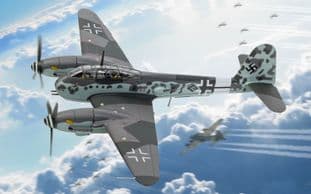
Although the Messerschmitt Me 410 was an effective replacement for the Bf 110 Destroyer, the failure of the Me 210 meant it entered service three years late.
As we now know, the Me 210 would be nothing more than a stepping stone to the Messerschmitt Bf 110’s actual replacement, but the time Germany spent trying to make the Me 210 into an acceptable aeroplane proved to be nothing short of a disaster. When the later Messerschmitt Me 410 Hornisse eventually entered service, it was actually an extremely capable fighting aeroplane, but this was the aircraft the Luftwaffe should have received during 1940, not three years later.
Had the Me 210 not happened, and the Me 410 Hornisse been delivered during the summer of 1940, perhaps the Luftwaffe might have had an aircraft which would go on to enjoy a reputation similar to that of Britain’s de Havilland Mosquito they admired and despised in equal measure, and the world might have seen why Göring had put so much faith in the Destroyer concept.
As it was, Messerschmitt Bf 110 crews were forced to soldier on whilst the long wait for their mount’s replacement dragged on, meaning that by the time the Me 410 Hornisse finally did enter service, experienced multi-engined heavy fighter crews were few and far between, further diminishing the impact of the Luftwaffe’s new twin engined Destroyer.
Despite suffering a protracted development and delayed service entry, the Messerschmitt Me 410 Hornisse proved to be an excellent fighting aeroplane, possessing ample power, impressive range and the ability to pack an extremely heavy offensive punch. In addition to its configurable under-nose weapons bay, the aircraft could accept an impressive array of externally mounted weaponry, particularly when used against the huge Allied bomber formations which headed deep into Germany from late 1943 onwards. Unfortunately, all that additional firepower brought with it increased operational weight, which wasn’t that much of an issue when the Hornisse could rely on fighter protection, but if caught alone by Allied fighters, became a very different story.
Eduard Tratt was a gifted Zerstörer ‘Ace’ from his service on the Eastern Front, and after receiving the Knight’s Cross of the Iron Cross, was given command of Erprobungskommando 25 and the testing of the Me 410 Hornisse in a bomber attack role. He would subsequently be given command of the reformed II./ZG 26 in that same role, scoring further victories against USAAF bombers and their Lockheed P-38 Lightning protection. His final victory would come on 22nd February 1944 during ‘Big Week’, when singlehandedly attacking the bombers of the 91st Bomb Group. Bringing down a B-17 Flying Fortress, his Me 410 may have been hit by return fire, because it appeared unable to take evasive manoeuvres when subsequently attacked by the P-51B Mustangs of the USAAF’s 353rd Fighter Squadron.
The Hornisse came down in the Harz Mountains without either man taking to their parachutes. Tratt was killed just two days short of his 25th birthday, having attained the title of the Luftwaffe’s most successful Zerstörer Ace of the Second World War, with 38 aerial victories credited from 350 operational sorties flown.
The third release in our popular Messerschmitt Me 410 Hornisse tooling, we are delighted to confirm that this appealing model is in our warehouse and shipping now.
STOP PRESS – We’re delighted to confirm that the CORGI team will be in attendance at the Classic Motor Show at Birmingham’s NEC from 13th-15th November coming, the UK’s biggest indoor classic car show.
We’ll be hoping to bump into lots of Vanguards collectors over the weekend, so if you are heading down to the show, please do drop by and meet the team.
We’re afraid that’s all we have this time around, but we will be back as usual in two weeks’ time to bring you a further exclusive selection of updates. As always, if you would like to drop us a line in the meantime to comment on anything CORGI model related, or to suggest a future blog topic you’d like to see covered here in DCD, you’d be more than welcome, and we’re always happy to hear your views.
As ever, our diecastdiaries@corgi.co.uk address is always the one to use.
If you can’t wait for the next blog, you will find plenty of CORGI model collecting discussions taking place on our official social media channels, access to which can be obtained by clicking on the respective links at the foot of the CORGI website homepage.
Link access to CORGI social media sites.
Thank you for continuing to support your CORGI Die-cast Diaries blog, as we head into our eleventh year of production. Our next edition is scheduled for publication on Friday 6th November.
Until next time, once again, thank you for your continued support.