
Welcome to the latest edition of Corgi Die-cast Diaries, your regular blog review of all the news, updates and topical stories from the captivating world of Corgi die-cast model collecting.
Following on from our magical flying motorcycle feature in the previous edition of our blog, we will be staying airborne for this latest edition of Die-cast Diaries, as we bring you the latest exclusive update from a highly anticipated dual Aviation Archive new tooling project. In fact, we really are ahead of the curve on this one, as we are bringing you the very latest information from two projects which still don’t have their individual product pages active on the Corgi website, but watch this space for impending developments on that front.
Showcasing yet another selection of exclusive image updates, we will be checking in on the two new 1/72nd scale Supermarine Spitfire model announcements made at the beginning of the year, as we give you a first look at BOTH of the prototype models produced from our new CAD files and whilst they are still firmly in the development phase, they do give us some indication of what these beautiful new models are going to look like. We will follow this up with a really interesting little feature looking at how our talented Senior Brand Creative takes our latest model releases and turns them into eye-catching full page adverts in some of the country’s best loved enthusiast publications. Using a trio of linked imaged to illustrate the point, we will show you exactly why we leave this kind of work to our resident expert.
Don’t forget, if you are proud of your Corgi collection, don’t keep your display all to yourself, send pictures to us here at diecastdiaries@corgi.co.uk so we can include them in a future edition of the blog and share them with our worldwide audience of model collectors. Whether your collecting theme be cars, trucks or aeroplanes, we would love to see your displays, so please do drop us a line.
Throughout the 24 year history of Aviation Archive, the Supermarine Spitfire has played a huge part in the success of the range and we hope that this newly tooled duo will only enhance its reputation. Please be aware that all these images feature hand built SLA prototype development models.
In the fascinating world of aviation, there are few aircraft types which can claim to be instantly recognisable to millions of people across the world today, even though they made their first flight over eighty years ago, but one iconic aircraft has to be considered to be at the top of this very small list of possibles, the Supermarine Spitfire. 86 years ago this month, the Vickers Supermarine company airfield at Eastleigh, near Southampton, played its part in aviation history, as this was the location of the first flight of Supermarine’s new Type 300 interceptor fighter, one of the most advanced aircraft in the world at that time. As chief test pilot Joseph ‘Mutt’ Summers strapped himself into the cockpit of prototype K5054 and prepared for the flight, he knew that not only would company officials be watching the flight, but also the eyes of the aviation world.
During a brief eight minute flight, the aircraft showed so much promise, that on landing, Summers reputedly told the engineers waiting to greet him on the ground ‘Don’t touch a thing!’ These few words heralded the start of an aviation phenomenon and the story of an aircraft which looked far too beautiful to take part in the horrors of war, but one which would go on to be regarded as the saviour of the British nation in her darkest hour of need. The Supermarine Type 300 was eventually given the name ‘Spitfire’ and with it, embarked on an unequalled service career, with first production Spitfire being delivered to No.19 Squadron Royal Air Force at Duxford on 4th August 1938.
The Spitfire would go on to become arguably the most famous (fighter) aircraft of all time, displaying its pedigree during the savage dogfights of the Battle of Britain, before going on to serve valiantly in every theatre of conflict during the Second World War. Produced in greater numbers than any other British combat aircraft, the basic Spitfire airframe proved to be so adaptable that the aircraft saw significant upgrade and improvement throughout its sixteen year service life, something which allowed the fighter to be in constant production throughout the Second World War. Using what was essentially the same basic airframe, the last of the Spitfires were producing more than double the power of the first machines, doubling the fighter’s rate of climb but also doubling the weight of the aircraft.
Possessing such a unique aviation pedigree as this, it is no wonder that the Spitfire has long been a favourite with model manufacturers over the years, with its enduring popularity ensuring that as design and manufacturing capabilities evolve, so newer, more accurate scale representations of the Spitfire continue to be produced. Manufacturers probably have more confidence that a new Spitfire project is destined for commercial success than any other aircraft type, simply by virtue of the fact that the aircraft’s popularity shows absolutely no sign of diminishing with the passage of time. With newly restored Spitfire’s joining the Warbird scene on an annual basis, people have more chance of experiencing a Spitfire display at one of Britain’s many Airshows than at possibly any time in recent history, not to mention the several operators who actively market the chance to fly in a two-seat variant of the aircraft. The impressive legacy of the Spitfire continues apace and for many people, the world of historic aviation begins and ends with the Spitfire.
From a Corgi Aviation Archive release perspective, as both of our new Spitfires are being produced in what for many is the traditional scale for model aircraft collecting, 1/72nd scale, we are going to concentrate our attentions on previous Spitfire model releases we have introduced in this scale. The first time a Corgi die-cast Spitfire joined the already popular Aviation Archive range was twenty years ago this year, a delightful little model which really was rather impressive and was one which would be responsible for introducing thousands of new collectors to the joys of die-cast model collecting. That first model was released as a series of three new tooling projects in commemoration of the 60th Anniversary of the Battle of Britain, with the Spitfire model being joined by new Hawker Hurricane and Messerschmitt Bf 109E models in the same scale, releases which proved extremely popular, as you might expect.
Two more views of the prototype Spitfire models, with the Mk.IX first and the T.9 bringing up the rear.
Prior to the introduction of these new models, model aircraft produced in die-cast metal may have had the benefit of weight to give them that appealing presence in hand, but could not always be described as being the most accurate scale representations of the subject aircraft. Following the release of these first three new Corgi models, things started to change and die-cast aircraft collecting was heading into an exciting new era.
As impressive as this first 1/72nd scale Spitfire model undoubtedly was, this new direction for Corgi was still in its relative infancy at that time and whilst collectors rushed to secure their examples of the new Spitfire model, they had no idea at that time that the tooling had been produced to a punishing design brief. Not only was the tool required to produce beautiful scale representations of the Spitfires which fought during the Battle of Britain, but it was also required to allow Mk.II, V and IX variants of the fighter to be produced from the same basic tool set, using various slide inserts to allow the necessary modifications. It could be argued that this was a little over-ambitious for that time and whilst many thousands of these models sit quite happily within our collections to this day, respective Corgi design teams have since returned to this famous aviation subject and produced updated and more accurate representations of the Spitfire for collectors to consider.
This is where we find ourselves today, welcoming two new 1/72nd scale Spitfire models to the Aviation Archive range, both completely new tooling projects, but with one being introduced to the range for the very first time and the other a more accurate representation of an existing, if recently unused model variant of the Spitfire.
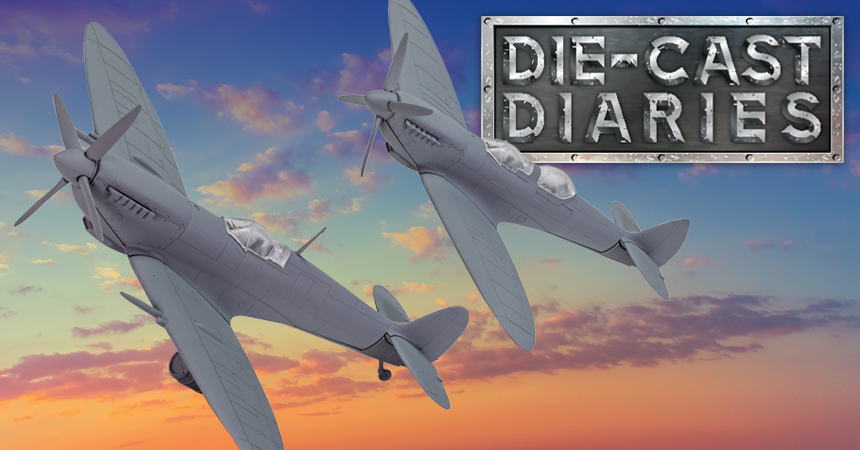
We are delighted to be in a position to bring readers an exclusive update from both of our new Spitfire tooling projects in this latest edition and have been cleared to include this interesting selection of supporting images, even though they feature early development samples. In a real break with tradition, we are very much ahead of the curve with both of these models from a blog perspective and even though they are not listed on the Corgi website at this present time, we are updating you almost in real-time, for no other reason than we know many of you will be interested. This does have to be accompanied by a rather important caveat however, because what you are looking at are early development sample models, ones which are still subject to significant alteration before they can be released for production. More than this, the samples you see here are not even made of metal and have been produced to aid our development team in fine tuning their CAD files prior to tooling production.
Both the models you are looking at here are stereo resin prototype models, produced at great expense and intended to give our designers a good idea of how their CAD files would look at this point if used to produce a scale Spitfire model. These one-off models act as something of a proof of concept exercise, but give our designers a physical three dimensional representation of what they have produced in their design software. Both models arrived at Corgi HQ as a collection of cured resin components, the products of a specialist prototyping machine, something like an extremely high-end 3D printer. Once received, every aspect of their production from scale accuracy to the fit of individual parts is assessed by the Corgi team, before returning to their design files to make any alterations they deem necessary.
Once the models have been assembled, they are sent to a ‘secret’ room in the bowels of Corgi HQ, where one of our model engineers will prepare them for painting, another important stage in the assessment of these prototype models. Masking off the clear parts, which at this stage don’t look all that clear because of the material they are made from, the models are then sprayed with a grey primer, as this shows up all the fine detail and allows our design team to assess every aspect of the model more accurately, both its good and bad points. At this stage, it is just as important to discover problems as it is to marvel at design innovation, because the vital next stage will be the production of the model tooling blocks themselves.
Although a fascinating insight into the design process, please don’t be too concerned by missing components and joint lines at this stage, as prototype models are only ever intended as a concept proof and the first metal shots from the new Spitfire toolings will have had most, if not all of these issues ironed out and will be a much more accurate representation of fit accuracy. For now though, please enjoy looking at these prototype model images which have only rarely been shown in the blog over the years, as we once again look at why these two variants of the famous Spitfire have attracted further new tooling investment from Corgi.
The most accurate die-cast Spitfire model we have ever made, we are really looking forward to bringing readers an exclusive first look at the first metal model to be produced from this new tooling. This image features the recently received SLA (3D printed) prototype.
Many aviation specialists and military historians describe the Spitfire Mk.IX was the most important variant of Spitfire in the aircraft’s entire production run and as a consequence, it is somewhat surprising to learn that it was actually something of an emergency stop-gap development. The arrival of the Luftwaffe’s new Focke Wulf Fw.190 fighter over the Western Front in August 1941 saw Spitfire Mk.Vs of the Royal Air Force operating on cross Channel raids falling victim to the ‘Butcher Bird’ in ever increasing numbers and something drastic had to be done. A major Spitfire upgrade programme was already in development at that time, however, introduction of the future Mk.VIII was still some way off, due to the fact that manufacturing plants still had to alter their tooling jigs for production of the new aircraft. Thankfully, there was a temporary solution. One of the major features of the new Spitfire would be its use of a powerful new version of the Rolls Royce Merlin engine and it was proposed that fitting this new engine to the existing Spitfire Mk.V airframe may give the combat performance boost the RAF were looking for.
The first 100 Spitfire Mk.IX fighters actually started out as Mk.Vc airframes adapted to take the new Rolls Royce Merlin 61 two stage, two speed supercharged engine, a combination which would produce a thoroughbred fighting aeroplane, one which was more than capable of challenging the Focke Wulf and the latest ‘Friedrich’ variant of the famous Messerschmitt Bf 109 fighter. In fact, the new Spitfire was considered so successful that this would become the second most heavily produced variant in the entire production run of this magnificent aircraft and if you include the aircraft powered by the licence built American Packard Merlin 266 (Spitfire Mk.XVI), even eclipsed the Mk.V in production numbers.
With further powerplant refinement taking place throughout the production life of this supposed stop-gap variant, the first Spitfire Mk.IX fighters began joining RAF Squadrons from July 1942, with this incredibly successful mark of Spitfire going on to see service past D-Day and well into the post war era. The last major Merlin engine powered variant of the Spitfire, this ‘emergency stop-gap fighter’ would actually go on to be considered something of an aviation classic, enhancing the incredible legacy of this most famous of fighting aeroplanes.
It is interesting to note that our new Spitfire T.9 tooling project is the first time either Corgi or Airfix have ever scanned an actual Spitfire, something which will definitely be a conversation point once this stunning new model is in our display cabinets.
For an aircraft as successful as the Spitfire was, and one which was produced in huge numbers throughout WWII, it is rather surprising to learn that there were no official two seat training variants of the aircraft in RAF service. With so many young pilots undergoing flight training for future postings to Spitfire squadrons, you might think a two seat training variant of the Spitfire would have been high on the list of Air Ministry requirements during the war, but this proved not to be the case. In fact, even though the Supermarine company seriously promoted the development and production of a two seat Spitfire as far back as 1941, the Air Ministry showed no interest in the proposal, presumably down to the fact that there was a shortage of new Spitfires at that time and they couldn’t risk the possibility of increasing this shortage. In any case, they saw no need to make changes to a pilot training programme which appeared to be working so well - a new pilot’s first flight in a Spitfire would therefore be his first solo!
The first ‘two seat’ Spitfires recorded were unofficial field modifications, undertaken by a few individual overseas Spitfire squadrons. From a purely numerical perspective, perhaps the most notable conversion of Spitfires for training purposes were modified by the Soviet Air Force, who would eventually be supplied with more than 1000 Spitfires. It is thought that the Russians actually converted several Spitfires to two seat configuration, but rather than moving the front cockpit slightly forward as Vickers Supermarine would later do, the Russians elected to simply add a second cockpit behind the existing one, using a narrower section of the fuselage and making these aircraft rather distinctive, whilst at the same time producing a rather claustrophobic working environment for the second pilot.
Once they became aware of the wartime Russian Spitfire conversions, Vickers Supermarine revived their interest in a two seat Spitfire as a private project in 1946, selecting a Spitfire Mk.VIII airframe (MT818) as their donor aircraft. In fact, one of the most interesting facts about the two seat Spitfire variant is that there is no such thing as a new-build Spitfire trainer, as every example without exception was originally manufactured as a single seat fighter.
We are really excited to be adding the Spitfire T.9 to the Aviation Archive range, a post war development of this famous aircraft, but one which has become incredibly popular over recent years.
Over recent years, the opportunity to experience a flight in the world’s most famous aircraft has become big business, to the point where just a few years ago, almost every Spitfire under restoration was being converted to T.9 or two seat Spitfire standard. These aircraft are now much loved in their own right, regularly appearing at Airshows and operating in all but the poorest weather conditions, offering Spitfire flights to a long list of hopeful fliers - this really is bucket list stuff, where seemingly no expense is spared in order to spend time in a Spitfire. If you are ever fortunate enough to take a flight in one of these magnificent aircraft, you will surely never forget the experience, with both yourself and anyone accompanying you on the day going on to have a real affinity with the Spitfire you flew in, or the one you saw flying next to you. These Spitfires made for two are maintaining and possibly even enhancing the legacy of this magnificent aeroplane, bringing R.J Mitchell’s classic design to the attention of a new generation of Spitfire converts.
With the genuine affection in which the Spitfire is held showing absolutely no sign of diminishing, we hope that these two similar, yet very different scale die-cast representations of the aircraft will soon be taking up a popular position within the Aviation Archive range and that we may even play our own small part in maintaining the legacy of arguably the world’s most famous fighting aeroplane.
The next update we bring you will hopefully be the sight of the first metal shots sample models, following manufacture of the production toolings themselves, at which stage we will have a good idea of when the first models should be available. Whatever we discover at that crucial stage, we will be sharing our findings with blog readers as usual.
Our ‘Senior Brand Creative’ Jules takes one of our standard product images and does something really special with them when creating her impactful adverts.
For even the most optimistic of model collectors amongst our numbers, we have to admit that the constantly changing situation on the high street is making it increasingly difficult for us to not only see the models we love in the metal, but to enjoy the simple pleasure of discussing our hobby with like-minded people. Most of us would also probably agree with the statement that our models are quite tactile entities in their own right and there is nothing quite like closely inspecting and even handling the next model we have earmarked for inclusion in our collections, prior to making that next considered purchase.
For the hobby as a whole, most of us might have the experience and collector knowledge to make a purchasing selection either on-line or via a printed advert, but for those who have yet to discover the simple joys of collecting, this must be quite a daunting first experience. Thankfully, the team here at Corgi have your backs and appreciate how difficult making a new model selection decision can be and we try to help where we can. Individual product pages have full descriptions and feature several different product images, as we attempt to replicate, if we can’t actually replace the thrill of visiting a well-stocked model shop. From a blog perspective, we celebrate our seventh anniversary later this year and over that time, take pride in the fact that we have brought our loyal readership as many illustrated model updates as we possibly could whilst they were in development, something which would hopefully have also provided a little support for the less experienced collectors within our ranks.
Just as the high street is experiencing some challenges at the present time, the same could be said of the printed magazine industry, with the advent of on-line publications and social media generally having an impact on circulation numbers. That being said, although we clearly have to be careful with print advertising budgeting in the current climate, we do still like to support magazines wherever possible and rather than simply replicate product or catalogue web pages in print, we call upon the talents of our photographers and graphic designers to create something a little bit special for this task. We know how difficult it can be to secure that valuable few seconds of consideration, but we think that some of our current print advertisements really do grab our attention, almost appearing to jump off the page.
The work of our ‘Senior Brand Creative’ Jules is well known to Die-cast Diaries readers, as we have shown the appealing theme logos she has created many times within the blog, along with showcasing the work she does on the professional presentation of our products across the various ranges. She is also instrumental in creating the adverts which appear in printed magazines and on social media and we thought you might like to take a look at a selection of the recent adverts she has been working on and to show you how she builds them up from the basic product image starting point. We feel certain that many of our readers will have come across these adverts and felt compelled to spend a little more time inspecting their finer points.
VA13901 - Jaguar XJ6 Series 2 4.2-litre, Avon & Somerset Constabulary
An image to captivate any Vanguards fan, this montage shows how the standard image was used as part of this full page advert.
The 4-speed manual overdrive XJ6 modelled was based at the Avon & Somerset Constabulary's Motorway Traffic base at Almondsbury, just off the motorway intersection of the M5 and M4 near Bristol. It was only used for motorway work, on both the M4 and M5, and carried the requisite equipment for dealing with incidents, including a medical kit, traffic cones and basic, but important, items such as a broom for sweeping away broken glass. It carried the call sign Tango Whiskey 1 and was one of a number of Jaguar XJ6s operated in this role as their power and high-speed stability made them ideal although officers also appreciated the comfort their sophisticated suspension provided.
Jaguars started being used by the UK police after the launch of the legendary XK engine in 1948, but it was the compact Jaguar 2.4 Saloon (retrospectively known as the Mk1), announced in late 1955, which was really adopted by the police. The much more powerful 3.4-litre version of the XK unit was fitted into the compact bodyshell in 1957, making it easily the fastest mass produced saloon of its era, and it was progressively modified, first into the Mk2 of 1959 then more radically the S-type of 1963. All served with distinction throughout the UK, especially on motorways, and the XJ6 Series 1 continued that tradition when launched in 1968, as did the 1973-1979 Series 2, including the 1975 example modelled here.
VA11118 - Land-Rover Series 1 80", Poppy Red
This red hot creation is a definite attention grabber and won’t let go of your eyes until you have explored every inch of the image.
It became clear almost immediately after the Land-Rover's launch in 1948 that it could be used in a far greater number of roles than Rover had initially envisaged. The vehicle modelled is the first Land-Rover built for the fire service, and thus the first to leave the Solihull works painted red instead of green. It was actually the first of a batch of four dispatched in February 1949 to the Derbyshire Fire Service, all of which were handed over to Derbyshire's Divisional Fire officer at the same time.
They were among the last vehicles made using the R86 1948 model-year numbering sequence, before production of the subtly different 1949 model-year vehicles commenced. Other than the red paint, they were all standard vehicles and were used to transport equipment and personnel around Derbyshire, a region where off-road capability is important because of the topography. All four were painted green to be sold off in the mid 1960s and the current owners, North Yorkshire-based Robert and Rachel Sargeant, spotted the vehicle on eBay in 2010. It was by then painted blue and had been off the road for 35 years but, although in very poor condition, it was complete and unmodified. The Sargeants embarked on a total restoration to return it to its original condition and livery that took 570 hours of work but was finished in time for the Series One Club's rally in June 2012.
VA13902 - Jaguar XJ12 Series 2 LWB, Juniper Green
When you go down to the jungle ….. perhaps not quite the Jaguar you were expecting to see!
The XJ12 modelled was a well-known Jaguar Public Relations car that featured in the 1977 Series 2 V12 brochure where it was shown with a raffish roll-neck wearing owner in front of a hot air balloon. The brochure states, 'You have a taste for excitement in life. Yet with a subtlety and refinement you appreciate through experience. We believe we can offer you a car which comes closer to your lifestyle than you ever thought possible'. It goes on to proclaim it 'the pinnacle of luxury' and that is confirmed by contemporary car magazine group tests, which the XJ12 continued to win with ease, even when competing with cars of twice the price.
The XJ series' unmatched refinement, superb ride and sophisticated road manners were the result of careful development work by unsung Jaguar design genius Bob Knight. When this was paired with the mellifluous V12 designed by former Coventry Climax man Wally Hassan, which is still one of the smoothest engines ever produced, the result was, without question, the best car in the world. The Series 2 was launched at the Frankfurt Motor Show on September 13th, 1973 and continued in production until 1979. It was a great sales success, with well over a 120,000 examples being produced and prevented Jaguar being drawn into the maelstrom of parent company British Leyland. It featured a more modern dashboard layout, improved air conditioning and revised styling.
Clearly, each member of the Corgi team brings their own skills and experience to bear in providing collectors with the models we all love to collect, but when looking at the impressive work featured above, some are clearly a little more public facing than others. Please keep an eye out for more of Jules’ Corgi advert creations in print and on social media in the future and perhaps drop us a quick line to let us know which ones made the most impression on you.
That’s another edition of Die-cast Diaries done and dusted, but don’t despair, we will be back again in two weeks’ time with another selection of Corgi model exclusives and we would be delighted if you could join us then.
In the meantime, we are always interested to hear your Corgi related views, so if you would like to drop us a line to comment on anything blog related or to suggest a topic you would like to see covered in a future edition of the blog, could we ask if you would use our diecastdiaries@corgi.co.uk email for all correspondence.
If you can’t wait for the next blog, you will find plenty of Corgi model collecting discussions taking place on our official social media channels, access to which can be obtained by clicking on the respective links at the foot of the Corgi website homepage.
Please use these links to access our Facebook, YouTube, Twitter and Instagram social media sites.
Thank you for continuing to support our Die-cast Diaries blog.
Our next edition is scheduled for publication on Friday 8th April.