
Welcome to the latest edition of Corgi Die-cast Diaries, your regular blog review of all the news, updates and topical stories from the captivating world of Corgi die-cast model collecting.
We have a fascinatingly diverse update of current Corgi projects for your enjoyment in this latest edition of our blog, with our usual selection of exclusive imagery to help us illustrate the ongoing development of projects in our Aviation Archive and Vanguards model ranges. We begin by re-visiting our new 1/72nd scale Supermarine Spitfire Mk.IX new tooling project to bring you right up to date with the very latest developments and to discuss a specific subject which has been causing a little collector concern on several social media sites recently. We follow this with a major blog exclusive and our first look at a significant new tooling addition to our Vanguards range, with VAN very much being the operative word here. Throwing the blog spotlight on our new Ford Transit Custom tooling, we have a selection of CAD imagery and an exclusive first look at several prototype models which recently arrived in the Corgi development offices.
Finally, we have an update from a new Vanguards model which has proved to be one of the fastest selling models, from a pre-ordering standpoint, in the history of this ever popular range, where we will be showing you the model in painted metal form for the very first time! We wonder if you can guess which model we are talking about?
That's the intro finished, so let's dive straight in with our latest Spitfire update.
The latest Spitfire product artwork image, the one which appears on both website product page and in the latest model catalogue.
As arguably the most famous aircraft to ever take to the skies and one which is instantly recognisable to millions of people the world over, the Supermarine Spitfire is a subject which will always command plenty of attention, especially if you are making a new scale die-cast model representation of one. We began the current year of blog updates with the news that we were working on introducing two new 1/72nd scale Spitfire additions to the Aviation Archive range, a classic Mk.IX fighter variant and perhaps a little unexpectedly, a two seat T.9 trainer variant, both of which have received plenty of attention since that time. From a blog perspective, one of the main reasons we decided to publish our Die-cast Diaries updates was to keep Corgi collectors updated and informed on everything we were currently working on and in all cases, share development information much more openly that we had ever done before - as you might well imagine, that was not without its challenges.
Because we knew Corgi fans would be interested in not only hearing about the latest new tooling projects much earlier than they had previously, but also to see first-hand the various development stages every new model must negotiate on its journey to eventual release, we decided to let readers into our die-cast world. This did mean that in some cases, we would be showing pictures of models which were still very much a work in progress and as such, were still subject to change. Even though we go to great lengths to confirm that is the situation when updating projects, there are still occasions where readers become a little concerned about what they are seeing and take to social media to voice those concerns. That has recently happened with regard to a particular aspect of the new Spitfire's design and we just wanted to take this opportunity allay those concerns right away.
Taking one of the most iconic aircraft in the history of flight and replicating that as a scale die-cast model is definitely not as simple a process as it might seem and for those involved in this kind of work, it can present numerous challenges. Even though we like to think we are extremely open when it comes to sharing information in our blog, there are some aspects of our work which must remain within the business for quite obvious commercial reasons, but we know the majority of our readership will fully understand this. Having said that, when there is an obvious concern and we can provide some reassurance, we will try our best to do just that.
An overlayed engineering image which shows the design teams requirement for wing dihedral on the new 1/72nd scale Spitfire tooling.
A fascinating image which shows the factory produced Spitfire wing jig to check the wing dihedral angle as soon as the wing section has been cast, cooled and prepared.
The issue in question here is that of Spitfire wing dihedral and the accurate scale representation of it. As you can see from the image above, this is something our development team were fully aware of during the design phase of these latest Spitfire projects, however, incorporating this into your design and having it manufacture in line with your requirements are not always one and the same thing and can have you scratching your head for a clever solution at times. During the development of these new Spitfire models, we have had prototype models which were perfect from a dihedral perspective and some a little less so, with exactly the same occurring when we progressed to the metal engineering samples stage. With each stage thoroughly reviewed by our team, reports are compiled and sent to the tooling manufacturer and production facility to ensure that within accepted manufacturing tolerances, slight adjustments might need to be made.
On this wing dihedral question, we wanted to show you the image above which is the ingenious solution the manufacturing plant developed to address the issue of Spitfire wing differences. The issue at hand here is off-tool part shrinkage, something which may be connected to several different factors, with prevailing atmospheric conditions at the time of production certainly being one. To check everything is as it should be, the factory have produced a jig which will be used to confirm the correct wing dihedral has been replicated before this model component can advance to the next stage, a procedure which is now in place ready for scale Spitfire production.
Just another interesting aspect of die-cast model production and some of the issues our development team have to overcome on a daily basis - and you thought producing collectable die-cast models was easy!
Anyway, we thought you might be interested to hear about this rather unusual Spitfire project update and see pictures of the manufacturing wing jig produced to help overcome the issue. Before we move on from this subject, Spitfire AA29101 has been the subject of a number of small detail placement and decoration updates since you last saw it, so we will be bringing you images of another sample model soon, but until then, here is an exclusive first look at the box artwork design produced in support of this beautiful release.
The arrival of the Luftwaffe’s impressive new Focke Wulf 190 fighter over the Western Front in August 1941 saw RAF Spitfire Mk.Vs operating over the Channel falling victim to the ‘Butcher Bird’ in ever increasing numbers - something had to be done and fast. A major Spitfire upgrade project was in progress at the time, however, the Mk.VIII was still some way off, as manufacturing factories had to prepare their tooling jigs to produce the new aircraft, but there did appear to be an acceptable temporary solution. One of the major features of the new Spitfire would be its use of a powerful new version of the Rolls Royce Merlin engine and it was proposed that fitting this new engine to a Spitfire Mk.V airframe would give the fighter a welcome boost in performance.
Referred to as the Supermarine Spitfire Mk.IX, the first 100 of these new fighters were actually Spitfire Mk.Vc airframes adapted to take the new Merlin 61 two stage, two speed supercharged engine, with this combination actually resulting in a thoroughbred fighting aeroplane, one which was more than capable of challenging the FW190 and the latest ‘F’ variant of the Messerschmitt Bf 109. In fact, the new Spitfire was considered so successful that this would become the second most heavily produced variant in the entire production run and if including the aircraft powered by the licence built US Packard Merlin 266 (Spitfire Mk.XVI) even eclipsed the Mk.V in production numbers. With further powerplant refinement taking place throughout the production life of this particular variant, the first Mk.IX Spitfires began joining RAF Squadrons from July 1942, with this famous mark of Spitfire going on to see service past D-Day and even on into the post war era. The last major Merlin engine powered variant of the Spitfire, this ‘emergency stop-gap fighter’ would actually go on to be considered something of an aviation classic.
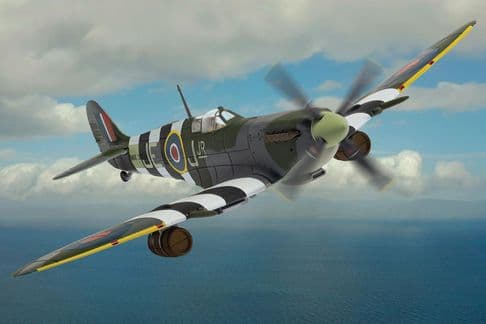
Wearing full D-Day identification markings, Spitfire MK329 JE-J 'Junior' was the personal mount of RAF ace pilot James Edgar 'Johnnie' Johnson, one of the RAF's top scoring fighter aces of WWII and one who's impressive tally of 34 confirmed aerial victories was scored exclusively against Luftwaffe single engined fighters. Flying extensively in support of the D-Day landings, Johnson and the squadrons under his command would be employed in aggressively clearing the skies of northern France of Luftwaffe fighter opposition, something they proved rather effective at doing. In fact, by D-Day, Johnson was one of the most successful Allied air aces still flying operationally, with his victories showing no sign of abating.
An exclusive first look at the box presentation for the new 1/72nd scale Johnnie Johnson beer carrying Spitfire Mk.IX.
Following the successful Allied invasion of Normandy on 6th June 1944, Wing Commander 'Johnnie' Johnson and the three squadrons which made up his No.144 (RCAF) Wing were amongst the first Allied fighter units to be sent to operate from temporary forward bases in France. Equipped with their trusty and battle hardened Spitfires, it seems as if not all of their fighters were used to keep the Luftwaffe in check, particularly the one Johnson flew and referred to as 'Junior'. It appears that Spitfire Mk.IX MK329 was something of a hybrid machine, not the one he flew in combat, but more of a hack airframe. It is thought that once his unit had been sent to operate in France, Johnson used this Spitfire to fly back to the UK on unofficial 'Beer Runs', returning to their temporary French home with two beer kegs attached under the wings of his aircraft. This practice was frowned upon by the RAF top brass, so some units came up with ingenious ways around restrictions, using washed out standard external fuel tanks as their makeshift beer carriers, but no matter how well they were cleaned out, the beer always had the unwanted aftertaste of fuel. As Wing Commander Johnson was highly regarded by both his men and his superiors, a blind eye may have been turned on his unofficial Spitfire sorties and the refreshing cargo they carried.
There are few details regarding the actual production and service career of Spitfire Mk.IX MK329 in existence, which Johnson described in his memoirs as being a collection of components from various different Spitfires, something of a mix and match airframe. This is borne out by the fact that its serial MK329 is very similar to that of his usual and favoured combat mount around that time, Spitfire MK392, an aircraft in which he scored several victories - is this the reason why he referred to this aircraft as 'Junior'? Whatever the details, this beautiful Spitfire and its unusual underslung load certainly makes for a fascinating wartime story.
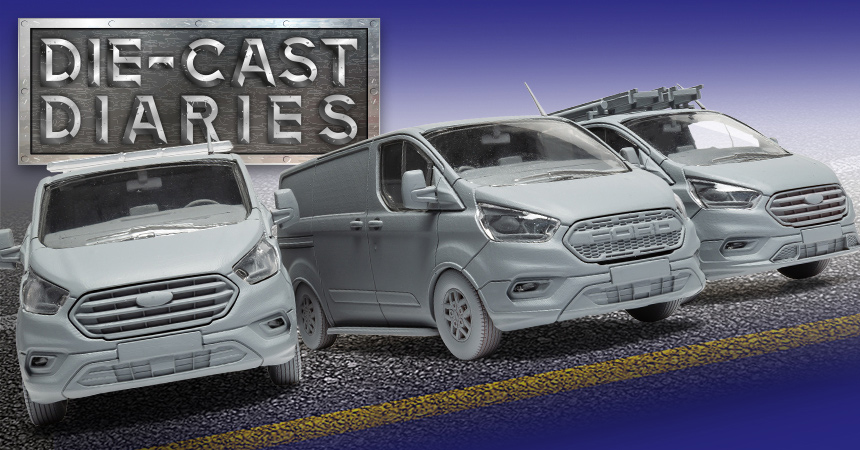
A trio of Vanguards delights, this is the first time that pictures of these prototype models have been published outside the company and have been produced by a specialist prototyping company using the new Ford Transit Custom CAD files.
The launch of our May to August 2022 model range earlier this year, included details of the continued new tooling investment in our Vanguards range of 1/43rd scale die-cast vehicles and confirmation of a project which would see several related and rather significant new models joining the collection in the not too distant future. When most of us think of classic British vehicles of the past sixty years or so, we might include such motoring icons as the Mini, various MG and Jaguar models, or even the sporty TR6, however, it is unlikely that a commercial vehicle would be amongst the suggestions offered, but are we being a little unfair in ignoring them? Our latest Vanguards new tooling project is our tribute to the latest incarnation of a vehicle series which has been a familiar and popular feature of Britain's road network since the mid 1960s and most definitely has to be considered a motoring classic in its own right - the Ford Transit.
Our latest new tooling project will introduce several of the many guises of Ford Transit Custom to the Vanguards range and up to this point, just the written confirmation of this and a fleeting glimpse of a computer rendered image have been the only details collectors have had, however, this is all about to change. This first development visit to the Ford Transit Custom project will not only be giving you the reasons why our tribute to these hard working vehicles have every right to be included in the Vanguards range, but will also be exclusively revealing an interesting selection of CAD and prototype model images for your viewing pleasure. Get ready for the scale Transit ride of your life!
From a die-cast model heritage perspective, it would be interesting to know just how many of our blog readers regarded a model of a Ford Transit as one of their favourite toys when they were young and how this model of one of the most numerous vehicle types on Britain's roads was probably our most played with toy. The model I am thinking of is of course the Dinky Ford Transit Police Accident Unit, a model which featured opening/sliding doors and a selection of bollards and warning signs which could be stored inside the model. Unwittingly, even during those formative years, we were paying our own respects to a vehicle which has to be described as a design classic, one which could be used for a seemingly endless number of transportation applications and one which became a catchword for all light commercial vehicles. If you needed a van, then it must be a Transit, no matter which manufacturer actually made the vehicle in question!
Straight from the computer of our designer, this next series of images feature CAD screenshots from the new Ford Transit Custom new tooling project.
The Ford Transit story as we know it, began back with the release of the first series 1 vehicles in 1965, when the Ford Company decided they were going to produce a new range of light commercial vehicles to support everyday trade and business activities, whilst at the same time, challenging the market dominance of rival manufacturers in this potentially lucrative field. Those first tentative steps marked the beginning of a period of market domination for Ford, with the Transit going on to be the vehicle of choice for thousands of tradespeople and business owners and becoming the best-selling vehicle of its type for many years to come.
The success of respective Transit ranges was mainly down to the physical size of the load carrying compartment, larger than its competitors and therefore able to carry more goods and oversized loads, with all this functionality achieved by a vehicle which was both reliable and stylish. The styling was rather American in appearance, functional, but with that little something undefinable about it and didn't the British market love it. In addition to this, Ford were clever in maximising the potential of the Transit, by taking it away from the feeling that it was just a workman's mode of transport and aligning it much more closely with a large and robust family car, something akin to a modern MPV (Multi-Purpose Vehicle). This feature was actually born out of necessity, as Ford's design teams were instructed to use as many components from their existing car ranges as possible, making both development and manufacture more cost effective, whilst at the same time giving this commercial load lugger a very different feel.
In addition to this, all this stylish load carrying capacity was mainly pulled along utilising Ford's existing range of car engines, with these cost savings ensuring that Transit pricing always remained extremely competitive.
As the Transit soon became the van of choice for thousands of tradesmen and businesses up and down the country, so the demand for these vehicles reached unprecedented levels. Indeed, as waiting times for new vehicles continued to increase, the second hand market flourished, becoming increasingly tight, with this increased demand dictating that used Transits always retained their value, a situation which didn't relieve the pressure on the new vehicle market.
Having unearthed such a winning formula, Ford were careful to maximise the potential of the Transit, making it an indispensable tradesman's tool and continually refining their vehicles, making ever more body-style options available and further increasing levels of interior comfort and equipment. Their mantra was that if Transit owners were going to be spending large periods of time in their vans every day, they wanted to make this a comfortable and pleasurable experience, almost as if they were in a family car of reasonable specification. The seemingly endless number of configuration options would give Transit buyers an incredible level of choice when it came to selecting their van and with 6 body styles, the option of either a short or long wheel base chassis and no fewer than 32 different door combinations, the choice of your new Transit was not an exercise for the indecisive amongst us - they really did have a Transit for every conceivable application.
The current incarnation of a British motoring icon, even if it is a commercial vehicle, these images all feature the prototype model produced from the new model CAD files, models which have only recently been received in the Corgi office.
The many admirable qualities possessed by the Transit were not lost on the less salubrious members of British society, as the load carrying capability, speed and car-like handling of these vehicles made them a popular choice for many with villainous intentions. Indeed in 1972, it was estimated that over 90% of bank raids which took place in the country used a Transit as their getaway vehicle.
Clearly, this posed quite a problem for the country's Police Forces, however, they did come up with an ingenious solution to this issue, they bought lots of Transits themselves! Using uprated vehicles with powerful engines, Police Transits were even more capable than the standard machines (the ones they were chasing), with speed, great handling and that legendary load carrying capability making them an arresting proposition. A less celebrated Transit claim to fame would be that it became one of the most stolen and broken into vehicles in British history, although it is not known if this is because criminals either wanted to use them for a job (or knew someone who did), or if they were just an easy target for the opportunist thief. Either way, warning labels stating that 'No tools or equipment are left in this van overnight' also became associated with Transit ownership.
Continuing the 57 year legacy of this magnificent vehicle, the latest incarnation of the Transit is the one which attracted the attention of the Corgi team and will soon be joining the Vanguards range in 1/43rd scale die-cast model form. The Transit Custom was unveiled at the 2012 Commercial Vehicle show in Birmingham and has continually benefitted from soft upgrades and trim level improvements over the years. The culmination of many years of commercial vehicle design and manufacturing expertise, these latest vehicles are the perfect combination of quality, functionality and style, with the now legendary choice of range options facing any Transit customer making one of these vehicles suitable for any conceivable business or recreational application.
With levels of style and comfort which continue to maintain the market position of the Transit, the interior spec of these vehicles are much closer to what you would expect to find in a quality family car than in a commercial vehicle, with the exterior styling also belying the rugged, hard-working nature of these vans. With vans, double cab-in-vans and Kombi vehicle options available, if you are driving a Transit these days, you are most certainly not a motoring poor relation.
A final look at our new Ford Transit Custom prototype models, which are already exhibiting impressive levels of detail. These beautiful models are destined to be popular additions to the Vanguards range.
The Ford Transit Custom models represented in the series of images posted here represent the standard 'Leader' model, the striking 'Sport' edition and the muscular appearance of the 'Trail' model and they are all destined to be making a welcome addition to the Vanguards range in the very near future. All being exclusively revealed for the first time, they begin with a selection of CAD screenshots produced during the early stages of the development process and are followed by a larger selection of prototype model images, which are being published for the very first time. Close inspection of the pictures clearly illustrate the impressive levels of detail our designers have managed to incorporate into their CAD files and how they have effectively captured the iconic lines of this commercial classic.
The next stage in the development process will be a first look at the engineering sample models, the first time the tooling blocks will have been used to produce die-cast components. Whilst still at a relatively early stage in the development of the new models, the sight of these first metal samples is nevertheless extremely significant and we look forward to sharing pictures of them with our readers as soon as they become available. At that stage, they will hopefully also be ready to take their place on the Corgi website and available for receiving pre-orders and we very much look forward to that.
Our new Ford Transit Custom tooling might not be the usual new project subject matter Vanguards collectors would expect to be joining the range, however, with its impressive 57 year ongoing heritage and iconic status within the motoring world, could you think of a more suitable subject for future inclusion in our 1/43rd scale model collections?
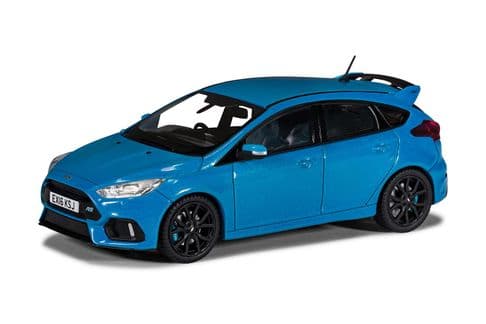
Just one final exclusive image for this edition, this time featuring a fully decorated sample model of our exciting new Vanguards 1/43rd scale Ford Focus Mk.3 RS in striking Nitrous Blue - what a beauty!
We end this latest development update with one final exclusive image and a first look at a new model tooling which is already earning quite the reputation for itself. We always knew that our Ford Focus RS Mk.3 would be popular with hard core Vanguards collectors, but since it made its appearance on the Corgi website, it has been one of, if not the fasting selling (in a pre-order sense) models in Vanguards history. The model we are looking at here is the first one our development team have seen in the metal and wearing its factory applied paint finish, representing another huge step towards this beautiful model being released. Although few unallocated models now remain, we thought we would end this update with a final look at the details behind this model and the real car which inspired its range inclusion.
VA15301 - Ford Focus Mk.3 RS in Nitrous Blue
Ford understand the reverence in which the RS badge is held and set out to make the Mk3 Focus RS the ultimate fast Ford. As soon as the first magazine road tests were published it was clear that they had achieved their goal. It had performance that could humble supercars costing twice as much yet it remained a practical 5-door hatchback that could easily be used as an everyday car. Highlights included four-wheel drive, launch control and a drift mode that created an internet sensation just after the car was launched in 2016 as stunt drivers and journalists battled to see who could drift a standard Focus RS in the most spectacular manner.
The resultant ebullient press coverage and bargain launch price of £31,000 meant the RS practically sold itself and was an instant classic. The car modelled was the first right-hand-drive example in the UK. Top Gear Magazine followed its production at the Saarlouis plant in Germany and their Journalists Ollie Marriage and Rowan Horncastle then drove it off the production line and back to the UK. It was subsequently road tested by Autocar, Piston Heads, Evo Magazine and many others. Most famously, however, it was the car Jeremy Clarkson chased Richard Hammonds new right-hand-drive Ford Mustang with during Series 1, Episode 6, of The Grand Tour. It has been retained by Ford and is one of the best-known cars in the company's heritage collection.
That's all we have for this Transit-tastic edition of our Die-cast Diaries blog, but we will be back as usual in two weeks' time with a further look at all the latest Corgi model developments, project updates and exclusive image reveals. Between editions, we are always interested to hear your views on all things Corgi, so if you feel like dropping us a line to comment on anything blog or Corgi model related, or indeed to suggest a topic you would like us to include in a future edition, please feel free to do so at diecastdiaries@corgi.co.uk.
If you can’t wait for the next blog, you will find plenty of Corgi model collecting discussions taking place on our official social media channels, access to which can be obtained by clicking on the respective links at the foot of the Corgi website homepage.
Link access to Corgi social media sites.
Thank you for continuing to support our Die-cast Diaries blog. Our next edition is scheduled for publication on Friday 18th November - where has this year gone?