
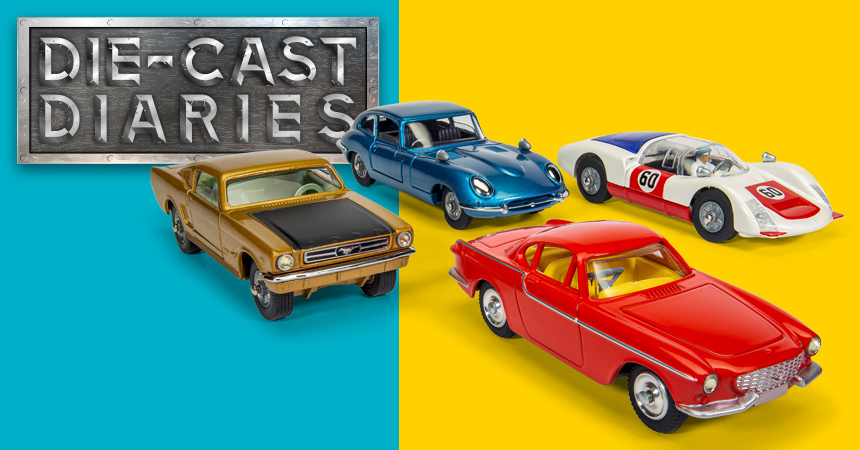
Welcome to the latest edition of Corgi Die-cast Diaries, your regular blog review of all the news, updates and topical stories from the captivating world of Corgi die-cast model collecting.
In this latest edition of our development update blog, prepare to be transported back to the golden era of Corgi model collecting, a nostalgia infused journey featuring some original and highly collectable models, but with a fascinating modern twist brought to bear during their production. Our latest range announcement included details of an exciting addition to the 2023 model range and a new collection of 'Classic Corgi models' which unashamedly take their inspiration from the 1960s, a time which has to be described as something of a 'Golden Era' for Corgi as a brand and indeed the production of die-cast model vehicles. Whilst these new models take their inspiration from those classic models of yesteryear, they have been produced using all the latest design and development techniques available to the Corgi team, whilst intentionally retaining the undeniable charm of the originals on which they are based.
In this latest update, we will featuring the first four newly tooled models in this series and thanks to the help of our development team, bring you details of how they have allowed today's model collectors to experience these toy and hobby classics from the past. Staying firmly on four wheels, we will be following this by featuring the latest pair of model additions to our ever popular Vanguards range, two scale representations of true British motoring classics, but both occupying very different sectors of the motoring market. Just to ensure this is not a complete model car fest, we will end by bringing you a little photographic tour of the Corgi showroom here at Margate, as we have recently updated our Aviation Archive display following range launch and in advance of a series of in-house presentations and thought you might like to see it.
As always, we have a blog full of exclusive imagery, so please join us for a little Corgi modelling indulgence for the next few minutes.
Corgi model nostalgia is a guarantee with our new range of newly tooled retro Corgi classic models.
Back in the carefree days of our youth, there was something quite magical and exciting about receiving a Corgi die-cast model vehicle as a Christmas or birthday gift, particularly as a present such as this was guaranteed to provide many hours of enjoyment for years to come. Back then, taking the model out of its box and adding it to our existing collection of models was the only thing that mattered and if we are being honest with ourselves, little thought was given to the poor box it came in, as it was all about the car inside.
The models themselves would provide hours of playing enjoyment for many thousands of youngsters, with their hard-wearing die-cast exteriors helping them to survive the rigours of ever more 'enthusiastic' motoring scenarios, with multiple collisions and the odd accident not challenging the metal exterior, but often having an effect on the paintwork. Indeed, like many other Corgi model owners, I would regularly give my models a new coat of Humbrol paint as I got a little older, just to revive their flagging fortunes, not knowing how such a sacrilege would be viewed many years later when these classic models had very become desired collectors’ items.
As most of these once revered items ended up in a shoe box, or at the back of a cupboard over the years, every time we stumbled across them in the years which followed, they always brought a smile to our faces, confirmation of how the battered contents of these toy boxes played such a significant role during our formative years. If you were lucky enough to have an impressive collection of Corgi models back then, you were definitely never short of friends.
Clearly, these models were intended to be played with for many hours by their fortunate owners and enjoyed throughout our childhood and into adolescence, so viewing them in their less than pristine state is actually just how they should look, with each paint chip and missing detail having its own story to tell, but O how things change. Now we are older and wiser, all that enjoyment came at quite a price, the future investment value of our beloved models. If only we had not played with our models and simply kept them for posterity in their boxed, safely packed away for some rainy day in the future and a nice little auction windfall, we would be sitting pretty now!
Obviously, that kind of thinking would never have entered our heads back then, but over the years, as we have seen the prices of original mint and boxed models which once used to lie on our living room carpet skyrocket, you can't help thinking what if. The high prices are clearly a reflection of the fact that the vast majority of youngsters treated their Corgi models in exactly the same way as we did, playing with them, as opposed to storing them away and how consequently, very few examples survived that time in genuine pristine condition. Imagine if you could show your own children the Corgi models which were such an important part of your own youth, but in boxed condition and without the scars inflicted on your originals? Well, thanks to the launch of our new Vintage Corgi toys range, that's exactly what you can do!
A fascinating combination of old and new, these models have been reverse engineered to match the original models as closely as possible, utilising all the latest design and manufacturing technology to do so.
In a development which can trace its origins back to an exciting partnership with our friends at the Corgi Model Club, some of the most iconic model releases from Corgi past have been recreated to establish a unique die-cast model collecting link with the heritage of our brand, allowing these much loved classics to take their place amongst contemporary model collections for the first time. Unless you had a pristine example of one of these models amongst your own collection, the only way you were ever likely to come across one was at a specialist auction and you would certainly pay for the privilege of securing one. Now, this project has brought these models back to life and allowed them to be owned in a manner for which they were originally not intended, to be collected and displayed for posterity.
This first quartet of models are the first of a major new series of releases and even though they are produced from the same tooling designs created in conjunction with the Corgi Model Club, will not be in the same format or liveries as their releases, with our models hopefully taking their place in model shops the length and breadth of the country, just as they did during the 1960s and 70s. Recreating the magic of this golden era of Corgi model production and collecting has not been without its challenges and speaking with our Development Engineer George, he talked us through some of the issues facing the team in allowing these models to take their places in a Corgi range once more.
As these models were always intended to be modern recreations of classic model toolings, each project began with the securing of an example of the original model, in as pristine a condition as possible, and complete with the original box. These models were either taken from our own archives or prized away from the collections of private individuals, but once in the Corgi office, the project could begin in earnest.
As we were essentially reverse engineering the models, having first taken copious photographic references, each model was carefully dismantled and prepared for scanning. At the same time, accurate colour references were also obtained, so the authenticity of the original releases could be maintained throughout. Once all this information had been gathered and the parts scanned, it was into the design software to work the parts backwards, actually quite a clever feat of digital engineering, with the only deviation from the original tooling design being to improve the overall fit and finish of each model, especially where they feature opening or moving parts.
The first four releases in this incredibly nostalgic range should be in our warehouse within the next two weeks. Prepare for some classic Corgi fun!
Once all this had been achieved, everything essentially proceeded like any other new tooling project, only in this case, we were attempting to retain the charm and heritage value of the original, not update and improve on a previous incarnation of the same subject. Even though George and his colleagues made fit improvements where appropriate, the real design skills required by this project was to remain faithful to these die-cast oldies, but goodies.
This attention to classic detail also extended to the recreation of the original box designs and whilst the sight of this distinctive artwork immediately transports us back to the appealing heritage of the Corgi brand, there are some subtle differences. You will note from looking at the boxes that for the first time, the artwork on the box matches the actual model inside, with the Ford Mustang for instance, being in the gold and black colours the model has been finished in. Again adding to the authenticity of these fantastic releases, the box finish itself has intentionally been produced in matt, just to maintain the heritage appearance of these beautiful little models.
The design work to recreate these attractive boxes is a blog subject in itself, so we will attempt to bring you that by way of a follow up article in our next edition, but for now, let's take a closer look at the quartet of new models which make up this initial release wave.
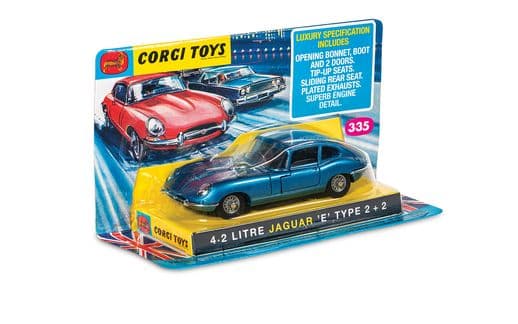
RT33501 Jaguar 4.2 litre E Type - Blue
Released in 1968 by Corgi Toys, the 335 Jaguar 4.2 E-Type is a brilliant replication of the iconic British Sports Car in feature packed toy form, featuring opening doors, bonnet and boot with tipping front seats and sliding rear seat in the interior. The model is presented in a striking metallic blue paint job, in a replica of the original display packaging that allows the model to be safely removed without damaging the pack itself.
New to the Corgi range for 2023, classics from our archives return as brand-new tooled models. Featuring rare colour options and reimagined recreation packaging, this collection is perfect for Corgi fans old and new, as well as gifting and collectors.
RT33001 Porsche Carrera 6 - Red & White
Originally issued in 1967 by Corgi Toys, the 330 Porsche Carrera 6 was only ever released in white with a choice of either red or blue trim colour options. This new issue of the model has opted for the red accented livery. The model features an opening engine cover and detailed interior, and a recreation Corgi Toys pack that has been newly amended to feature the colour of the model inside, after the original packaging release always featured the car in an un-produced green livery.
Featuring rare colour options and reimagined recreation packaging, this collection is perfect for Corgi fans old and new, as well as gifting and collectors.
RT22801 Volvo P1800 - Red
New to the Corgi range for 2023, classics from our archives return as brand-new tooled models. Featuring rare colour options and reimagined recreation packaging, this collection is perfect for Corgi fans old and new, as well as gifting and collectors.
Originally issued by Corgi Toys in 1962, the 228 Volvo P1800 was released in several colours, including this striking red. The model is supplied in a recreation of the original Corgi Toys packaging.
RT32001 Ford Mustang Fastback 2+2 - Gold & Black
First issued in 1965 by Corgi Toys, the 320 Ford Mustang Fast Back Coupe was released in several colours - but never in this new gold and black version. The livery of this new Corgi model replicates colours used on a rare unreleased test version, now finally widely issued for the first time ever. The model includes opening doors, and a recreation Corgi Toys pack that has been amended to feature the colour of the model inside.
Clearly from a colour presentation perspective, the Mustang is a slight deviation from how we positioned the range earlier, but now allows the Corgi Collector access to a model which was only ever intended as a test example, but with some images circulating amongst collectors, has always been something of a modelling enigma. Now the gold and black Mustang can finally take its place within many a Corgi model collection.
We are delighted to confirm that all four of these beautiful new heritage models (such a fantastically contradictory description) are on their way to us and should be in our warehouse and available for shipping in around ten days’ time. We had better start creating some space in those display cabinets, but whatever you do, don't throw the boxes away this time!
We couldn’t let the Morris Minor's birthday pass without making our own die-cast contribution to the celebrations.
Even though we have already seen quite a number of significant anniversaries marked this year, we most definitely couldn't let this latest edition of our blog go by without paying our own die-cast modelling respects to the venerable and much loved Morris Minor, on the occasion of her 75th birthday. This British motoring classic, which started life as an affordable family car and has since become a popular as a restoration subject vehicles, was actually conceived back in 1941, as the world was enduring the darkest days of the Second World War and British manufacturing companies were engaged in full time war production. Forward thinking executives at Morris Motors were already giving thought to life after conflict and how they could quickly take advantage of such a situation, effectively maintaining their current production capacity. Whilst diverting little from their concerted war effort, they gave the go ahead for the development of a new small family car, one which would go on to become a familiar sight on Britain’s roads and one which holds a special place in annuls British motoring history.
Launched at the Earls Court Motor Show in 1948, the new Morris Minor MM was initially available in just two versions, a two door saloon and a two door tourer (convertible), both utilising a 918cc engine and costing the princely sum of £358. The design philosophy behind the new car was to make a practical, economical and affordable family vehicle which the average man in the street would take some pride in owning and not just think that this was the only car he was able to afford.
With generous curves and a tall body shell, the new Morris was to benefit from good road holding and was designed to maximise interior space, making it an instant hit with families looking for a practical motoring solution and effectively getting the population moving independently of public transport. The effectiveness of its design and its overwhelming popular appeal saw the Morris Minor become Britain’s first car to sell over one million units, in a production run which lasted from 1948 until 1971.
The Morris Minor was manufactured in three distinct production series – the original Minor MM, which featured split windscreen and headlights placed low to the ground, positioned either side of the front grille, the Minor Series II (from 1952) with a re-designed front profile and headlights placed higher on the top of each wing, in what became a distinctive feature of these vehicles. Finally, the Minor 1000, which introduced a curved single piece windscreen and larger rear window.
Interestingly, the original codename for this entire motoring project was ‘Mosquito’ and many felt that this would be carried through to the production vehicle itself and was only changed during the final stages of development – I wonder if the Morris Mosquito would have commanded the same affection as the Minor does to this day.
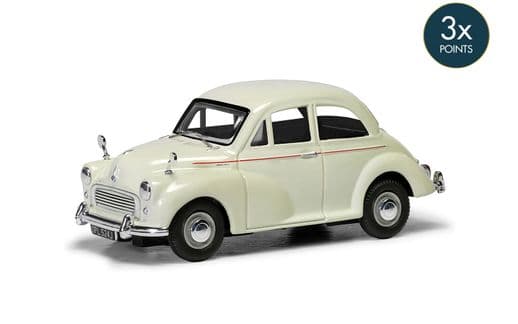
Clearly, we were not going to allow this auspicious occasion to pass without making our own Die-cast model tribute to the Morris Minor in her anniversary year and have just released this pretty little version of this much loved car, one which really conveys everything this classic is all about.
VA05811 Morris Minor 1000 - 'Molly' in Snowberry White
The Morris Minor was launched at the first post-war British Motor Show which was held at London’s Earl Court in October 1948. With various updates and a change of engine in 1952 it remained in production as a saloon until November 1970 and in Light Commercial Vehicle form until April 1971. The car modelled was built on August 25th, 1970, making it one of the last produced, and was despatched to Wadham Stringer Limited, Reigate, Surrey, a well-known Morris distributor. Current owner Sharon McCallum bought 'Molly', as the car has long been called, by accident in August in 2014 after going to view it in Hailsham for a friend who later changed their mind.
Devon-based Sharon is a life-long Minor enthusiast who’d wanted one since travelling in her Great Uncle Fred’s Almond Green example, which was the first car she travelled in as a child and was later purchased by her brother. Molly joined her Trafalgar Blue saloon, (Hamilton) and the Damask Red van (Harvey Major), she uses for her Trombone repair business. Sharon met husband Dennis Saupe while on a ‘Minors on Tour UK’ event in 2016 and a year later the couple embarked on a month long 3500-mile touring holiday from Land’s End to John O’Groats in Molly, which included many sightseeing diversions and a stop at Gretna Green to get married. Molly never missed a beat and is much loved as a result.
If there is a better looking classic British sports car out there, we would love to see it. The Triumph TR6 is both cultured and classic, a real head turner to this day.
There are some cars which just stand the test of time, manage to look good even in the face of the latest supercar competition and will always be described by millions of people as desirable. For many, one of the few vehicles which can boast inclusion in this exclusive motoring club is the Triumph TR6, a beautifully elegant looking sports car, with something of a tiger under the bonnet.
Although the Triumph company was synonymous with the production of motorcycles, it went on to produce its first motorcar in 1923, having only moderate commercial success at first, but going on to become recognised as manufacturers of some really attractive sports car designs. For many, one of the best looking Triumph models ever produced, the Triumph TR6, would enjoy commercial success both here in the UK and across export markets and looking at our latest scale representation of one, it isn't difficult to see why.
On the face of it, this car appeared to be the logical next iteration of a successful series of small British sports cars in the TR range, however, the TR6 was much more than just a simple upgrade and was actually something of a motoring behemoth. Fast and powerful, but all presented in a beautifully sleek package, it's interesting to note that despite the car being one of the most attractive to be found on Britain's roads, the vast majority of the production run would be for export overseas - at that time, it appeared that the world just couldn't get enough of British style when it came to sports cars. First appearing in 1968, the TR6 is definitely viewed as something of a motoring classic and is still a head-turner wherever you are fortunate to come across one.
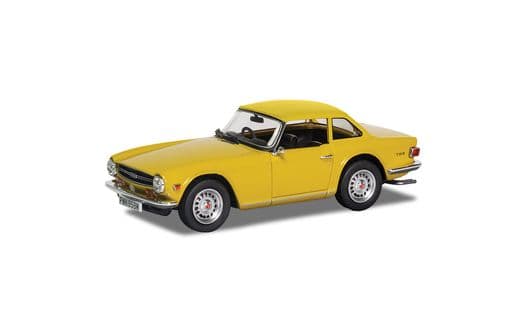
VA14702 Triumph TR6 (Hard Top) - Mimosa Yellow
The TR6 modelled here was ordered with a hardtop instead of the usual hood and was built on November 6th, 1973, then despatched two days later to British Leyland’s Swansea-based dealer Lex Mead. The first owner took delivery on January 1st, 1974, and apparently, took it home to his wife who immediately said, ‘you’d better take that back - I’m pregnant’. He kept it for around three months then returned it to Lex Mead. It was purchased shortly afterwards by David Morrish, who had to wait to take ownership because the steering wheel had been stolen. Lex Mead eventually supplied the car with the Mota-Lita wheel it still has, as Triumph couldn’t provide a replacement.
David Morrish used the car regularly and had it maintained by Triumph wizards Bill and Mack at Philog Garage, Whitchurch, Cardiff. Suitably decorated, it featured in his wedding to Sue in 1978 and new-born son Nick was taken home from hospital in it in 1980. David needed a more practical car in the late eighties so his father, Ernest, used it until the late nineties at which point it went into storage. David commissioned a TR specialist to restore the car in 2008 and since being finished in 2012, it has been maintained by Triumph specialist Spiro Tanti at Classic Cars, Cardiff. Nick has been its custodian since 2015 and his young son, Ted, is looking forward to driving this family heirloom one day.
Both the Triumph TR6 and 70th Anniversary Morris Minor are the latest additions to the Vanguards range and are available now.
Ready for take-off, the rearranged Aviation Archive display wall in our HQ showroom stands ready to receive visitors.
Finally for this edition, as we have undertaken a little release rearranging in the Corgi showroom over the past week or so, we thought you might like to see our wall of Aviation Archive, just so this latest edition wasn't exclusively on four wheels. In times past, many a Corgi stockist could boast an impressive display of models to tempt collectors with during their latest visit, but over the course of the last 25 years of the ranges' existence, displays of such impressive magnitude have become a little less common.
That being said, if you think this is something of a generalisation and that your preferred supplier can still boast an impressive display of Aviation Archive models, please do let us know, sending us a picture and some details and we will be sure to include these in a forthcoming blog. Please use our diecastdiaries@corgi.co.uk contact details.
Back to our showroom - with all the work our Senior Brand Creative has done over the past couple of years in providing the brand with a fresh new presentation look, whilst at the same time retaining core Corgi elements, we think our wall of Aviation Archive looks more striking than ever and although we are clearly biased, believe this section of the Hornby Hobbies showroom is the most visually appealing. See what you think and if you look closely, you might even see a rather spectacular advanced sample model on display that we haven't shown in the blog yet!
These BIG jets definitely mean business, especially with the soon to be released second 1/48th scale Eurofighter Typhoon in the display case to keep order!
Aviation delights as far as the eye can see, which one will be the next addition to your collection?
We are afraid that's all we have for you in this latest edition of Corgi Die-cast Diaries but we will be back as usual in two weeks' time with a further selection of model project updates. Between editions, we are always interested to hear your views on all things Corgi, so if you feel like dropping us a line to comment on anything blog or Corgi model related, or indeed to suggest a topic you would like us to include in a future edition, please feel free to do so at diecastdiaries@corgi.co.uk.
If you can’t wait for the next blog, you will find plenty of Corgi model collecting discussions taking place on our official social media channels, access to which can be obtained by clicking on the respective links at the foot of the Corgi website homepage.
Link access to Corgi social media sites.
Thank you for continuing to support our Die-cast Diaries blog. Our next edition is scheduled for publication on Friday 16th June.