

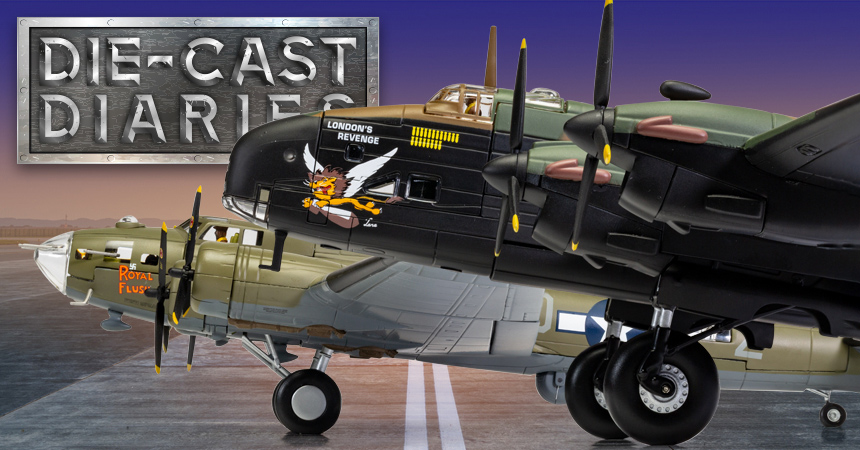
Welcome to the latest edition of Corgi Die-cast Diaries, your regular blog review of all the news, updates and topical stories from the captivating world of Corgi die-cast model collecting.
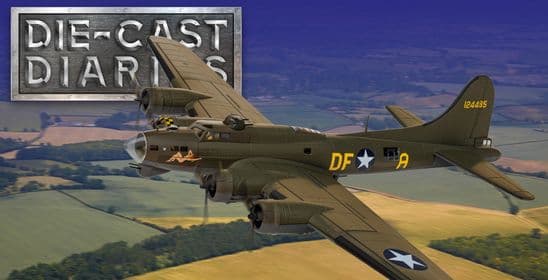
For our latest Corgi blog posting weekend, we will be taking the opportunity to look a little more closely at two of the new Aviation Archive models which made their public debuts on the Corgi stand at this year’s Royal International Air Tattoo, both examples of Allied four-engined heavy bombers from the Second World War. The Boeing B-17 Flying Fortress has to be considered one of the most significant warplanes of the 20th century, whilst the Handley Page Halifax is positioned historically as the second of Britain’s four engined ‘heavies’ to enter service with Bomber Command. Both make for appealing additions to the range, and both can claim links to tv and film productions – we will be looking a little more closely at the stories behind each of them.
Taking a different collector direction altogether, we are pleased to be bringing you a guest feature supplied to us by our Head of Marketing David Mather, as he shares details of a recent meeting he had with motoring celebrity Richard Hammond, and a scanning appointment at Llandow Circuit in the Vale of Glamorgan. Lavishly illustrated throughout, we think this latest update will be of interest to a great many Corgi collectors.
So, we have film star aeroplanes and recently scanned racing sports cars in this latest edition of Die-cast Diaries.
WWII heavy bombers in die-cast metal, now who would have thought that was going to happen?
Twenty-four years ago, a development in the world of scale aircraft model production occurred which had aviation enthusiasts feeling more than a little sceptical, but one which definitely attracted their interest. Although the production of fully decorated die-cast scale aircraft collector’s models was nothing unusual by that time, a new tooling announcement scheduled to be joining the Corgi Aviation Archive range was certainly looming large on their radar, and was beginning to create quite the stir.
Corgi had been producing beautifully finished 1/144th scale die-cast model aircraft in their new Aviation Archive range since 1998, however, whilst these models were already finding a growing collector base across the globe, the aviation enthusiasts community were still very much aligned with the scale plastic modelling world at that time, as these models offered both larger scales and a perceived higher level of detail.
The release of the Battle of Britain 60th Anniversary collection models in 2000 brought accurate 1/72nd scale models to the collector world, with the Spitfire, Hurricane and Messerschmitt Bf 109E all being released at the same time, and all managing to further encourage aviation enthusiasts to seriously consider these beautiful little models. Appearing widely throughout enthusiast media at the time, these models managed to sway a great many new collectors to the die-cast cause, however, there were still those who remained unconvinced, and were still putting off a visit to their local model store.
All that changed the following year, when news started to circulate that Corgi were about to add a 1/72nd scale Avro Lancaster to their die-cast Aviation Archive range, a development which few enthusiasts saw coming, and one which positively demanded further investigation. Surely a die-cast Lancaster in this scale could never be produced to the levels of detail and accuracy a discerning collector would expect, and would ultimately prove to be something of a disappointment. Nevertheless, despite some still having a few lingering doubts, curiosity got the better of those still to sample the range, and the new Lancaster saw thousands of people heading to their local model store.
The Continuation of a fine Aviation Archive tradition.
Once they had the chance to inspect this magnificent model, it proved to be a significant moment for many current Aviation Archive collectors, as they simply fell in love with the Lancaster, which for the Corgi design engineers involved with the project was an absolute triumph. Clearly, die-cast aircraft model collecting had just come of age, and collectors were now looking forward to future releases, and many more classic aircraft types being added to the Aviation Archive range in this most popular of aircraft collecting scales. Just as the Lancaster had proved a winner for Bomber Command during the Second World War, so the die-cast Corgi representation of it served to break down any remaining barriers of resistance amongst the collector fraternity, it really was that good.
Over the coming years, further four-engined heavy bomber aircraft types continued to join the range, with the Boeing B-17 Flying Fortress appearing in 2002, a model which would also have and incredibly positive impact on the hobby, but with the range not being able to boast a Handley Page Halifax until 2007. With the latest Avro Lancaster release commemorating an aircraft which was used against the mighty German Battleship Tirpitz towards the end of 1944, we’re now in a position to bring you the latest sample model images of impending four-engined heavy bomber additions to the range, one being the ever popular B-17 Flying Fortress, with the other being an RAF bomber which hasn’t featured in an Aviation Archive range for six years, the Handley Page Halifax.
As you would expect, both models come with interesting stories attached to them, and as both made their public debuts recently, and both models are scheduled for release over the next few weeks, it’s high time both were placed in the DCD spotlight.
An aircraft which was without doubt one of the most famous fighting aeroplanes of the Second World War, the Boeing B-17 ‘Flying Fortress’ would see extensive use during the European air war in conjunction with its four engined fighting hangar mate, the Consolidated B-24 Liberator, an aircraft which was incidentally produced in greater quantities than the Fortress. Perhaps by virtue of the gun-toting colloquialism by which the bomber would always be known, in addition to the film unit officially assigned to covering the successful 25th mission of the ‘Memphis Belle’ bomber, the B-17 was arguably the most famous American aircraft of the entire war and the one which came to represent the sheer industrial power this mighty nation could bring to bear in times of war.
Most of us can only imagine how terrifying it must have been to take one of these bombers into combat, but how magnificent the sight of hundreds of aircraft climbing from their bases right across East Anglia must have been for people on the ground, as they prepared to head out on their latest raid.
Built from the outset to undertake daylight precision bombing attacks against enemy targets, the heavy defensive armament carried by these bombers was thought to provide enough defensive firepower to protect them against enemy fighter attack from any angle. When the bombers were correctly arranged in their meticulously planned defensive box formations, the mutual protection offered by this withering collection of .50 calibre machine guns would be enough to deter any enemy pilot from being foolish enough to launch an attack.
That was the thinking which guided the development and service introduction of the B-17, however unfortunately, plans drawn up on blackboards and flipcharts have a habit of coming undone in the melee of combat, and that is exactly what would happen in the skies above Europe.
Even armed with their impressive defensive firepower, Flying Fortress crews who were made up of young men from all over America, soon found themselves fighting for their lives almost every time they entered contested airspace. What made matters worse, was the fact that each and every one of them knew that if by some miracle they managed to make it back to Britain, they would have to do this all over again tomorrow, or perhaps the day after.
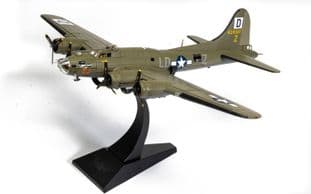
The next series of six images all feature an advanced production sample of this latest Boeing B-17 Flying Fortress, and the incredible mission which inspired its inclusion in the range.
Certainly in the early days of these daylight bombing operations, there was a sense of foreboding amongst many crews, as the losses being experienced by the Eighth Air Force were frighteningly high, and it really must have seemed to those young man that it was only a matter of time before their number was up and a piece of shrapnel or a mid-air collision would have them spending the rest of the war as a POW, or worse. In fact, when it came to the profession of being USAAF WWII bomber aircrew, the perils started long before they embarked on their first operational missions.
With pilots, navigators, bombardiers, flight engineers and air gunners all arriving at training airfields across America, young men from different walks of life and different characters were all thrust together in autonomous flying units which would become as close as any brotherhood, all learning their respective trades at the same time, but each with a shared common goal - to go to war. Learning to fly these highly complex machines competently, they knew that their ultimate reward would be combat operations, but would they be long laborious hours of coastal anti-submarine patrols flying from a home based airfield, or would they be joining so many of their comrades before them in heading for the savage fighting in Europe, flying from an unfamiliar base in England, a country most had never even been to?
For those destined for Europe, they would have to fly their assigned aircraft via one of the potentially hazardous Atlantic Ferry Routes, where excellent navigational skills and the hope that their aircraft would remain serviceable throughout the journey were primary concerns, particularly if they became separated from the rest of the squadron during the one of the legs. On arrival in the UK, it was a case of getting used to their new surroundings, new customs and commanding officers, before embarking on an intense period of training in advance of their first combat mission, something which always loomed large on the horizon.
Once crews were released for combat, they had all the existing worries of general health, aircraft serviceability and navigational effectiveness to be concerned with, in addition to now having to form up in crowded skies, often in less than ideal conditions, before taking their place in carefully planned formation boxes. These were intended to give the raid maximum protective cover from enemy attack, with any section out of position placing themselves and the rest of the formation at much greater risk.
And then there was the Luftwaffe, both in the air and flak units on the ground, each one determined to make sure this would be the only time you and your crewmates would dare to attempt a raid over their territory, but if you did come back, that you fully aware of what horrors awaited you. The sobering thing is that all this was being faced by young men who were around 21 years of age and in many cases, even younger than that.
Once thrust into the teeth of combat, the odds facing them were frightening and if crews believed in faith, luck or were simply superstitious, they were going to need all the help they could get from all three. Again, assuming an aircraft did not develop technical problems during a mission, which could take up to eight hours to complete, all crews prayed for a safe return, however, many factors would need to be satisfied for this to happen, including the bravery, experience and fatigue levels of the individual crew. In the heat of battle, would each man make the right decision when the chips were down, or would a momentary lapse in judgement place the entire crew in mortal danger?
And then there were the statistics, those terrifying statistics, particularly during the early months of the USAAF daylight bombing campaign. In a tour of 25 completed missions, the first five, and the last five were statistically the most dangerous, with the majority of crews being lost within those mission windows. Whilst nobody really wanted to know the actual odds against their potential survival, whether they knew or not, these brave young men still climbed aboard their bombers time after time, mission after mission, until they themselves became another statistic, or were cleared to return home.
Statistics can be open to interpretation in most cases, but as far as USAAF bomber crews during the Second World War were concerned, it’s generally accepted that crews had a 51% chance of losing their lives on operations, a 12% chance of being killed in non-operational flying accidents and a 13% chance of becoming a prisoner of war. This left an incredibly fortunate 24% of airmen who would survive the war unscathed, with every one of them putting their faith in the hope that they would be within this fortunate group. As you can see from the statistics above, unfortunately for most bomber crews during WWII, there were any number of random, yet deadly ways in which their continued safety could not be guaranteed.
As for the bombers themselves, these aircraft were mass produced to fulfil an essential wartime purpose and were not exactly manufactured for longevity. In some cases, after surviving the arduous ferry flight from the US, bombers would be lost during training and familiarisation flights over the UK, without even making it to their first operational mission, but for those which did, by late 1943, the average survival rate for a B-17 was just 11 missions.
The small army of ground trades were unquestionably the unsung heroes of the European air war, working long hours and in all weathers, to expertly ensure that their aircraft was not only serviceable for the next mission, but was in the best shape it could possibly be in to enable it to bring its crew home safely. Often using components cannibalised from other damaged aircraft, engines, tails, wings and even sections of fuselage were used to patch up their bombers, just so their squadron could meet its quota of machines for the next raid, knowing that on their return, they would probably have to do it all over again.
Despite this staggering combat attrition rate, some faithful B-17s managed to buck the statistical trend, and post combat mission totals which far exceeded the meagre expected average, aircraft which were celebrated as ‘Lucky Ships’ and taking on personalities all of their own. For others, their names were perhaps remembered because they were lost on their first mission, or in some cases, were the only aircraft from their squadron, to make it back from a particularly disastrous mission.
After something of an inauspicious start whilst negotiating their training at several bases across America, the 36 B-17F Flying Fortresses of the USAAF 100th Bomb Group negotiated the treacherous Atlantic Ferry Route, to arrive in England in late May 1943. By early the following month, they had moved to their new base at Thorpe Abbotts, south of Norwich, or Station 139 if you were an American serviceman. After a period of training and local familiarisation, the group flew it first mission on 22nd June 1943, however, this was only a diversionary flight into the North Sea, intended to confuse the Luftwaffe and divide their forces, thus assisting another raid.
Their first combat mission took place three days later, when the 100th sent seventeen B-17 crews as part of a larger force of 275 aircraft sent to attack targets in the Bremen area, at that time, without the benefit of fighter protection. The crews were to gain their first experience of determined Luftwaffe fighter opposition and the murderous flak over enemy occupied Europe and out of a total loss of 18 bombers, three were from the 100th. To put that in perspective, that was thirty men lost on the first mission the unit had flown.
The missions would come thick and fast for the men of the 100th BG from this point onwards, including an attack against the Messerschmitt fighter production facilities at Regensburg, where nine of the unit’s B-17s were lost, and a return to Bremen on 8th October, when a further seven Flying Fortresses were lost. The mission which would draw the most attention to the 100th Bomb Group and be responsible for providing the name which continues to define it, the ‘Bloody Hundredth’, took place on 10th October 1943.
This raid was sent to target the homes of railway workers at Munster, and saw thirteen of the 100th Bomb Group’s Fortresses being committed to the total force. On the way into the target, the formation was repeatedly attacked by a huge force of enemy fighters, with the onslaught only ending when the intense and deadly flak barrage took over on the run into the target. Six of the 100th’s bombers were lost during the outward leg of the mission.
On turning for home, the fighters returned once more, and the American bombers continued to fall from the skies, as it seemed the Luftwaffe were determined to make a statement defence on that fateful day, convincing the American airmen to never come back again. As ground crews and commanders waited at Thorpe Abbotts for the return of their aircraft, they must have been horrified to see just a single B-17 aircraft approaching the airfield, and that appeared to be heavily damaged.
The pilot of Boeing B-17F Flying Fortress 42-6087 ‘Royal Flush’, Lt Robert ‘Rosie’ Rosenthal, had only managed to nurse his aircraft home after flying such aggressive defensive manoeuvres over Europe, that attacking fighters couldn’t get his aircraft in their sights. Nevertheless, the aircraft was returning with two engines out, a huge hole in one of its wings and several crew members having sustained injury. Royal Flush was the only one of the thirteen 100th Bomb Group B-17s to make it home from that disastrous mission.
Conducting their final bombing raid on 20th April 1945, the ‘Bloody Hundredth’ would take part in 306 missions during WWII, with a total of 8,630 sorties being flown. Whilst not actually suffering heavier losses than other groups, other than during their initial introduction to combat flying in Europe, they would lose 229 aircraft during combat operations, or to salvage, and 757 aircrew would be posted as KIA or missing. A further 923 would become prisoners of war.
Robert ‘Rosie’ Rosenthal would become a legendary figure within the US Eighth Air Force, an exceptional pilot who would go on to complete two tours of duty (52 missions), be shot down twice, but evade capture on both occasions, and be heavily decorated for his extraordinary service. He is one exceptional airman who represents the thousands of men who bravely flew daylight bombing missions from bases in the UK during the Second World War, facing unimaginable horrors, but performing their duty with distinction and honour, in the name of freedom.
The legend of the ‘Bloody Hundredth’ was dramatized in the recent Masters of the Air miniseries produced by Apple TV, and based on the book by Donald L. Miller.
Whilst the Spitfires and Hurricanes of Fighter Command were overcoming the challenge posed by the Luftwaffe during the Battle of Britain, and effectively removing the immediate threat of enemy invasion, the Air Ministry were busy ensuring that a significant type of new aircraft was heading for its service entry at the earliest opportunity, the first of the RAF’s four engined heavy bombers. If Churchill’s ‘Few’ had managed to buy the nation time, it was Bomber Command who were going to exact Britain’s terrible retribution, by pulverizing German targets night after night, with the Short Stirling heavy bomber joining the fight from early 1941 onwards.
Unquestionably, the most significant factor in reducing the effectiveness of the Luftwaffe’s bombing campaign during the Second World War was their inability to introduce a capable heavy bomber, one which could be deployed in large numbers, and on all fronts. By stark comparison, the Allies were almost spoilt for choice when it came to operating this type of devastatingly effective aircraft, and following the introduction of the four engined Short Stirling, Bomber Command’s attack plans took on a new dimension of operational capability.
The second four engined ‘Heavy’ to enter squadron service with the Royal Air Force, the Handley Page Halifax had originally been developed to compete for the same specification requirement as the twin engined Avro Manchester, however, the Air Ministry urged the Handley Page Company to further develop their design to make use of four Rolls Royce Merlin engines, as opposed to the two new experimental engine types which were proving so problematic.
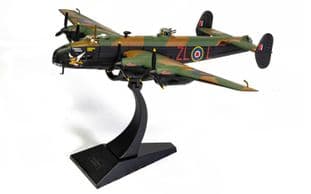
As with the B-17 reviewed above, this next series of images all feature an advanced production sample of the latest Handley Page Halifax, a model scheduled to be joining the range early next month.
The prototype aircraft made its first flight in the Autumn of 1939, having been constructed at the company’s Cricklewood facility, but was then then dismantled and transported to RAF Bicester for re-assembly and flight testing. The mighty new aircraft could carry bombs in its large bomb bay and in the inner sections of the wings, but a slightly smaller load than either the Stirling which preceded it, and the Lancaster which followed it into service.
On entering service with RAF No.35 Squadron, the unit embarked on an intensive 4 month work-up with the Halifax, prior to be committed to bombing operations on the night of 10th/11th March 1941. Although a significant increase in Bomber Command’s offensive capability, the Halifax initially proved to be something of a disappointment, with engines and engine power output proving to be a constant headache for both the RAF and Handley Page throughout the Halifax’s service career. This would see the aircraft undergoing almost constant development throughout its service live, and quite a high number of different variants of the bomber seeing service during the war.
It's interesting to note that the Handley Page Halifax proved to be much more versatile to the RAF than the Lancaster during the Second World War, and whilst the Lancaster was almost exclusively used as a bomber, the Halifax would be used in a variety of different roles. In addition to this, of the 6,178 aircraft built, the majority were not built by Handley Page themselves, but by English Electric in the northwest of England, as bomber production was taken on by several different companies around the country. Ultimately, the Handley Page Halifax would equip 34 Squadrons in Europe and a further 4 in the Far East, making this an incredibly important aircraft to the Allied war effort.
Underlining the incredibly dangerous nature of the missions these mighty aircraft were designed to undertake, of the 6,178 aircraft built, only five Halifax’s would manage to complete one hundred operational sorties or more, taking their places as Bomber Command’s celebrated ‘Centurions’. Nevertheless, Halifax crews were incredibly fond of their aircraft, and would always maintain that theirs was the best RAF heavy bomber, even more capable than the much celebrated Avro Lancaster.
With Bomber Command operations intensifying considerably towards the latter end of the Second World War, attempts were made to both boost the morale of aircrews engaged in this dangerous work, and raise the profile of the herculean effort they were contributing towards eventual Allied victory. One such attempt involved the men and machines of No.427 Squadron Royal Canadian Air Force, who christened the unit ‘The Lion Squadron’, and invited the film company Metro Goldwyn Mayer to adopt them – their famous lion was shown at the beginning of their movies.
In a high profile event, which was covered by a national film unit, the managing director of MGM (UK) Mr Samuel Eckman Jr. accepted the invitation and presented the squadron with an impressive bronze lion for luck, also giving smaller versions of the lion to all members of the unit’s air and ground staff, along with the offer of free entry into MGM cinemas. For the crews, the most interesting aspect of the day was a draw to see which MGM star individual crews would draw, with their name to be carried on the side of their bomber.
Handley Page Halifax Mk.V DK186 / ZL-L was already named ‘London’s Revenge’, but was further embellished with distinctive flying lion artwork (based on the MGM logo), and subsequently drew the most sought after star, Lana Turner – ‘L for Lana’, who’s name they proudly took to war.
This new bomber flew its first operational mission on the night of 29th/30th May 1943, when it was one of 63 bombers sent to attack targets in the city of Wuppertal, in Western Germany, and on that mission, was flown by the Commanding Officer of No.427 Sqn. RCAF, following the high-profile MGM adoption ceremony. The aircraft would go on to complete 26 operational missions, with the last one taking place on the night of 25th/26th November, after which the aircraft was sent to work with one of Bomber Command’s Heavy Conversion Units.
Damaged when she taxied into a ditch on 22nd April 1944, the damage suffered proved to be beyond economical repair and she was unceremoniously scrapped, probably not something which attracted the same level of interest as her starring role in the MGM adoption ceremony twelve months earlier.
Great stories and fantastic models, we very much look forward to welcoming both the new Halifax and 100th Bomb Group B-17F Flying Fortress to the range over the next few weeks, with the arrival of ‘Royal Flush’ now being imminent.
As well as immortalising some of the world’s most significant aircraft as scale die-cast model collectables, Corgi have earned a much cherished reputation for the production of beautifully detailed 1/43rd scale model cars over the years, with our popular Vanguards range continuing to go from strength to strength. In our constant search for suitable new tooling additions to the range, we’re fortunate to come into contact with some passionate car owners, and just sometimes, the odd motoring celebrity.
Our Head of Marketing David Mather was lucky enough to enjoy such an experience recently, when a pre-arranged visit to a racing circuit in South Wales brought him into contact with both, and he has kindly supplied the following review of his day for our enjoyment.
Over to David.
It’s fair to say that working with Richard Hammond was never on my career bingo card, but ever since taking an unexpected phone call on the wet and windy first Friday in January 2024 it has, of course, proven to be an ongoing joy.
After launching our first model in The Smallest Cog x Vanguards collection, we’ve seen the 1:43 scale version of Richard’s restored Ford Escort Mk2 RS2000 become something of a poster child for bringing new collectors into the fold. Numbers we have indicate that 40% of purchasers of the model were entirely new customers, and following the sell-out of the first wave of the model we are well into working through our second order. Clearly from a mercenary business point of view, this is something we like to see, so over the last eighteen months we’ve been diving deeper into working with Richard and his team at The Smallest Cog.
Before the racing, let’s get down to the business of some serious LIDAR scanning.
Interior details are just as important when obtaining this detailed information, which is just as well, as nothing escapes the prying eye of the scanning lens.
This type of scan data file is incredibly useful to our design engineers when working on any new model tooling project.
The latest step in this partnership debuted earlier this week, where we revealed the start of development on a new tool MGB GT in the Vanguards range via a video produced by the team at DriveTribe. Created by Jeremy Clarkson, James May, and Richard Hammond, DriveTribe is now exclusively run by Richard and is one of the best online sources of motoring content with an audience in the millions. The perfect place to surprise announce a new Vanguards model for 2026!
For clarity, the choice of an MGB GT wasn’t driven solely by the fact that Richard Hammond owns and drives one as a race car (that is sponsored by CORGI!) Before Christmas 2024 we undertook a piece of market research to determine a steer on what models we should be prioritising in the Aviation Archive and Vanguards ranges. While we haven’t revealed the full results of that survey – spoilers! – it did tell us that among both existing Vanguards collectors and never before surveyed people that the MGB GT sat happily in third place among the options presented – behind two Fords, but certainly the highest non-Ford subject on the list.
Quite literally, off to the races then.
Working with the team at DriveTribe, we came up with a fun concept to reveal that the MGB GT was going to be joining the Vanguards range, while also bringing vehicles to a specific place that we could LIDAR scan so we could actually accomplish a piece of marketing work and a piece of development work simultaneously. And so we found ourselves at Llandow Circuit in the Vale of Glamorgan in early June, watching Richard pit his MGB GT against Mike Fernie’s MG ZR in a head-to-head track test to prove whether a classic race car could outpace a more modern hot hatch. Pure DriveTribe fun in short, with a chunk of CORGI talking about a new model in the middle of it.
More scan data images secured during David’s visit to South Wales.
A research overview. The Corgi team discuss artwork and decoration files with Peter and Andrea Thomas, who brought their beautiful MGB GT along.
To maximise our time though, we worked with the Swansea MG Enthusiasts Club to locate an additional MGB GT for us to scan while the filming was going on. We were thus joined on the day by Peter and Andrea Thomas, who brought their lovely later model rubber bumper car to the track for us to scan in the track paddock while the racing went on behind us. Our researcher Mark Pinnigar had furnished us with a thorough document that lists of all the potential configurations and parts required for a fully featured MGB GT tooling, and while we would need to gain an additional scan of an early silver bumper equipped vehicle separately, being able to scan two different eras of the car made the day very worthwhile from a development point of view.
Once the scan was complete of Peter and Andrea’s car, Richard drove his car into the paddock for us to scan while I recorded the CORGI chunk of the DriveTribe video alongside him. The Cog Racing MGB GT goes by the pet name of Doris, and started her life in Richard’s ownership as the final car he drove on Top Gear. The day previously, Richard had been thrashing her around the track at the legendary Silverstone circuit, and on the morning of our filming and scanning had driven her down to Wales on a trailer behind one of the Cog’s Ford Ranger Raptors. Thankfully, though a bit tired, Doris was unscathed for the scan.
To become a pure racing car, Doris has obviously undergone a dramatic amount of modification and part of our mission was to capture the exterior and interior details that set her apart from the standard classic MGB GT like Peter and Andrea’s. These include a full race interior and roll cage, as well as an enlarged fuel tank that now occupies the boot. The aim will be to use Doris as the lead release off the new tooling in 2026 as a Special Edition, meaning we can order as many as we want as long as the demand is there. Peter and Andrea’s MGB GT will be joining Doris in the first wave of more standard limited edition Vanguards releases from the tooling, with the MGB GT forming one of five – yes, five! – new tool Vanguards models planned for release in 2026.
Two for the price of one – this proved to be a busy day of scanning activity for the Corgi team.
Celebrities one and all!
A model collecting name of distinction. David confirmed significant additions to the Vanguards range over the coming twelve months.
Why so many? Basically, next year is a big double anniversary year – not just CORGI’s 70th anniversary but also Vanguards’ 30th anniversary, and so a heavy tooling investment in the range was always on the cards. You’ll see the MGB GT debut alongside the already announced Range Rover Classic (more news on that soon!), as well as the most popular Ford subjects from our previously mentioned market research piece – but those reveals are for another day!
One other Die-Cast Diaries announcement though – you’ll be able to find the CORGI team attending DriveTribe Live at Bicester Motion on August 30th, where we’ll be not only making another exclusive The Smallest Cog x Vanguards product announcement, but also exclusively selling that new product to event attendees early, ahead of CORGI website pre-order availability. Make sure to grab your tickets if you haven’t already!
https://drivetribe.com/events/
We’re afraid that’s all we have for you this time around, however, we’ll be back as usual in two weeks’ time with a further exclusive selection of the latest Corgi model updates. As ever, you could always drop us a line if you felt moved to do so, to comment on anything blog, collecting or Corgi model related, or even perhaps to suggest a topic you might like to see the team cover in a future edition. As always, our diecastdiaries@corgi.co.uk address is the one to use.
If you can’t wait for the next blog, you will find plenty of Corgi model collecting discussions taking place on our official social media channels, access to which can be obtained by clicking on the respective links at the foot of the Corgi website homepage.
Link access to Corgi social media sites.
Thank you for continuing to support your Corgi Die-cast Diaries blog. Our next edition is scheduled to be published on Friday 22nd August, and we look forward to seeing you all back here then.
Thank you for your continued support