

Welcome to the latest edition of Corgi Die-cast Diaries, your regular blog review of all the news, updates and topical stories from the captivating world of Corgi die-cast model collecting.
As many Die-cast Diaries readers will no doubt already be aware, last Friday morning witnessed the unveiling of our latest Corgi May – August model collection, and if our web stat figures are to be believed, it appears that many website visitors have also downloaded their digital copy of our new catalogue during their visit, so thank you for your support. Obviously, range launch is a time of great excitement amongst those in the collector community and indeed for us here at Corgi too, and with just a week of pre-ordering activity to refer to, we already know that our latest collection of models has struck a chord with many die-cast collectors and we look forward to charting their progress over the course of the next few editions of our blog.
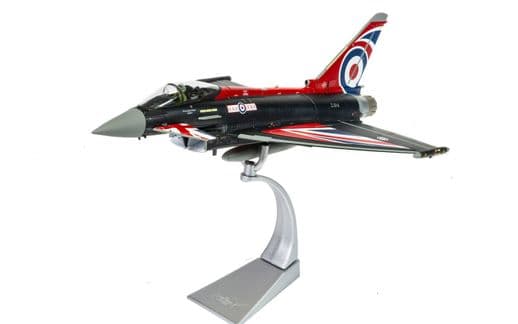
In what has turned out to be an interesting few days for the RAF’s Typhoon Display Team, our headline new model announcement is our scale die-cast tribute to arguably the most distinctive and best loved Royal Air Force jet powered aircraft of the post war era, a patriotically presented Eurofighter Typhoon FGR4. This particular aircraft shares its RAF No.29 Squadron flight training duty time with thrilling Airshow audience with its dynamic display performances throughout the summer months.
In this latest edition of Die-cast Diaries, we will be introducing you to ‘Blackjack’ and some of the other highlight announcements which make up our latest model collection. As has now become customary, we will also be including our Head of Marketing’s latest range introduction video for those who have yet to watch it, so he can guide you through the new collection section by section, in his own inimitable style. Richly illustrated throughout, this latest blog post will attempt to provide you with a flavour of our latest model collection, however, there’s simply no substitute for heading to the Corgi website and discovering all our latest models for yourself, at a pace which suits you. For that reason, we will be including several access links to get you straight there, where you can review all the finer points of our new collection for yourselves.
It's new model time again in this latest edition of your Die-cast Diaries blog.
A model announcement of this magnitude demanded that our latest Eurofighter Typhoon project feature on the front of our latest catalogue.
The joy associated with Corgi model collecting is all encompassing and can take many forms, from amassing a collection of models which would be the envy of all your peers, to simply enjoying a scale die-cast representation of your favourite aircraft or vehicle, but with approaching 68 years of heritage to call upon, Corgi models will have been important to a great many people at one time or another over that period. One of the most enjoyable aspects of being a time served Corgi collector is our enjoyment of the various catalogue front page presentations which have tempted us over the years, each one exciting and each one having us clamouring to explore it, allowing us to discover the die-cast delights within.
With some of the earliest incarnations of Corgi catalogues now being incredibly rare and difficult to find in good condition, an impressive collection of such publications is almost as important as an impressive collection of models and if you have a complete set safely stored away, well that’s quite the boast and the envy of many. Over the years, there have been many iconic catalogue front page presentations, full of interest and impact, having immediate appeal to the already converted, but also calling to those who have yet to come under Corgi’s spell, and we are pleased to say that the digital era is no exception. In fact, if you’re looking for a Corgi catalogue front which exudes dynamism and excitement, then our latest offering is positively supersonic!
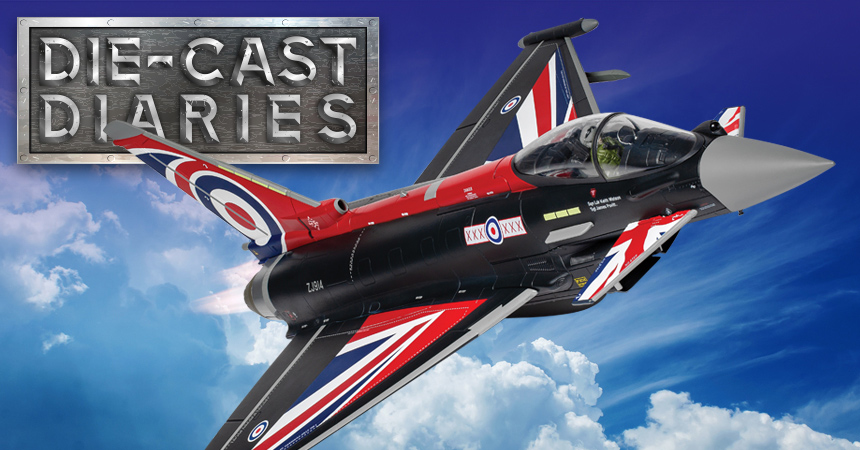
If ever a Corgi catalogue cover screamed ‘grab me’ and featured a contemporary subject which was familiar to millions of people throughout the country, then our latest effort is that and then some, a fabulous addition to any Corgi catalogue collection. The cover image features one of the latest additions to our Aviation Archive range and the third release from our 1/48th scale Eurofighter Typhoon FGR4 tooling – hold on to your hats, because Blackjack’s inbound!
With Airshows still being one of the nation’s most popular summer events from an attendance perspective, the aircraft which represents the RAF’s latest airspace defender is always going to be a firm favourite with both the general public and Airshow enthusiasts alike, especially if it breaks away from the usual air superiority grey presentation of standard squadron jets in spectacular fashion. As you might imagine, collectors have been imploring us to include ‘Blackjack’ in a Corgi range ever since our 1/48th scale Typhoon was announced, but as you can appreciate, this is no ordinary Typhoon presentation and took some time for us to arrange. That being said, we are delighted to now have ‘Blackjack’ in the range and going of pre-ordering activity, so are you!
AA29003 - Eurofighter Typhoon FGR4 ZJ914 'Blackjack', Royal Air Force Typhoon Display Team, Flt Lt Adam O'Hare, 2022 Typhoon Display Pilot, RAF No.29 Squadron, Coningsby, 2022 Airshow season.
As the aircraft charged with protecting UK airspace from unauthorised incursion, the interceptor fighters which perform this role have always become firm favourites with enthusiasts and arguably the most widely recognised aircraft types of their era. Currently performing this vital role, the Eurofighter Typhoon FGR4 is an incredibly capable aircraft born of an international design collaboration which aimed to produce an agile air defence fighter (European Combat Fighter Project) for service with several European air forces. Such a collaboration held the prospect of keeping costs to more manageable levels for those involved, as they were being shared across the partner nations, although each would ultimately have their own requirements, something which would put a strain on both costs and working relationships.
At the time this new aircraft entered the development phase, Britain’s sovereign airspace was being policed by such aircraft as the McDonnell Douglas F-4 Phantom and BAe Tornado F.3, the air defence variant of the RAF’s highly capable Tornado strike jet and whilst both were classic aircraft in their own right, neither could really describe themselves as being agile performers. With the US Air Force able to boast such manoeuvrable aircraft as the General Dynamics F-16 Falcon and world leading McDonnell Douglas F-15 Eagle, the new Eurofighter consortium was looking to develop their own agile fighter, one which was much better suited to the modern and constantly changing air combat arena.
The multinational consortium was made up of the aviation industries of Britain, Germany, Italy and Spain and as the project progressed, it was clear that the new Eurofighter was going to be an extremely advanced aeroplane indeed. Designed to be aerodynamically unstable at all speeds, the aircraft was controlled by a powerful suite of computers, which combined to endow the fighter with exceptional agility.
Making extensive use of composite materials, the aircraft was to be powered by a pair of Eurojet EJ200 engines which propelled the fighter to a maximum speed of Mach 2.35 (currently limited in RAF service) and the ability to supercruise without the use of afterburner. These engines were just as advanced as the aircraft itself and were designed in 15 fully interchangeable modules, with everything monitored in real-time to ensure the early indication of any potential problems with the unit. This was all designed to keep the aircraft serviceable and ready for action.
Equipped with an impressive array of targeting and defensive technologies, the Typhoon can also carry a seemingly endless selection of ever more capable weapons, as it has developed from its original air superiority fighter designation, into an exceptional multi-role platform, one which is truly at the forefront of military aviation technology. Now at the midpoint of its service life, the Typhoon is expected to remain in service until 2040 and beyond.
One of the most complex artwork files we have ever produced, ‘Blackjack’ will make for a fitting centrepiece for any model collection.
The Typhoon era began in earnest on 27th March 1994, when the first prototype aircraft made its maiden flight from the EADS facility at Manching in Bavaria, to be followed six days later by the first flight of Britain’s first development Typhoon (ZH588) from the Bae facility at Warton in Lancashire. The name ‘Typhoon’ was officially adopted for the new fighter in September 1998, the same year that the first production contracts were signed, committing nations to purchasing an aircraft they had already been working on for five years at that point.
The first operational RAF Typhoon Squadron was No.3 Squadron, which was established at Coningsby on 31st March 2006 and by the summer of 2007, the unit were sharing national QRA (Quick Reaction Alert) responsibilities with the RAF’s existing Tornado F.3 force, initially on a rolling month on - month off basis, but working up to taking this important duty over entirely.
The only thing that remained now was to introduce the Typhoon to the British public and allow this exciting new aircraft to take its place on the UK Airshow circuit as a regular display performer. Although the Typhoon had displayed at the huge RIAT show in 2004, this was a restricted performance from a development aircraft which only served to whet the appetite for what we could expect to see the aircraft doing in years to come. For a sizeable 50,000 crowd, that event proved to be the 2005 Cosford Airshow, an event which boasted a typically impressive line-up of historic and serving RAF aircraft, but for the first time, also a Eurofighter Typhoon display, but still a development aircraft based at Warton on that occasion.
Over the course of the next few dynamic minutes, this early Typhoon T.1 pre-production aircraft proceeded to do things that an 11-ton aeroplane really shouldn’t be able to do, cartwheeling across the sky at the whim of its pilot, keeping his display routine within the confines of a relatively small imaginary box above the airfield. With the display pilot making full use of the aircraft’s ultra-responsive afterburners, the dark skies only served to add to their impact, as they flicked on and off like a pair of powerful torches.
Ending the display with a spirited high-speed pass, followed by a pull up into the angry skies above, the Typhoon had introduced itself to an Airshow audience and what a performance it was. The age of the Typhoon had arrived, and this was now the aircraft everyone now wanted to see.
Now nineteen years on, the Typhoon is a mature combat aircraft, arguably one of the most capable aircraft in world service today and one which is now in service with the air forces of nine nations, with just under 700 aircraft ordered to date. Still the consummate Airshow performer, thousands of Airshowgoers will be looking forward to seeing this year’s Typhoon Display Team putting this exciting performer through its paces and with it, inspiring the next generation of future Royal Air Force recruits.
As one of the World’s most capable multi-role combat aircraft, the Eurofighter Typhoon FGR4 is not only the pride of the Royal Air Force, but also the consummate Airshow performer and as such, continues to serve as an effective recruitment tool for the force. As if a Typhoon display wasn’t appealing enough as an Airshow attraction, RAF officials sanctioned the ‘special presentation’ of their display jet for the 2021 Airshow season, a scheme which immediately ensured that Typhoon ZJ914 went on to become the highest profile aircraft in current Royal Air Force service.
The scheme is a real head-turner, taking its design inspiration from the Union Flag and the Royal Air Force roundel, applied over a smart black aggressor scheme and it didn’t take long before it worked its way into the hearts of enthusiasts and aviation photographers the length and breadth of the country. Colloquially referred to as ‘Blackjack’, the RAF’s display Typhoon is a headline performer of growing repute and for the 2022 Airshow season, was flown by Flt Lt Adam O’Hare, operating the aircraft under the electrifying callsign ‘Anarchy 1’. Flight Lieutenant O’Hare took the stunning good looks of his jet and combined this with a dynamic display routine full of exciting high energy manoeuvres, high speed passes and with full use of the aircraft's powerful afterburners to leave spectators in awe and desperate for more. Ensuring the RAF Typhoon was always the highlight of any display in which it appeared, Flt Lt ‘Paddy’ O’Hare used every ounce of power his Typhoon’s EJ200 engines could generate to demonstrate the incredible agility of the aircraft, ensuring that everyone went home with an appealing selection of photographs, along with a renewed appreciation of the Typhoon's impressive performance after every show.
The RAF Display Typhoon has worn this popular scheme for three full display seasons and even throughout the early months of work up for the new display pilot for the forthcoming 2024 Airshow season. Although the RAF may choose to mark this 80th Anniversary year of the D-Day landings by presenting their display Typhoon in a new commemorative scheme, many enthusiasts will be hoping that ‘Blackjack’ retains her iconic scheme and may still appear at Airshows around the UK.
As we now know, this year’s D-Day 80th Anniversary commemorations has seen the RAF presenting another one of their 29 Squadron Typhoons in spectacular fashion and whilst ‘Moggy’ will be taking the lead when it comes to fulfilling display commitments this coming Airshow season, Blackjack will continue to serve as its able deputy and may still get the call to perform itself, should there be any serviceability issues with the D-Day Typhoon. Clearly, the arrival of ‘Moggy’ provides us with more attractive Typhoon subject matter for future range consideration, but for now, we are really excited for you to see Blackjack in all its die-cast glory – it’s an absolute stunner.
Before leaving the subject of Aviation Archive models and moving on to showcasing our latest range launch video below, we just wanted to mention that our latest collection of aircraft models includes our own scale die-cast tribute to this year’s D-Day 80th anniversary commemorations and the long overdue return of a range favourite, the Republic P-47 Thunderbolt. We will be featuring each and every one of these models in much more detail within forthcoming editions of the blog, but for now, we are pleased to say that this latest range boasts a strong showing of Aviation Archive subjects.
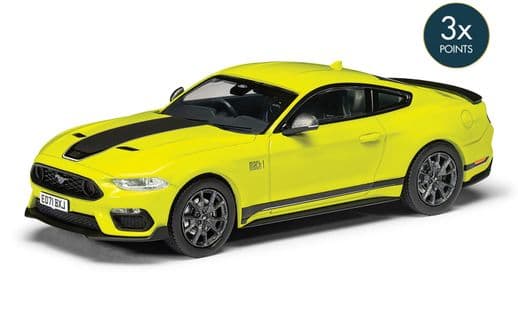
A vision in yellow, our latest Mustang release is a real attention grabber.
As any Corgi collector will happily tell you, range launch day is never about a single model or indeed a single sub range of models, but is a celebration of the continued heritage of the brand and the hopeful impending release of one or two future classics. For this latest May to August announcement, there is also an extremely strong showing from our popular Vanguards range, as several new models and a couple of model sets are all due to grace our collections over the next few months.
Just as ‘Blackjack’ served as an effective call to action for Aviation Archive collectors everywhere, if Vanguards collectors were hoping for an eye-catching new model to draw attention to their beloved models, they were not left disappointed. In fact, if the sight of a new Ford Mk6 Mach 1 wasn’t enough to draw admiring glances, one presented in Grabber Yellow surely would.
VA15504 Ford Mustang Mk6 Mach 1, Grabber Yellow
The iconic Mach 1 nameplate appeared for the first time on a UK-market, right-hand drive Mustang in the summer of 2021, and this new more performance-oriented Mustang was instantly recognisable by its redesigned front splitter and graphics. Advertised as 'the most track-capable Mustang ever to grace UK shores', its specification was very impressive and included MagneRide® adjustable dampers, a Tremec six-speed manual transmission with rev-matching technology for seamless down-shifts, a limited-slip differential, and an upgraded oil-cooler to keep the 454bhp 5-litre V8 cool whilst exploiting its prodigious performance. In true Ford tradition, at only £55,185, it was also fantastic value for money as the few cars available offering comparable performance were considerably more expensive.
We don’t often show Vanguards artwork files, but we had to make an exception for this stunner.
The example modelled here was added to Ford's Press Fleet on September 2nd, 2021, and retained until February 17th, 2023. During that time, it was used for Ford's corporate events or track driving days, and it appeared on TV twice, in the Wheeler Dealers' Yellow Car Special and BBC Top Gear's Christmas Special. It was also loaned to various magazines and newspapers for road-testing, including The Sunday Times, The Sun, The Mirror, Top Gear Magazine, Goodwood Media, What Car and Autocar. For the final ten months of its PR duties, it was on long-term test with CAR magazine, mainly in the care of the magazine's then deputy features editor, James Taylor, who was a big fan of the Mach 1's handling and character.
As appealing as the new Grabber Yellow Ford Mustang undoubtedly is, there’s one thing that’s even better than looking forward to welcoming a stunning new Vanguards model addition to our collections and that’s a release which contains multiple new Vanguards models. The new range includes a Ford Capri sporting trilogy collection set which is already proving to be an extremely popular addition, and a set we will be looking at in more detail in a forthcoming edition, but that’s not the only new model set announcement.
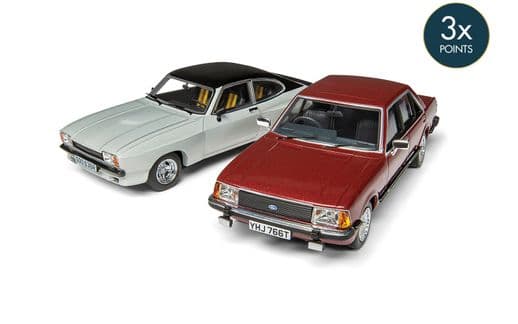
Towards the back of the latest catalogue, our latest Screen Stars release comprises of two beautiful Ford cars which our tribute to two real motoring head turners, cars which also served as much loved modes of transport on popular TV programmes, where they would become just as famous as the characters who drove them.
CC91991 – Ford Capri Mk2 X-Pack and Ford Granada Mk2 2.8i Ghia.
Although pictures of the PP sample models have made it into the new Corgi catalogue, we are aware that the Capri has a couple of issues which have already been addressed, such as the upholstery style and the fact that this one has been finished as a left-hand drive model.
In the late 1970s, Ford vehicles were among the most popular cars to appear on the streets of Britain, but also in television dramas that gathered millions of viewers around screens at home. Their presence on some of the top-rated shows of the era helped add to their desirability among the public but also secured their place as true classic cars.
Debuting in 1969, the Ford Capri Mk1 was intended as the European equivalent of the iconic Ford Mustang. The Mk2 arrived in 1974 with a revised and larger body compared to its predecessor while retaining the sports coupe’s attractive basic outline. The X-Pack performance option was introduced in 1977, featuring an upgraded engine and wider wheels which required a modified fibreglass body kit to contain the larger wheelbase, giving these vehicles distinctive and easily identifiable flared wheel arches.
The Ford Granada was developed as an executive car, debuting in 1972 and succeeding the Ford Zephyr in the same market space. The square bodied Mk2 version was produced between 1977 and 1985, though under the bodyshell there was little structural difference from the Mk1. The car featured a wide range of engine specifications, with the 2.8 litre V6 sitting at the peak of the available options. The car was a strong seller for Ford in the late 1970s, with numbers peaking in 1979 with over 50,000 vehicles sold.
The question now is, can you place this iconic motoring duo in the programme in which they appeared?
This first post range launch edition of Die-cast Diaries is only intended to provide an overview of what was announced this time last week and encourage those who haven’t yet sampled the delights of the May – August range to head for the Corgi website and take a look for yourselves. In addition to providing all the release information and model details you might need, you will also be in the right place for adding the models which interest you into your pre-order account, further adding to your Hobby Rewards total in the process. Whilst there, please don’t forget to download your copy of the latest Corgi catalogue for your files, as printed copies can be in short supply and we don’t want you to miss out.
Another page taken from the new Corgi May – August catalogue. If you haven’t already inspected it, please use the links included in this latest blog to download your copy.
As we advance through the next few editions of our blog, we will be bringing you further details related to the new model announcements just made, sharing a host of exclusive imagery which showcase the development journeys each one has to take, prior to taking their places in our display cabinets. Please do join us every other Friday for more of the latest Corgi model developments.
That's all we have for you in this edition, however, please join us again in two weeks’ time for another exclusive insight into the wonderful world of Corgi. Between editions, we are always interested to hear your views on all things Corgi, so if you feel like dropping us a line to comment on anything blog, collecting or Corgi model related, or perhaps to suggest a topic you might like to see us cover in a future edition, please do get in touch at diecastdiaries@corgi.co.uk.
If you can’t wait for the next blog, you will find plenty of Corgi model collecting discussions taking place on our official social media channels, access to which can be obtained by clicking on the respective links at the foot of the Corgi website homepage.
Link access to Corgi social media sites.
Thank you for continuing to support your Die-cast Diaries blog. Our next edition is scheduled for publication on Friday 17th May.