
Welcome to the latest edition of Corgi Die-cast Diaries, your regular blog review of all the news, updates and topical stories from the captivating world of Corgi die-cast model collecting.
We find ourselves in strange, uncharted Corgi waters as we put this latest edition of our fortnightly new model project update blog together. By the time you will be reading this introduction, our latest May to August model range will be available for viewing in all its glory, but as we post our blogs late on Thursday evening, to ensure everything works as intended prior to the delivery of our notification email at Friday lunchtime, we may know what’s coming, but I’m afraid we can’t say anything about it at this stage.
That being the case, allied with the fact that there’s never any substitute for heading to the Corgi website and discovering all the new models scheduled for release over the coming few months for yourselves, we will be including the range launch video for your viewing pleasure in this edition, although it will initially be on a countdown timer until 10.00 on Friday morning. Hopefully the new range will have something for every collector taste in there, and you won’t have to wait long to get ‘eye’s on’ now.
So, as our latest range launch is clearly the biggest news this weekend, and would ordinarily be reviewed in Die-cast Diaries, what can we bring you as an update feature in this edition? Well, how about an exclusive first look at the engineering sample which is linked to one of the most eagerly anticipated Aviation Archive new tooling projects of recent years, our stunning die-cast scale tribute to the striking Messerschmitt Me 410 ‘Hornisse’. Only arriving in the Corgi Development Office earlier this week, we are indebted to our Head of Marketing David for turning round this image selection in super-fast time, and in range launch week as well. We knew you would be interested to see them, so this is our headline feature for this edition.
In a relatively light edition due to impending range launch, we will end by bringing you details of a new model many of us will have been adding to our display cabinets over the past few days, but for those of us still sitting on the fence, it’s time to act
We’re on Corgi time again this weekend, and that excitingly involves range launch!
One of the jewels in the aviation crown of the RAF Museum collection, this magnificent Messerschmitt Me 410 is the only complete example of this aircraft currently on public display anywhere in the world.
For collectors of the Aviation Archive range, many will share the opinion that Luftwaffe subjects from the Second World War can be inexplicably appealing when it comes to collecting scale die-cast model representations of them, something which has been a feature throughout the entire 27 year history of the range. Is it the rather sinister shape and colour schemes these aircraft were famous for, or is it simply the fact that for most people, they represented the might of an enemy force which attempted to impose its will on the rest of the world. It might also have something to do with the fact that relatively few of these aircraft survive to this day, and those with an interest in these aircraft usually have to travel great distances to see one in the metal.
That is certainly the case with the subject of the latest new tooling addition to our Luftwaffe aviation range, as there are only two complete Messerschmitt Me 410’s known to be in existence, one in deep storage at the American National Air and Space Museum awaiting restoration, and a beautifully presented example on display at our very own RAF Museum Midlands. As the only option available to our development team, our new model used scan data from the aircraft on display at Cosford, sharing information our colleagues at Airfix used in support of their own Me 410 project, one which has proved incredibly successful for them since release.
Although we did have the opportunity to utilise the scan data produced in support of the Airfix kit project, the business of designing a scale plastic model kit and a die-cast metal collectors’ model are very different processes, so other than using the scan data as our research template, the Corgi team were essentially starting from scratch. As we proceed towards production, we will endeavour to unlock some more of the CAD secrets this project holds, just by way of keeping us all informed on the progress of this much-anticipated new model in forthcoming editions.
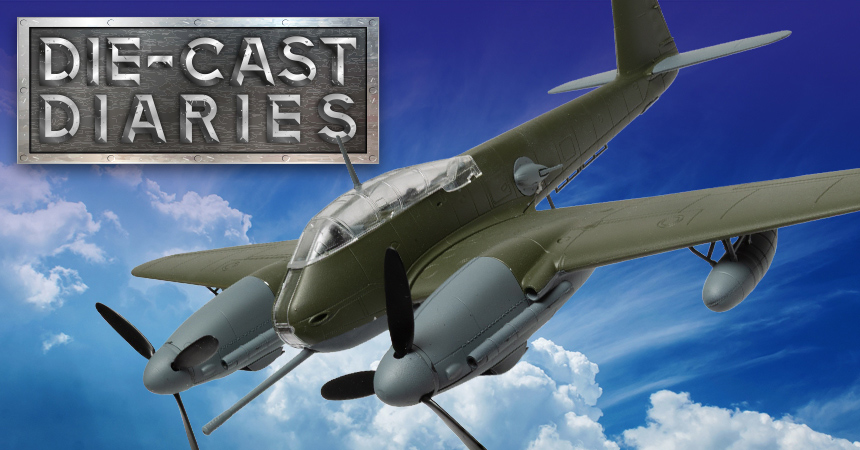
For now though, this latest update gives us the opportunity to bring you right up to date with the Hornisse project, by sharing a series of pictures which are exclusive to Die-cast Diaries readers, images which show the engineering sample model produced from the new Messerschmitt Me 410 design files. This exciting stage marks the first time the design files have been committed to metal, and whilst still subject to further modification, do allow the development team the ability to assess the validity of the design work to date. A critical stage in understanding how the design files have replicated surface detailing on the new model, the team will have to assess whether this detail is exactly as intended, and will look good when paint is applied to the model.
This and the following five images all feature the metal engineering sample produced from our new Messerschmitt Me 410 design files, and are being exclusively shown to Die-cast Diaries readers as their latest visual exclusive.
Unfortunately, I haven’t had the chance to inspect the model for myself as of yet, however, David did tell me that it’s a real looker, possessing a weight which definitely appeals to all Aviation Archive collectors, and surface detailing which is extremely impressive. Shape replication is also impressive, which for something as distinctive as the Messerschmitt Me 410 posed several challenges for the design team, so is incredibly pleasing to hear, and the selection of optional parts suggest that this is going to be a popular addition to the range in the very near future.
As DCD regulars will know only too well, the arrival of this engineering sample certainly underlines the fact that the Messerschmitt Me 410 is advancing nicely towards initial release, but also signifies a period of intense evaluation work for the team, as every aspect of the model’s design and production replication will be assessed, scrutinised and possibly modified, to ensure that this new model meets our, and more importantly, our collector’s expectations. She is looking very good though, and we think you’re going to like what you see.
So, why did we feel that the Messerschmitt Me 410 would make for a suitable and popular addition to the Aviation Archive range. Well, aside from the fact that it’s a WWII Luftwaffe subject and they are always popular, this aircraft was arguably the closest the Luftwaffe ever got to introducing the perfect ‘Destroyer’, the heavy fighter concept favoured and championed by Luftwaffe Commander-in-Chief Hermann Göring. It could also be argued that the Me 410 was the German aircraft which came closest to emulating the prowess of the de Havilland Mosquito Göring hated, yet admired so much.
One of the most distinctive and aggressive looking aircraft of the Second World War, the Messerschmitt Me 410 was intended to be the replacement for the Messerschmitt Bf 110 Destroyer which started the war as Göring’s intended airspace dominator, but would suffer a severe mauling at the hands of Fighter Command during the Battle of Britain. A true multi-role aircraft, the updated and much improved aircraft should have been in service by late 1940/early 1941, however, the new aircraft’s protracted development, and flawed design would eventually see Messerschmitt returning to the drawing board.
The result of these design and development challenges did eventually result in the introduction of an extremely capable fighting aeroplane, however, it entered service two years later than intended, thus seriously reducing the impact it had on the European air war. Had the Messerschmitt Me 410 been introduced in early 1941, it would probably be remembered as one of the most significant aircraft of the entire war.
Now seems like an appropriate time to discuss something which can cause confusion when discussing Messerschmitt designed and produced aircraft of the Second World War. Why is the Messerschmitt Bf 110 described as a Bf 110, whilst the Messerschmitt Me 410 has an Me nomenclature? Well, as confusing this might be when describing different aircraft types produced by the same company, it’s all down to time and the ownership of the company.
Talented aircraft designer Willy Messerschmitt was employed by the Bayerische Flugzeugwerke (Bavarian Aircraft Works) during the 1920s and 30s and was responsible for overseeing some of the most significant aircraft developments in Germany during that time. Following Hitler’s rise to power and the modernisation of the German military, Messerschmitt worked on such classic aircraft as the Bf 109 and Bf110 fighters, aircraft which would form the backbone of the Luftwaffe for much of the Second World War.
The fortunes of the company ebbed and flowed during the late 1930s, mainly because of powerful people and long held grudges, however, Messerschmitt would later take over the company, after which time it would be referred to as the Messerschmitt Aircraft Company. The actual date of this transfer isn’t really of any great importance to this question of aircraft nomenclature, just when the individual aircraft projects were started. If the Messerschmitt aircraft started its design project life when the company was still Bayerische Flugzeugwerke, then it’s referred to as a Bf (as in Bf 109), however, if that project started when Willy Messerschmitt was in control, then that Messerschmitt is an Me. Essentially, early Messerschmitt designs are usually Bf, whilst later ones will be Me aircraft, however, once a Messerschmitt, always a Messerschmitt.
When Hermann Göring envisaged what his Zerstörer force might look like as the concept was first muted back in the mid 1930s, surely it must have been something like what a sky full of Messerschmitt Me 410 heavy fighters going into combat would have been, a truly awesome sight. Although this was essentially the development of the earlier, and extremely disappointing Me 210 and indeed, shared a great many visual similarities to its immediate predecessor, the Me 410 was a very different aircraft indeed. In fact, Hitler would go so far as to proclaim it as his 'Backbone of Germany's Home Defence', having seen a cannon armed example flown during a demonstration of his Wonder Weapons.
If you know where to look, despite the similarities shared by the two aircraft, it isn't difficult to differentiate between a Messerschmitt Me 410 and its predecessor and with it, identifying an effective combat aircraft from an extremely flawed one. Looking at a side profile of the aircraft, the Me 410 has a slightly taller and noticeably longer fuselage, with lengthened, more refined engine nacelles housing the new and more powerful Daimler Benz DB 603 engines.
These modifications alone helped to give the aircraft a more elegant appearance, if also finally realising its potential as an effective combat aircraft. The instability issues which blighted its predecessor were addressed by redesigning the wing shape, and incorporating automatic leading edge slat technology, to give the aircraft much better low speed handling characteristics. The wing of the Me 210 featured two different leading edge sweep angles, with a 6 degree sweep inboard of the engines and 12.6 degree sweep outboard, however, the Me 410 wing design did away with this, maintaining a constant 5.5 degree sweep across the length of the leading edge.
When combined with the automatic leading edge slats, these modifications virtually eliminated all the instability issues suffered by its predecessor, allowing the Me 410 to concentrate on becoming an effective combat aircraft, rather than simply staying in the air.
The prototype Messerschmitt Me 410 made its first flight during the Spring of 1942, immediately showing itself to be a much more capable aircraft than its predecessor, essentially the Zerstörer the Luftwaffe had been hoping to introduce two years previously. Now given the name Hornisse (Hornet), they were hoping the new heavy fighter would stir up a storm in the air, and like its predecessor, was ordered in large numbers not long after the flight of the prototype and even attracting the same priority production status.
From the outset, even though the first aircraft were produced as Schellbombers (fast bombers), it could easily be argued that the Messerschmitt Me 410 was a true multi-role aircraft, one capable of performing a variety of different tasks effectively, with flexibility intentionally built into its overall design. Could it even be suggested this was the closest the Germans ever came to producing an equivalent to the British de Havilland Mosquito they hated and admired so much?
With its ventral weapons bay which featured in the nose of the aircraft, the Messerschmitt Me 410 could be configured to perform a multitude of operational tasks, with fast bomber and heavy fighter being its primary roles, but with others such as night fighter, intruder, reconnaissance, bomber killer, torpedo bomber, dive bomber, long range/maritime strike and training roles all eventually being undertaken. In fact, something of a design industry was to grow around the concepting of proposed future variants of the Me 410 throughout its service life, even though it entered service two years later than initially anticipated.
Although developed as a Schnellbomber, many of the first Me 410s entering service were used in nightfighter/intruder or reconnaissance roles, however, it didn't take crews long to discover that this was a much better aeroplane that its predecessor, as it was welcomed into widespread service. Unfortunately, with the aircraft entering service two years later than initially anticipated, the Hornisse would have to contend with much stronger Allied air opposition, and their latest aircraft which were much more capable than the ones it would have faced in 1941.
The Messerschmitt Me 410 Hornisse was an excellent multi-role aircraft, but despite its undoubted potential, the tide of the air war across the entire European Theatre was finally beginning to turn in favour of the Allies, and the Me 410 would rarely be able to operate in uncontested airspace. Nevertheless, it has to be considered one of the most attractive, yet equally sinister looking Luftwaffe aircraft of the Second World War.
All the images used to illustrate this update feature the metal engineering sample model produced from the Messerschmitt Me 410 CAD files, and we think you’ll agree, it’s already looking like being a worthy, and extremely impressive addition to the Corgi Aviation Archive range.
Please watch this space for more updates.
We started this update by confirming that our latest range launch event (May – August) will be taking place at 10.00 on Friday morning, but how we therefore find ourselves in an unusual place whilst putting this blog together, as it will be posted on the Corgi website approximately 12 hours prior to range launch. That means that whilst we clearly know which new models will be added to the website tomorrow morning, we’re currently sworn to secrecy, and for very good reason. As the blog is posted late on Thursday evening to allow final checks to be made prior to the notification email links being sent at lunchtime on Friday, if we had included any information relating to the new range in this latest edition, the eagle eyed amongst our number will have potentially had twelve hour’s advanced notice of our new range content.
As you might imagine, the powers that be would not be happy with a situation like that, so we have taken steps to keep our readers fully informed on all matters new models, without giving any trade secrets away in the process.
Below, you will find our latest May – August range launch video embedded into this blog update, where Corgi guru and genial host for such occasions, Head of Marketing David Mather, will take you through all the new model releases which will be fighting for collector display space in your cabinets over the coming four months. As always, we’ve tried hard to include something for every collector taste, and hope there are at least one of two that take your fancy.
Obviously, having enjoyed the video, there really is no substitute for spending a few minutes perusing the Corgi website at your leisure, to discover all the finer points of the latest range, and perhaps to select a pre-order, or two. Whilst there, please don’t forget to download your copy of the latest catalogue in pdf form, as these have become almost as collectable as our models themselves, and will definitely serve as an effective aide-mémoire in the years to come.
Although currently on a countdown timer, as soon as we pass the allotted hour for range launch, the video will miraculously appear in all its new model glory.
Please take a look at our latest May – August model range.
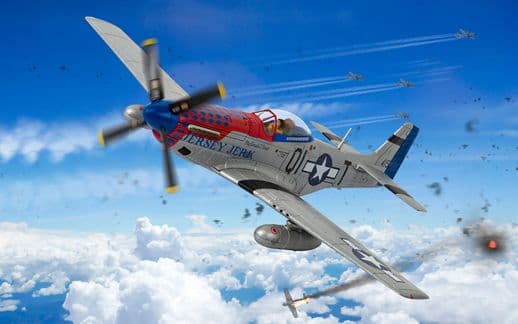
As the latest UK Airshow season is now off and running, many hundreds of thousands of people will be hoping to fill their senses with the sights and sounds of aircraft displaying for their viewing pleasure over the summer months, be they of the modern military, or classic aviation variety. One aircraft which has a claim to being the most attractively presented of all current UK based Warbirds, North American P-51D Mustang ‘Jersey Jerk’ is operated by Ultimate Warbirds, and is a fine example of this famous fighting aeroplane.
This particular aircraft is actually CAC CA-18 Mk.21 A68-110, an Australian built version of the Mustang, which is currently masquerading as the WWII mount of USAAF ace pilot Major Donald Strait, a man who would be credited with 13.5 aerial victories during his two European air war tours of duty.
Many Aviation Archive collectors will have just received their example of our beautiful 1/72nd scale die-cast representation of Major Strait’s wartime ‘Jersey Jerk’, if pre-ordered through the Corgi website, or their preferred model supplier and I have to say, it looks quite magnificent in the display cabinet. Unfortunately for those who are still sitting on the die-cast fence, it’s time to start our engines, because if we want one, we need to bag one now – they’re going faster than a Mustang about to score its latest victory.
As far as distinctively presented Mustangs of the Second World War are concerned, there were few that were as colourful as the machines flown by the 356th Fighter Group of the US Army Air Force. Flying out of RAF Martlesham Heath in Suffolk, just a short flight from Britain’s North Sea coast, the group were colloquially referred to as either the ‘Martlesham Playboys’ or perhaps more understandably, the ‘Blue Diamonds’. After successfully completing his flight training in the US, Donald J Strait arrived in England to fly the P-47 Thunderbolt in the Autumn of 1943. A native of Verona, New Jersey, he proudly took the name of his home state into combat with the Luftwaffe in the skies above Europe, naming his aircraft ‘Jersey Jerk’.
Achieving three aerial victories whilst flying the Thunderbolt, Strait was to enjoy his most prolific period of combat success once his unit converted to the North American P-51D Mustang at the end of 1944. Wearing the now distinctive markings of the 356th Fighter Group, Captain Strait and his ‘Jersey Jerk’ were to score a further 10.5 confirmed aerial victories in the final months of WWII, including a rather productive day on 20th February 1945 when he dispatched no fewer than three Fieseler Storch Luftwaffe observation aircraft during the same mission. With a total of 13.5 aerial victories, Donald Strait ended the war as the most successful ace pilot in the 356th Fighter Group.
A stunning addition to any model collection, ‘Jersey Jerk’ is now in limited availability territory, with very few still available via the Corgi website and even less remaining for our trade partners. In fact, if stockists attempt to replenish their stocks over the coming week, this Mustang will be gone. Please use the link above to be taken to the ‘Jersey Jerk’ Mustang web page to take another look at this latest Mustang release, because if it’s one you need in your collection, this might be your last opportunity before being forced to scour the secondary market.
We’re afraid that's all we have for you this time around, however, we’ll be back as usual in two weeks’ time with a further exclusive selection of the latest Corgi model updates. As ever, you could always drop us a line if you felt moved to do so, to comment on anything blog, collecting or Corgi model related, or even perhaps to suggest a topic you might like to see the team cover in a future edition. As always, our diecastdiaries@corgi.co.uk address is the one to use.
If you can’t wait for the next blog, you will find plenty of Corgi model collecting discussions taking place on our official social media channels, access to which can be obtained by clicking on the respective links at the foot of the Corgi website homepage.
Enjoy range launch!
Link access to Corgi social media sites.
Thank you for continuing to support your Corgi Die-cast Diaries blog. Our next edition is scheduled to be published on Friday 30th May, and we look forward to seeing you all back here then.
Thank you for your continued support