
Welcome to this latest edition of Corgi Diecast Diaries, your regular blog review of all the news, updates and topical stories from the captivating world of Corgi die-cast model collecting.
It feels so good to now be back on our normal blog scheduling, where we can just get on with the business of keeping our readers informed about all the very latest Corgi model development news and exclusives. We are once more looking forward to an extremely busy year and would be delighted if you joined us on this diecast journey of model discovery. With that in mind, what do you have to look forward to in this latest edition? We start by throwing the blog spotlight on another major new tooling project announced with the launch of our new 2021 model range and an Aviation Archive addition which has long been requested by collectors, our 1/72nd scale Bristol Beaufort Mk.I. We follow this up by seeing how members of the Corgi team have been getting creative with the first product adverts released to several magazines and periodicals this year, looking behind the scenes at how the team produced a particularly stylish Vanguards ad. We will be reviewing the latest signed sample models to arrive in the Corgi offices and preparing for the imminent arrival of a model which marks one of the most significant events in the Second World War. We will also be giving readers the opportunity to meet a new member of the Corgi team, as Mumbles makes his Diecast Diaries debut, before ending by looking at a trio of models which are about to pass from being in stock, to becoming another in a long line of Corgi previous releases. Another feature packed edition awaits your inspection, so let’s dive straight in.
This fascinating image is being shown exclusively for the benefit of Diecast Diaries readers and comes straight from the computer of the Corgi Development Manager. It features a CAD screenshot of the base model of our new Bristol Beaufort Mk.I and allows us an insight into how the new model has been designed
The announcement of the new Corgi Aviation Archive range back in 1998 came as quite a shock to the unsuspecting aviation enthusiast world and had many people desperately trying to get more information about the new models. Going by what Corgi were famous for, surely these new models would be a little bit toy(ish) and not worthy of consideration for enthusiasts who were used to spending hours working on their latest Airfix modelling masterpiece, in order to get an accurate scale representation of their favourite aircraft. With the first releases being in 1/144th scale, these new Corgi models may not have ticked everyone’s model collecting boxes, particularly if your thing was military aviation, but they did show great promise and were most certainly not toy-like. Incorporating lots of impressive detail, these models were extremely well made and pre-finished to an exceptional standard, probably better than the capabilities of most modellers, allowing collectors to have a fine scale representation of an aircraft, without having to do all that modelling work. And then there was the weight, that really appealing weight. Manufactured using solid die-cast main components, with plastic and metal details, anyone picking one of these models up for the first time couldn’t help but smile - the weight was just so appealing, especially when we were used to plastic kit building.
Despite this impressive start, the still relatively small range, combined with the fact that many of the first releases were civilian aircraft, meant that many kit builders with a fascination for WWII subject matter didn’t throw their hats into the Corgi ring at that stage, but definitely kept an interested eye on the range. All that changed in 2000, when the Aviation Archive range matured into a serious contender for anyone interested in aircraft, as the first high quality 1/72nd scale models were released, with aircraft which fought throughout the Battle of Britain firmly in Corgi’s sights. With the year 2000 marking the 60th Anniversary of the Battle of Britain, the first releases in this larger scale were a Spitfire, Hurricane and Messerschmitt Bf109E and they were magnificent. Marking three of the most iconic aircraft of WWII, they were well engineered, expertly manufactured and beautifully finished - all you had to do was take them out of the box and enjoy them!
These first three 1/72nd scale fighters were joined later the same year by a P-51D Mustang and the first two jet powered aircraft in the Aviation Archive range, in the shape of the English Electric Lightning and the Hawker Hunter. If aviation enthusiasts were still finding themselves a little hesitant in making the switch to becoming a diecast collector, one magnificent model announced in 2001 would change all that and have them rushing headlong to their local model shop, desperate to get their hands on one. Incredibly, the engineers at Corgi had taken the decision to tool up for an Avro Lancaster in 1/72nd scale, an impressive model which seemed almost too good to be true, but once it was released, became the must have model of the year for thousands of enthusiasts. Setting new standards in diecast manufacture and finish, this Lancaster tooling is not only the most significant model in the Aviation Archive range, but also arguably the most important in the history of diecast model production, due to its finesse and quality of finish. Responsible for recruiting many enthusiasts to the ranks of diecast aircraft collectors, the 1/72nd scale Corgi Lancaster enjoys an almost iconic status amongst collectors and is as popular today as it was when it first appeared.
Two more design images showing how the new 1/72nd scale Bristol Beaufort made it into the Aviation Archive range, one of the most heavily requested collector additions of recent years
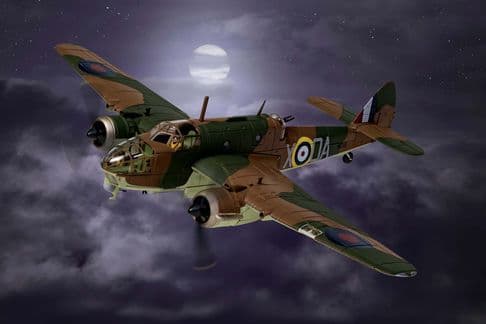
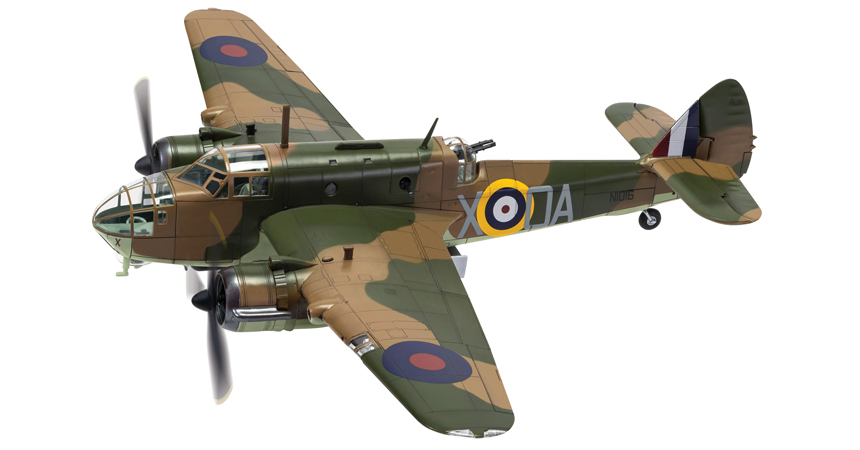
Since that time, the ever growing numbers of collectors addicted to the Aviation Archive range have never been shy when it comes to suggesting aircraft subjects they would like to see added to future ranges, especially once they became aware of the levels of detail and accuracy our designers were able to incorporate into the models. One subject which has appeared high on many people’s future Aviation Archive ‘wants list’ over the years, the Bristol Beaufort was a particularly interesting looking twin engined torpedo/standard bomber/reconnaissance aircraft from the Second World War and one which heralded from the same design stable as the Blenheim and Beaufighter. With the other two aircraft already in the range, collector’s had renewed hope that a Beaufort might still be a possibility for future consideration and would therefore have been delighted to hear that the 2021 range included the Beaufort as one of two high-profile new tooling announcements. One of the perceived gaps in the Aviation Archive range has just been filled and we are delighted to be in a position to bring you an overview of this exciting project now. As you would expect, we also have a rather impressive selection of exclusive images to show as well.
As an island nation, one of the most crucial battles Britain had to win during the dark days of the Second World War was to maintain the integrity of her merchant shipping lanes whilst at the same time, denying her enemies the ability to obtain supplies by sea. In the months which preceded the beginning of WWII, the most effective anti-shipping torpedo equipped aircraft available to the British was the Fairey Swordfish biplane and whilst this proved to be an exceptionally capable aircraft during the war, the RAF were in desperate need of a powerful, modern torpedo bomber, capable of mounting long range maritime strike missions.
The second in a successful trio of twin engined aircraft designed by the Bristol Aeroplane Company during the 1930s, the Beaufort is significant by the fact that it was the only monoplane produced for the Royal Air Force designed from the outset as a torpedo bomber and reconnaissance platform. An aircraft which can trace its development lineage to the Blenheim light bomber, which was one of the most important aircraft in British aviation history, the Beaufort was unusual in that it was ordered by the Air Ministry whilst the project was still ‘on the drawing board’, a move which showed they had great faith in the Bristol Company, whilst at the same time highlighting the RAF’s urgent need for the aircraft.
This is a real scoop for the blog and a very rare opportunity to see a new model tooling engineering sample whilst it is still being worked on by our Development Manager. Usually only produced as an engineering prototype to check the validity of the tooling design, it must be stressed that this stunning model is still in the development stage and these images feature an engineering sample which may still be subject to several changes before it can advance further. Having said that, it is looking rather good
Although originally intended as an evolutionary development of the existing Blenheim bomber design, it quickly became apparent that the new aircraft would look quite different to its predecessor, possessing a much deeper front fuselage section to accommodate its crew of four and the requirement to carry a torpedo in a semi-recessed position under the fuselage. These modifications resulted in a gross weight increase of around 25 percent over the Blenheim and required the adoption of more powerful engines, so this extra weight did not hamper the performance of the new aircraft. Indeed, the development of the Beaufort would end up being rather protracted, mainly because of engine issues and even though the initial contract for production aircraft was placed in August 1936, it would be more than two years before the prototype Beaufort took to the air, despite the RAF’s pressing need for this important new aircraft.
Eventually entering Royal Air Force service with No.22 Squadron Coastal Command in January 1940, the Bristol Beaufort proved to be a rugged and highly manoeuvrable attack aircraft, even though the development of the new engines would continue to be something of a problem. Initially employed conducting mine laying missions in enemy waters, Beauforts would later mount attacks against the German battleships Scharnhorst and Gneisenau and the heavy cruiser Prinz Eugen using torpedoes, however, in the European theatre of operations, the aircraft would mainly be used in the role of medium bomber. In the Mediterranean, Beauforts operating from Egypt and Malta would take a terrible toll of Axis shipping and during a concerted maritime onslaught from the middle of 1942, Beaufort crews would make a significant contribution in denying Rommel’s Afrika Korps the vital supplies they needed to continue fighting the desert war.
For an aircraft which had quite some WWII pedigree, in addition to being such a heavily requested collector addition to the Aviation Archive range, the Corgi team knew that as their latest new tooling project, they would be looking to incorporate all the latest design and manufacturing advances into this new model. At the very outset of the project, they had the huge benefit of having access to CAD design files from the new Airfix kit of this same aircraft, even though the two projects could hardly be more different from a design perspective. Having the definite benefit of being able to access the shape, orientation and dimensional reassurance of the Airfix base model files, from this point forwards, they were very much on their own. With both the manufacturing processes and the material used during production being significantly different between plastic and diecast model production, each individual component of the new Corgi Beaufort would have to be designed from scratch, using the base model as a template, but working out the most effective way to split the parts and ensure their effective assembly. This can be a complicated and time consuming business and as we now all know, it also goes hand in glove with significant financial outlay.
This final selection of images has a little bit of everything Corgi Beaufort, CAD model screenshot, engineering sample model and concept image produced for catalogue inclusion. We are delighted to be introducing you to this exciting new model
The exclusive series of images we are delighted to be showing here are a combination of tooling development CAD screen grabs kindly supplied by our Development Manager and a further selection of images featuring the engineering sample model which only recently arrived in the Corgi offices. This unique model is intended to allow the development team the ability to assess every aspect of the new tooling’s design, giving them a clear indication of what the new model might look like if it were produced from the tooling in its current state. We do have to stress that we are only being allowed to show these images on the strict proviso that we once again reaffirm to readers that they are a representation of a model which is still in development and may be subject to design change. Although it looks fantastic to us, our Development Manager, with his hyper-critical eye, has already highlighted a number of details which will require re-tooling or re-speccing. Nevertheless, when this model is released later in the year, we can already see that we are in for something of a treat.
In our next update from the Beaufort tooling project, we will bring you the very latest available images from this exciting new model, as it continues along its development journey through to initial release. We will also take a detailed look at the first scheme the new model will be wearing upon release and why this marks one of the bravest, most selfless actions performed by any Allied aircrew during the Second World War. Until then, we hope you have enjoyed our current development review of this highly anticipated new Aviation Archive model, one which we can’t wait to see displayed next to examples of our Blenheim and Beaufighter model releases.
This image features the final Signed Sample model of the impending Vanguards VA13313 Ford Capri Mk1 3000E in Silver Fox, a model which came in for some unusually close attention in support of a new and very different ad idea
When looking at the latest collection of Corgi models which make up the 2021 range, it can sometimes be easy to overlook the fact that the team responsible for bringing all this together are relatively small in number, if extremely talented and hardworking. When their creative prowess runs free (as it usually does), exciting things happen across all our model ranges and keeps the rest of us adding to our diecast model collections, however, excellence and innovation are not just confined to the production of beautiful models, sometimes it can also be employed in promoting them as well. In the previous edition of the blog, we saw how our Photographer David made something of an image ‘splash’ when he was asked to come up with a concept for new range header pages for the 2021 catalogue and we are delighted to say he has been at it again, this time in connection with a forthcoming Vanguards advert which is scheduled to appear in enthusiast motoring magazines in a few weeks’ time.
With the team determined to freshen things up from an advertising perspective this year, David was included in a meeting where this subject was discussed at some length and the possibility of breaking away from the standardised adverts of the recent past which possessed a slightly corporate feeling was explored. Never one to shy away from a challenge, David was keen to get involved and as he is also instrumental in providing content of our Diecast Diaries blog, kindly kept a photographic record of his travails for our benefit.
The brief for the exercise was to try and create a main image which possessed something of a stylized 1970s feel, a picture which would then be passed on to our Senior Graphic Designer Jules, so she could work her magic once again. The subject model for this exercise was the soon to be released Ford Capri Mk1 3000E in Silver Fox VA13313, with its colour description instantly giving David some creative ideas. With a photographic set-up in mind, he set about finding some appropriate props for the shoot, all the while thinking how he was going to persuade the most important prop to take part, his fiancée. Utilising a leather place mat, the final Signed Sample Capri model, one of his neck ties and a glass of something soothing, everything was falling nicely into place, however, their remained one last element to the image, his in-house hand model.
The three combined images above show how David set up his props to create something really different in respect of a Corgi advert - we don’t know what you think, but we think it looks really effective and is a definite attention grabber! Can you spot the difference between the two glasses? This must have been a tough assignment
The final image and how it looks in the body of the advert itself. Keep an eye out for this in your favourite enthusiast motoring magazine
With his home studio now in full work from home effect and his tried and trusted tethered multi-picture stitched image system to be employed once more, there was just one more crucial detail to arrange - what colour David’s fiancée should paint her nails? With the 70s inspired colour decided upon and the nails suitably decorated, it was time to put the plan into action and whilst the finished image certainly looks effective, its creation was not without its challenges. Trying to direct ‘the hand’ from his position away from the set-up and whilst looking at a monitor, it did take a while to obtain exactly the effect he had in mind, however, it was definitely worth the effort, as it certainly makes for an interesting image and will certainly grab the attention of anyone coming across the advert in the weeks ahead.
If you inspect the image selection above closely, you will not only see how David managed to obtain this appealing image and all the props he used, but you will also notice a couple of little anomalies in there. In the picture David sent us which shows the image displayed on the live view screen of his camera, it appears as if the photoshoot hadn’t been going so well at that stage and he had succumbed to the demon drink and drained the glass of its contents. Also, on the original advert copy, we inadvertently appear to have created a completely new series of Ford Capris, ones which were powered by a 0.3 litre engine - as they say, it will be alright on the night!
A final look at the ‘Silver Fox’ Capri, a model which will forever be linked with our Photographer David, his home studio and his fiancée’s hand
The model itself is a little beauty and as it is scheduled for an imminent spring release, this might be your final opportunity to ensure you have one coming your way. The catalogue copy for VA13313 Ford Capri Mk1 3000E - Silver Fox reads as follows:
The Capri was created to replicate in Europe the spectacular success of the original 1964 Mustang in the USA. The two cars were conceptually similar, taking components from volume selling saloon cars and wrapping them in an achingly beautiful, and thus desirable, coupe bodyshell. When launched in 1969, Ford dubbed the Capri, ‘The car you always promised yourself’ and it created almost as much of a sales frenzy as the Mustang had. The 3000E was launched in March 1970 and was one of the most desirable Capri variants offering GT performance with the added luxury features which befitted the wearing of Ford’s E for Executive badge.
Please keep an eye out for this beautiful new Capri model and also for its starring role in this rather distinctive new advert.
Another new model tooling which is just about to make its debut in display cabinets all over the world, the first two models from our Vanguards VW Camper tooling will soon be arriving in model shops everywhere
In each forthcoming edition of Diecast Diaries, we are going to attempt to bring our readers details of projects from right across the current Corgi model development schedule, from those which are relatively new and still in the early phases of design and production, right through to those which are just about to hit the model stores, or arrive on your doorstep, if you happen to have pre-ordered them. Obviously, we will be covering every stage in between, along with bringing you a variety of topical, interesting and reader based features along the way, but we intend to include some for now, some for the not too distant future and some for later in the year, just for a bit of model collecting variety.
With that in mind, the appealing picture above features two releases from a new model tooling we have been following for just under a year now, but as both of these feature production sample models, this signifies that we will soon be able to add them both to our personal collections. A vehicle which has long been the choice of the design conscious, slightly more adventurous motorist, the Volkswagen Type 2 Campervan has enjoyed a real renaissance in popularity over recent years, meaning that owners of this iconic vehicle which first appeared during the 1950s, are now viewed as people with impeccable style and taste.
The distinctive Volkswagen Camper Van was a development of the famous VW Beetle automobile and even though on first look it appears to be a much larger vehicle, it utilises the same basic chassis, engine and transmission of the earlier Beetle. At a time when Europe was in need of a cost effective light transport vehicle to get businesses moving, it would form the basis of a successful series of vehicles which could be produced as a microbus, pickup, transporter, van, general utility and recreational vehicle – quite an important machine really.
A significant new tooling addition to the 2020 Vanguards range, this beautiful new model has been developed as both the original Volkswagen Type 2 Split screen (T1), which was in production from 1950 until 1967 and the later Volkswagen Type 2 Bay window (T2) version, which was in production from 1967 until 1979. Just to add a little context to these descriptions, the original Beetle was referred to as the Type 1 Volkswagen Beetle. A design which became extremely well known during its lengthy production run, the Campervan has been enjoying a significant renaissance over recent years and is now seen very much as something of an aspirational purchase and one of the ‘coolest’ vehicles you could possibly be seen in. For that reason, many of these vehicles are now receiving some long overdue TLC and are changing hands for handsome sums of money.
VA14500 - Volkswagen Type 2 1500 SP Devon Caravette Pearl White and Velvet Green
The camper modelled here was built in Hanover, Germany, in October 1966 to option codes M396 - UK market RHD, and M543 - no seating in load area. It was supplied directly to VW’s official UK camper van builder, Devon Conversions, Sidmouth. Although Devon Conversions specialised in VW’s, founder Jack White having started by converting his own VW in 1955, they did expand into producing campers using other base vehicles. The company moved to larger premises in 1960, a former gas plant called the Alexandria Works, which had its own rail link to get vehicles in and out efficiently, and by the mid 1960s were converting well over a 1000 vehicles per year.
VA14501 - Volkswagen Type 2 Camper ‘RAT-Look Splitty’
The Rat-Rod or Rat-Look scene is a huge and growing part of classic car culture and air-cooled VWs have been central to its creation and popularity. RAT is an acronym for ‘Recycled Automotive Transport’, a perhaps ironic salute to the prevailing western culture, but RAT-Look vehicles are not what they appear. Mechanically they are often far better than they were when new. More powerful engines, better brakes and custom suspension are hidden under an exterior which has been carefully and expensively prepared to look like it’s been abandoned in the sun for decades. The finish is often preserved by a matt clear coat varnish, which stops the vehicle rusting and preserves that ‘patina’.
All of the product images shown here feature advanced production sample models, so both of these first two models from the new Vanguards VW Camper tooling are due for imminent release and should be with your favourite model supplier over the next few days. If you can’t quite stretch to one of the real vehicles at this present time, at least these beautiful 1/43rd scale examples with give your model display something of a stylish upgrade in the meantime, or at least until your lottery numbers come up.
A magnificent new model which is now being delivered to those people who pre-ordered it either with us or through their usual model supplier, has proved to be a huge hit with collectors both here in the UK and across the Atlantic, as it commemorates one of the most astonishing feats of airmanship displayed in the entire Second World War. AA36615 – Lockheed P-38G Lightning 43-2264 ‘Miss Virginia’ White 147, 339th Fighter Squadron, 347th Fighter Group, ‘Operation Vengeance’, Guadalcanal, 1943 is an example of a US aircraft which at that time in the war, was the only one which possessed both the range and firepower to attempt an interception mission which had little chance of success, but if it did, would be a significant act in avenging the surprise attack against US forces at Pearl Harbor. Known to the Japanese military as ‘Whispering Death’, due to the quiet hum generated by the aircraft’s pair of Allison V-1710 engines, the P-38 Lightning was a magnificent fighting aeroplane and arguably the best the Americans had until the arrival of the P-51B Mustang.
In what proved to be one of the most significant aerial engagements of the Second World War, ‘Operation Vengeance’ was the ambitious plan to intercept an aircraft carrying Japan’s most accomplished military tactician and architect of the Pearl Harbor attack, Isoroku Yamamoto. The mission was entrusted to brilliant US aviator Major John Mitchell, who would have to plot a course far enough away from islands inhabited by Japanese spotters and low enough to avoid detection by enemy radar, whilst ensuring his fighters intercepted the enemy formation at exactly the right moment. With only a map, his watch and a highly accurate compass borrowed from the US Navy installed in his fighter, the mission had only a slim chance of success, but was a risk they had to take.
The only aircraft capable of undertaking this perilous 1000 mile round trip was the Lockheed P-38 Lightning and even then only by using drop tanks containing additional fuel – indeed, due to short supply, each aircraft was fitted with a single large 330 gallon drop tank, as well as a smaller 150 gallon tank. As the sixteen Lightnings took off from Kukum Field, Guadalcanal at 7am on 18th April 1943, they had no idea of the size of the enemy force they would be facing, or if indeed they would manage to intercept them. In a feat of exceptional airmanship, the Lightnings arrived at the anticipated interception point just one minute behind schedule and to a shout of ‘Bandits’ from one of the American pilots. In the ensuing dogfight, ‘Operation Vengeance’ would strike a huge blow in the fortunes of the Pacific War and highlight that America would accept nothing less than total victory.
This next trio of images all feature the final Signed Sample of the ‘Operation Vengeance’ P-38 Lightning, a model which is now being unpacked and placed in display cabinets everywhere
Having been forced to endure the horrors of the surprise Japanese attack at Pearl Harbor, the American people found themselves dragged into a war they had tried so hard to avoid, but were now determined to avenge this day of infamy. Their long fightback began with victory at the Battle of Midway in June 1942, but for the men of the USAAF 347th Fighter Group, their chance to inflict a huge psychological blow against the Japanese nation and specifically against man who had planned the Pearl Harbor attack would come in April the following year. US Navy intelligence code-breakers had been monitoring Japanese communications for months and discovered that Admiral Isoroku Yamamoto planned to fly from Rabul to troops stationed in the Solomon Islands, to boost their morale in the wake of the Midway defeat. Flying in one of two Mitsubishi G4M ‘Betty’ bombers and protected by six Zero fighters, the formation was intercepted by sixteen US Lockheed P-38G Lightnings, whose pilots had made the long flight from Guadalcanal with one specific aim – vengeance. In the ensuing dogfight, P-38G ‘Miss Virginia’ piloted by Rex T. Barber, slipped in behind the bomber carrying Admiral Yamamoto and unleashed a torrent of bullets from his .50 calibre machine guns, sending it crashing into the jungle below. ‘Operation Vengeance’ had been successful and one of America’s most deadly enemies had been eliminated.
This magnificent new model is available now, but has almost completely sold out - in fact, by the time you are reading this, ‘Miss Virginia’ could be consigned to the Aviation Archive history books!
Visitors to the Corgi website over the past few months may well have stumbled across an interesting new character on some of our pages, a new member of the team who has a rather specific remit to his role. Mumbles is the brainchild of our Assistant Brand Manager Meg and she has worked hard not just to create his unique identity, but also to facilitate his integration into the world of Corgi. She has the following to say about her four legged friend:
Named after the beautiful coastal community in Swansea, Mumbles was created as a Mascot with the sole purpose to be a communicator for our brand. His allure is two-fold … we aim to capture the interest of younger collectors and at the same time, hopefully the hearts of our older ones.
After talking with many of our collectors, we were reminded that collecting is a deeply personal hobby. It evokes sweet nostalgia-soaked memories of your childhood and we wanted to translate that magic to a younger audience. Whilst many of us experienced collectors use Corgi to look backwards, we hope to use Mumbles to show children a way forward. With Mumbles’ help we plan to broaden children’s horizons and show them that there is no limit to what they can be when they grow up.
He’s currently the ambassador for our CHUNKIES range, taking young collectors on imaginative adventures using a play proof version of our iconic diecast models. With this foray into a different market than one Corgi is traditionally known for, we have hoped to introduce all of the best traits of seasoned collectors, to a younger demographic. Discipline, attention to detail and a love for all things Corgi, to name just a few!
Mumbles have proved to be a fantastic tool for bridging the gap between old and new Corgi, and young and veteran collectors. He has given many of you a chance to share your passion for the hobby with your kids and we hope that he will be a catalyst for creating memories for many more years to come.
We would like to thank Meg for letting us have this contribution to the blog and we look forward to seeing where she takes her creation next, charting all the Corgi adventures he is going to have. Maybe Mumbles will help to inspire a new generation of Corgi model collectors into this wonderful hobby of ours.
In future editions of the Corgi blog, we will be featuring a small selection of models which are down to the last few pieces in our warehouse and are just about to pass onto our ever growing list of ‘previous releases’. This time, we are featuring three models which are now in such short supply that by the time you are reading this feature, they may all have actually sold out. At the head of the image montage above, our Tools of the Trade Bodgit & Scarper Transit, which featured in the previous edition of our blog, must have found favour with many a reader, as there are now less than a dozen pieces available in our warehouse. As we all enjoyed discussing the cheeky tongue firmly in cheek nature of these smile inducing models last time, it seems as if those discovering the range for the first time knew someone who would appreciate having one of these models to display on the dashboard of their van, or at home on the mantlepiece. The other three Tools of the Trade models are still available for now, but Messrs Bodgit & Scarper have almost moved on.
The second model appearing on this endangered list is the last aviation item remaining in our 60th Anniversary product line, which not only benefits from special commemorative packaging, but also comes with a 60th Anniversary pin badge included. The subject matter isn’t too shabby either, as it features the Hawker Hurricane Mk.I (V7357/SD-F) of Sgt. James Harry "Ginger" Lacey, RAF No.501 Squadron, Gravesend, Sep 1940, one of the highest scoring ace pilots of the Battle of Britain and a must have release for any Aviation Archive collector. Produced in support of our 60th Anniversary back in 2016, this model was produced in greater quantities, but at an extremely attractive price and has now become so depleted that just one outer box of models now remains in our warehouse. No scale Battle of Britain collection should be without this beauty, so if you still have to get your hands on one, this could be your final opportunity.
The last model in this limited availability trio brings us to the current Royal Air Force and an aircraft which patrols our sovereign airspace, ensuring no potentially hostile incursions go unchallenged. AA36410 Eurofighter Typhoon FGR.4 ZJ924, RAF No. IX (B) Squadron, Lossiemouth, Moray, Scotland, May 2019 ‘The Green Bats keep flying’ was released partly in association with our RAF Tornado retirement series of models and partly to commemorate the continuation of No.IX Squadron’s history and the fact that as they stood down as a Tornado unit at Marham, they immediately reformed at RAF Lossiemouth to fly the Eurofighter Typhoon. Marking an interesting chapter in the continuing story of today’s Royal Air Force, there are now only a handful of these handsome models available, so we are placing you on ‘short finals’ if you were thinking of adding one to your collection. Although it is always a positive thing when models sell through, it is also sad to see them go in a way, as they have clearly been popular and from this point forwards, collectors will be forced to look to other sources to try and secure one, if they missed it.
We will have another selection of low availability items in the next edition of our blog.
We are afraid that’s it for another edition of Diecast Diaries, but as we are still trying to catch up with our schedule following our slow start to the year, you are only going to have to wait two more weeks for your next instalment of Corgi diecast exclusives. In the next edition, we will be looking at how the second release from our 1/48th scale Phantom tooling will include several interesting modifications, in addition to including a host of other Corgi development exclusives. Until then, we are always interested to hear from our readers, especially those of you who would like to suggest a subject for future inclusion in our blog.
Better still, if you would like to send us pictures of your own model collection, or details of a Corgi model release which is special to you, you may even find yourself featuring in a future edition of Diecast Diaries. As always, we would be grateful if you would address all correspondence to our usual diecastdiaries@corgi.co.uk email address.
If you can’t wait for the next edition of our blog, there is always plenty of Corgi model related news, views and conversation taking place on our official Facebook and Twitter social media pages, which welcome your contribution. We look forward to reading about all the latest Corgi collecting discussions and pictures of your favourite models over the coming few weeks.
Finally, we would like to thank you all for your continued support. We very much look forward to bringing you much more Corgi related news, features and updates in future editions of our blog.
Our next blog is scheduled to be published on Friday 26th March.
The Corgi Die-cast Diaries Team