

Welcome to the latest edition of Corgi Die-cast Diaries, your regular blog review of all the news, updates and topical stories from the captivating world of Corgi die-cast model collecting.
With the dust now settling on our final range launch for the year, we can concentrate on the enjoyable business of bringing our readers all the latest development information, as these projects near their respective release dates. As hinted at in our previous edition, we will also be launching a new initiative on the Corgi website in the near future, a video series where we not only look at some of the most desirable models ever to feature the Corgi logo, but also the actual machines which inspired their range inclusion. We’re not quite ready to go live yet, but we are very close and will be bringing you an update a little later.
As you will gather from the title of this latest edition, we will be featuring two iconic names from the worlds of motoring and aviation this time around, or should we say our die-cast representations of them. We look forward to welcoming the latest additions to the Aviation Archive range by paying a visit to the Rolls Royce Heritage Flight hangar at East Midland Airport and we look at the latest incarnation of one of the most famous models in the history of die-cast model car production, an absolute heavyweight model when it comes to our hobby.
We will be using a recent model announcement to help us mark ‘Batman Day’ which is celebrated this coming weekend, and we will have information regarding the limited availability status of a recently released and extremely desirable 1/48th scale model. Finally, we will bring you the latest information regarding a new video series initiative we hope Corgi fans will enjoy in the future, one in which some of our readers might even appear in the fullness of time.
Please join us as we delve into the die-cast world of Corgi model collecting once again in this latest edition of Die-cast Diaries.
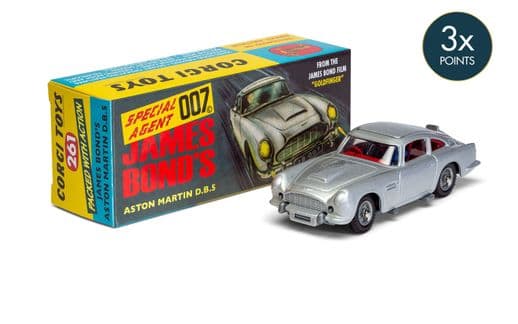
A significant new tooling addition to the Corgi range, this Aston Martin DB5 has a very interesting story to tell.
For those of us in the fortunate position of being able to represent this fantastic brand, it really is quite humbling to think that we might be helping to continue the proud heritage of Corgi in our own small way. What’s perhaps even more poignant is that we’re helping with the production of models which many of us used to play with ourselves during our formative years, models which really did mean so much to us back then, even if we didn’t treat them with the same reverence as we do now.
No matter who you are, or what you do, Corgi models will probably have been a part of your lives at one time or another and it only takes the sight of our favourite model from back then, or the distinctive box presentation that meant a new model was heading our way, to take us straight back to a time when our model collection was everything to us. I say that a little guardedly, because for some of us now, our collections are probably so large and still so important to us that it might actually form part of our retirement planning!
That aside, ranges like Vanguards and Aviation Archive may allow us to collect the models which are currently important to us, but rarely go back to re-introduce models which were around when we were younger, as both fall appropriately into the realms of limited edition production ranges. Our Classic, Pop Culture and Corgi Toy ranges are a different tooling proposition altogether though and definitely lend themselves to being released to new collectors periodically over time, either updating existing models to introduce new features, or to go in the opposite direction and attempt to recreate the charm and nostalgia of an original release.
An original 261 DB5 model which is on display in the Corgi section of Wonderworks at Margate.
Die-cast homage to a model classic, this new model is available now.
The current September to December range can boast not one, but TWO absolute die-cast model heavyweights, both of which are newly tooled versions of the classic models which preceded them, with both bringing back plenty of pleasant memories for thousands of people who played with them as kids. As both are amongst the most popular models to ever wear the Corgi name and are indeed also some of the best-selling die-cast car models ever produced, their inclusion is surely something for all Corgi collectors to get a little excited about.
Taking the first of these models as our subject for now, what do you get if you combine one of the most beautiful prestige cars ever produced with the coolest, most famous secret agent in popular culture – die-cast immortality, that’s what! A Corgi model which possesses a reputation above all others, the classic 261 James Bond Aston Martin DB5 model was first produced back in 1965 and released in time to catch that year’s busy Christmas market. Although clearly an attractive model, Corgi officials at the time must have been confident that they were on to a winner, because that first Christmas, around 3 million models were sold and they really did struggle trying to meet the constant repeat demand for restock.
There are actually a couple of interesting features/stories relating to that original model, which all help create the mystique around this classic release. Although the original packaging stated that the model was from the Goldfinger film, it was actually released when the latest film in the Bond phenomenon lineage was attracting record audiences all over the world, and that film was Thunderball. It was also interesting to note that the model was released wearing a gold paint finish, when the vehicle which appeared in the film was actually finished in ‘Silver Birch’. This was apparently because when the Corgi development team at the time were reviewing the sample model prior to production, they felt that the silver finish made the car appear a little ‘unfinished’ and might reduce the impact of the model.
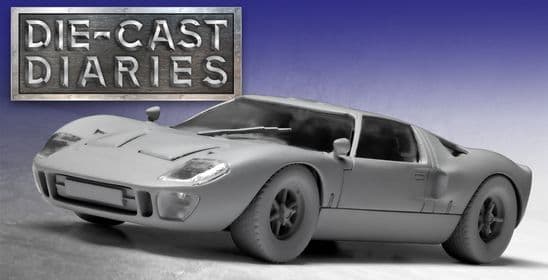
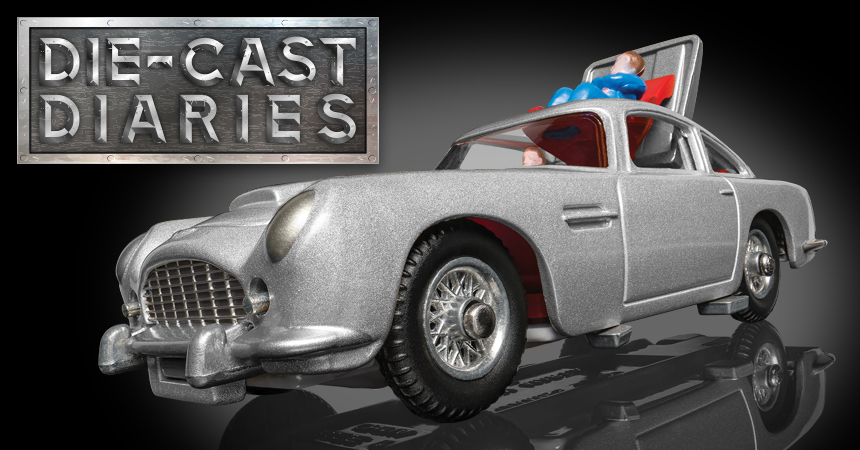
A graphic rendition of the new model which was used for this edition’s header image.
Classic but also new, this fantastic new model pays due respect to one of the most significant models in die-cast collecting history.
The rather radical decision was taken to paint the model in a gold finish, something which would turn this into a toy classic - with the box description featuring the Goldfinger reference, presumably the Corgi team felt they had a little marketing latitude with their last minute colour alteration decision. Whether by luck or very good judgement, what they served up a die-cast classic and the Christmas trade certainly didn’t appear to have a problem with the colour.
The original 261 model was produced using Corgi’s existing Aston Martin DB4 tooling and whilst the front and all interior features were modified, the model retained the thinner back end of the donor tooling. Although an evolution of an existing tooling, what the Corgi team produced was impressive in the extreme, a model which still holds the position of being the fastest selling and most famous die-cast toy car of all time, selling 3 million units that first Christmas and currently standing at over 5 million models sold.
Even now, anyone would be delighted to get their hands on this beautiful new model.
Moving the story forward, 1968 saw the DB5 model undergoing a re-tool, reflecting its status as one of the most successful models in the toy world. This model carried the number 270 and benefitted from a more accurate overall shape, many more innovative features, such as the rotating number plates and at last, the Silver Birch paint finish worn by the film star 007 car. This new model would serve as the tooling blueprint for subsequent ‘action parts’ DB5s, including another fairly major revision, which resulted in the release of model number 271.
Running through the antecedence of the original 261 DB5 model, we can see that this version of the model was never actually released in silver before and to mark the 60th anniversary of the release of the Goldfinger movie, we were determined to do something about it. This model is a newly tooled version of the classic 261 Aston Martin DB5, featuring all the legendary action features of the original, including the working ejection seat, pop up rear bullet shield and spring out over-riders and machine guns. In this anniversary year, the (new) 261 has been produced in the iconic Silver Birch paint finish of the real car, a first for this most famous of all die-cast car models!
Already available on the Corgi website, this model will continue the fascinating story of the James Bond Aston Martin DB5 in Corgi die-cast model guise and we already know this will unquestionably be our best-selling model of the year. You know what they say, class is permanent, and this is definitely one classy new model.
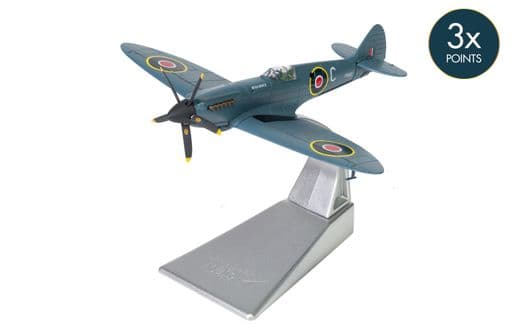
Another model which was first announced in the current Corgi catalogue, but has also just arrived in our warehouse, Supermarine Spitfire PR.XIX PS853 is our scale tribute to an aircraft which is now a regular performer on the UK Airshow circuit and has become a firm favourite with the many thousands of people who love attending such events. In addition to being an airworthy example of Britain’s most famous aircraft, this Spitfire has a rich history and will actually be celebrating its 80th birthday next year. Significantly, she is owned and operated by the heritage section of Rolls Royce, a flying ambassador for the company and a reminder of the contribution this famous company have made, and continue to make, in the field of aviation propulsion technology.
This model project has been quite some time in the planning, and we’re extremely grateful to our friends at the Rolls Royce Heritage Flight for the support they have given us throughout and the incredible access we have been allowed to their stunning aeroplanes. We are particularly indebted to Maintenance Engineer Dean Wright, who has not only been a driving force throughout this project, but has been so generous with his time and incredible knowledge that we simply couldn’t have done this without him.
As one of the most important fighting aeroplanes in the history of warfare and one which would go on to see service throughout the entire Second World War, the Supermarine Spitfire performed a variety of roles during the war, including that of high-speed, high-altitude photo reconnaissance platform. As the RAF's premier fighter of the day, a small number of modified Spitfires were used early in WWII to perform specialist photo reconnaissance duties, with individual aircraft modified to carry photographic equipment in something of a hand-built, bespoke manner at that time.
Prior to the use of Spitfires, much larger aircraft had been carrying out reconnaissance missions from the very first days of the Second World War, however, it quickly became apparent that the two most important factors in establishing effective photo reconnaissance support were speed and altitude, along with specialist training, and the RAF simply didn't have aircraft capable of consistently carrying out such missions at that time. To make matters worse, the Germans knew exactly what these aircraft were attempting to do, and were determined to prevent them from returning home with their valuable photographic intelligence.
Initially, two standard Spitfire Mk.I fighters were modified for photo reconnaissance duties and whilst these were certainly an operational improvement over the Blenheims and Lysanders which had previously been undertaking these missions, the RAF still had much work to do if their photo reconnaissance Spitfires were to prove successful in this highly specialised role.
All the model images shown here feature an advanced production sample of our beautiful new Rolls Royce Spitfire.
Work continued in something of a bespoke fashion until the introduction of more powerful variants of the Spitfire transformed the art of aerial reconnaissance, allowing missions to be flown at higher altitudes, at greater speeds and over longer distances than they had been previously. Now, all the lessons learned since the start of the war could be brought to bear in perfecting this service and even though Photo Reconnaissance Spitfires would operate wherever British forces were deployed, with their services being in great demand, it's always surprizing to discover that relatively few aircraft were actually produced specifically in this photo reconnaissance configuration.
The pinnacle of Spitfire photo reconnaissance capability arrived with the introduction of the Rolls Royce Griffon powered variants of the aircraft, an aircraft which made full use of the now highly effective infrastructure behind the gathering, examining and dissemination of photographic intelligence in Britain. Handling of the new aircraft was regarded as excellent and they proved to be real 'speedbirds', something Photo Reconnaissance pilots relied upon, as they were flying unarmed missions deep into enemy occupied territory.
Flying at altitudes of around 40,000 ft, PR.XIX Spitfires were almost impervious to both ground defences and interception by the majority of piston powered Luftwaffe fighters. Indeed, even the much-feared Messerschmitt Me 262 jets would have difficulty bringing down a Spitfire PR.XIX, even if one could be spared from anti-bomber duties. If a Spitfire was being stalked by an enemy fighter, the tactic used by most pilots was to enter a shallow dive, gradually building up more speed as they gently descended earthwards. A pilot also had the option of increasing altitude still further and whilst there were reports of Spitfires flying well above 40,000 ft, for the pilot, this was actually an exercise fraught with many potential dangers.
Capable of maintaining a steady 370mph even at extreme altitude, these aircraft also carried the highest internal fuel load of any PR Spitfires, all attributes which made these the most effective clandestine, information gathering variants of this famous aircraft ever produced. Clearly, when operating at these altitudes, the aircraft were usually only deployed on days when the weather was fine, as cloud cover and stormy conditions would preclude the taking of photographs, or force them to fly at lower, more dangerous altitudes.
Rolls Royce’s Dean Wright giving us details of the aircraft he spends so much time caring for.
If cloud cover was unexpectedly obscuring any target, PR pilots had the discretion of descending to a lower altitude in order to secure the imagery they needed, however, this significantly increased the risk or interception, or sustaining damage inflicted by enemy flak defences. Photo reconnaissance Spitfires would regularly be sent to provide raid effectiveness imagery following a bombing mission, arriving over the target area only minutes after the last bomb had been dropped, with their pictures determining whether the bombers would have to return once more in the days which followed.
Operating with the specialist Photo Reconnaissance units at RAF Benson, the RAF's Spitfire PR.XIX aircraft worked tirelessly in the months leading up to the D-Day landings, providing detailed imagery of enemy defences and supply depots across the intended invasion area. Careful not to alert the Germans to the most likely location of the long-anticipated invasion, these missions were flown along a vast stretch of European coastline, from Bordeaux in the southwest, to the Low Countries in the north, a crucial aspect of these pre-invasion preparations.
With the work of these Spitfires being so crucial to the outcome of the Second World War and clearly so dangerous for the pilots who flew them, it’s a little surprizing that they failed to receive the recognition they surely deserve during the post war years and how a National PR Monument has still to become a reality.
Now a popular display aircraft on Britain’s vibrant historic aviation scene, Supermarine Spitfire PR.XIX PS 853 is an example of one of the highly specialised Spitfires which served so successfully during the latter stages of WWII in providing detailed intelligence imagery for Allied commanders. A genuine Second World War veteran, PS853 was one of 79 Spitfire PR.XIX aircraft built by Vickers Supermarine at their Southampton factory towards the end of 1944 and was subsequently delivered to the Central Photographic Reconnaissance Unit at RAF Benson on 13th January 1945. She would go on to fly operationally with RAF Nos. 16 and 268 Squadrons from bases at Melsbroek and Eindhoven in Holland, sorties which are thought to include several missions gathering information on suspected German V-Weapon sites across northern Europe.
Following the end of the Second World War, Spitfire PS853 would serve for a time with the Meteorological Research Flight at RAF Woodvale, but would soon become associated with performing commemorative flypasts at various events across Britain and would be one of the first aircraft to be allocated to the RAF’s fledgling Historic Flight at Biggin Hill in 1957. Over an eventful few years which followed, she would serve in the Station Flight of several RAF stations, spend some time as a gate guardian, before officially joining the Battle of Britain Memorial Flight in 1964.
The Flight would eventually sell PS853 thirty years later as they needed to raise funds for the restoration of Hawker Hurricane LF363, which was badly damaged following engine failure at RAF Wittering in September 1991, however, following the tragic death of her new owner, the aircraft was subsequently acquired by the Heritage Department of Rolls Royce in September 1996.
Since that date, Supermarine Spitfire PR.XIX has gone on to thrill millions of spectators at Airshows and events right across the country, with her displays of grace and power all taking place to the distinctive throaty growl of her Rolls Royce Griffon engine, a sound which demands every eye in her vicinity be glued to her every display move.
A fitting flying tribute to the work of Photographic Reconnaissance Units during the Second World War, Spitfire PR.XIX PS853 also proudly represents the rich aviation heritage Rolls Royce possess in the field of aero engine technology. Cared for by a team of passionate engineers, she is a much-loved focal point of their impressive Heritage Flight activities, and whilst based at their impressive East Midlands Airport facility, can be seen displaying at Airshows and events across the country.
It's been nine years since the Aviation Archive range has been able to boast the inclusion of a Spitfire PR.XIX model release and we think you will agree that wait has been worth it, because our Rolls Royce Spitfire is a real cracker. In our warehouse now, with pre-orders being processed, this is our opportunity to own a scale representation of one of the best loved historic aircraft on the UK historic aviation scene and the pride of the Rolls-Royce Heritage Flight fleet.
If you take your model to an Airshow where PS853 is appearing, you might get the Rolls Royce team to sign the box, which I’m sure they’d be happy to do.
We hope you like her Dean.
We are delighted to report that our 1/48th scale model tribute to the RAF Typhoon Display Team’s previous display jet ‘Blackjack’ has now been released and is meeting with widespread collector acclaim. Some of the comments posted on various social media sites have seen numerous people describing this as the best Typhoon model they have seen and by far and away, the best model in their collections. Clearly, we’re overjoyed to read these comments and are delighted that all our hard work has paid off with this release – we spent a lot of time ensuring this model would be everything we hoped, so we thank everyone for their kind comments.
As the current Airshow season draws to a close and the debate rages on about whether enthusiasts prefer Blackjack, or Moggy from a scheme presentation perspective, we thought you might like to know that only around 100 models remain in our warehouse and as retail partners continue to restock this fabulous model, it won’t be long before Blackjack is marked as being out of stock. If you have your example safely tucked away in your display cabinet, we hope you are pleased with her, however, if you have yet to have your own Corgi Blackjack experience, now might be a good time to make your arrangements.
For those readers who use the Corgi website for their collecting, don’t forget that you can always use your accumulated reward points against the price of your model, with our Blackjack Typhoon looking like the perfect way with which to treat yourself, as the dark nights close in.
Forewarned is forearmed, and now at least you know that our scale die-cast tribute to this most distinctive of RAF jets is close to joining the aircraft on which it’s based in the pages of aviation history as an out of service/out of stock aircraft.
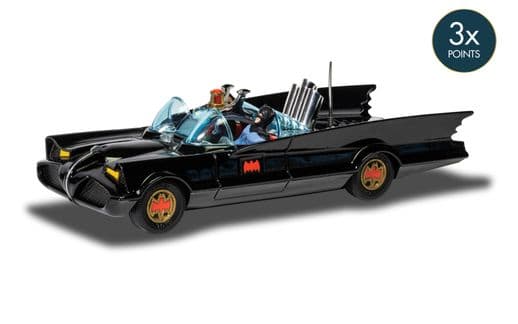
The launch of our latest September to December model range also saw the long overdue return of another die-cast model classic, one which hasn’t featured in a Corgi range for over forty years, and one which comes close to rivalling the 007 DB5 in the annals of die-cast history, our 267 Batmobile. A model which again, many of our readers will no doubt remember from their youth with incredible fondness, this model was called into action whenever we saw the bat silhouette shining in the night sky above Gotham City, or just where we happened to be playing with it at the time, and came complete with Batman and the Boy Wonder figures, along with a host of working features.
A model which was first produced in 1966 to align itself with the incredibly successful US TV series starring Adam West and Burt Ward, it’s interesting to note that that original series and its stars only lasted for two years, but is still regarded by many as the iconic incarnation of the Caped Crusader, still standing the test of time. Mirroring the success of that original series, the original 267 Batmobile vies for the position of the most successful Corgi car model ever produced, again with around 5 million models being produced over the lifetime of this model.
A faithful replication of the iconic Batmobile Batman and Robin used in their crusade to fight crime and challenge evil, this eye catching black model was not only beautiful to look at, but also provided endless hours of fun, something the Corgi designers cleverly ensured when creating the model. It incorporated such appealing features as a flip out chain cutter on its bonnet, a projectile firing rocket launcher and a simulated rocket flame pulsating at the rear of the car when you pushed it along. This was a toy at heart and as such, was intended to be played with, but if your model suffered damaged, or lost some of its paint, there was only one thing for it, get a new one – Holy Replacements!
Following on from that successful first release, the model went into production several times and was subject to some revisions, such as changes to its wheels and the addition of a Batboat tow hook in 1973, a modification which did away with the jet flame feature. All good die-cast things must come to an end, and the model disappeared from the Corgi range in 1983, leaving those models in the hands of collectors and in pristine condition, to change hands for incredible sums of money.
In a year which marks the 85th anniversary of Batman, we are delighted to have the Batmobile back in a Corgi range once more, a newly tooled model which takes its inspiration from that original model from back in 1966. Complete with figures of our Dynamic Duo, the new model has the pop-out chain cutter, the rocket launcher with 12 missiles included and the tow hook which may, or may not support the release of another Bat-tastic release in the future – check the Gotham City grapevine for news of this in forthcoming range announcements.
Such an appealing model, the Batmobile will be taking its place in a Corgi range for the first time in over forty years.
The new model has also gone some way to righting a die-cast wrong, because this new Batmobile includes the Batboat hook, whilst also retaining the pulsating jet flame feature – Holy Innovations!
Again, this really is big news for fans of classic die-cast models, and we are really proud to have the Batmobile back in the range once more. We are even presenting the model in a recreation of the packaging which supported its 1970s release, complete with model number classic graphics and envelope of instructions. Once we have this model in hand, there’ll be no place for Jokers and Penguins, and our display cabinets will be a much safer place.
We intend to bring you some development updates from this project in a forthcoming edition, including an exclusive look at the design files and tooling work undertaken to allow this model to take its place in the range once more, so please keep an eye out for that.
We end this latest edition of the Corgi blog with news of an exciting development for Corgi collectors, our new video series. Coming soon to the Corgi YouTube channel, our Corgi Scale Mates series will be looking to match our die-cast models with the car, aircraft, tank, truck or other machine which inspired its inclusion in the range.
It’s intended that we will feature in depth interviews with those who either own, operate, or care for the real subject, but always from an enthusiast perspective and always with an element of fun and enjoyment. We want these to be a real celebration of our hobby and a way of shining a die-cast spotlight on those who have helped us produce some of the best loved models in the collecting hobby.
The first instalment is scheduled to go live in early October and will feature our recent visit to the Rolls Royce Heritage Flight hangar and close access to their magnificent Supermarine Spitfire PR.XIX. Unfortunately, this also means you’re going to be seeing a bit more of the Corgi team in all our glory, and some of us don’t exactly have a face, or an accent, for TV exposure – you lucky people!
That's all we have for you in this latest edition, however, please join us again next time for another exclusive insight into the wonderful world of Corgi model collecting. Between editions, we are always interested to hear your views on all things Corgi, so if you feel like dropping us a line to comment on anything blog, collecting or Corgi model related, or perhaps to suggest a topic you might like to see us cover in a future edition, please do get in touch at diecastdiaries@corgi.co.uk.
If you can’t wait for the next blog, you will find plenty of Corgi model collecting discussions taking place on our official social media channels, access to which can be obtained by clicking on the respective links at the foot of the Corgi website homepage.
Link access to Corgi social media sites.
Thank you for continuing to support your Die-cast Diaries blog. Our next edition is scheduled to be published on Friday 4th October, and we look forward to seeing you back here then.