
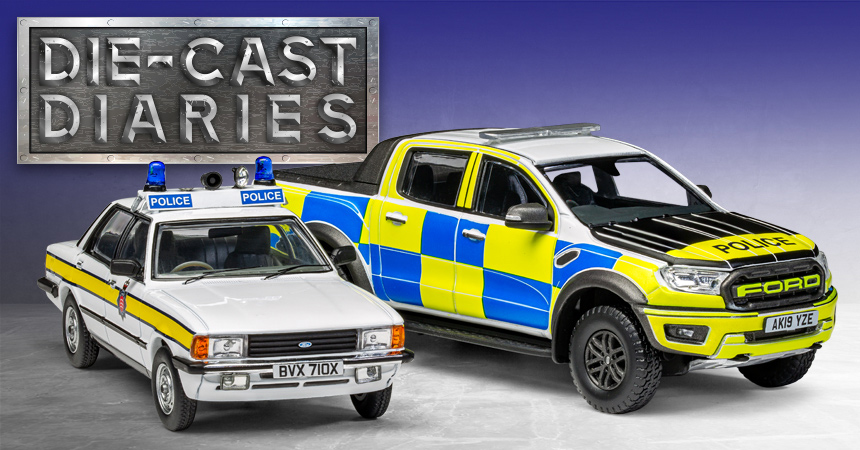
Welcome to the latest edition of Corgi Die-cast Diaries, your regular blog review of all the news, updates and topical stories from the captivating world of Corgi die-cast model collecting.
With a rather soggy RIAT weekend now well and truly behind us, we're delighted to report that we have a spectacular edition of Corgi project updates for you this time around, with details of several new Vanguards models, the latest update from our tribute to the future of motor racing and full details of the new Aviation Archive model which was unveiled to such popular acclaim at the Fairford show. With another new Vanguards tooling project fast approaching initial release, we have exclusive final production model images of the first two Ford Ranger Raptor releases to share with you, along with a rather arresting, but incredibly appealing third release from our popular Ford Cortina Mk5 tooling.
As we head into the final E-Prix weekend of the current season, we are excited to bring you the latest images of our newly tooled Gen 3 Formula E car model in 1/43rd scale die-cast, along with some rather significant changes to how this handsome new model will be positioned in the marketplace, but we will get to that a little later. Last, but by no means least, we will be bringing you details of our new model announcement from the recent Royal International Air Tattoo and the return of a model tooling which has been absent from the Aviation Archive range for around sixteen years, but will now triumphantly take its place once more in spectacular fashion, our 1/72nd scale English Electric Canberra.
Already shaping up to be something of a bumper edition, please join us as we enter the exciting world of new Corgi model developments once again, surely the best way to start any weekend break.
The new Ford Ranger Raptor model is about to muscle its way in to many a Vanguards model collection.
When it comes to statement new tooling additions to the popular Vanguards model range, few can boast the physical presence of our new Ford Ranger Raptor model series, our scale die-cast representation of this muscular go-anywhere beast of a vehicle. As we prepare to welcome this stunning new model to the range, we are delighted to be in a position to bring readers one final Raptor project update, where we will be featuring images of actual production models from the first two Raptor releases, giving you a clear indication of what you can expect when these impressive models arrive. We can definitely confirm that these models are not to be messed with and as far as our Vanguards collections are concerned, we'd all better start making some space, because the Ranger Raptor is coming through!
The purposeful Ford Ranger Raptor series is now an established range of vehicles which began their life as a successful series of compact pickup trucks, but as its name suggests, are definitely a little more ‘exciting’ than your average pickup truck, a vehicle which people of a more adventurous nature might well see themselves driving. Ford marketeers have been clever in not pigeonholing their Raptor to one particular sector of the vehicle market, aiming this range at a wide target audience, be that for business, or for pleasure.
Clearly, the Raptor is going to attract the attentions of business owners who are looking for a no-nonsense vehicle capable of transporting people and equipment across all types of terrain with ease, but for these core consumers, why should a vehicle such as this not also be stylish, in a rugged sort of way, and something you would be happy to use socially at the end of a busy working day? The Raptor is the sort of vehicle which is equally at home plying its trade as a hard-working agricultural vehicle with endless working applications, as it is cruising around a city centre, no doubt attracting plenty of admiring glances in both environments.
A bit of a beast, the new Vanguards Ford Ranger Raptor only just fits inside a standard Vanguards presentation box and once it gets out, it's not going to want to be put back in there again!
Owning a Raptor is a real statement of style and adventurous nature, people who don’t necessarily like to conform (well, at least not all of the time) or have interests which may be a little more active than most. Even though you might not be a champion rock climber or talented rugby player, if you own a Ranger Raptor, people could be forgiven for thinking you might well be. The ultimate incarnation of the Ford Ranger line, the Raptor is aimed at those who are looking to combine the ability to take their lives ‘off the beaten track’, without having to compromise on luxury, performance or style, a motoring force of nature that demands to be taken seriously. Dismiss the Raptor at your peril, because this off-roader is coming to get you!
With the ability to go where other forms of transport wouldn’t dream of venturing, the Raptor has been designed to excel in these challenging environments and is described as a street legal derivative of an off-road competition vehicle - how could you not want one of those? Even though it possesses all the credentials to be an off-road winner, it is surely on our normal roads where this vehicle will find its strongest sales support, as it's the very embodiment of a ‘don’t even think about messing with me’ vehicle. With its stunning good looks and purposeful styling, who wouldn't want to get behind the wheel of a Ford Ranger Raptor?
Taking the Vanguards range to new modelling frontiers, the inclusion of the Ford Ranger Raptor may have come as something of a surprise subject for some collectors, however, now that it's almost here, we know this new model's going to make quite an impression and we can't wait for you to experience it in the metal. Let's take a closer look at the details behind the first two, imminent Raptor releases.
VA15201 - Ford Ranger Raptor Press Vehicle - Ford Performance Blue.
The Ford Ranger Raptor was developed by Ford Performance, a division of Ford famous for developing cars wearing the legendary RS badge. It mixes the tough go-anywhere ability of other models in the Ranger line up with the kind of performance and driving pleasure that appeals to the enthusiast. It’s powered by a 2-litre Bi-Turbo Ford EcoBlue diesel developing a mighty 500 Nm of torque, which is distributed to the Ranger’s four-wheel drive system via a 10-speed automatic transmission, so it’s always in the right gear at the right time. The race-bred off-road FOX Pro suspension is designed to tackle fearsome terrain with ease while leaving the occupants in comfort.
The Ranger Raptor proves that you don't have to compromise on style if you need a rugged, no nonsense off-road capable vehicle.
The Raptor modelled here was one of the first built and was retained by Ford of Britain for press and publicity duties. It has featured in many TV programmes including the BBC’s Top Gear, Dream Jobs with Chris Hoy on Motor Trend and Amazon’s The Grand Tour, where it was used as a support vehicle. It was also road tested by numerous magazines including CAR, Parkers, Auto Express, What Car and Company Van Today. Additionally, it has been widely used by the Ford Press team for various events including The Society of Motor Manufacturers and Traders test drive days which are attended by both journalists and industry figures. It was a key vehicle in Ford of Britain’s Press Launch for the New Ranger in 2019.
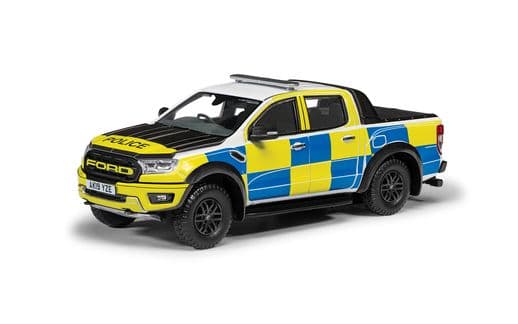
VA15202 - Ford Ranger Raptor - Police Demonstration Vehicle, South Wales Police.
The Police Raptor demonstration vehicle modelled here was converted by Ford’s Special Vehicle Preparation Team in Essex during 2019, shortly after the Raptor was launched. The base vehicle cab was stripped down to gain access to the roof and dash areas so it could be fitted with an all-LED blue light and search light facility, plus a sophisticated communications system and ANPR capability. It was then finished with the high performance Battenburg livery now used by all UK police vehicles. The Raptor’s 2-litre Bi-Turbo Ford EcoBlue diesel engine, which develops 500 Nm of torque was left standard, as was the four-wheel drive system which distributes all that torque to BF Goodrich K02 33-inch all-terrain tyres.
A cattle rustler’s nightmare - no matter what the terrain, if you're being pursued by a Police Raptor, you'd better prepare for a night in the cells.
This high-profile vehicle has been loaned to a number of police forces across the UK for evaluation prior to possible purchasing and has been used by many Police Rural Crime teams. It was found to be especially useful in tackling hare coursing and farm thefts, where off road pursuits across farmland are required, an unusual task to which the high-performance Raptor is particularly well suited. The vehicle is designed to tackle fearsome terrain with ease while leaving the occupants comfortable and alert thanks to its race-bred off-road FOX Pro suspension. The Baja desert race mode setting improves the vehicle’s high-speed off-road performance, while the impressive 10-speed automatic transmission makes sure the Raptor is always in the right gear at the right time, whatever the conditions.
As you can see from the boxed model image we have included as part of this review, the Raptor really is a die-cast monster of a model and only just fits inside the traditional Vanguards presentation casing. One thing's for certain, once the Raptor is unleashed from its packaging, there's no way it going to allow us to put it back in there - prepare for some display case shenanigans, because the Raptor is about to muscle its way in.
The first two models from our new Ford Ranger Raptor tooling are now scheduled for imminent release.
With the final two races of the current Formula E season taking place at the London ExCel racetrack this coming weekend, everyone is looking forward to an exciting end to the championship, with several drivers still in contention for being crowned E-Prix champion for 2022/23. With British driver Jake Dennis currently leading the standings, he is sure to have plenty of support over the weekend as race fans will be willing him on to become the first British Formula E champion, the end of a thrilling campaign for both the sport and this extremely talented British driver.
Conceived in 2011, the first Formula E championship was actually held in 2014, but since 2020, the series has benefited from FIA World Championship status and is now surely set for much greater exposure and the support of many more motorsport enthusiasts. Obviously, the aim of Formula E is to help drive and promote electric vehicle technology and to that end, what better way could there be to attract attention than to race 200 mph capable electric racing cars around city circuits, with all the associated razzamatazz the world of high-end motorsport brings with it. Behind all the glamour of world class motorsport, there is a serious message to share and that is how Formula E aspires to accelerate change towards an electric future, one race and one city at a time. Using the spectacle of world class sport, the championship sends a powerful and meaningful message to help alter perceptions and speed-up the switch to electric mobility.
This current season witnessed the introduction of the new Gen3 cars, a development which was more revolutionary than a simple technical update. Basically, the championship changed everything about the cars they intended to use, making the vehicles lighter and possessing more power, with the 350kw electric motors capable of producing the equivalent of 470 bhp. In fact, this latest Gen3 design is all about the efficient management of energy, with certain phases of racing actually generating its own energy, returning this to the car's battery and further enhancing its performance.
These really are cutting edge racing cars which are now so powerful and so efficient that the drivers taking them to the track really are pioneers and unbelievably courageous in doing so. Make no mistake, Formula E is exciting, top class motorsport and electric racing cars are here to stay.
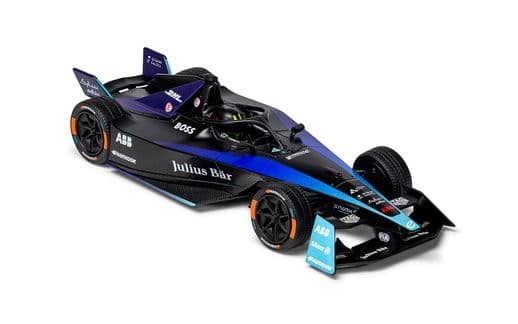
The latest Gen3 Formula E cars possess much greater power than their electric predecessors and now not only come close to matching the performance of Formula 1 cars, they're beginning to look much more like them too.
Our die-cast model tribute to this exciting championship is a faithful representation of these highly advanced Gen3 racing cars and has undergone some quite significant change over recent weeks. We have now decided to make this forthcoming model an exclusive Corgi website only release and at the same time, reduced the price to £39.99, by way of heralding this new era of Gen3 Formula E motor racing. We are also now in a position to share the latest model images from the project, with the car resplendent in its updated championship livery. With these cars now capable of achieving speeds of over 200 mph, the future of world motor racing is most definitely electric.
This project has actually been quite a demanding one for the Corgi development team to negotiate, with the highly advanced shape of the Gen3 car and all the cutting edge technologies it incorporates, not exactly lending themselves to being immortalised as a scale diecast metal collectable, certainly not without putting up a good fight anyway. The decoration of this striking car has also posed one or two challenges and with the current season in full swing, our friends at Formula E have had more pressing matters than checking our latest sample model to be frank. Having said all that, we are delighted to say that the project is now coming to fruition and we can now look forward to this exciting new model taking its place in the 2023 Corgi range.
The image updates we have included here feature the latest sample model received in the Corgi offices, however, in light of the recent changes announced to the pricing and availability of the model, all pre-orders will now need to be placed via the Formula E Gen3 - Championship livery webpage on the Corgi website.
A surprise aviation attendee at this year's Royal International Air Tattoo, our new 1/72nd scale English Electric Canberra may have only been on display in model form, but it was definitely a welcome, if extremely unexpected addition to the 2023 Aviation Archive range.
Aviation enthusiasts across the country will be only too aware that it's been 17 long years since the Royal International Air Tattoo has been able to boast the appearance of an English Electric Canberra, however, that situation changed just a couple of weeks ago, as a Canberra once again graced the world's greatest military Airshow! Okay, we might be talking about a scale version of the aircraft, but this was still big news from this year's show and definitely something to be celebrated. Of course, we are talking about the 1/72nd scale Corgi Canberra we announced as an exclusive addition to this year's range at the show, but if pre-ordering activity is anything to go by, this one has really struck a chord with collectors.
Although our English Electric Canberra tooling yielded its first model release back in 2004, the Aviation Archive range has not been able to boast the inclusion of a Canberra model for sixteen years now, so it could be argued that its return is long overdue, particularly when bearing in mind the significant position the aircraft occupies in the history of aviation. There have been attempts to bring the Canberra back into respective ranges since its previous appearance, however, for one reason or another, it never managed to make it all the way through the development process, which makes this all the more significant as a range addition announcement.
The first visitors to the Corgi and Airfix marquee on the Friday morning of this year's Royal International Air Tattoo would have been surprised to see our new Canberra positioned in our main display cabinet, particularly as we weren't scheduled to announce its existence to the world until midday, so some enthusiasts sites managed to steal a march on the main announcement and have a Corgi scoop of their own to boast. As for livery selection, we wanted to go with a Canberra which has been high on our list for quite some time now, one which will appeal to Canberra enthusiasts the world over.
The Aviation Archive range has always been fortunate enough to have strong support from collectors in Australia and New Zealand and we not only wanted to introduce a model which would be of particular interest to them, but also one which marked the significant role performed by Canberras wearing the roundel of the Royal Australian Air Force. Using the callsign 'Magpie', RAAF Canberras made a telling strike contribution during the Vietnam War and we wanted this latest release to mark the significant commitment the RAAF made to this conflict.
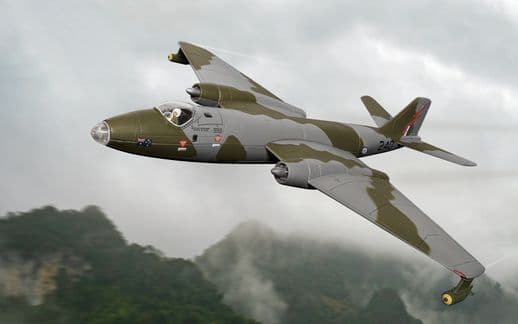
AA34710 - Government Aircraft Factories (GAF) Canberra Mk.20 A84-240, No.2 Squadron Royal Australian Air Force, On detachment to USAF 35th Tactical Fighter Wing, Phan Rang Air Base, South Vietnam, Vietnam War, Circa 1969.
With its reputation as one of the most effective military aeroplanes of the entire Second World War, the de Havilland Mosquito was always going to be a tough aviation act to follow, but as Britain entered the jet age, this significant task was the one facing acclaimed aircraft designer 'Teddy' Petter and his team at the English Electric Company in the North West of England. Building on the already impressive capabilities of the Mosquito, their new multi-role aircraft would be required to fly both higher and faster than its famous wartime predecessor, whilst at the same time possessing the same legendary versatility of Britain’s WWII Wooden Wonder - quite a daunting design prospect facing them.
The English Electric company had an established reputation of manufacturing electrical equipment, heavy machinery, transformers, trams and railway locomotives, however in later years, also expanded into the growing consumer electronics market, early computer technology and aviation. With the onset of war, English Electric became much more involved with the production of aircraft, but not initially those of their own design. From their factories at Preston and Samlesbury (near Blackburn), they produced Handley Page bombers for the RAF, starting with the twin engined Hampden and later moving on to the four engined Halifax heavy bomber. At the peak of production, they were delivering 81 new Halifax bombers to the RAF each month (achieved in February 1944), finally producing a total of 2,145 aircraft, whilst also constructing 770 of the smaller Hampden, a figure which represented over half of the total production run of this aircraft type.
Ready for take-off, our new GAF Canberra Mk.20 model made its Aviation Archive debut at this year's Royal International Air Tattoo and is being welcomed back into the Corgi fold after an absence of 16 years.
With all this invaluable production experience behind them, English Electric were determined to start producing their own aircraft and embarked on a significant expansion of its design and development facilities. Securing the services of talented former Westlands designer 'Teddy' Petter, their new recruit was given a free rein in building a team of young and forward thinking professionals, with their first project being a significant one - designing the intended replacement for the famous de Havilland Mosquito. This was a hugely ambitious undertaking for a relatively new aviation company and would be asking much of their recently assembled design team. Clearly, their new aircraft would have to fly higher and faster than any British production aircraft had ever done before, making use of all the very latest developments in both aerodynamic and propulsion technologies, if they were going to achieve their goal. Adopting many of the design philosophies which made the Mosquito such a success in the first place, the new aircraft would have to be fast, lacking any form of defensive armament and relying on speed, altitude and stealth to avoid interception by enemy aircraft - something special was happening in Lancashire.
Making its first flight in May 1949, the English Electric Company's new medium jet bomber was an aviation thing of beauty, sporting beautifully clean lines and clearly designed for speed. The aircraft showed great promise right from the start and was already causing plenty of excitement within the Air Ministry. Even as test pilot Roland Beamont was conducting the first flight of prototype VN799, English Electric were already in receipt of an advanced order for 132 aircraft. The Royal Air Force were so confident the new aircraft would give them a significant technological edge, that they didn't want to delay the service introduction of the new aircraft one day longer than necessary. Soon given the name Canberra, the new bomber would enter RAF service with No.101 Squadron from January 1951, with the Squadron being fully operational just four months later – their aircraft possessed exceptional performance and the RAF had the ground-breaking new jet bomber they had been hoping for.
The English Electric Canberra quickly proved to be a great source of national pride for Britain, particularly as the new aircraft was coveted by almost every air force in the world. The Canberra possessed incredible performance and started to break aviation records for speed, distance and altitude almost immediately, underlining its status as one of the most advanced and strategically capable aircraft in the world. It would also be true to say that the ground-breaking Canberra created a few problems for both bomber crews converting to the new aircraft and fighter pilots attempting to intercept them. The aircraft the Canberra was mainly replacing in RAF service was the mighty Avro Lincoln (along with the ageing Mosquito and Washington bombers) and bomber pilots converting to the new jet were clearly facing quite a challenge. They were moving from a large, fairly sedate four-engined bomber utilising WWII technology, to an aircraft which was the fastest in Royal Air Force inventory, possessing jet fighter-like performance and bristling with all the latest aviation developments.
It was also reported that during military exercises, the Canberra was so fast and could fly at such extreme altitudes that the Meteor fighters equipping RAF front line fighter units at the time simply could not intercept it, which was obviously a cause for some embarrassment within the force. This actually resulted in Canberra pilots being ordered to fly their aircraft under restricted performance parameters, thus allowing the Meteors to get close enough to simulate interception, all a little farcical really.
As the intended replacement for the de Havilland Mosquito, the RAF's first jet powered bomber matched and in many ways exceeded its design brief, with the Canberra proving to be arguably even more adaptable an aircraft type and being produced in more than 40 different variants during its impressive service life. Equipping no fewer than 65 RAF Squadrons at one time or another, the Canberra would also prove to be an incredible export success for Britain, purchased by 15 overseas air arms and built under licence in both the US and Australia. Several of the 48 aircraft built in Australia by the Government Aircraft Factory would go on to serve with distinction during the Vietnam War.
Following the end of the Second World War, the Australian government embarked on a radical reorganisation of their armed forces, placing an emphasis on smaller, more agile forces, but equipped with the latest and most effective equipment available. It was decided that the Air Force would receive the new British Canberra jet bomber and whilst it was not intended that the country would make use of nuclear munitions at that time, the Canberra's ability to deliver them was seen as an advantageous additional deterrent threat option.
Australia would eventually procure forty-eight Canberras, all of which were built under licence in the country by Government Aircraft Factories, with all of the aircraft's Rolls Royce Avon engines also built under licence, this time by the Commonwealth Aircraft Corporation. The Australians were of the opinion that their forty-eight cutting-edge Canberras would be a more effective aerial deterrent than their entire wartime force of some 254 heavy bombers, such was the faith they showed in the Canberra. Australian built Canberras were designated Canberra Mk.20 and the forty-eight aircraft were allocated serial numbers A84-201 through to A84-248.
Resplendent in newly designed packaging, our new Canberra will be of interest to Aviation Archive collectors, Canberra enthusiasts and anyone with an interest in Vietnam air war operations. We can't wait to welcome this model back into a Corgi range.
The first Australian produced Canberra flew in May 1953 and went on to serve with No.82 Wing later that same year. RAAF No.2 Squadron would be the first to be equipped with the Canberra, with No.6 Squadron being the second in 1955, followed by No.1 Squadron as the third and final unit in 1958.
During the Vietnam War, eight Royal Australian Air Force Canberras from No.2 Squadron operated under a memorandum of understanding between the RAAF and the USAF, operating from Phan Rang Air Base in central South Vietnam, attached for the duration to the 35th Tactical Fighter Wing of the United States Air Force. These aircraft would provide crucial additional strike support for US units and were requested because of the aircraft's endurance, bombing accuracy and their ability to operate below the notoriously low cloud bases which often affected this region, if required.
The first RAAF Canberra arrived at Phan Rang on 16th April 1967 having made the two hour transit flight from its base at Butterworth in Malaysia and the eight allocated aircraft would go on to serve with distinction during a four year period operating in support of the Vietnam War. With both RAAF air and ground crews operating at maximum efficiency, the Australian Canberras posted an impressive serviceability rate of 97%, but perhaps even more impressive than this, despite only flying 6% of the USAF 35th TFW's operational sorties during the conflict, they managed to inflict 16% of the damage inflicted.
By the time No.2 Squadron returned to Australia in 1971, they had become the final operational Canberra unit in the RAAF, but returned with a proud record of both serviceability and operational effectiveness throughout their deployment. Marking a glorious chapter in the history of Canberra operations, No.2 Squadron would be awarded two overseas citations for their achievements in Vietnam, the Cross of Gallantry with Palm, from the Republic of Vietnam and an Outstanding Unit Award from the USAF.
GAF Canberra Mk.20 A84-240 was one of the eight RAAF Canberras which served with such distinction during the Vietnam War and was actually to suffer combat damage during her lengthy deployment. On retirement from service, she was traded for a RNZAF Harvard, an aircraft which is now on display in the RAAF Museum. She was actually flown to retirement in New Zealand and escorted in for her final landing by a formation of RNZAF A-4K Skyhawk jets. She can now be found as one of the much-loved exhibits on public display at the RNZAF Museum at Wigram, in Christchurch.
The model on display at RIAT was a pre-production sample model and as we always like to stress, is still a development sample and subject to further changes. Nevertheless, we thought you would like a closer look at this appealing future release and to see the artwork produced in support of its range introduction. We will bring you a further Canberra update once we receive the next sample model, however, we can confirm that the Vietnam Canberra is scheduled for an Autumn release.
An arresting sight, Police liveried Vanguards model releases have always been popular with collectors and we are about to benefit from two cracking new additions. It would be a crime against diecast not to pick up one of these beauties!
The above heading was a vain attempt at something resembling a vaguely humorous police colloquialism from years past, but I think all I might have done there was highlight my advancing years! Throughout the history of the Vanguards range, model representations of police vehicles have always proved extremely popular with collectors and indeed when new tooling projects are announced, many collectors look to see if a police force liveried variant would be a possibility for the vehicle subject chosen. As far as our recently introduced Ford Cortina Mk5 tooling is concerned, that moment has now arrived and we are pleased to be able to include these final production sample model images of the next impending release in this latest update.
With the previous two models from this tooling selling out in no time, the arresting sight of this Essex Police livered Ford Cortina is only going to continue this trend, particularly as this new model is about to fill a significant space in many a Vanguards collection. Now scheduled for an early September release, this really attractive little model is being featured in one of our updates for the first time, although we fear that when it next receives a mention, it will be to confirm that it has followed its two predecessors into the 'Sold out Club'.
VA15003 - Ford Cortina Mk5 2.0 - Essex Police.
The manual Cortina 2.0 modelled here was an area car in service with Essex Police from March 1982. It is believed to have been based in Basildon and would have served for around three years before being replaced. In this era, Police forces often bought products from a company that had production facilities in the area so Essex Police almost exclusively used Fords. Cortinas served in a variety of roles because of this policy, from Traffic to CID and were well liked by the officers because they were comfortable and, when needed, quick enough to be useful. A small number of 2.3-litre V6 Cortinas were also used by Traffic Police to complement the more common Granada.
The first Police liveried release from our new Ford Cortina Mk.5 tooling, we expect this to be just as popular as the two models which preceded it.
UK wide, Fords have probably been the most popular vehicles for use in the area car role since the 1960s, mainly due to the adaptability, performance and economy offered by the Cortina. The area car method of policing was, however, pioneered by Nottingham Police in 1932, who trialled single operative vehicles where the driver used his left hand to operate a Morse key on a box where the passenger seat would have been, while driving, and listened via a hat-mounted earpiece.
The Metropolitan Police introduced an ‘Area Wireless Car Scheme’ in 1934, with two uniformed officers, actually talking to a control room rather than using Morse code, and the success of this meant it was gradually adopted and adapted the world over.
This latest addition to the Vanguards Police vehicle range is scheduled for an early September release.
Prize time - who was the lucky recipient of this stunning new 1/48th scale Eurofighter Typhoon FGR.4 model?
We end this latest Corgi update with something of an Aviation Archive call to action. You may recall that in our previous edition, we celebrated the first public display outing of the second release from our 1/48th scale Eurofighter Typhoon FGR.4 tooling at the RIAT show by announcing a competition with one of these stunning models awaiting our lucky winner. That competition is now closed and we will be e-mailing our winner over the next couple of days, so it might be an idea to keep an eye out for any e-mails arriving in your inbox with the words 'Corgi Typhoon Competition' in their title.
One lucky Corgi collector is about to receive some very good news, but for now, we would just like to thank each and every one of those who took the time to take part, because you all helped to make this such a successful endeavour.
We're afraid that's edition of Corgi Die-cast Diaries in the can, however, we will be back as ever in two weeks' time, with a further selection of model project updates to inform you about. Between editions, we are always interested to hear your views on all things Corgi, so if you feel like dropping us a line to comment on anything blog, collecting or Corgi model related, or even to suggest a topic you might like to see us cover in a future edition, please do drop us a line at diecastdiaries@corgi.co.uk.
If you can’t wait for the next blog, you will find plenty of Corgi model collecting discussions taking place on our official social media channels, access to which can be obtained by clicking on the respective links at the foot of the Corgi website homepage.
Link access to Corgi social media sites.
Thank you for continuing to support our Die-cast Diaries blog. Our next edition is scheduled for publication on Friday 11th August.