As the awesome destructive power of the Atomic age brought an end to the Second World War, the British Government were desperate to obtain an independent nuclear capability of their own. As a significant research and development partner on the Manhattan Project (US, British and Canadian development of the first nuclear bombs), Britain had expected America, as their friend and close Ally, to share this nuclear information with them, but America were reluctant to do so. Initially, the US had hoped to establish some form of international control over nuclear weapons, which meant that not even their close allies could be trusted with this highly classified information. Britain would be forced to resurrect her own indigenous nuclear programme, as ministers of the day felt that it was vital for continued national security that the British military should have access to nuclear weapons, regardless of the associated costs.
As the first nuclear weapons were rather heavy and cumbersome free-fall bombs, the decision to develop an independent British nuclear deterrent would also require development of new aircraft to deliver these weapons. In the latest edition of Aerodrome and in conjunction with a magnificent new model tooling announcement from Airfix, we are going to look at one of the three aircraft that was designed to provide Britain’s nuclear deterrent – the distinctive Handley Page Victor.
In the years following the end of the Second World War, the massive technological advances associated with this conflict began to transform the armed forces of the Allied nations. The Royal Air Force were still equipped with many piston powered aircraft, but these were being replaced by the latest generation of jet powered designs, as Britain was very much at the forefront of this relatively new technology. Bomber Command were still operating Lancaster, Lincoln and Washington four engined piston powered bombers, but the arrival of the magnificent English Electric Canberra jet bomber in the late 1940’s, would change the future of bomber design and finally announce the arrival of stable, reliable and extremely powerful jet engines.

Britain’s independent nuclear free-fall bomb ‘Blue Danube’
The requirement to deliver Britain’s nuclear bomb effectively resulted in the Ministry of Supply issuing a design specification (B.35/46) to aircraft manufacturing companies, for them to submit proposals for a new aircraft. It would have to be a medium range jet bomber, capable of carrying a 10,000 lb ‘Special gravity bomb’ (which was basically a conventionally launched free-fall nuclear weapon) to a target approximately 1,700 miles away. It would have to fly at a cruising speed of 580 mph, at altitudes of between 35,000 and 50,000 feet, in order that the aircraft could evade potential enemy fighter attack - this was to be an important design element, as the aircraft would not be equipped with any defensive armament and would have to rely on speed and altitude to evade enemy fighters.
There is some conjecture as to why Britain decided to proceed with three different Bomber designs for their deterrent force, but the beginning of the Cold War was certainly a significant factor. Following the end of WWII, lack of investment and the general wind down of Britain’s military capability resulted in the Soviet Union becoming an increasing threat. After six years of war, the British public simply did not have the appetite for more military posturing, but Britain as a nation was very much under threat and the nuclear age was here to stay. The RAF simply did not have the ability to strike deep into the Soviet Union and military planners were becoming increasingly worried about Britain’s vulnerability to attack by Soviet forces and her ability to withstand such an attack. The race to develop an effective nuclear deterrent and a means with which to deliver the weapon, were now of vital national importance.
If you accept the political state of Europe in the late 1940s and the genuine fear the destructive power nuclear technology propagated, it is clear to see why the establishment of an independent nuclear deterrent and the V-bomber force was so important to British national security. One question that certainly does come to mind though is why did Britain decide to produce three separate aircraft for the strategic nuclear bomber role? You will remember that we looked at how Britain desperately wanted to achieve nuclear capability, with cost not being a limiting factor – the start of the Cold War, Britain’s perceived vulnerability to attack and the work of the nuclear technicians meant that time was very much of the essence. A suitable delivery aircraft had to be found and there was no room for error. This could very much explain why designs from Vickers, Avro and Handley Page were ordered into production, as it would allow for three totally separate aircraft to be developed by different manufacturers and powered by different engine types – this would definitely increase the possibility of at least one effective aircraft being available to the RAF. It could also be argued that this decision helped to provide much needed work for the ailing British aviation industry, at a time when the inconvenience of mergers and amalgamations would have resulted in unacceptable delays.
There is also another significant reason for the multiple manufacturer V-bomber development programme and that is simply the highly advanced nature of the work that was being carried out, in relation to these designs. When you consider that at the time development started on the strategic nuclear bomber designs, Bomber Command was still operating both the Lancaster and Halifax bombers in some numbers and work on the new jet bombers was of a highly advanced nature – these aircraft really were cutting edge for this era. Indeed, the development process itself took longer than with earlier aircraft designs, due to the advanced technologies that had to be incorporated into the jet bomber designs. Overcoming numerous development problems associated with new aviation technology was to prove time consuming.

The first V-bomber to enter RAF Service – the Vickers Valiant
The first V-bomber to enter RAF service was the Vickers Valiant and although the aircraft was a significant leap forward in bomber design, the prototype aircraft did not actually satisfy the full specification requirements set out by the Air Ministry. This did cause something of a problem, particularly as the RAF were now desperate for their new bomber – the Ministry simply altered their requirement and Valiant development continued apace. Although still highly advanced, the Valiant was a relatively conventional design and Vickers made a promise that they could have the aircraft ready on schedule – when the aircraft entered service in early 1955, it became Britain’s first high-level strategic nuclear bomber. Britain now had its long awaited independent nuclear deterrent. Not only is the Valiant significant as the first V-bomber to enter RAF service, it was the first RAF aircraft to drop an operational British nuclear weapon – indeed, it proved to be the only aircraft of the British V-force trio to actually deliver a nuclear payload, as these early weapons were tested over Southern Australia and in the Pacific.
 The unmistakable shape of the Avro Vulcan – V-bomber No.2
The second of the V-bombers to enter service was perhaps the best known British bomber of the Cold War period and arguably the most successful of the V-force designs, the mighty Avro Vulcan. The first bomber aircraft to use a delta wing configuration, the Vulcan entered service following nine years of development, which really does illustrate the highly advanced nature of the aircraft’s design. Perhaps the most striking manifestation of Britain’s early nuclear deterrent capability was the sight of four all white Avro Vulcans blasting off the runway at either Waddington, or Scampton on quick reaction alert, displaying to the world that Britain was ready and able to respond to any act of aggression – this was exactly the show of strength military planners were hoping for when they issued their 1947 Operational Requirement.
Handley Page’s response to the specification B35/46 was an aircraft designated HP.80. This futuristic design was viewed as something of a radical option at the time and was very different to any British aircraft that had gone before it. Possessing a sweeping crescent shaped wing design, which incorporated three stepped kinks from the wing root to the tip, reducing in angle at each point, the Victor was certainly a distinctive looking aircraft. Designed with high speed flight stability as a primary consideration, the Handley page aircraft also had a high T-tail unit and pointed front fuselage.
The radical wing design required a significant amount of testing to ensure its suitability and Handley Page decided to produce a radio controlled 1/3rd scale glider model which they designated HP.87. Unfortunately, this aircraft was destroyed during its first flight, which required a major re-think. The solution was to construct a manned prototype, but again on a smaller scale – the resultant aircraft was a very strange looking aircraft. Designated HP.88, the aircraft was basically the fuselage of a Supermarine Attacker, with the addition of the crescent wing and high T-tail. Flown numerous times during the summer of 1951, the aircraft yielded valuable flight data for the design team, but tragedy was to strike the programme in August 1951, as the aircraft crashed during a test flight, killing pilot Duggie Broomfield. To further compound this tragedy, the wing design being tested on the modified Attacker had now been revised and prototype HP.80 bombers had already been placed into production.

The unusual Handley Page HP.88, based on the Supermarine Attacker
The Prototype HP.80 (Victor) WB771 was completed and readied for its maiden flight at the Handley Page facility at Radlett. At the eleventh hour, government officials felt that the runway at Radlett was not long enough for the flight to take place safely and a decision was taken that the flight should take place at Boscombe Down. This was no small task, as the airfield was 90 miles away and the aircraft would have to be transported there by road – the prototype was de-assembled and disguised for the journey, whilst a detailed reconnaissance of the proposed route was undertaken. At a number of points along the journey, it was found that lack of clearance would be an issue and bulldozers were called in to make the necessary earthwork alterations. With the large, tarpaulin covered structure eventually embarking on this somewhat unnecessary journey, the secret nature of the project would surely have raised more than a few eyebrows.
HP.80 prototype WB771 was finally re-assembled and prepared for flight at Boscombe Down and on Christmas Eve 1952, the aircraft gracefully took to the sky for the first time – the take-off distance was found to be surprisingly short for an aircraft of this size and clearly illustrated that the rather ignominious road journey from Radlett really did not need to take place. The aircraft performed impressively on its first flight and displayed no apparent vices.
 Handley Page HP.80 prototype aircraft at Farnborough
For a British public desperate to celebrate the achievements of their home grown aviation industry, the sight of this impressive new aircraft at the 1953 Farnborough Airshow must have been a special occasion. Sporting a highly distinctive paint scheme of black fuselage with red cheat line and silver wings and tail, this must have been a truly memorable sight and certainly one that excited the British press. Proudly displaying the best of British aviation design and technology, WB771 was without doubt one of the highlights of the 1953 show. Again, tragedy was to strike and the aircraft was lost the following year, as the tail unit sheered off during a low level manoeuvre, claiming the lives of the entire crew.
The Handley Page design team were quick to modify their new aircraft, as soon as the test and development flights highlighted potential deficiencies in the design – it has to be remembered that they really were charting new aviation territory with this aircraft and were encountering problems that had simply not been considered previously. Despite the setbacks associated with the testing of any new aircraft, the Air Ministry were so impressed with the aircraft and, it has to be said, so desperate for their nuclear bombers, that they placed an order for 25 production aircraft in June 1952, which was to be designated Victor B.1. Again, the highly advanced nature of the design resulted in a number of frustrating production delays. Numerous handling and design issues were encountered during testing and addressed as they occurred – these modifications would then have to be incorporated into the aircraft, which were already in production.
In November 1957, following ten years of development, the Handley Page Victor B.1 entered RAF service with No.232 Operational Conversion Unit at RAF Gaydon. In the spring of the following year, RAF No.10 Squadron at Cottesmore became the first operational Victor Squadron and Britain had her final V-bomber.
As well as being a particularly handsome looking aeroplane, the Victor proved to be an extremely effective design, which was more than capable of fulfilling the role for which it was intended. Sharing the same design feature as the earlier V-bombers, the four Armstrong-Siddeley Sapphire engines were housed in the wing roots of the aircraft, which helped to give the Victor its impressively clean lines but did create some problems when it came to engine servicing and maintenance. Compared to the Valiant and Vulcan, the crew compartment of the Victor was positively cavernous, although it still retained the configuration of only having ejection seats for the pilot and co-pilot. The Victor also possessed much greater bomb carrying capacity than either of the earlier V-bombers.
 Anti-Flash white painted Victor of Britain’s nuclear V-force
In many respects, the Victor outperformed the design requirements laid down by the original specification and proved to be an extremely accomplished strategic bomber, even though constantly changing operational requirements would challenge its capabilities and potential effectiveness. The early Victors were delivered in a rather sinister all over anti-flash white paint scheme, which was designed to protect the aircraft from the effects of nuclear blast but clearly served to indicate the mission profile of these handsome bombers. Originally configured to carry Britain’s first independent nuclear bomb ‘Blue Danube’, the Victor was flexible enough to be adapted to carry the later ‘Yellow Sun’ weapon, or an impressive array of conventional munitions. A total of 50 Victor B.1 aircraft were eventually built for the Royal Air Force.
Despite the undoubted success of the Victor B.1 bombers, Handley Page felt that they had not realized the full potential of the design and they began work on producing an upgraded ‘Super Victor’. Clearly demonstrating the flexibility of the original design, the Victor B.2 featured a number of significant improvements over the earlier aircraft, as designers looked to send the aircraft higher and faster. The new Rolls-Royce Conway turbojets replaced the original Sapphires, but required some significant re-design of the wing area. The intake inlets were increased in size, to allow for greater airflow into these more powerful units and wing modifications to the root and tip areas resulted in an overall span increase of some 10 feet. A host of internal equipment upgrades made the aircraft more effective and the inclusion of an auxiliary power unit in the right wing stub allowed the aircraft to self start, without the need for specific ground support units.

The unusual crescent shaped wing of the Handley Page Victor
As the Victor showed itself to be a strong and flexible airframe, other modifications soon followed and the clean, sleek appearance of the early aircraft soon disappeared beneath a multitude of probes, lumps and bumps. These were all designed to increase the operational effectiveness of the aircraft, as its operating environment evolved and better technology became available. Almost as soon as the B.2 Victors entered service, a significant modification was required to allow the aircraft to carry the ‘Blue Steel’ nuclear stand off missile. This was carried in a semi-recessed position under the fuselage of the Victor, with the missile adopting a distinctive nose down attitude. These white anti-flash Victors were arguably Britain’s most distinctive nuclear deterrent aircraft, during the period when the RAF carried this significant responsibility, before handing over to the submarines of the royal Navy.
Unfortunately for the RAF and their Victor Squadrons, the pace of aviation development was not confined to Britain alone and advances in Soviet fighter and Surface to Air Missile effectiveness was to have a significant impact on V-force operations. The high altitude delivery of nuclear munitions was now unreliable at best and futile at worst and the V-bombers were quickly switched to performing low-level strike operations, a role for which they were not designed. The white anti-flash scheme was replaced with a tactical camouflage and one aircraft was clearly more suitable for this role than the other two – the large wing area of the Avro Vulcan gave it a distinct advantage in lower altitude operations. It would not be long, however, before the RAF would be forced to relinquish its role as Britain’s nuclear deterrent force and pass this responsibility to the Royal Navy. Indeed, the switch to low altitude operations would claim the service life of the Vickers Valiant, as significant stress fractures were discovered in the spars of the aircraft and they were ignominiously withdrawn from service. These low level strike missions were also not particularly suited to the Victor, but the effectiveness of the design dictated that they would be suited to another important role.
 Duxford’s unique Victor B.1A XH648, wearing RAF No.57 Squadron colours
With the ability to re-fuel aircraft in the air becoming increasingly more important, the RAF had converted a number of Valiant aircraft to perform this task. At the same time, they were also using a number of older Victor B.1 aircraft in trials to assess the type for future use in this role. When the Valiants were withdrawn from service, following the discovery of fatigue cracks, the RAF were left without tanker support. This obviously created a huge problem for the RAF and the Victor tanker test aircraft were rushed into service, with more Victors quickly earmarked for tanker conversion. The aircraft used a hose and drogue system, with recipient aircraft taking fuel from a hose trailed from pods under the outer wing of the Victors, which proved to be a stable and effective platform for this task.
The first Victor Tankers in service only had the two outer wing refuelling stations fitted, but later conversions included provision for a third, fuselage installed centreline Hose Drum Unit and increased fuel carrying capacity. Even though there were now three refuelling stations on the Victor, a maximum of two aircraft could take fuel at any one time and these must both be on the outer stations. The central unit actually had a much increased flow rate and was ideal for refuelling larger transport or bomber aircraft, or even re-fuelling another airborne refuelling aircraft.
As the latest Victor B.2 aircraft proved to be unsuitable for the low-level strike role, many of these aircraft were placed in storage – they did not stay there for long. As the original Victor tankers were drawing close to retirement, plans were drawn up to convert the B.2 aircraft to dedicated tanker support aircraft, as the Victor had proved to be particularly suited to this role. The original proposal to complete this work was submitted by Handley Page, but the company was now in financial difficulty and in a perverse twist of fate, the work was actually carried out at the Avro factory at Woodford – their long time manufacturing competitor.
 Elvington based Victor K.2 tanker XL231 ‘Lusty Lindy’
The new Victor K.2 tankers were equipped with a three point refuelling system, with all bombing gear removed from the aircraft allowing a much increased fuel load to be carried. As the aircraft would no longer be required to fly at high altitude, the wing of the Victor was strengthened and significantly clipped at the tips, to reduce stress on the wing and increase its operational effectiveness. For many aviation enthusiasts, the K.2 tanker version of the Victor is the only one they remember seeing in flight and will be their lasting memory of this extremely distinctive aircraft.
Although the Handley Page Victor was designed as a high speed, high altitude strategic nuclear bomber, it was thankfully never called upon to fulfil this dreadful role, but it was to see significant action in its final tanker configuration. The Falklands War of 1982 saw a number of Victors heavily involved in both tanker refuelling sorties and long range reconnaissance missions and when studying the logistics of these operations, it certainly leaves you impressed with the capability of the Handley Page Victor. On one particular reconnaissance mission over the South Atlantic, a Victor was in the air for 14 hours and 45 minutes and covered a distance of some 7,000 miles!
 The unmistakable profile of the Handley Page Victor
Without doubt, the most significant mission undertaken during the Falklands conflict was the Black Buck raid against the Argentine held airfield at Port Stanley. Displaying the tenacity and flexibility of the Royal Air Force, no fewer than eleven Victor tankers took off with a single Avro Vulcan bomber and undertook a meticulously coordinated plan to re-fuel the Vulcan and each other, allowing the Vulcan to be in a position to attack the runway at Port Stanley airfield. Under strict radio silence, the mission proved to be a success and even though only one bomb actually struck the runway, the psychological impact was immeasurable on both sides. For Britain, it proved that they could undertake a mission of this immense complexity and bring everyone home safely and for the Argentinians, it showed them that they were dealing with a determined adversary, who were capable of striking not only at their forces on the Falkland Islands, but also on mainland Argentina itself. For the crews of the Victor tankers, this must have been a proud moment and although the Vulcan stole most of the glory, it was they who got the Vulcan to the target and they who brought it home!
The swansong of the Victor tanker force proved to be the 1990 Gulf War, when coalition forces were sent to challenge the Iraqi invasion of Kuwait. Wearing a smart desert paint scheme, the RAF Victors were sent to support the coalition air operations over the Gulf and refuelled not only RAF aircraft, but also a number of other Allied aircraft. RAF No.55 Squadron sent eight Victor K.Mk.2 tankers to the Gulf, with a number of aircraft gaining some rather appealing artwork during their deployment and although the aircraft were very much in the twilight of their operational careers, they distinguished themselves whilst in the Gulf. These grand old ladies managed to keep many an Allied fighter fuelled up and ready for action. On their return to the UK, these magnificent aircraft were extremely popular static display items at UK Airshow events, both for their impressive performance in theatre and for the artwork that adorned many of the airframes. Unfortunately, 1993 saw the disbandment of the Victor tanker force and the end of the once mighty V-bombers. Significantly, the Victor was to remain in RAF service for almost ten years after the retirement of the Vulcan, even though it was in a much different role than the one it was originally indented for.
 Gulf War veteran XL231 is kept in ground taxiable condition at the Yorkshire Air Museum
The past few months have been dominated by discussion regarding the final flights of the last flying Avro Vulcan, but for many enthusiasts and military historians, the Handley Page Victor was the most technologically advanced and most effective of Britain’s mighty V-bomber force. Many also feel that the Victor does not receive the respect that this magnificent aircraft surely deserves.
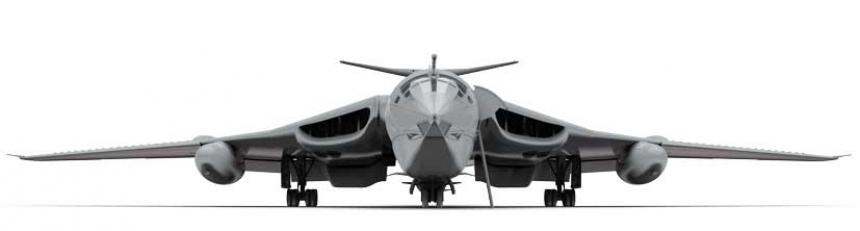
 Computer rendered 3D image of the new 1/72nd scale Handley Page Victor B.2
By the time you are reading this latest edition of Aerodrome, modellers all over the world will be aware of the big IPMS Telford show announcement from Airfix – they will be releasing a totally new 1/72nd scale model of the Handley Page Victor B.2. This new model will obviously be an extremely popular addition to the growing range of fantastic new Airfix model releases and will again be produced using the impressive development processes now in place at Airfix. The tooling will feature the option to include a ‘Blue Steel’ nuclear stand-off missile under your Victor, allowing the modeller to produce perhaps the most iconic configuration of Britain’s Cold War V-bomber force. The model will also sit nicely with the existing Airfix Avro Vulcan in 1/72nd release, which many modellers will already have in their collections.
The Victor B.2 version of the aircraft saw some significant improvements to the existing B.1 design, which allowed the aircraft to operate at higher altitudes. Powered by Rolls Royce Conway engines, these air hungry beasts required a re-design of the air intake section of the wing roots, to increase the amount of airflow into the engine. The B.2 also featured a pair of distinctive retractable air intakes, which were positioned on the upper fuselage of the aircraft, just in front of the tail fin – known as the ‘elephant ears’, these scoops would feed ram air turbines, to provide electrical power in emergency situations. The B.2 Victors were also capable of carrying the ‘Blue-Steel’ nuclear stand-off missile and acted as Britain’s nuclear deterrent, until this role was taken over by the Navy.
 Computer rendered 3D image of the new 1/72nd scale Handley Page Victor B.2
This announcement will clearly be of great interest to modellers and I am sure that many of you would like to find out more – simply head for the Airfix website, where the team will bring you all the latest details and keep you fully informed as this exciting new Victor B.2 project progresses.
I am afraid that’s it for another Aerodrome, which seems to have turned into something of a monster edition. I am off to see the new Airfix Victor B.2 at the Scale Model World show at Telford now, but I will report back for Aerodrome duty again next Friday.
As usual, you are welcome to discuss our latest blog either on the Airfix Aerodrome Forum or Corgi Aerodrome Forum. If you have any specific comments, questions or suggestions for future editions of Aerodrome, please feel free to let us know via Airfix Facebook or Corgi Facebook, or on Airfix Twitter or Corgi Twitter using #aerodrome. It would be great to see any Handley Page Victor images you may have lurking in your photographic collections!
Until next week, thank you very much for reading.
Michael
© Hornby Hobbies Ltd. All rights reserved.