

Welcome to this latest edition of Aerodrome and our regular look at the fascinating world of aeroplanes and the historic aviation scene around the UK.
Although we’re now just a week away from the clocks going forward and the start of British Summer Time, it still feels quite some way off being able to attend our first Airshow of the year, so we still need to look elsewhere for our Aerodrome blog subject inspiration. Thankfully, we’ve had a good winter when it comes to finding new and interesting events and venues to attend, and in this regard, this week’s subject offered two appealing ‘firsts’ for me, in terms of aviation experiences.
With next Monday marking the 35th Anniversary of an Avro Vulcan making its final flight in Royal Air Force service, we needed little excuse to enter the world of this much-loved Mighty Delta in this latest edition. We will be reviewing a recent event arranged to photograph the youngest preserved Vulcan in existence, Avro Vulcan B.2 XM655 at her Wellesbourne Mountford airfield home, the first time I had ever photographed this Vulcan, and the first time I had ever visited its Warwickshire airfield home. As you would expect, we will be bringing you a selection of images which were all taken during this day/evening event, and a review of what proved to be an extremely enjoyable few hours admiring a Vulcan.
We find ourselves in the company of Britain’s youngest Avro Vulcan in this latest edition of Airfix and Corgi Aerodrome.
When it comes to spending time with preserved examples of Britain’s most iconic Cold War jet powered bomber, we’ve actually done rather well over recent months, and haven’t needed to call on the charms of famous XH558 ‘Spirit of Great Britain’ once. We’ve attended events at the Avro Heritage Centre featuring Vulcan XM603 on a couple of occasions, and spent a spectacular day with XL426 and the Vulcan Restoration Trust as their aircraft blasted down the runway at Southend Airport. These are in addition to visiting a couple of museums which have Vulcans amongst their collections, so we’ve been rather fortunate on the Vulcan front.
As this coming week will mark the 35th anniversary of the final flight of a Vulcan in Royal Air Force service, we thought a Vulcan feature would be highly appropriate for this latest edition of Aerodrome, and noticed an event taking place at the former RAF Wellesbourne Mountford Airfield which featured Britain’s youngest example. What could be more perfect.
Avro Vulcan B.2 XM655 was built and made her first flight from the Avro factory airfield site at Woodford in Cheshire during 1964, the third to last example of the aircraft to be produced. As the final two aircraft XM656 and XM657 have now both been scrapped, this earns her the significant title of being the youngest Vulcan still in existence.
On joining the Royal Air Force, she was allocated to No.9 Squadron at RAF Cottesmore on 23rd November 1964 in the low-level tactical bombing role, but would also go on to fly with Nos.12 and 35 Squadrons during her time there. Whilst at Cottesmore, she would take part in several overseas bombing exercises, including time spent flying in Malta, Singapore, the US and Canada.
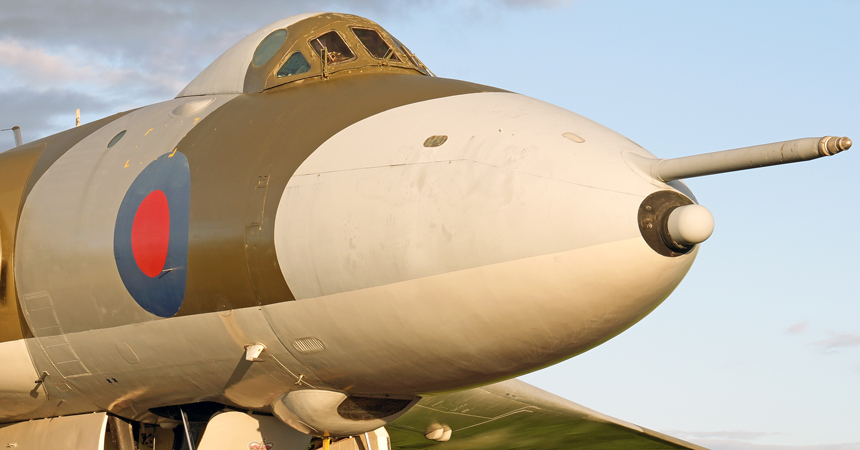
Avro Vulcan XM655 is beautifully turned out at Wellesbourne Airfield, and is the youngest Vulcan in existence.
On 12th January 1968, she would join the Waddington Vulcan Wing, which at that time consisted of Nos.44, 50 and 101 Squadrons, but by 1975, would also include No.9 Squadron. Training at a high state of readiness, the aircraft was constantly supporting crews sent on overseas deployments, perfecting the low altitude strike role for which the Vulcan was never really intended, but actually took to like a duck to water.
In 1970, she would embark on her first around the world deployment, which was an exercise planned to demonstrate the RAF’s ability to effectively reinforce far-flung areas of the Commonwealth in times of conflict, something they achieved with distinction, whilst allowing several friendly nations to enjoy seeing Vulcans at close quarters during the flights out and back again.
By 1983, the Waddington Wing was operating in a somewhat depleted manner, with XM655 serving alongside remaining Vulcan K.2 tankers converted as a result of the previous year’s Falklands Conflict, but with the threat of withdrawal now being very real. With the announced disbandment of No.50 Squadron due to take place in the spring of 1984, Vulcan XM655 was put up for disposal by the Ministry of Defence at the end of 1983.
In 1984, the aircraft was bought by businessman Roy Jacobsen who harboured a serious ambition to fly the aircraft on the Airshow circuit both here in the UK and in North America. Having only completed a Cat 3 Check a few days earlier, XM655 was flown from RAF Waddington to Wellesbourne Mountford airfield by Squadron Leader Joe L’Estrange on 11th February 1984, the first of the former RAF Vulcans to enter civilian ownership. In support of his ambitious plans for the aircraft, he secured the civilian registration G-VULC for the aircraft here in Britain, and N655AV for when she was flying in North America.
At this point, it’s probably appropriate to state that despite these impressive plans being articulated by the new owner, the CAA provided little in the way of encouragement for him, clearly stating that no Vulcan would ever be granted a permit to fly without a great many difficult to achieve conditions having been met first. Nevertheless, the project started to gain momentum and the business of fund raising began in earnest.
A relic of the Cold War era, this particular Vulcan is still full of life and determined to show what she can still do.
Unfortunately, ambition and desire are of little use when trying to get a 60 ton former RAF nuclear bomber into the skies in civilian hands, and two years of setbacks, delays and official intransigence caused the owner to lose interest in the aircraft, but not before he’d bought another Vulcan off the MoD and had it delivered to Southend Airport (XL426). His original aircraft was still sitting idle at Wellesbourne, and with parking fees now beginning to rack up, the airfield owners challenged the Vulcan’s owner to discharge his payment responsibilities. The upshot of these discussions was that ownership of the Vulcan passed to the airfield itself, and a new chapter in the history of this aircraft could begin.
As you might imagine, several years of inactivity, neglect and being stored out in the open left XM655 looking in something of a sorry state, something which wasn’t helped by vandals breaking into the aircraft and causing significant damage, something which later would cost much in both time and money to put right. An engineering group was established to care for the mighty delta, and the future started to look much more positive for XM655.
Arguably the most significant development since her arrival at Wellesbourne was the establishment of the 655 Maintenance and Preservation Society (655MaPS) in late 1998, the group which have cared for this impressive aircraft ever since. Over the years, their activities have included the establishment of workshops, securing of on-site storage units for equipment and the purchase of ground support equipment, all through Society activities and donations from Vulcan enthusiast supporters.
Further activities undertaken have included several repaints of the aircraft, a return to as close to her service configuration as possible, and the maintenance in running order of the aircraft’s more powerful Bristol Olympus 301 engines, with the engines regularly being run to check everything is in order, usually every three months or so. The aircraft is also maintained with fuel permanently in her tanks, with the team stating that it’s always better to keep the systems and seals ‘wet’.
The 655MaPS website also includes the following information about the condition of the aircraft they spend so much of their time caring for.
XM655 is virtually complete in terms of installed equipment, with the H2S Radar, the Terrain Following Radar (TFR) and Identification Friend or Foe (IFF) systems all still in-place, as well as the complete suite of Electronic Counter Measures (ECM) equipment. The only notable item missing when XM655 left RAF service was the in-flight refuelling probe; not surprising considering the world-wide hunt for serviceable probes which had occurred during the Falklands conflict a couple of years earlier. Eventually, a replacement probe was obtained and installed, and XM655 regained her familiar profile.
A few years ago, we were able to ensure that the aircraft looks like a bomber – mounted within the cavernous bomb bay is a ‘Vulcan Seven Store Carrier’ which is the piece of kit from which were suspended seven 1,000lb conventional high explosive bombs. This has been provided on long term loan from the RAF Museum. More recently we have been able to obtain and install seven dummy bombs, making things even more realistic.
She is certainly a credit to their steadfast efforts, and they must be righty proud when enthusiasts descend on them to admire their magnificent aircraft.
This early season trip to the former RAF Wellesbourne Mountford Airfield was planned so I could take my place amongst the enthusiasts attending an early season photoshoot event, one which had Vulcan XM655 as its rather impressive subject. As mentioned earlier, I had never previously photographed this particular Vulcan whilst in civilian hands, and I had never been to Wellesbourne airfield before, so this seemed like an ideal opportunity to break two ducks on the same trip.
Wellesbourne Mountford Airfield can trace its heritage back to the Second World War and the establishment of a Class A airfield to be used by Bomber Command. Opened in April 1941, three large concrete runways and associated taxiways were constructed on local farmland, with the airfield destined to be a significant location in the training of British and Commonwealth aircrew for service with Bomber Command. Home to No.22 Operational Training Unit, the aircraft mainly seen on the airfield during the wartime years were Vickers Wellingtons and Avro Ansons, and whilst training was the main task of the airfield, instructors and proficient students did take part in bombing raids, when maximum effort raids were called for.
Towards the end of the war, the airfield was used by No.3 Glider Training School, as they prepared crews for intended deployment to the Far East, but with the end of the war, the airfield again returned to a fixed wing training role with the arrival of No.9 Advanced Flying Training School. Students would spend time flying such aircraft as the North American Harvard, de Havilland Chipmunk and Airspeed Oxford, with Avro Ansons being used by students at the RAF School of Photography which was also based there for a time.
The close proximity of the V-Bomber base at RAF Gaydon later dictated that military flying activities were curtailed and in 1964, the airfield was returned to its original owners. Since then, some of the facilities have either reduced in size or disappeared altogether, but Wellesbourne is now an interesting and vibrant general aviation airfield, with plenty of facilities to support the enjoyment of aircraft and aviation, including a rather impressive Vulcan bomber at the 18 (northern) end of the airfield.
Despite an uncertain start to her time at Wellesbourne Mountford, the committed members of the 655 Maintenance and Preservation Society have ensured that their Vulcan is now in rude health.
The event I was attending was one run jointly by the 655 Maintenance and Preservation Society and Threshold aero, and held the prospect of Vulcan XM655 being made available for a late afternoon/early evening photoshoot appointment. After I had already secured my place, we were later informed that the team behind XM655 also intended to conduct an engine run during our visit, which was just something else to look forward to – a howling Vulcan is always a rare treat of an experience.
With everything packed and checked, I made sure I arrived at the airfield in good time and joined other enthusiasts in gathering for the safety briefing, which is always the precursor to any enjoyable evening of aviation photography, particularly as this is an active airfield, and our wait was made all the more entertaining by watching people heading out on flying lessons, or enjoying a flight experience over Warwickshire.
Although this was an early season event, the weather was actually quite good and as the sun was out, and there was a huge puddle just in front of the Vulcan, we photographers were itching to be unleashed, so we could take up an inglorious position lying on our bellies. For some of us, it was a good job they had some lifting gear on site, just in case we needed a little help getting back to our feet.
Once released onto the airfield, we all made use of the good light to secure our pictures of this magnificent machine, with the Threshold team doing their level best to pander to our every photographic wish – crew access door open or closed, Sentinel Tug in or out of shot?
Thankfully, on events such as these, there is a certain decorum amongst fellow photographers, and whilst we’re all attempting to get that ‘special’ picture, most will always be mindful of the needs of others and not occupy any position for more than would be deemed appropriate, perhaps with the exception of that puddle which was proving so popular, because we all wanted to spend time working with that. Despite everyone watching how effectively to got down and hauled yourself up again, this was just too good a photographic opportunity to refuse, and most of us had at least a couple of goes enjoying this rather unique water sport pastime.
Double Delta delights at Wellesbourne Mount
Although this picture can never do it justice, the video being filmed here is recording the symphony created by a pair of Bristol Olympus 301 engines.
With the moon out and blue hour just a few minutes away, the 655MaPS team gave us all an entertaining break by treating us to an engine run, because they were fully aware that a living, engine running Vulcan is always more impressive than a quiet, static one. XM655 is one of the Vulcans equipped with the more powerful Bristol Olympus 301 engines, and she likes nothing more than showing them off.
Refusing the offer of ear plugs so I could benefit from the full Olympus experience, apparently, only two of the engines (nos. 3 and 4) were fired up for this demonstration, but they still made an almighty racket. Even more impressive than that, when the power was turned up to a higher setting, the thrust being generated was absolutely incredible and it really did seem as if our Vulcan’s brakes might not survive the experience, sending her off down the taxiway at any moment – the power really was so impressive.
Once the engine run had ended and all checks had been completed, we had a few more minutes to grab our final few shots, as the winter timings meant that we had a relatively early finish to the event, but not before visiting the on-site shop to pick up a couple of souvenirs. I have to say that my first visit to Wellesbourne Mount had been an extremely enjoyable success.
On behalf of all those in attendance, I would like to thank the Threshold team for arranging another thoroughly enjoyable event, and the entire 655MaPS crew for allowing us access to their magnificent Vulcan. She really is a credit to you all, and allowing enthusiasts to spend a little time in her company is nothing less than an aviation treat – she’s an absolute stunner.
This final selection of images begins as the light started to fade at Wellesbourne airfield.
We can all keep updated with the latest news and event information by checking the official XM655 Maintenance and Preservation Society website, and if you would like to help support their efforts in preserving this impressive piece of British aviation heritage, any donation or purchase from their webstore will always be gratefully received.
I can say with some confidence that this will definitely not be my last visit to Wellesbourne Mountford airfield and Avro Vulcan B.2 XM655.
I’m afraid that’s all we have for you this time around, however, we’ll be back again in four weeks’ time with more news, updates and pictures from the fascinating world of aviation. Thank you for your continued support and as always, if you would like to comment on anything blog related or suggest a subject you would like to see covered in a future edition of Aerodrome, please do drop us a line at aerodrome@airfix.com, where we would be delighted to hear from you.
Should you wish to continue the aviation discussions between editions, you will always find something of interest over on the Airfix Aerodrome Forum and if social media is more your thing, please use the respective official social media icon links at the bottom of the main Airfix and Corgi website homepages to access our official sites.
The next edition of Aerodrome is scheduled to be published on Friday 17th April, and we look forward to sharing more aviation inspired content with you then.
I hope to see you all back here in four weeks.
Michael