Welcome to the latest edition of Aerodrome and our regular look at the fascinating world of aviation. One of the most exciting developments in historic aviation this year came at the Imperial War Museum Duxford and the re-opening of their American Air Museum in March – thanks to pictures supplied by two Aerodrome readers, we are going to be taking an interesting look at some of the logistics behind the transformation of this museum and the unique photographic opportunities this work afforded enthusiasts. As this proved to be a significant and costly operation, it is unlikely that such exhibit movement will be attempted again for the foreseeable future and this latest edition of Aerodrome will make a fascinating companion feature to our previous museum opening review. We would like to extend our grateful thanks to Ian Crawford and Steve Kimpton for allowing us to use their photographs in this latest blog.
In late 2014, the Imperial War Museum at Duxford announced that their famous American Air Museum would be the subject of a major transformation, which would necessitate its closure for the duration of these significant works. Although many enthusiasts assumed this would simply be a change around of the aircraft on display in this impressive building, the trustees of the museum had much bigger plans than this. Interestingly, as Duxford is an extremely popular destination for enthusiasts, schools and film production units, the work to be carried out would be very much in the public eye, even though the AAM itself would remain closed during this period.

The McDonnell Douglas F-15A Eagle is now displayed in the AAM
The huge glass front of the building would have to be dismantled, so that the aircraft on display could be taken to other locations on the airfield, where many would receive some renovation attention prior to their return to the museum. Whilst this was being done, design engineers would work on the empty shell of the American Air Museum building, in preparation for the planned exhibits to return. For months, aircraft not usually seen outside of the AAM could be seen at various locations around the airfield and if you were really lucky, being transported from one place to another. Although Duxford is always an interesting place to visit, during the period of these exhibition changes, there would have been unusual picture opportunities on an almost daily basis.
Amongst the myriad of aviation delights on display at Duxford, perhaps the most impressive and undoubtedly the largest is Boeing B-52D Stratofortress 56-0689. This massive aircraft has been one of the most popular exhibits at the Imperial War Museum for over thirty years and is perhaps the most visible manifestation of the awesome offensive strike capability of the American Air Force. It is also quite incredible that whilst this particular aircraft has been a source of fascination for Duxford visitors for a great many years, the B-52 Stratofortress is still in front-line service with the US Air Force over sixty years since it entered service and is likely to remain so until around 2040.

The B-52 Stratofortress keeps an eye on the transformation of the American Air Museum

Another view of the B-52 whilst outside during the renovation work
The museum’s B-52 is certainly one of their most significant exhibits, particularly when considering that this huge aircraft was actually flown into the airfield – the largest aircraft ever to land at Duxford. In October 1983, 56-0689 made her final flight as a USAF aircraft when she was delivered to Duxford as a gift from the US Air Force. As the RAF had sent three Avro Vulcan bombers to US museums the previous year, this was to be a high profile presentation to the Royal Air Force of a bomber that not only marked a current USAF type, but one which had served with distinction during the Vietnam War. The delivery flight would be a significant occasion for the crowds gathered at Duxford and a particularly challenging one for the crew of the mighty bomber – they would be attempting to land the aircraft on the shortest runway a B-52 could be operated from. With this in mind, the aircraft was carrying minimum fuel reserves and had been stripped of all unnecessary equipment to save weight for the short landing and having completed two practice approaches, the crew made a perfect landing at Duxford, to the delight of the gathered crowds.
This particular aircraft had been built in 1956 and was originally delivered to the USAF 28th Bomb Wing at Ellsworth Air Force Base, South Dakota in October 1957 and during its career amassed an impressive 15,000 flying hours. The aircraft was also heavily involved during the Vietnam War, taking part in no fewer than 200 bombing missions in support of the American war effort – with these credentials to its name, this particular aircraft would rightly form a major component of the future American Air Museum at Duxford. Following its arrival at Duxford, the Stratofortress was displayed on the open airfield, as was the case with many of the other larger exhibits at the Imperial War Museum, but following the decision to build the American Air Museum, she was destined to have a much more appropriate home. With the opening of the museum in 1997, the mighty BUFF moved indoors and became the centrepiece of this uniquely British tribute to American air power.

These unique photographic opportunities are unlikely to be repeated
As work got underway on transforming the American Air Museum, the existing exhibits would have to be completely removed from the building, including those suspended from the ceiling and the imposing B-52 Stratofortress, around which every other item would have to be arranged. This would see the museums most impressive exhibit having to spend time in the open air, for the first time in eighteen years and allow anyone lucky enough to visit Duxford during the duration of the renovation works, the opportunity to take some unusual and extremely interesting photographs, before the B-52 was returned to her protective home. Indeed, this would be the case for all the former residents of the AAM, as everything needed to come out and be stored elsewhere, until the engineers were ready to welcome them back to their new homes. All around Duxford, aircraft had to be moved closer together, or take up temporary residency in different hangars as the aircraft from the American Air Museum needed to be accommodated for the duration of the works, in what turned out to be an extremely interesting period in the history of the Imperial War Museum.
As the largest hangar on the Duxford site, a great many of the aircraft from the AAM would find a temporary home in the AirSpace ‘Super Hangar’, including the majority of the larger aircraft. The Boeing B-17, B-24 Liberator, Douglas Dakota and the impressive Lockheed SR-71 Blackbird could all be found in the conservation area of AirSpace, whilst many of the smaller aircraft were placed in the various smaller hangars at Duxford. It must have been really unusual to see aircraft that you readily associate with the American Air Museum being displayed in other parts of the museum, especially if they were usually suspended from the ceiling of the museum and were now sitting quite comfortably on their undercarriage. The following section includes a number of images featuring aircraft temporarily housed in different locations at Duxford, for the duration of the American Air Museum renovations.


Some of the larger aircraft were housed in the AirSpace ‘Super Hangar’

The Fairchild A-10A Thunderbolt II on its undercarriage and in search of a temporary home

Two eras of Thunderbolts at Duxford, WWII P-47D and A-10A Thunderbolt II

McDonnell Douglas F-4J Phantom II waits to move back to its home
With the completion of the preparatory work on the American Air Museum building itself, it was time to start moving the aircraft back inside, many in different positions to the ones they occupied previously. Indeed, when everything was in place, only the centrepiece B-52 Stratofortress and the McDonnell Douglas F-4J Phantom II would occupy the same positions they did prior to the transformation works. New aircraft, such as the McDonnell Douglas F-15A Eagle, which had spent many years on display outside the AAM would make it into the museum for the first time, whilst others would be forced to make way in the re-shuffle – both the T-33 Shooting Star and the F-100 Super Sabre would not make it back in and would eventually be crated up and sent back to the US and their USAF owners.


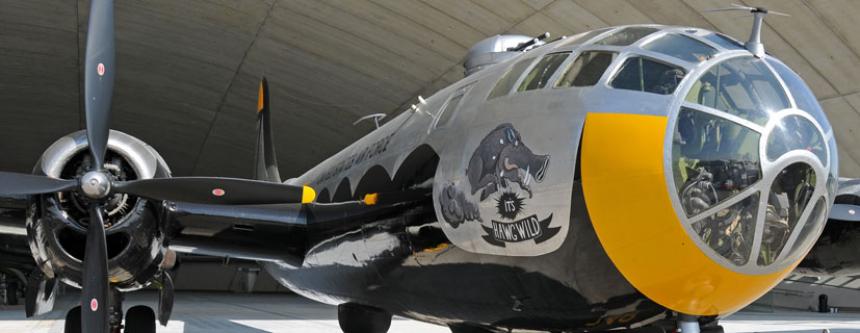
Famous Duxford resident Boeing B-29A ‘IT’S HAWG WILD’ enjoys a little time in the sun

Recently renovated North American B-25 Mitchell waits patiently at Duxford

Safely secured in position, the B-25 makes for an impressive sight
Our full review of the transformation of the American Air Museum can be viewed in Aerodrome edition 42, including a collection of exclusive pictures which were taken before the museum was re-opened to the public in March of this year. Although the magnificent collection of US aircraft are still central to the displays contained within the museum, it is now much more than just an opportunity to get close to some of the most important aircraft in the history of aviation. It could more accurately be described as a celebration of the unique links between Britain and American service personnel over the years and how the incredible stories of real people illuminate these static museum pieces and help to bring them to life. With a host of interactive stories, displays and artefacts, a visit to the American Air Museum really is an immersive experience and one which will have visitors coming back many times to sample its delights. With the 2016 Airshow season now over and our opportunities to obtain our aviation fix much reduced over the winter months, the transformed American Air Museum is definitely a reason to visit the Imperial War Museum at Duxford in the near future, where you will undoubtedly be impressed with all the changes. An enthralling day out for all the family, this new museum helps to tell this incredible story of Anglo-American cooperation, bravery and sacrifice in a unique manner, set in the surroundings of this extremely distinctive building.

An unusual picture showing the empty American Air Museum

The new display starts to take shape, as aircraft begin to return to the AAM
We end this particular review by looking at one of the new aviation exhibits which is now suspended from the ceiling of the American Air Museum. Perhaps some of the most iconic aircraft in the history of Duxford airfield are the black and white chequer nosed Mustangs of the USAAF 78th Fighter Group, which were stationed at this Cambridgeshire airfield during the latter stages of WWII. Former USAAF pilot Huie Lamb had flown out of Duxford during the final months of the Second World War, assigned to the 82nd Fighter Squadron, 78th Fighter Group and managed to amass 61 combat missions over enemy occupied Europe. Having previously flown the mighty Republic P-47 Thunderbolt, Lamb converted to the North American P-51D Mustang in late 1944 and was assigned a machine which he named ‘Etta Jeanne’ after his younger sister back home in Texas. On his first combat mission in Etta Jeanne, the aircraft developed mechanical problems and he was forced to ditch in the North Sea. His squadron mates rushed to get help for their comrade and succeeded in guiding a Walrus rescue aircraft to his position, just as an exhausted Lamb was beginning to lose consciousness in the freezing water.

North American P-51D Mustang ‘Etta Jeanne’ following her restoration
Once recovered, Lamb was assigned another Mustang, which he decided to name ‘Etta Jeanne II’, which proved to be a much more reliable machine and one he flew operationally until the end of the war. Lamb would end the war having gained the status of ‘ace’ pilot and was one of the few airmen able to boast the destruction of a Messerschmitt 262 jet fighter and the shared destruction of an Arado Ar 234 jet bomber – quite an achievement.
In 2013, at the age of 89, Huie Lamb made the long trip from his home in Texas to the Imperial War Museum at Duxford, where he had flown combat operations during 1944/45. Having been introduced to museum staff, he regaled them with tales of his wartime experiences and life at Duxford during the latter stages of WWII. He also brought with him a collection of photographs he had taken during his time at Duxford and allowed the museum’s historian to view this unique record of life on this operational airfield almost seventy years earlier, featuring some the aircraft and personalities at a wartime Duxford. The opportunity to meet this incredible man must have left quite an impression on the museum staff, as Huie would be invited back to Duxford the following year, to take part in a very special event. With a P-51D Mustang scheduled to be exhibited in the newly renovated American Air Museum, the museum had decided to finish the newly restored aircraft in the colours of Huie Lamb’s 78th Fighter Group P-51D ‘Etta Jeanne II’. In front of the American Air Museum building and with Huie Lamb proudly sitting in the cockpit of the Mustang, this beautiful aircraft was unveiled to the press in October 2014. Visitors to Duxford can now see ‘Etta Jeanne II’ displayed suspended from the ceiling of the recently transformed American Air Museum. It helps to mark a distinctive American aircraft which operated from this famous Cambridgeshire airfield during the Second World War and a pilot who bravely served his country in demanding circumstances, helping to secure a hard fought victory for the Allied nations.

Huie Lamb’s Mustang is one of the highlights of the transformed American Air Museum
Huie Lamb’s Mustang ‘Etta Jeanne II’ is positioned at the glass wall end of the American Air Museum and with its distinctive black and white chequer nose, it makes for an attractive addition to this superb display. It also helps to tell just one of the fascinating personal stories that can be discovered within the numerous exhibits and displays at the AAM, which is now fully open to the public and surely destined to become a hugely popular attraction at this famous Cambridgeshire airfield. For full details on what you can see at the Imperial War Museum Duxford and information regarding facilities and opening hours, please head for the IWM Duxford website.
I hope you found this slightly alternative look at Duxford’s American Air Museum aviation movements interesting and I would once again like to thank Ian Crawford and Steve Kimpton for kindly sending us their fantastic photographs and allowing us to use them in our latest blog. If any of our readers are intending to visit an aviation museum over the winter months, please do let us have your pictures, as it is always interesting to see what fellow enthusiasts are getting up to. Please send them to our direct e-mail address at aerodrome@airfix.com or airfix@corgi.co.uk, or by posting them on our Forum, or social media accounts detailed below.
To join in with all the latest social media discussions regarding Aerodrome and aviation matters in general, please head for either the Airfix Aerodrome Forum or our Corgi Aerodrome Forum and have your say. If you have any specific comments, questions or suggestions for future editions of Aerodrome, please do feel free to let us know by using either the Airfix Facebook or Corgi Facebook pages, our Airfix Twitter or Corgi Twitter accounts, using #aerodrome.
Finally, we are always looking to increase readership of our blog and would be most grateful if you would help to spread the Aerodrome word and introduce like-minded aviation enthusiasts to our numbers. Please mention us to anyone who may be interested and direct them to the Airfix, or Corgi websites, where they can find our previous blogs - http://www.airfix.com/uk-en/news/aerodrome or http://www.corgi.co.uk/news/aerodrome. You can also pick up Aerodrome on both the Corgi and Airfix Facebook pages.
Thank you very much for taking the time to read our latest blog and I look forward to bringing you more aviation related content in two weeks’ time.
Michael
© Hornby Hobbies Ltd. All rights reserved