
Welcome to this latest edition of Aerodrome and our regular look at the fascinating world of aeroplanes and the historic aviation scene in the UK.
In celebration of Women's History Month, the Airfix Community Team have spent the past few weeks interviewing, collating and posting a series of fascinating interviews documenting the achievements of women in aviation and in order to mark the end of this month of activities in some style, we thought it would be a good idea to bring all this work together in Aerodrome blog format. Our intention is to provide a comprehensive overview of these features, providing links to various sections of the Airfix website, where full interviews and supporting images can be found, before ending with our own contribution to Women's History Month.
As we look to give Aerodrome a little spring clean, we will be ending the blog with our new Hangar News feature, where we will be posting information about forthcoming blogs, current developments from the world of aviation and where appropriate, sharing updates from both the worlds of Airfix and Corgi, but always retaining that all important aviation theme. We may vary this order a little over coming months until we find the perfect format, so please bear with us because we are really excited about what we have planned. As always, if you would like to let us know what you think, or would like to suggest a subject for future inclusion within an Aerodrome blog, please use our aerodrome@hornby.com address for all correspondence.
For many of us, our understanding of women's contribution to aviation usually stems from our interest in the Second World War and how with so many men away on active service, many of the roles previously performed by men had to be taken over by women. Unfortunately, even when making such a benign statement as this, there is always the fear that some may take offence at such terminology and how the fear of being labelled as sexist is a constant peril, even though that is clearly not my wish or intention. There is no doubt that back in those times, even though the nation desperately needed the vital contribution of a large and active female workforce, they did face unacceptable discrimination, but surely we don't have to worry about such issues now, haven't we progressed since then? Isn't it now just a case of opportunities for all and if you are the right person for any position applied for, then surely you're just the right person?
Anyway, having hopefully negotiated those choppy waters and getting back to our blog subject, many thousands of women performed a myriad of essential tasks on the Home Front, but sticking with the subject of aviation related tasks, were involved such duties as serving in barrage balloon units, to making up a large proportion of workers involved in both munitions and aircraft production. Perhaps the role which most readily comes to the attention of aviation enthusiasts was the work of the Air Transport Auxiliary force during WWII and how 168 women pilots ferried aircraft between test and manufacturing facilities and RAF airfields around the country, in all weathers. With most of these women having more aircraft types in their logbooks at the end of the war than most of their male contemporaries, one day they could be delivering a de Havilland Tiger Moth to an RAF airfield, the next a Handley Halifax bomber and usually after just reading the Pilot's Notes the night before.
Despite this being a totally engrossing subject, for this month of events, we wanted to look a little deeper into this subject and with the help of some inspirational and extremely knowledgeable people, were able to do just that. We began proceedings with the team producing a YouTube video which provided a brief history of the role women played during the Second World War, which can be accessed via this link, before embarking on a series of features and interviews with women who had a passion for aviation and decided to make it their careers. We will be looking a little more closely at a couple of the stories posted during the month, however, one of the first posts published over the past few weeks brought Captain Barbara Hamer to our attention, a true aviation pioneer.
Barbara Harmer's work experiences ranged from initially making a living as a hairdresser, to regularly flying at supersonic speeds. Later deciding to take up a post as an air traffic controller at Gatwick Airport, aviation got into her blood and after gaining her Private Pilot's Licence, continued her studies until attaining her Commercial Pilot's Licence in May 1982. Eventually securing a position flying with British Caledonian, she would later join British Airways, a move which would eventually see her selected for an intensive six-month conversion course to fly Concorde. On 25th March 1993, she became the first qualified female pilot on Concorde and later the same year, made her first Concorde flight as First Officer. She was the first of just two women to ever fly Concorde commercially, the other being Air France pilot Béatrice Vialle, who did so for the first time in 2001.
Sharing stories, two successful pilots with their respective aeroplanes in the background. (Image Credit - Adrian Dowling/Source RAF Manston)
The image featured above shows Barbara Harmer deep in conversation with fellow female aviation pioneer Flight Lieutenant Jo Salter, the first female Fast Jet pilot in the Royal Air Force, with their iconic aviation mounts in the background - quite the picture. (Image Credit - Adrian Dowling/Source RAF Manston).
The first of our major supporting interview opportunities came when the team were fortunate enough to speak to Kirsty Murphy MBE, who generously gave her time to tell us about her fascinating flying career and some of the many highlights this included. In a feature we entitled From the front line to the display line, Kirsty gave us an insight into the many challenges she faced in becoming an RAF Tornado GR4 pilot, to later becoming the first female pilot to serve with the Red Arrows.
Kirsty reflected on the time she applied to join the Red Arrows and how this was an incredibly tough selection process, where only the best of the best need apply, never mind actually dream of becoming a member of the team.
Describing how she learned of her acceptance to the team, Kirsty said: "I remember the moment vividly. I was on No.13 Squadron flying [Tornado] GR4s at the time and how there was a gap between coming home from the selection week and finding out if I had been successful, a gap which I remember felt like months, but was actually only a couple of weeks. I knew I was close to finding out as myself and another pilot on the squadron had applied for the role. The boss asked to see us both and he called the other pilot in first.
I was sat there in the office waiting for their conversation to end. The other pilot came out of the Boss’s office and just walked past me and said, 'it’s your turn'. There was no emotion on his face. So, I had no idea if he got in or not, which in hindsight probably meant that he hadn't.” Even talking about it now has the hairs standing up on the back of my neck! I walked in and I honestly thought there’s no way I got in! I was expecting my first application to be almost like putting a marker in the sand and showing my interest in becoming a member of the team at some point in my career.
Effectively, I thought it was a good idea to try to get people to know my name and face, and then I had thought that I’d apply again the next year, as I felt quite inexperienced in some ways in my application, not because of my flying abilities, but in terms of my lack of experience in Red Arrows application attempts.
Lots of candidates apply two or three times. Many people on the short list, had applied before, so they knew what to expect and they seemed so much more confident about the whole process than I was. One of the other pilots shortlisted and I thought we were never going to get in, that the other applicants really ‘know what they're doing’, so let's just enjoy it."
The rest, as they say, is Red Arrows history and you can read Kirsty's full story by clicking this access link.
Our next inspirational aviator was Mandy Hickson and whilst her career experiences in the Royal Air Force are certainly fascinating, it's perhaps what she decided to do after leaving the force which is having the greatest impact. Since leaving the Air Force 12 years ago, Mandy has enjoyed widespread success, publishing a bestselling book titled ‘An Officer, not a Gentleman’, in addition to becoming an in-demand motivational speaker.
During our interview, Mandy said, "I realise that we almost have a responsibility to the next generation to put ourselves out there and to be those role models, very visible role models to say we’ve done it and there's no reason why you can't too. You really can do it, and that ladder is firmly rooted on the ground for people to literally stream up behind us now.
I left the Air Force 12 years ago now, with the intention of going into commercial flying because that’s what every pilot does when they leave the Royal Air Force, or certainly the majority do. There’s a chapter in my book right at the end called ‘Flying with Emily’ - I was flying with the volunteer reserves, and flew with a young girl who was really good. At the end of the flight, we were chatting and she said, ‘I want to be a pilot just like you’. This conversation really hit home to me and I realized that I didn’t have to go into the airlines and I didn't have to just follow the same path as everyone else. That's the point where I thought perhaps it would be better for me if I did something different.
I realised that if I took a different track, I might be able to give others the encouragement to follow their dreams, maybe even providing them with the push they needed. I thought my story was quite a powerful to be able to share and I started sharing [it] with school groups initially. I’ve since spoken to over 100,000 school children globally, covering all five continents during lockdown. I’ve spoken to plenty of air cadets and all the university air squadrons as well, and everything seems to have been really well received".
The full interview with Mandy can be accessed using this link.
Our final interview in what turned out to be quite an inspirational series was with former Flight Sergeant Liz McConaghy, who at the age of 21, became the youngest female Chinook crew member to deploy to Iraq and later, went on to become the longest serving, with 17 years in the Royal Air Force, with no fewer than ten deployments to her name.
A woman in demand. Because of her links to Chinook ZA718 'Bravo November', Liz McConaghy was always in front of a camera during the RAF Museum's exhibit unveiling day in 2022.
I was fortunate enough to be in the company of Liz at an event last year, where she was one of the special guests invited to the RAF Museum Midlands for the unveiling of a spectacular new exhibit, RAF Chinook ZA718 'Bravo November'. Liz has a particular affinity with this famous aircraft, as it was the one in which she made her first flight following her acceptance into the force and incredibly, the one in which she made her final flight prior to leaving. As such, on the day Bravo November was unveiled at her new Cosford home, Liz was in great demand and every time it seemed I would have an opportunity to speak with her, another microphone or camera sped towards her with a request for yet another interview.
I have since been fortunate enough to speak with her and we will be producing an article later in the year specifically about her association with Chinook 'Bravo November', so please keep an eye out for that. If you head for the interview posted on the Airfix Community pages, you will find not only details about Liz's service as a member of a warzone Medical Emergency Response Team, but will also learn the story behind her decision to join the Royal Air Force in the first place.
Liz described how her brother was two years older than she was and went to join the army at a place called Police Barracks in Northern Ireland. She went with him the day he went to complete his BARB test and whilst she was sat in the foyer of the Careers Office waiting for him, noticed a magazine on the table, which had a picture of a guy hanging out from the side of a helicopter on what she thought was a rope. She asked the chap in uniform there, What it was all about, because she thought it was the coolest job ever. She said, ‘What’s the job? The guy on the rope?’ and he replied, ‘Well, actually, it’s a wire, and the job is in helicopter recruitment'. Well, that was the moment for her and she knew that was the job she wanted.
Is this the most historic post WWII RAF aircraft currently on museum display?
On one of the days she was on her way to the Police Barracks to attend an interview, she described how when she parked her little car, how a Chinook went thudding over the top at that very moment. She said, 'I remember looking up and seeing the belly of the aircraft. Obviously, Chinooks are so distinctive and so loud, it just hit me right in the chest. That’s when I went ‘that’s what I want to work on, it’s so cool’.
She went on to tell us, "I only found out years later when I was chatting to someone in the crew room on the squadron around 10 years later, that they actually never went into Police Barracks, it was really rare because the landing site was so small, meaning they usually had to clear the whole car park. There was me thinking this must be routine, these helicopters coming in at night, but it wasn’t. It was quite unique."
We were honoured to spend time in the company of all these inspirational women over the past few weeks and to hear their stories, which to them, probably didn't seem all that extraordinary, but to the rest of us most certainly are. They certainly helped to make our contribution to Women's History Month memorable and we hope you enjoyed discovering some new aviation information.
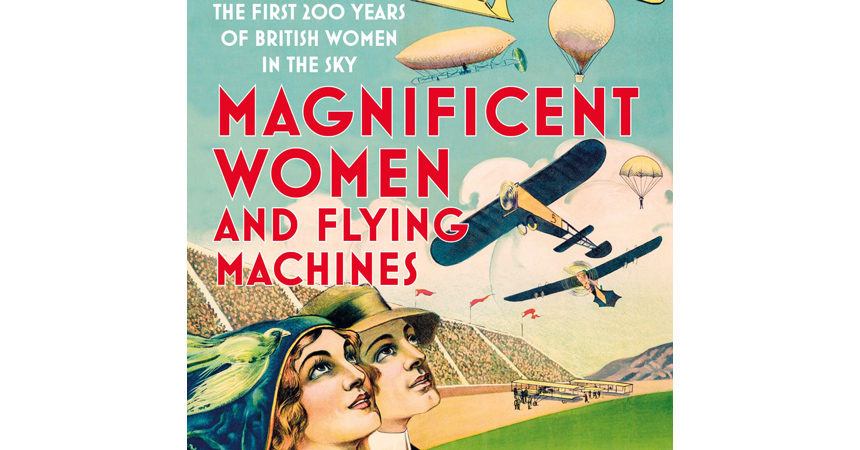
My own particular involvement with this month of content activities was to have the absolute privilege of speaking with Sally Smith, author of the recently published book Magnificent Women in their Flying Machines, a fascinating chronicle of the first 200 years of British women in the sky. A celebrated journalist and writer, Sally has also spent a lifetime achieving in aviation, but in slightly different way to how we might expect. A hugely accomplished parachutist and balloonist, Sally was the founder and team leader of the first all-girl parachute display team, in addition to being a former member of both the British Parachute Team and the Australian Ballooning Team.
Sally told me that the initial inspiration behind writing the book came from a conversation she had with her son, who happens to be a commercial pilot. She asked him 'Who was Britain's first female commercial pilot?', but with her son unable to answer, Sally decided that she was going to do a little research on the subject, unaware that this first tentative search would lead to the discovery of a whole series of incredible stories about incredible women. As she was learning about these people and all their achievements for the first time, she thought that if she was unaware of them, then maybe other people would be too, which is where the idea of writing the book came from.
Here are just two of the fascinating stories Sally came across whilst conducting her research.
It's interesting to note that by 1926, only nine British women had obtained a flying licence, but how over the following twelve months, they would be joined by nine more, one of whom was Manchester girl Winifred Brown. The daughter of a successful local butcher, Winifred was a determined character full of spirit and with the support of her doting father, was encouraged to try new things and find her calling. This included learning to play tennis and as a member of a local tennis club, she met a young man who she thought had a particularly exciting interest, flying. Just one of the reasons why she found him attractive, her new friend took her to the recently established Lancashire Aero Club at Woodford aerodrome, where she marvelled at the beautifully presented aeroplanes on the field. Thanks to one of the club members, she was later taken on a flight of the area, something which completely captivated her and on landing, she immediately inquired about the possibility of taking lessons, even though there were no women members of the club at that time.
With the continuing financial support of her father and with the new club keen to promote a positive image, Winifred started her lessons, flying as often as she could from Woodford and in April 1927, successfully obtained her pilot's licence. Her flying activities were put on hold soon after for a rather specific sporting reason - an extremely accomplished hockey goalkeeper, Winifred was selected to join the England Ladies Hockey Team on a tour of Australia, which she did travelling with her boyfriend and mother. On her return to England and with her father clearly looking forward to having his daughter back, he had quite the surprise waiting for her, her own aircraft, a brand new, locally made Avro 594 Avian III.
Over the next few months, Winifred would fly the aircraft at every opportunity, making ever more ambitious flights and testing her growing navigational skills, becoming quite the local celebrity in the process. Attending as many aviation events as she could within sensible flying distance, she soon became attracted by the thrill of air racing and how some of the best pilots of the day were all involved in these exciting competitions. With a couple of unsuccessful race attempts behind her, she decided that she would enter the prestigious King's Cup Air Race in 1930, an event to be held at the Hanworth Flying Club in London. This decision was partly made by virtue of the fact that her own aero club had grown significantly since she had gained her pilot's licence, but how they were now banning women pilot's from this and other clubs from entering many of their competitions, something which annoyed her greatly. In addition to this, they were also less than supportive about her intention to enter the King's Cup race, worried that she might bring shame upon their club, which was just the sort of injustice to make her all the more determined.
Arriving in London with her boyfriend as co-pilot and navigator, she would be going up against the most celebrated airmen of the day, men such as Squadron Leader Augustus Orlebar who had set the world speed record of 357.7mph in a Supermarine S.6 seaplane and Geoffrey de Havilland and his son, who were all looking to take that year's trophy. On arrival, whilst most of the male pilots were rooming at the clubhouse and invited to take part in a pre-competition social event, Winifred was refused a room for reasons not explained and was forced to take a room at the local pub, actually feeling that this gave her a better opportunity to prepare for the coming race.
A truly historic image which shows Winifred Brown receiving the King's Cup trophy from Sir Philip Sassoon following her victory in the 1930 race.
A handicap race which held the potential for all aircraft to be attempting to cross the finish line at the same time, the King's Cup was a true test of airmanship, requiring the very best of its competitors and not simply relying on the speed of their particular machine. Winifred had prepared meticulously for the race, checking her aircraft, calculating the route and assessing wind and weather conditions they were expecting to encounter and by the time she landed at Barton aerodrome near Manchester at the end of the second leg of the race, her father ran up to her aircraft to excitedly inform his daughter that she was in third place.
Unfortunately, a deteriorating weather forecast placed her current success in doubt, but as she was now on home territory and as she knew these skies lack the back of her hand, she had an idea. Flying a challenging cross-Pennine route through the Woodford Pass, she would hopefully avoid the worst of the weather and allow her to continue flying the route ahead of many of the other competitors. Her hunch was right and with her trusty biplane exceeding speeds of 100 mph, by the time she eventually landed back in London, she had actually moved up the leader board. In fact, with people running across the airfield to greet her, it soon became apparent that she had achieved what many had thought impossible, she had won the 1930 King's Cup Air Race.
Everyone wanted to congratulate the girl from Manchester and meet the woman who had beaten the most celebrated aviators in the country. With the presentation made and with the prestigious trophy and telegram from the King in hand, Winifred was invited to join the rest of the competitors staying at the clubhouse, but graciously declined. If the pub was good enough for her before the race, it was good enough for her after her victory. There really is something quite appealing about the thought of her walking away from the celebratory scenes at the airfield, on her way back to the pub with the King's Cup and a telegram from the King himself in her hands.
Diana Barnato was born into a wealthy family living in central London, whose father was a celebrated motor racing champion who famously won three consecutive Le Mans 24 hour races. Benefitting from quite a privileged upbringing, Diana would often accompany her father to Brooklands racing circuit, which is where she first became interested in aviation, as she frequented Brooklands aerodrome and enjoyed many a flying lesson during her visits.
Following the outbreak of the Second World War, she volunteered to drive ambulances on the Home Front, however on hearing about the opportunities offered by the Air Transport Auxiliary, decided that this was the role for her. There was a problem though, she only had ten hours of solo flying experience behind her and this would surely not be enough. Nevertheless, through her influential social connections and having undertaking a concerted period of flying and study, she was granted an evaluation flight for possible ATA acceptance in March 1941, a flight which could hardly have gone any better for her. Confident that she had shown the required level of flying skill, she allowed herself a little celebration and decided to go horse riding, a decision which didn't have quite the same outcome. Whilst attempting to jump a fence, she was unseated and fell heavily, breaking her jaw in the process. When she received her ATA acceptance telegram, she was also receiving medical attention in the hospital, not the ideal start.
Diana would take her role as an ATA pilot very seriously and despite having a reputation for being something of a party girl, rarely allowed anything to get in the way of her flying. This work required the delivery of aircraft in all but the most severe of weather conditions and as a result, many of these pilots became highly proficient in their craft. There were always occasions when the unexpected happened, in the Diana's case, having to land an aircraft with an engine fire in a field and also being fired upon by a Luftwaffe Messerschmitt Bf 110 whilst delivering an unarmed aircraft, not to mention the sheer variety of types these pilots were expected to fly.
Hard at work, Diana Barnato delivering aircraft during WWII in her role as an ATA pilot.
It wasn't all work for Diana though and there were stories where she still found time to spend a pleasant afternoon with friends, landing her aircraft in a carefully selected field and enjoying a nice picnic on a summer's afternoon. Unfortunately, tragedy was also never too far away and if she wasn't loosing friends in the ATA to accidents, she was losing partners in wartime aircraft crashes, as it seemed that everyone in flying she got close to met with an unfortunate fate.
By the time the ATA disbanded, Diana Barnato had delivered 260 Spitfires, along with a wide variety of other aircraft types, which included Typhoons, Mustangs, Hurricanes, Beaufighters, Mosquitos and Wellingtons, quite the aviation logbook. Unable to leave the thrill of flight, she decided to study for her commercial pilot's licence, which of course she secured, but was also later asked by a former flying colleague if she would get involved with the Women's Junior Air Corps, a Ministry of Education initiative to inspire young women and introduce them to aviation.
In 1963, she would be the recipient of the Jean Lennox Bird Trophy for her tireless work with the Women's Junior Air Corps and later that same year, achieved something no other female aviator had ever done - she went Supersonic! This came about because of her work with the WJAC and having spent a particularly bad weather weekend with students at a RAF Middleton St George, she spent the evening relaxing with pilots attending their conversion course to fly the English Electric Lightning. As you might well imagine, it didn't take long before the conversation turned to the possibility of her taking a flight in the Lightning and whilst the idea appeared to be quite well received, she knew that if she stood even the slightest chance, official clearance would have to be granted. Fortunately for her, she just happened to know the then Minister for Defence and a meeting was arranged in London.
During her meeting, Diana had produced a list of reasons why she felt she should be allowed to fly a Lightning, however, even she thought they were all a bit flowery to say the least. After delivering the list speech, she looked the Minister squarely in the eyes and simply said, "I really do want to fly the Lightning", however as it happened, she needn't have worried, because the Minister had an ulterior motive. He could see that the publicity potential of such a flight would have huge national interest and in addition, might just attract sales opportunities for the Lightning overseas, so to Diana's amazement, permission was granted.
Now it was on to the specifics and it definitely would not be a case of reading a pilot's manual and off you go, things were very different with the Lightning - this was a rocket ship and only the best RAF pilots were selected to fly it. The first stage was for Diana to undergo a thorough medical examination, then to go through an altitude pressure chamber test. Once completed, it was off to Middleton St George once more, this time to spend hours in their Lightning simulator, and all the time, the RAF's publicity machine was getting into full gear - if she had any reservations, there was no backing out now.
The fastest woman in the world and the first British woman to break the sound barrier, Diana Barnato Walker took her place in aviation history.
On 26th August 1963, the big day had arrived and RAF Middleton St George was alive with the nation's press corps and heightened expectation. Diana was to fly in Lighting T4 XM996, with Squadron Leader Ken Goodwin at her side, but with Diana in control of the aircraft. Having given her interviews and posed for pre-flight photographs, it was on to the serious business and the Women's Speed Record attempt. With the pair strapped in and with engines running, the Lightning sped along the runway and into the air, however no amount of simulator training could prepare Diana for this experience, as the performance of the Lightning was simply spectacular.
In what only seemed like seconds, the aircraft was at 42,000 ft and too high - Diana wasn't wearing a pressure suit and they had to lose altitude quickly. Once back down at 30,000 ft, the aircraft accelerated once more, initially appearing to vibrate, but then returning to calm, level flight - she had done it, the speed indicator was reading Mach 1.65 and she had broken the sound barrier. There was no time for celebration however, as Squadron Leader Goodwin pointed out that if they carried on at their current heading, they would be over Norway in no time, so a course was set for home and the awaiting press.
Once back on the ground, the enormity of the situation hit Diana - she had just become the fastest woman in the world and the first British woman to break the sound barrier. All in all, not a bad day's work really.
Speaking with Sally about her book, she told me that this turned out to be something of a lockdown project and whilst some of her research activities proved to be a little more difficult, she was able to really crack on with her writing commitments. One thing she described as being a little frustrating was the fact that during the information gathering stage, there appeared to be no end of information relating to the achievements of male pilots in existence, but how there was very little relating to women aviators. I did ask her if this made her a little angry, but she said not, it was really just what she had expected.
Having read the book myself, I have to say that I found it absolutely fascinating and even though I like to think I know a bit about aviation matters, I discovered lots of stories and personalities I knew nothing about. The thing I enjoyed most was how Sally takes us on a journey through 200 years of British women's involvement in aviation, from Letitia Sage in 1785, right through to Helen Sharman in 1991, along with a series of honourable mentions for others who didn't manage to attract a chapter of their own. This really is a great read, providing details of women who achieved great things in aviation, women most of us will know little about.
To allow two Aerodrome readers to enjoy this book for themselves, Sally will be providing us with two signed copies and all you have to do to be in with a chance of winning one is to e-mail us at aerodrome@hornby.com with the answer to this question - In which year did Winifred Brown win the King's Cup Air Race?
Please give your entry the subject title Women in Aviation and our two winners will be selected at random on Monday 24th April, when the competition will close. Our winners will be notified by e-mail and announced in the next edition of Aerodrome - all usual Hornby Hobbies competition T&C rules apply and there is no cash alternative to the prize available - good luck to all who enter.
We would like to thank Sally for her invaluable help with this feature and to congratulate her on the successful launch of her thoroughly enjoyable book. Magnificent Women and their Flying Machines is available now in all good bookshops and via the usual online suppliers.
The consummate aviation entertainer, Carolyn Grace behind the controls of the Spitfire she knew so well.
We couldn’t end this particular edition of Aerodrome without paying tribute to a lady who entertained millions of people whilst displaying her famous Spitfire, but who was tragically killed in a car accident late last year. One of the best loved personalities on the UK Airshow scene, Carolyn Grace was a Warbird display pilot of some repute, with many hours displaying Spitfire ML407 to her name and a list of Airshow display appearances which could not have been matched by many.
Always a crowd favourite, our Spitfire Lady will be sorely missed.
For those of us who were fortunate enough to have enjoyed one of her displays, we will always remember her smile once she landed back at the airfield and how whilst she clearly loved what she was doing, always acknowledged the adulation of the crowd by looking a little embarrassed by all the attention. Another significant contributor to the world of women's achievement in aviation, like many others who were fortunate enough to share a few brief moments in the company of Carolyn Grace, I would simply like to say, Thank you.
Our friends at Newark Air Museum have asked if we would inform Aerodrome readers of a significant impending anniversary for them, their Golden Jubilee celebrations. On 14th April this year, Newark Air Museum (NAM) will have been officially open to the public for fifty years and to celebrate this golden jubilee anniversary occasion, NAM is hosting a two-day special event on the weekend of 15th and 16th April at their famous site in eastern Nottinghamshire, close to the Lincolnshire county border.
Various themes will be marked during the event to recognise both NAM’s past achievements, and also with an eye to future developments and associations. One particular aim is to try and get as many people as possible to attend the celebrations who were present at the official opening back in 1973. NAM already has a number of people amongst its membership who fit this particular profile, however, the museum trustees are keen to make contact with any members of the public who were at the official opening in 1973.
If you have one of these distinctive first day covers in your collection, you will be able to gain free access to Newark Air Museum's Golden Jubilee event in April.
The official opening in 1973 was marked with the release of a special First Day Cover, copies of which were flown across the local area in various aircraft. If anyone attends the Golden Jubilee event with an original First Day Cover, that person will be allowed free admission to the museum celebrations.
Looking to the future, the event will be the first time that NAM has hosted a display from the Air and Space Institute (ASI) in Newark, who will be present on both days and who are creating exciting opportunities within aviation.
Ross Tarnowski, ASI’s, Head of Learning and Skills for Engineering and Technology said: “It is great to see Newark Air Museum reach their 50th anniversary and a significant milestone in their rich history. Since opening, the museum has gone from humble beginnings to one of the largest volunteer managed aviation collections in the UK. I am really pleased that the Air & Space Institute has a partnership with the museum which allows our learners access to this unique collection".
It sounds like the museum have a spectacular weekend planned for all who attend and we wish them good weather and a successful event.
New arrival at Biggin Hill, this distinctive Hispano Buchon will hopefully be seen chasing Spitfires around the skies of Kent in the near future.
Finally for this edition, with the Airshow season now only a month or so away, many operators will be preparing for a busy summer of flying, with some much loved Warbirds about to make their first post winter test flights. On a recent visit to the Biggin Hill Heritage Hangar, we were fortunate enough to see one of the latest arrivals to their facilities, an aircraft whose arrival meant that we were lucky enough to see no fewer than THREE Messerschmitt Bf 109s during our visit. It's interesting to think that this famous old wartime RAF station is now such a haven for an aircraft which was the nemesis of the RAF during WWII and as such presents a fascinating historic aviation dichotomy. Anyway, as the good people at Biggin Hill Heritage clearly know, their impressive collection of Spitfires will need to be chased by something!
We will be bringing readers a full review of our visit to the Biggin Hill Heritage Hangar in a forthcoming edition of Aerodrome, so please keep an eye out for this.
I’m afraid that’s all we have for you in this latest edition of Aerodrome, but please keep checking back throughout the year as we endeavour to bring you a series of topical aviation related reviews and features from around the country. As always, if you would like to comment on anything blog related or to suggest a subject you would like to see covered in a future edition, please do drop us a line at aerodrome@corgi.co.uk, where we would be only too pleased to hear your views.
Should you wish to continue the aviation discussions between editions, you will always find something of interest over on the Airfix Aerodrome Forum and if social media is more your thing, please use the respective official social media icon links at the foot of the main Airfix and Corgi website homepages to access our official sites.
The next edition of Aerodrome is scheduled to be published on Friday 28th April, when we will have more aviation features to bring you.
Thank you so much for your continued support of our Aerodrome blog.
Michael