
Welcome to this latest edition of Aerodrome and our regular look at the fascinating world of aeroplanes and the historic aviation scene around the UK.
With the UK Airshow season now in full swing, we’re all going to have plenty of event temptation to allow us to obtain our aviation fixes over the coming few months, just needing the good old unpredictable British weather to play ball in order to make this a memorable year. The past few days witnessed the latest historic aircraft restoration triumphantly taking to the air, as Aerodrome favourite Douglas C-47 Skytrain ‘Night Fright’ made her first post restoration flight from Coventry Airport. We would like to send our heartfelt congratulations to Charlie Walker and his team, and can’t wait to see 'Night Fright' making her triumphant UK Airshow debut, which will hopefully be not too far away now.
For this latest edition of Aerodrome, we will be celebrating the start of the 2026 Airshow season by checking in to two events held at the delightful grass airfield at Old Warden, a venue which usually takes the responsibility of hosting the first true Airshow event of each new season. This year, I’ve been fortunate enough to have already attended TWO major Airshows held by the Shuttleworth Collection at their home airfield, both of which featured tributes to the Supermarine Spitfire in this 90th anniversary year of the first flight of prototype Supermarine Type 300 K5045, the first of 20,351 Spitfires produced. We will have Spitfire action from both the Season Premier and Wings & Wheels Air Shows for you in this latest edition.
It’s chocks away for a Spitfire anniversary celebration in the latest edition of Airfix and Corgi Aerodrome.
Arguably the most famous Spitfire in the world, The Old Flying Machine Company’s Mk.IXb MH434 was the star item at Shuttleworth’s Season Premier Airshow.
When it comes to the important work of blowing the cobwebs of Airshow inactivity off for the nation’s expectant army of aircraft enthusiasts, the Shuttleworth Collection are no strangers in taking on that significant responsibility. For several years now, the airfield at Old Warden in Bedfordshire has held the first Airshow of the new season, with thousands of people making the annual pilgrimage to be present at the occasion, and to witness some aviation action they’ve been starved of for so many months.
We do have to qualify this statement by mentioning the fact that Shuttleworth’s near neighbours at IWM Duxford did hold an event the previous day, however, this was a flying day and not an Airshow in the traditional sense of the word, leaving Old Warden to take that honour once again.
For aviation enthusiasts and those with even the slightest interest in classic machines in working condition, the Shuttleworth Collection is famous the world over, with their airfield home at Old Warden in rural Bedfordshire surely being one of the most idyllic locations from where to see old aeroplanes flying. Home to an unmatched collection of historic aeroplanes, they are maintained by a small team of professional engineers, supported by a small army of volunteers, with their ultimate aim being to ensure that every aircraft in the collection should be preserved in airworthy condition and displayed regularly for Collection visitors, and in the name of aviation heritage.
Shuttleworth’s Airshows have something for everyone, from barnstorming flying action to restored WWII fighters.
With the Collection’s aircraft usually residing within the protection of the six historic hangars at the airfield, the regular schedule of Airshows and events at Old Warden allow these aviation classics the opportunity to spread their wings to the delight of the crowds in attendance, and should one aircraft be unavailable to fulfil its display slot, a replacement aircraft is simply pulled from its hangar and prepared for flight. With a collection which can boast several of the world’s only remaining airworthy examples of particular aircraft types, as well as the oldest surviving airworthy aircraft to be found anywhere in the world (in the shape of the 1909 Blériot XI), Old Warden airfield has to be regarded as one of the most significant locations in the historic aviation world and as enthusiasts, we are extremely lucky to be able to visit it regularly.
Although simply using the Collection’s aircraft for display purposes would ensure enthusiasts are treated to world class Airshow in its own right, one of the most appealing features of any Airshow held at Old Warden is how the organising team always attempt to invite interesting visiting aircraft to perform at their shows. Not only do they try to secure some of the most appealing historic aircraft available in the UK and from further afield, but they also know that any aircraft displaying at Old Warden is a spectacle most enthusiasts will happily travel great distances to see, as this really is a very special place for aeroplanes.
This year, the Shuttleworth events team have pulled out all the stops to make this a memorable year for the enthusiast, and as such, will see many enthusiasts making several visits to this historic airfield to sample their aviation wares, and as they’ve clearly put in so much work in serving up something special, let’s hope the weather comes to the party. I’m certainly intending to be at most of them, and I’ll be gathering as much content for Aerodrome readers as possible.
The most famous Spitfire in the world was resident at Old Warden for the duration of their Season Premier Airshow.
The Airshow world likes nothing more than having a significant aviation anniversary to commemorate, and this year has one which is certainly worth celebrating – the 90th anniversary of the first flight of the Supermarine Type 300, the first Spitfire. As Britain’s most famous aircraft, and arguably the most famous of all the aircraft which took part in the Second World War, this part of the world has a strong connection with the history of the Spitfire, even though that association is strongest at the nearby airfield at Duxford.
Duxford was the airfield which accepted the delivery of the first production Mk.I Spitfire in August 1938, and would become home to the first Spitfire Squadron in the Royal Air Force. An important sector station during the Battle of Britain, Duxford would also go on to become a significant location for the post war operation and restoration of Spitfires, a role which it proudly maintains to this day.
Despite Duxford’s unmatched association to the Spitfire, if you want to experience a Spitfire display at the most intimate airfield venue in Britain, and arguably at any airfield in the world, then attending a show at Old Warden needs to be at the very top of your priority list. Allowing close access to display aircraft and with a display line which allows spectators to experience the majesty of a Spitfire display more effectively than anywhere else, its no wonder that Spitfire aficionados hold this venue above all others, and when there’s a particularly significant Spitfire on the display program, a trip to Bedfordshire is quite simply a must.
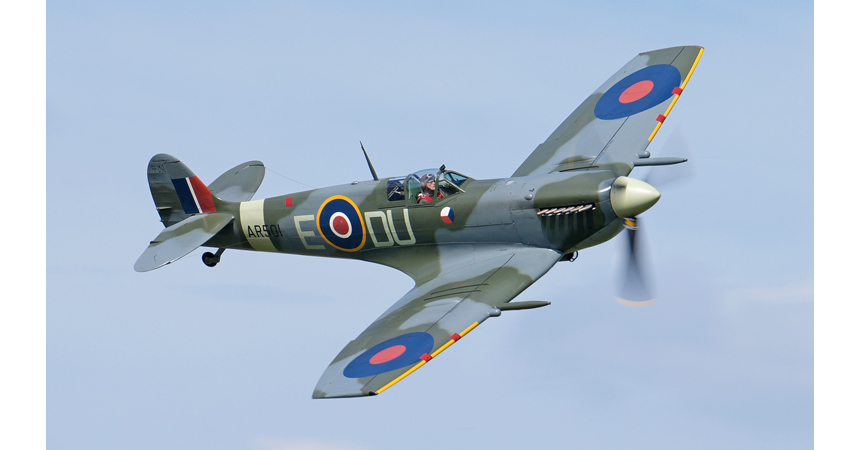
The Shuttleworth Collection does have a beautiful example of the Spitfire amongst their aircraft inventory, with Spitfire Mk.Vc AR501 understandably being the star of many an Airshow event over the years, but in this significant Anniversary year for the Spitfire, the organising team arranged for a very special Spitfire visitor to grace their first show of the year, an aircraft which many people regard as the most famous Spitfire in the world, the Old Flying Machine Company’s Spitfire Mk.IX MH434.
When it comes to the subject of post war airworthy Supermarine Spitfires, there’s one aircraft which stands above all others, an aircraft which whilst having an active wartime service career, went on to arguably do more in helping to preserve the legacy of this most famous of British aircraft than any other, and continues to do so to this day.
Supermarine Spitfire LF Mk.IXb MH434 was produced at the Vickers Supermarine Castle Bromwich factory during the summer of 1943, making its first flight in the hands of famous Supermarine Test Pilot Alex Henshaw on 7th August 1943. Just six days after that first flight, the fighter was delivered to her first operational squadron, No.222 (Natal) Squadron based at Hornchurch in Essex, a new replacement machine as the unit was upgrading their existing Spitfire fighters. During an active service career, MH434 would be regularly flown by South African pilot Flt Lt Henry Lardner-Burke DFC, who would use this aircraft successfully in combat with the Luftwaffe. She can claim to have several aerial combat victories to her name, in addition to several more shared and probable victories, which mark her as an aircraft possessing real wartime combat provenance, and a fascinating story to tell.
After completing 79 operational sorties during the Second World War, MH434 was retired in March 1945 and sent to No.9 MU at Cosford, where she was placed into storage, awaiting probable disposal, however, this was not to be the end of this particular Spitfire’s operational flying career. She would later form part of a consignment of 25 Spitfires purchased by the Royal Netherlands Air Force, but whilst some were indeed shipped to their new owners and unloaded in Holland, the majority would actually remain on board the ship bound for the Dutch East Indies, for use in operations against Indonesian pro-independence guerrilla forces. Flying fighter bomber missions during her time in Southeast Asia, she would go on to fly a further 165 operational sorties in this role.
Following the withdrawal of Dutch forces from the region, MH434 arrived back in Holland during the summer of 1950 and to something of an uncertain future, however, she would later be one of several aircraft sold on to the Belgian Air Force, and what would be a rather short lived period wearing Belgian Air Force markings. For MH434, a much more active and historically significant future awaited her.
In March 1956, this Spitfire was purchased by a young airline pilot who had always dreamt of flying a Spitfire, brought back to the UK, where she underwent detailed inspection at Elstree aerodrome. She would carry the civilian registration G-ASJV and would be flown for fun by her new owner who could hardly believe his good fortune, and under his ownership, the aircraft also made her film debut in the 1965 movie 'Operation Crossbow'. Her film credentials would go on to include appearances in the seminal Battle of Britain movie, after which her owner decided to sell his Spitfire to the production company, after a change in circumstances.
Following the conclusion of filming work, Spitfire MH434 was sold once more, this time to Cathay Pacific Airways board member and millionaire businessman Sir Adrian Swire, who having purchased the Spitfire, released it for service on the fledgling UK Airshow circuit, with the fighter often being displayed in the hands of former Red Arrows leader and ace pilot Ray Hanna.
Such a spectacular sight, is it any wonder the nation still has its enduring affection for the incomparable Spitfire.
Flown for the first time by Ray Hanna in 1970, he would go on to become synonymous with this aircraft, with his thrilling displays doing much to present the Spitfire to a new generation of admirers. Everyone fortunate enough to have enjoyed one of his Spitfire displays in MH434 will probably have described the experience as one where man and machine were in perfect harmony, a spectacular assault on the senses. In fact, Mr Hanna would become so attached to this Spitfire that when an opportunity to purchase her presented itself in 1983, he moved heaven and earth to enable him to get her. Under his ownership, she would become the founding aircraft of the Old Flying Machine Company.
During her time with OFMC, MH434 would become a much loved component of the UK's growing Warbird scene, with Ray Hanna's stunning displays leading many to describe him as the finest Spitfire pilot the world had ever seen. Displays which created an aviation legend all of their own, Ray's displays where he performed the finale at the annual Biggin Hill Airshow would become the stuff of aviation folklore, displays of grace and power where this famous pairing would hold the crowd spellbound in a manner only they were able to do.
Such memorable aviation experiences, the fact that they were taking place at one of the most famous former RAF Fighter Command stations only served to enhance the reputation of the Spitfire, creating an Airshow legend which all who witnessed it will never forget. There was something very special about a Ray Hanna Spitfire display at Biggin Hill, an enduring feature of the UK’s incredibly popular Airshow scene.
Over the years, Spitfire MH434 would go on to star in numerous TV, film and commercial productions, whilst at the same enhancing her growing reputation by performing to millions of people at Airshows up and down the country. In this role, it could be argued that she has done more to maintain the legacy of this iconic aircraft than any other, and has certainly introduced the Spitfire to new generations of admirers. Every time she takes to the skies, we are witnessing aviation history right in front of us, a wartime Spitfire that has introduced itself to more people than any other during the years of peace which followed.
Still the star of many an Airshow event and residing at her long term IWM Duxford home, a venue which many consider to be the spiritual home of the Spitfire, MH434 has created an aviation legacy all of its own, a combat veteran aircraft with aerial victories to its name and one which had never been fully rebuilt since leaving the Castle Bromwich factory in 1943.
The most famous Spitfire in the world, MH434 joined the Shuttleworth Collection’s Mk.Vc AR501 to help them commemorate the 90th Anniversary of the first flight of the Spitfire at the recent Season Premier Airshow.
Unquestionably, she is a piece of British aviation history the public can experience on a regular basis, be that getting close to her in her home hangar at Duxford, or during one of her many display commitments during each Airshow season. Of all the airworthy Spitfires in the world today, surely MH434 has to be considered the most famous Spitfire of them all - the greatest of the few. She also remains one of the highlights of any display program, and it’s always a treat to spend some time in the presence of Spitfire royalty.
For this year’s Shuttleworth Season Premier Airshow, Spitfire MH434 made the short flight from her home at IWM Duxford to operate from the famous grass airstrip at Old Warden, to the delight of those in attendance. She was actually a replacement aircraft for one of several visitors which were unable to make it to this first show of the season, but as she possesses such historic aviation pedigree, would never be thought of as a substitute – MH434 is always a highlight.
With her appearance helping to mark this year’s 90th anniversary commemorations of the first flight of prototype Spitfire K5054, MH434 flew in formation with the Shuttleworth Collection’s Spitfire Vc AR501, which is in clipped wing configuration once more, with this pairing already serving up an aviation treat which will rank as a season highlight for many.
The 2026 Airshow season is now well and truly up and running, and this first show of the year has already set a high bar in commemorating this significant anniversary year for the Supermarine Spitfire.
The Shuttleworth Collection’s AR501 taking off for its display slot at Old Warden.
You may ask yourself, what could be better than attending the first Shuttleworth Airshow of a new season, and the answer must surely be, attending two major Airshow events within three weeks of each other at Old Warden airfield, and that’s exactly what we’ve had to start 2026. In addition to this, as 2026 marks such a significant anniversary in the history of the Spitfire, displays featuring this famous aircraft were once again major contributors, albeit this time in conjunction with other aircraft types.
At the Season Premier show, the display included an unusual pairing of classic British aircraft types, one a classic fighter aircraft from the Great War, with the other being the Shuttleworth Collection’s famous Spitfire Mk.Vc AR501, something many people in the crowd were looking forward to seeing. Unfortunately, the gusting wind conditions at that first show of the year meant that it wasn’t possible to attempt this display item, but they had much more success at the show which took place just a few weeks later.
Supermarine Spitfire Vc AR501 is always a popular performer at any Shuttleworth show, with many enthusiasts being of the opinion that she has the nicest sounding Merlin engine of all currently airworthy Spitfires in the UK – it just seems to purr. Interestingly, she only returned to Old Warden skies in March 2018, having spent the previous twelve years undergoing extensive renovation of both its airframe and the Rolls Royce Merlin engine which powers it.
AR501 is a genuine combat veteran aircraft and unlike many airworthy Spitfires flying in the world today, is in remarkably original condition, lovingly cared for by the talented engineering team at the Shuttleworth Collection, and currently configured with clipped outer wings, although she has previously displayed in the more usual full elliptical wing configuration. The idea behind removing the outer sections of the wing was to give the aircraft a better roll rate at lower altitudes, something which could prove crucial when engaged in combat with the latest Luftwaffe fighters at low to medium altitudes.
A fascinating display showcasing classic British fighters from both world wars, it was a challenge to have the Bristol F.2B Fighter and the Spitfire in the same piece of sky at the same time.
This picture perfectly illustrates the speed difference between these two classic aircraft.
It is a common misconception that these aircraft had the outer sections of their wings hacked off in an inglorious manner when making this roll improving performance modification, however, the wingtips of all Spitfires were actually manufactured as separate pieces, made from wood and covered with an aluminium skin. These were attached by using two large bolts and a collection of smaller screws, so there was nothing as savage as taking a saw to a Spitfire’s wing in order to allow it was to operate at lower altitudes - perish that uncomfortable thought.
Initially entering Royal Air Force service with No.310 (Czech) Squadron, a relatively short, but active wartime career included providing fighter escort for USAAF bombers and on at least one occasion, providing cover for a bomber formation which included the famous B-17F Flying Fortress ‘Memphis Belle’. Spitfire AR501 has been in the care of the Shuttleworth Collection since the mid 1970s and following the recent completion of its extensive renovation, she is now a regular performer at Old Warden shows, thrilling audiences with the sight and sound of this aviation classic.
For this unusual display pairing, the Spitfire was flown in the same airspace as the Collection’s magnificent Great War era Bristol F.2B Fighter, an example of one of the finest fighting aeroplanes of the First World War, one which is surprisingly large considering its legendary fighting credentials. In what must have been a challenge for both pilots, there is a difference of almost 250 mph when it comes to the top speed capabilities of both aircraft types, so this display was never going to be one of flying both in close formation, but was merely a case of getting the two aircraft in the same piece of sky at the same time. For the many photographers gathered on the airfield on the day, the trick was to capture both aircraft in the same frame, and to have at least one of them sharp.
One of the most visually impactful highlights of the Wings & Wheels Airshow was the formation display by Aero Legends Spitfire T.9 NH341 and North Wales Military Aviation Services’ BAC Strikemaster Mk.82a, particularly their breathtaking first pass. Although this legendary pairing marks the transition from piston to jet power, the speed difference between the two aircraft was much kinder for the display pilots, meaning the pair were able to maintain their positions throughout several impressive formation passes, even though it would have still requires skilful management of each aircraft’s power settings.
Most enthusiasts are fully aware that all two seat Spitfires actually started life as single seat fighters, meaning that in some cases, aircraft which allow members of the public to enjoy experience flights in this most famous of wartime aeroplanes may actually be doing so in a Spitfire which possesses real WWII combat provenance. This Spitfire was originally constructed as an LFIXE variant at the famous Castle Bromwich factory in early 1944 and would later be delivered to No.411 (Grizzly Bear) Squadron RCAF a week after D-Day.
The aircraft would only serve with the one unit during WWII, and have a very short service career of less than a month, during which time it claimed two combat victories, but tangled with many other Luftwaffe fighters. She was delivered to No.411 Squadron at an advanced landing ground in Normandy on 12th June 1944, and would fly her first combat sortie two days later. She would go on to undertake 27 operational sorties in the hands of 9 different squadron pilots over the course of the next few days, including 10 patrols over the Normandy Beachhead and one bomber escort mission. She destroyed two Messerschmitt Bf 109s on 29th and 30th June 1944, but was herself brought down by Fw190s on 2nd July.
This next series of images were all taken during a thoroughly enjoyable Spitfire and Strikemaster display at the Shuttleworth Wings and Wheels display.
Parts from the aircraft’s wreckage were displayed in a French museum for many years, before being secured in support of an ambitious restoration project around twelve years ago, arriving at Historic Flying Ltd.’s facilities at Duxford during the summer of 2015, the results of which can be admired here. If you would like to fly in a genuine combat veteran Spitfire in this 90th Anniversary year of the prototype aircraft’s first flight, you need to give the good people at Aero Legends a call, who will be only too pleased to help you achieve your dream.
Spitfire NH341’s display partner for this second Shuttleworth Airshow of 2026 was BAC Strikemaster Mk.82A G-SOAF, and aircraft which has been a stalwart of the UK Airshow circuit for many years. The Strikemaster was the light attack variant of the BAC Jet Provost trainer which served in large numbers with the Royal Air Force, but with this derivative being developed for the export market, and for customers looking for a cost effective jet with training and light attack/counter insurgency capabilities.
The Mk.82A was the variant description for a second batch of aircraft produced for the Air Force of Oman, who would go on to use the type for an impressive 30 years, before retiring their aircraft in favour of more modern types. Resplendent in its Omani colour scheme, and with its smoke generator working to maximum effect in the blue skies over Old Warden, this display was extremely impressive, a real treat for those gathered to witness it. With close formation passes, more dynamic tail chase manoeuvres and even an exciting on-crowd break, this really was a highlight act on the day, and one to look out for as we make our way through the busiest period of the 2026 Airshow season.
The Hispano Buchon always gets to play the baddie at any Airshow event it attends, but has become a much loved performer in its own right.
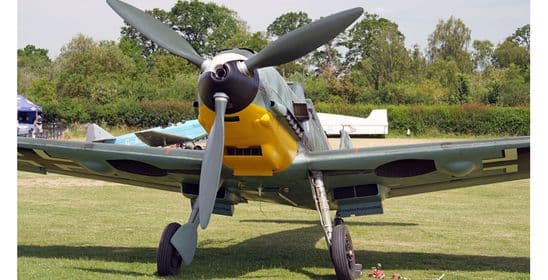
We couldn’t have an edition devoted to Spitfires without including at least one example of its aviation arch enemy, now could we! So as not to stray too far from the subject though, the Messerschmitt Bf 109 we’re including isn’t exactly a Messerschmitt, and it is powered by a Rolls Royce Merlin engine. For many of us, this is about as close as we’re going to get to an enemy aircraft, although the Shuttleworth team might have something to say about that towards the end of this month.
Whilst not a genuine WWII era aeroplane in the truest sense of the description, the Hispano Buchon has long served as the enemy on the UK Airshow circuit and as such, is actually held in extremely high regard amongst aviation enthusiasts. Based on the fuselage of a Messerschmitt Bf 109G-2, the Buchon was a licence built Spanish version of this famous German fighter, one which may trace its heritage back to the Second World War, but one which didn’t actually take to the air until after the end of hostilities.
Possessing a distinctly different appearance to that of its famous Luftwaffe operated forebears, these Spanish built and operated Messerschmitts were supplied somewhat incomplete, with the most significant omission being their Daimler Benz engines powerplants, however, rather than giving up on the deal and simply sourcing another aircraft type, the Spanish Government elected to use a different engine to power their new fighters, the readily available Rolls Royce Merlin engine. Despite this major difference, the Buchon has gone on to play its Luftwaffe role extremely well and as a consequence, has also become a hugely popular UK Warbird performer in its own right.
It’s always a treat to see a Buchon operating from the hallowed grass runway at Old Warden.
This particular Buchon was one of many aircraft purchased from the Spanish government in 1968 by the production team behind a significant new movie project, the Battle of Britain film which is still a favourite with many enthusiasts. Given an authentic new paint scheme, the aircraft would play the part of a Luftwaffe Messerschmitt Bf 109E in the film, one of 17 airworthy examples of the Spanish built fighter used during the aerial sequences filmed on location in Spain and here in the UK.
On completion of the filming work, the aircraft was acquired by a new owner in the US in lieu of payment for piloting services provided during filming, later shipped to the US, where it would stay until arriving back in Britain during the mid 1990s. A concerted effort to restore the aircraft back to flying condition began in 1998, with the work being taken on by the Real Aeroplane Company at Breighton, in North Yorkshire, work which resulted in the Buchon making her first post restoration flight in May 2006.
Since that date, this characterful fighting aeroplane has become an extremely popular flying adversary at Airshows all over the UK, in addition to playing starring roles in several major film and TV productions over the years. Having masqueraded as the Spitfire’s arch aviation enemy for many years now, the Buchon has surprisingly managed to secure legions of admirers during her time on the Airshow circuit and is now a much loved historic aircraft performer in its own right. For the Wings & Wheels show, she was giving the Spitfires at Old Warden a day off, as she was required to play the same role in a Mediterranean Air War sequence, harassing the Collection’s Gloster Gladiator, before being chased off by the Fighter Collection’s Grumman FM2 Wildcat. I don’t know why, but I always find myself being a little sad when its always the Buchon that’s forced to lose these mock combat sequences – couldn’t we let it win just the once!
Unfortunately for the Buchon, most displays usually end with it streaming smoke. Couldn’t we let it be on the winning side just once!
As you can see from the selection of pictures included with this latest blog, The Shuttleworth Collection have already served up two spectacular shows for the nation’s aviation minded public to enjoy, with several more high-profile events scheduled to follow. With the Airshow team arranging for some spectacular guest participants to join their world famous collection of historic aircraft, I have a sneaking suspicion that this won’t be our last Aerodrome visit to Old Warden this year.
I’m afraid that’s all we have for you this time around, however, we’ll be back again in four weeks’ time with more news, updates and pictures from the fascinating world of aviation. Thank you for your continued support and as always, if you would like to comment on anything blog related or suggest a subject you would like to see covered in a future edition of Aerodrome, please do drop us a line at aerodrome@airfix.com, where we would be delighted to hear from you.
Should you wish to continue the aviation discussions between editions, you will always find something of interest over on the Airfix Aerodrome Forum and if social media is more your thing, please use the respective official social media icon links at the bottom of the main Airfix and Corgi website homepages to access our official sites.
The next edition of Aerodrome is scheduled to be published on Friday 10th July, and we look forward to sharing more aviation inspired content with you then.
I hope to see you all back here in four weeks.
Michael