
Welcome to this latest edition of Aerodrome and our regular look at the fascinating world of aeroplanes and the historic aviation scene around the UK.
Despite the loss of the Royal International Air Tattoo this year, those of us with an interest in historic aviation have been particularly well catered for by show organisers up and down the country, with the team behind the Shuttleworth Collection’s event schedule being deserving of a special mention. With this venue already being a firm favourite with aviation photographers and those looking to enjoy a more engaging aviation experience, some of the display acts they’ve managed to attract this year have elevated their already stellar reputation to even new heights, and how we’ve loved seeing the aircraft they’ve secured for their various shows.
In this latest edition of Aerodrome, we will be reporting from Shuttleworth’s Festival of Flight Airshow, which took place over the last weekend in June, a show which was so full of highlights that no single review feature could ever do it justice. For that reason, we’ll be taking a more focussed approach with this review, and will be looking at just one of the aircraft which graced this spectacular show, an aircraft whose attendance was a real coup for show organisers, and for many people in attendance, already stands as the highlight act of the entire Airshow season.
Our subject for this edition is the iconic Messerschmitt Bf 109 and one particular example of this famous German fighter, Bf 109E-4 ‘Red 12’, an aircraft which made a much anticipated UK Airshow debut at this year’s Festival of Flight Airshow, and truly was a sight to behold. In addition to looking at the history of the Bf 109 and of this particular aircraft, we will also be uncovering a few Bf 109 fun facts, in addition to bringing you an exclusive series of photographs all taken during Festival of Flight weekend.
It’s definitely a case of Achtung Messerschmitt in this latest ‘Red 12’ edition of CORGI and Airfix Aerodrome.
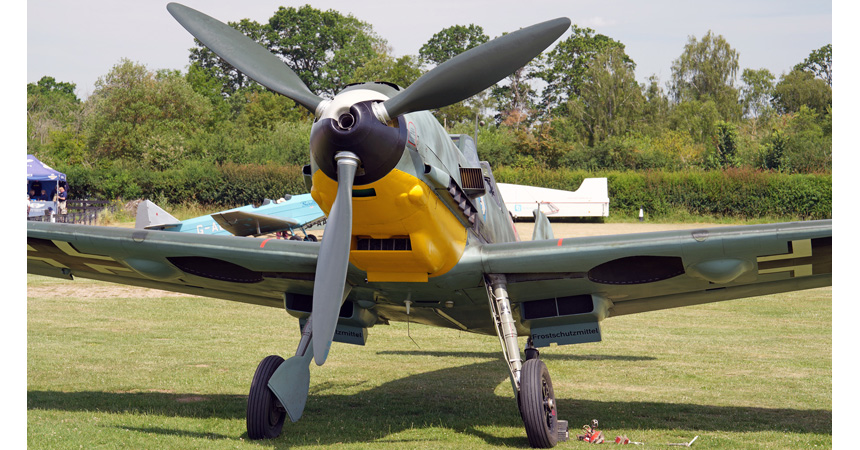
Make way for a Messerschmitt. Bf109E-4 ‘Red 12’ was definitely the star attraction at this year’s Shuttleworth Festival of Flight Airshow.
For an aircraft which presented the Luftwaffe with the finest fighting aeroplane to have ever to taken to the skies, and one which would place them at the very forefront of aviation accomplishment during the second half of the 1930s, it’s interesting to learn that the aircraft didn’t exactly have the best of starts, and because of a high profile clash of personalities, almost didn’t even get off the ground in the first place. When the prototype eventually did make it into the sky, it only did so thanks to a British designed engine.
There is an old saying in business that it’s not what you know, it’s who you know, and for the chief designer at Bayerische Flugzeugwerke Willy Messerschmitt, this was certainly something he would have agreed with. Following the death of a famous test pilot whilst flying one of his transport aircraft designs, Messerschmitt made a sworn enemy of Erhard Milch, a Great War ace pilot and influential State Secretary of the Reich Air Ministry.
The pilot killed in the crash was Hans Hackman, a close personal friend of Milch, who took his death really badly, with the situation being made personal by Willy Messerschmitt’s perceived lack of remorse or compassion at the loss. In his position of significant influence, Milch was determined to make those he viewed as being responsible for his friend’s death pay a heavy business price, and went out of his way to undermine them at every opportunity.
Thankfully for Messerschmitt, he had a reputation for being one of the most innovative minds in world aviation at that time, a man who had also managed to cultivate his own friends in high places, meaning that this personality class didn’t prove too detrimental in the end.
The origins of the new Messerschmitt fighter go back to 1934, and specifications issued by the RLM for the production of a new breed of aircraft, a fast and manoeuvrable monoplane interceptor, at a time when the aviation world was dominated by biplane designs. For such an important and potentially lucrative contract, Germany’s big three aircraft companies were invited to submit proposal, Focke Wulf, Heinkel and Arado, but somewhat surprisingly, the smaller, less well known Bayerische Flugzeugwerke were also invited to join the program.
As Germany was still bound by the restrictive terms of the Treaty of Versailles, Willy Messerschmitt had gained significant design experience in the production of advanced sports touring aeroplanes, such as the Bf 108 Taifun, an exceptional little aeroplane which incorporated a host of advanced features, and was regarded as an exceptional design.
With so many people coming to see the Messerschmitt, the only way to disperse the crowds around it was to take it from its hangar and onto the controlled aircraft park on the airfield itself. Although safe from touching hands, this rare fighter was still very much centre of attention.
Adopting a similar design philosophy to their existing Messerschmitt Bf 108 Taifun sports/touring aircraft which made its own first flight in 1934, and was introduced the following year, the new fighter utilised lightweight construction principles and from the very beginning, was designed with the intention of being mass produced. The design incorporated the use of large and robust brackets at the firewall bulkhead, serving as anchor points for the lower engine mounts and main undercarriage pivot points. Whilst this did allow the wings to be removed with a minimum of fuss for transportation or maintenance it did give the fighter its characteristic narrow track undercarriage, something which always made ground handling somewhat challenging.
As the prototype aircraft neared the date of its first flight, the project was in danger of suffering significant delay, as the new Junkers Jumo engine was still some way off being available, something which forcing a radical solution to be sought. That solution proved to be a deal struck with the Rolls Royce Company in Britain, whereby four Kestrel VI engines were secured in exchange for a Heinkel He 70 Blitz aircraft, which the British company would use as an engine testbed for future development programs. Powered by the Rolls Royce engine, the prototype Bf 109 (V1) made its first flight at the end of May 1935, however, it would be a further twelve months before the Junkers Jumo powered prototype took to the air.
Historically, the Germans used the summer Olympics of 1936 to reveal their capable new fighter aircraft to the watching world and whilst everyone marvelled at the achievements of the world’s greatest athletes, military officials across Europe watched with trepidation as this new fighter took to the skies, immediately stepping up their own regeneration programs, as the threat of future conflict had just increased exponentially.
Entering Luftwaffe service in February 1937, the Messerschmitt Bf 109 fighter also equipped the German Expeditionary Air Force which took part in the Spanish Civil War, where the performance of the fighter was later evaluated, and improvements made after allowing service pilots to make their recommendations. In fact, with over 34,000 aircraft eventually produced, the Bf 109 was subjected to almost constant improvement and development throughout its service career.
A rare example of this famous fighting aeroplane and the third of this variant to be restored here in the UK, ‘Red 12’ has been restored to E-4 standard.
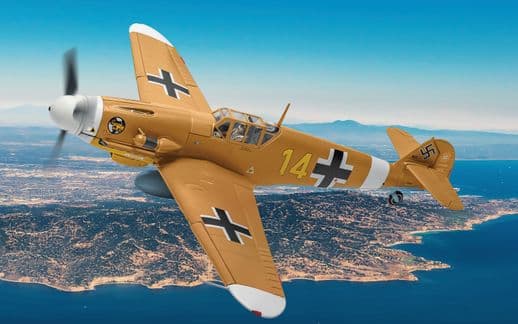
The first four production variants of the Messerschmitt Bf 109 were all powered by the Junkers Jumo 210 engine, an advanced unit which was Germany's first truly modern engine design, however, front line fighter aircraft are always looking to benefit from ever greater speed, and this search would lead to the first major re-design of the Bf 109 with the introduction of the 'E' or 'Emil' variant, the aircraft which was in widespread service during the Battle of Britain.
This mature version of the fighter adopted the more powerful Daimler Benz DB600 series powerplant, a 33-litre direct fuel injected inverted V12 unit which made the Luftwaffe's main fighter even more combat effective – the French and British air forces would have their hands full with this capable warbird.
The adoption of this new engine did require extensive design modifications to be adopted, not only around the areas of the mounting frame and engine cowling to shoehorn this larger, more powerful powerplant into what was actually a relatively small fighter aircraft, but also to add additional cooling ducting around the inner wing sections, to provide effective cooling for this beast of an engine.
In fact, it's interesting to note that the development of both the Messerschmitt Bf 109 and its famous British adversary, the Spitfire, went hand in glove with engine development, ensuring that both could remain at the forefront of world fighter performance and more specifically, competitive with each other throughout the war.
Earlier variants of the lightweight Bf 109 had to be upgraded once the Germans learned that the new British Hurricane and Spitfire fighters would be equipped with eight machine guns each, forcing the Messerschmitt to take on greater firepower and the resultant increase in weight that brought with it. Forming the backbone of the Luftwaffe’s fighter force, around 200 Messerschmitt Bf109 fighters were committed to the attack against Poland, where around 60 would be lost, mostly to ground fire.
As the Wehrmacht turned its attention towards the west, the excellent close coordination between air and ground forces saw them roll through Europe to the French border in a frighteningly short period of time, however, with France being the next country to face the might of the modern German military, the Germans would surely be facing a much stiffer test. The two opposing forces were of a similar size and strength and in many respects, the French would have the upper hand when it came to ground forces and anti-aircraft defences.
Such a stunning aeroplane, the Shuttleworth team must be commended for working hard to ensure their airfield had the honour of introducing this beautiful aeroplane to a UK Airshow audience.
Unfortunately, the French had organised their military forces in line with outdated concepts and doctrines, and their failure to adopt radar technology effectively relegated their air force to mounting standing patrols and being on the back foot from the start. With around 1,000 Bf 109 fighters allocated for the coming offensive against France, the Luftwaffe was now a well-oiled fighting machine and in less than a week, they managed to deplete the French air force to 1/3rd of its fighting strength and in the month from 10th May 1940, the Allies had lost 1,850 aircraft, with 950 of these being French.
Operationally, the Messerschmitt Bf 109 was an impressive aeroplane indeed, with the ‘Emil’ being the first fully mass-produced variant of the fighter. The design of the fighter intentionally made ease of access to its systems a priority, so ground crews could easily work on the aircraft when they were deployed at forward operating airfields. Guns, cooling and electrical systems could all be accessed easily, and the engine cowling featured large removable panels, which were secured using robust toggle latches, which were incredibly simple to operate. Should an engine need to be changed completely, the design of the aircraft allowed the entire process to be completed by an experienced team in just a matter of minutes.
Despite many people believing that the Battle of France was an easy victory for the Germans, from an aviation perspective at least, the Luftwaffe didn’t have it all their own way. Although a great many Allied aircraft were lost, the Luftwaffe would also suffer a significant number of aircraft losses, including large numbers of Messerschmitt Bf 109 fighters. Indeed, those Allied airmen who fought so valiantly during the Battle of France believed that their efforts in weakening the Luftwaffe proved to be a major factor in their subsequent inability to overcome Fighter Command during the Battle of Britain.
Ultimately, around 53 Luftwaffe pilots would attain ‘Ace’ status during the Battle of France, with Wilhelm Balthasar of JG.1 being the most successful, with 23 victories to his name. As the Luftwaffe’s Jagdgeschwaders moved to new bases in Northern France in advance of operations against Britain, their pilots may have been supremely confident in their abilities, however, things would be very different when fighting over the English Channel.
Despite the Messerschmitt Bf 109 becoming arguably the most famous aircraft operated by the Luftwaffe during the Second World War, and the one most feared by Fighter Command, certainly during the summer of 1940, it’s interesting to note that it wasn’t seen as the most important aircraft type from an operational perspective, immediately prior to the start of the Second World War. That was reserved for the much vaunted Zerstörer force favoured by Hermann Göring, larger, more powerful aircraft, which were seen as bomber destroyers and airspace dominators. Wherever the Wehrmacht was on the advance, it was the Zerstörer force that would be sweeping the skies clear of enemy aircraft.
Axis aircraft star of this year’s Festival of Flight Airshow – is there a Spitfire in this shot ……. Can’t see it!
Initially at least, the Messerschmitt Bf 109 was seen as a point defence aircraft, working closely with, and protecting ground forces, whilst also required to deny the enemy the ability to mount reconnaissance sorties in the airspace above them. In fact, despite the fact that more of them were produced, they were of much lower importance than the larger Messerschmitt Bf 110, the heavy fighter so championed by Göring.
Early combat operations following the beginning of the Second World War soon changed that thinking, with the Bf 109 quickly showing its operational effectiveness. Small and highly manoeuvrable, almost like an armed aerobatic aircraft, the Bf 109 was much more adept at clearing the skies of enemy aircraft, whilst the larger Destroyers proved inferior against lighter, single engined fighters, and were much more suited to supporting ground forces, with their range and heavier firepower.
In addition to this, the single engined Bf 109 was much easier and cheaper to produce than their twin engined counterparts, were able to operate from more basic airfields, and were highly flexible when it came to moving forward to recently captured enemy airfields. Messerschmitt Bf 109 pilots wasted no time in showing what their aircraft could do, and at the same time redressing the strange favouritism the twin engined heavy fighters initially had over them. Willy Messerschmitt’s diminutive war eagle was here to stay.
Supremely confident and going up against a Royal Air Force their commanders had told them was in disarray and on the verge of collapse, the Battle of Britain proved to be a step too far for the Bf 109, and whether this was down to poor tactics, the English Channel or Radar technology, the wings of the Messerschmitt were well and truly clipped over England. Despite this, the aircraft would undergo almost constant development throughout its service career, and a strike eastward would soon restore the fighters fortunes, for a time at least.
After 30 years in restoration, this stunning example of a WWII Luftwaffe fighter has already become one of the most popular aircraft on the European Airshow scene.
The aircraft which had the nation’s enthusiast corps all rushing to secure tickets for this year’s Shuttleworth Festival of Flight Airshow was just one aircraft out of a total production run of around 34,000 examples of this German fighter, a genuine combat veteran aircraft which was making its UK Airshow debut at Old Warden airfield.
Messerschmitt Bf 109 Werk Nummer 1983 was constructed as an E-4/B fighter bomber variant of the ‘Emil’ at the Erla Maschinenwerk factory in Leipzig during 1939, and would be sent to fight in Northern Russia once accepted into Luftwaffe service. The restoration program which followed its acquisition highlighted the fact that once in service, it had been upgraded to E-7 standard, which amongst other improvements allowed the aircraft to carry a centrally mounted under fuselage external fuel tank, however, the aircraft’s owner elected to have the aircraft restored to its original configuration.
Operating over the Murmansk sector during late 1941, early 1942, she served with 5./JG5 and operated from several airfields in theatre, but whilst photographs of aircraft operating from airfields in Finland and Russia do exist, no images of this exact aircraft have been unearthed to date. Although information regarding this aircraft’s combat career have again proved difficult to come by, and therefore it isn’t known if the airframe had any combat victories to its name, what is known is that its final combat sortie took place on the 24th January 1942, when the aircraft’s pilot made a wheels-up forced landing near Titovka, with his aircraft having sustained damage. It appears that the pilot managed to walk away from the incident relatively unscathed.
The moment we’d all been waiting for – Messerschmitt Bf 109E-4 ‘Red 12’ accelerates down the grass runway at Old Warden and into Bedfordshire skies.
As can often be the case with such rare aeroplanes, the actual details surrounding this incident are once again sketchy at best, and the subject of educated guesswork and opinion. The official reports into the loss of the Messerschmitt simply state enemy action as being the cause, and whilst one train of thought is that the fighter was engaged in combat with Soviet Hawker Hurricanes, the detailed inspections made during the later restoration project did find damage from shell strikes, but couldn’t definitively confirm whether this damage was a result of aerial combat, or being struck by anti-aircraft fire.
What we do know is that the aircraft came down in the Russian tundra, and that’s where it would stay for the next half century or so, until discovered in the early 1990s and recovered to Moscow, where it could be inspected by those interested in purchasing it. The aircraft was duly purchased by a renowned European based collector and enthusiast, who had the aircraft moved to the UK and to embark on an ambitious and extremely costly restoration project, one which would take 30 years to complete.
Restored to an incredibly high standard, the aircraft is now in as close to its wartime configuration as could be achieved around current regulations, and with the aircraft having completed a series of engine and taxi runs during late 2022 and early 2023, the date of the aircraft’s first post restoration flight was now upon the Messerschmitt team.
Beware the Hun in the sun, except we couldn’t get enough of this example.
When you need a man to take charge of the test flight of a newly restored, rare and incredibly expensive original Messerschmitt Bf 109 fighter, there really is only one man for the job, Charlie Brown. An incredibly experienced test and Warbird display pilot, Charlie has many hours at the controls of Germany’s most famous fighting aeroplane in his spectacular logbook, from displaying Bf 109G-2 ‘Black 6’ at Duxford and around the UK, to spending time at the controls of both the Bf 109E restorations which preceded this one – ‘Red 12’ would be making it three Emils for Charlie!
That first flight took place at Bonn-Hangelar airfield on 19th June 2023, with Charlie bringing all his experience to bear in ensuring everything proceeded as hoped, with more than a few tears of joy and relief shed amongst the watching team. The aircraft would continue to negotiate its flight test program for the rest of 2023 and into 2024, and as pictures of the aircraft started to circulate amongst the enthusiast community, thoughts obviously turned to the subject of the aircraft’s debut Airshow appearance. The honour of adding this magnificent restoration to an Airshow flying display program fell on the team behind the annual La Ferté-Alais show near Cerny, just south of Paris, leaving Britain’s enthusiasts ever so slightly envious, but hopeful for the coming Airshow season.
Back home in the UK, the Shuttleworth Collection’s schedule of Airshows for the year was already looking like being something very special indeed, with their Festival of Flight show looking like being a highlight event, with the Flying Bulls heading over from Austria and the RAF Typhoon Display Team bringing the noise over this delightful little grass airfield, but when news of a certain Messerschmitt visitor addition to the program started to circulate, a show sell out was guaranteed.
Operating from the airfield at Old Warden for the weekend of the show, the Messerschmitt was the closest thing to an aviation celebrity that it’s possible to get, and to say she was a welcome addition to the display programme would be the understatement of the season. Once again flown by the inimitable Charlie Brown, his experience in flying this aircraft not only allowed it to be displayed in style on its UK Airshow debut, but also to be flown in formation with other dissimilar aircraft types over the weekend, including a Gloster Gladiator biplane, and its wartime rival, the Spitfire.
If a Gladiator found one of these on his tail during WWII, it probably wasn’t going to end well.
Landing back at Old Warden after capturing an army of new Messerschmitt admirers.
Pilot Oberstleutnant Charlie Brown accepting the adulation of the Old Warden crowd.
‘Red 12’ proved to be an Airshow revelation, and whilst the aircraft undoubtedly stole the show, she also managed to work her way to the top of the ‘favourite aircraft’ chart of many an enthusiast in attendance. We just hope it won’t be too long before we can fill our senses with the sight of this beautiful aeroplane, and the sound of its rare Daimler Benz engine once again, but certainly do have to commend the team at the Shuttleworth Collection for their efforts in securing this magnificent Messerschmitt for our enjoyment this Airshow year – thank you to everyone involved.
Even the Spitfires at Old Warden were looking on with interest as this rare visitor made itself right at home during Festival of Flight weekend.
Please enjoy this final selection of Messerschmitt Bf 109E-4 ‘Red 12’ images, which were all taken during a memorable Festival of Flight Airshow over the weekend of the 27th & 28th June this year.
Classic fighters over Old Warden – just look at the difference in size between the Thunderbolt and the Messerschmitt!
I’m afraid that’s all we have for you this time around, however, we’ll be back again in four weeks’ time with more news, updates and pictures from the fascinating world of aviation. Thank you for your continued support and as always, if you would like to comment on anything blog related or suggest a subject you would like to see covered in a future edition of Aerodrome, please do drop us a line at aerodrome@airfix.com, where we would be delighted to hear from you.
Should you wish to continue the aviation discussions between editions, you will always find something of interest over on the Airfix Aerodrome Forum and if social media is more your thing, please use the respective official social media icon links at the bottom of the main Airfix and Corgi website homepages to access our official sites.
The next edition of Aerodrome is scheduled to be published on Friday 4th September, and we look forward to sharing more aviation inspired content with you then.
I hope to see you all back here in four weeks.
Michael