
Welcome to this latest edition of Aerodrome and our regular look at the fascinating world of aeroplanes and the historic aviation scene around the UK.
We embark on a new year of Aerodrome blogs where we report on some of the most interesting aviation related developments from around the UK by actually returning to the final event we attended in 2025. Braving the winter weather, unexpected details circulated via social media about a nightshoot event which featured an aircraft that had been off the enthusiast radar for some time, had us making plans to head down to Cranfield Airport. Our subject was an iconic British jet from the Cold War era, one which is uniquely presented, and one I had never previously seen in the metal.
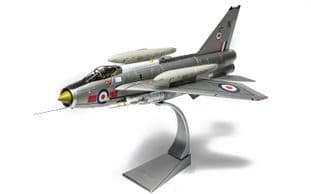
In this first edition of Aerodrome for 2026, we will be reporting from the Cranfield village side of this famous old, but still active airfield, and a first nightshoot event featuring English Electric Lightning T.5 XS458. With a selection of photographs which were all taken on the day, we will see how this beautifully presented Lightning is now an extremely rare bird indeed, and how she can still count on the support of a dedicated band of supporters who remain steadfast in their determination to keep her in good order.
That being the case, we felt that a review article featuring the most exciting aircraft ever produced by Britain’s aviation industry was definitely the best way with which to welcome in the New Year.
Lightning T.5 XS458 was joined by the beautifully restored cockpit section of F.6 XS898, an aircraft which also flew into Cranfield following the RAF withdrawal of the aircraft.
Royal Air Force station Cranfield opened in June 1937, when it became home to the Hawker Hind biplanes of Nos. 62 and 82 Squadrons, aircraft they would only operate for a short period, as they exchanged them for Bristol Blenheims shortly after. During its history, Cranfield would become a centre for nightfighter training from the end of 1941 onwards, before a post war role serving as the home of the Collage of Aeronautics, and a significant location in the development of the Harrier.
Also linked with the servicing of the aircraft of the Battle of Britain Memorial Flight during the early 1960s, the airfield is currently described as a global research airport, conducting groundbreaking research into the future of aviation and the advancement of aviation technology. Linked to Cranfield University, this active airfield has a worldwide reputation in conducting this specialist work, which makes this a rather fitting home for such a groundbreaking British aircraft type as the English Electric Lightning.
My only previous experience of being at Cranfield was back during my teenage years, when I travelled down with a friend to attend an Airshow during the early 1980s, one where we paid at the gate and were given ticket number 003 (we always like to turn up early). Once inside, we were forced to take refuge in the car because the weather was so bad, with heavy rain and a cloud base that was so low that we were in it!
The airfield PA announced that B-17 ‘Sally B’ was inbound to the airfield, so we stepped outside to watch her land. Unfortunately, there was no let-up in the weather and whilst we could clearly hear her as she made a low pass over Cranfield, we most definitely couldn’t see her. If memory serves me correctly, the B-17 didn’t even attempt a landing and instead elected to return to Duxford, not long after which the entire show was cancelled due to the conditions. We were invited to vacate the airfield, exchanging our ticket for a refund, so with that being my only previous experience, I was definitely due a more successful visit to Cranfield.
Another view of XS898 during her visit to Cranfield in December.
This latest opportunity came when I noticed a post on an enthusiast website announcing that the team dedicated to looking after English Electric Lightning T.5 XS458 were running an afternoon and evening photoshoot event, to commemorate the first flight of the aircraft, which had taken place almost 60 years ago to the day (of the event). As I had never previously seen this aircraft since she’s been resident at Cranfield, and how events where enthusiasts can get close to her have been a little thin on the ground over recent years, this seemed like an ideal opportunity, so a place was duly secured, and travel plans made.
When it comes to aircraft which have earned a stellar reputation during the post WWII era, few can match the affection in which the Lightning has always been held, since the first aircraft joined the Royal Air Force in 1960. The aircraft’s incredible performance and stunning good looks earned it plenty of admirers across the globe, but if you were British, it was also an immense source of national pride for us. An aircraft designed as a point defence fighter to protect Britain’s nuclear deterrent V-Bomber bases, the Lightning was fast and responsive, and even for pilots used to flying some of the worlds most advanced and capable aircraft, getting behind the controls of a Lightning was a pure adrenalin rush.
The first operational variant of the Lightning interceptor was the F.1, an aircraft which presented the RAF with a cutting edge fighting aeroplane and one which was a huge technological leap ahead of any aircraft which had gone before it. A fully integrated air defence platform, the Lightning employed a powerful radar unit which allowed its pilot to detect and intercept a target by day and night and in all weathers, and once in range, could deal with the threat either using its 30mm Aden cannons or the new Firestreak air to air missile.
This was the first time that I’d seen XS458 since she’d been resident at Cranfield, and therefore also in this unique livery.
The unit selected to have the honour of ushering the RAF into the Lightning age was No.74 Squadron 'The Tigers' at Coltishall from July 1960, with the same airfield having previously played host to the Air Fighting Development Squadron and their important work in preparing the Lightning for squadron service. Their gleaming natural metal Lightnings must have made for a magnificent sight and certainly represented the pinnacle of aviation achievement at that time - if you were selected to fly Lightnings, you must have felt more than a little pleased with yourself. Having said that, for these first Lightning jockeys, the prospect of flying this latest RAF speedster must have been quite a daunting one, particularly as their first flight in the aircraft would also be their first solo - there was no such thing as a two seat Lightning at that stage.
Only the very best pilots were selected for conversion to the Lightning, with this process starting with the presentation of a comprehensive guidance manual which they had to learn from cover to cover. This was backed up with hours of classroom based ground instruction and time spent on the new Lightning simulator, all the while knowing that what awaited them was a first flight in this beast of an aeroplane, one which some had christened the 'Frightning'. Once all this had been safely negotiated, it was time for their first Lightning solo and one of the most significant entries in their logbooks.
The Lightning may not have posed too many problems for most capable pilots, however, it certainly did require some getting used to. For those pilots coming from the Hawker Hunter, which in itself was an excellent aeroplane, they were in for quite a thrilling first flight. Although a stable aeroplane which was reportedly extremely pleasant to fly in most phases of the flight envelope, the Lightning represented a quantum leap in performance terms, and everything had to be done much more quickly than in other aircraft - you always had to have your wits about you. To illustrate this, the optimum speed for landing approach in a Hunter was around 130 kts over the airfield threshold, but in a Lightning, this had increased to something like 165 kts for touchdown at 155 kts.
With its Firestreak missile system, the Lightning was also part of a cohesive air defence network, a complex machine which demanded much of its pilot, but at the same time a real pilots aeroplane. The Lightning was a huge technological leap forward for the Royal Air Force and didn't its pilots love it!
The RAF's original Lightnings were very much point defence fighters, with their mission profile being that of performing a 'supersonic dash' to their vectored target, firing their missiles, before immediately returning to base for debrief or to refuel for a further sortie. Their main responsibility was to protect the integrity of Britain's nuclear threat, protecting the V-bomber force from any potential offensive strike coming from behind the Iron Curtain. Taking off at high speed, the Lightning pilot would climb to interception height as quickly as possible and neutralise the threat, with these speedsters never intended to mount long and arduous standing patrols.
The starboard side of the aircraft is presented in RAF No.111 Squadron livery.
As far as the fuel hungry Lightning was concerned, range, or more specifically the lack of it, would always be something of its Achilles heel, and would keep the design team at Warton busy looking for improvements throughout its service life. As an Airshow display act, the fast and graceful Lightning was the consummate performer and anyone lucky enough to have ever seen one of these aircraft making its fast, final pass, before pulling up into a vertical climb in full reheat will probably hold this as an experience they will never forget - the Lightning was certainly the darling of the British public.
As the technologically advanced Lightning settled into Royal Air Force service, designers and technicians at Warton were hard at work incorporating improvements and ever greater fuel carrying capacity to subsequent variants of the interceptor. Essentially, the next two variants of the Lightning, the F1A and F.2 only featured relatively modest upgrades, with the F.2 introducing such improvements as fully variable afterburning Rolls Royce Avon Mk.210 engines, a steerable nose wheel and a more functional cockpit layout for the pilot.
As far as development of this magnificent aircraft went, the next variant, the Lightning F.3 was a different beast altogether, and an attempt to unleash the full awesome potential of this incredible aeroplane. Featuring a larger, squared-off fin, the Lightning F.3 also sported improved radar, more powerful engines, greater fuel carrying capability and new Red Top missiles. The only detriment appeared to be the removal of the Aden cannon, something pilots would soon come to lament and lobby their superiors to somehow get back. They would eventually get their wish with the introduction of the next, definitive variant of the Lightning, the F.6, one of the most capable interceptor aircraft to ever see Royal Air Force service.
Despite its very different front profile, the Lightning T.5 was still a speedster, and still combat capable.
As the Lightning was a highly complex aeroplane and a significant upgrade in jet fighter performance terms, it was clear that a two seat trainer variant was going to be needed for the large number of pilots destined to fly the aircraft during its service life. From a design perspective, the adoption of a stacked Rolls-Royce Avon engine arrangement was to keep the front profile of the aircraft as narrow as possible, as every ounce of speed was required from this air defence bullet of an aeroplane.
When it came to the training variant of the Lightning, there was no option but to adapt this design rationale, as this was such a complex aeroplane and the feeling was that the instructor would need a direct view of the student pilot’s actions during a flight, and be able to quickly see if he needed to intervene. This meant that the side-by-side arrangement led to a distinctly different looking aeroplane, and even though the cockpit was still snug to say the least, Lightning trainers did look very different from their single seat counterparts.
It is interesting to note that despite this increase in frontal area, the power from the aircraft’s Avon engines meant that performance loss was minimal and throughout their service life, these Lightning trainers retained full combat capability, and in the event of conflict would have joined the more numerous single seaters in clearing Britain’s airspace of encroaching hostile aircraft. The first T.4 trainers were based on the Lightning F.1A variant, but the later T.5 was a development of the F.3 fighter, boasting roughly the same performance, but having a slightly lower maximum service ceiling.
The Lightning T.5 ended up being rather rare birds, with only 22 aircraft constructed at the English Electric/British Aircraft Corporation factory at Samlesbury in Lancashire, with the first two prototype aircraft being essentially hand built.
Now a very rare bird indeed, Lightning T.5 XS458 was built during 1965, making her first flight on 3rd December 1965 – this recent event was arranged to mark the 60th anniversary of that first flight. She was delivered to the Royal Air Force in February 1966, when she was allocated to No.145 Squadron/226 Operational Conversion Unit at Coltishall, before moving to RAF Binbrook during 1974. She would remain at Binbrook until being withdrawn from service in 1987, initially serving with No.11 Squadron, but also flying under the colours of No.5 Squadron whilst there. She subsequently returned to No.11 Squadron, the unit she was with when her RAF career came to an end.
Struck off charge during the summer of 1988, she was sold to a private buyer who secured several other former RAF Lightnings and had plans to keep them in airworthy condition, with this mini Lightning force all being flown down to Cranfield in support of this project. XS458 flew in the colours of No.11 Squadron wearing the identification code DY.
Unfortunately, the exciting plan to keep as many of these aircraft flying as possible didn’t come to fruition, as the CAA refused permission for such a high performance aircraft as the Lightning to be flown by a civilian operator, so the owner let the aircraft go to other private owners both here in the UK and overseas, with XS458 being the only one of the original Lightnings flown into Cranfield to remain there.
Stored outside and looking a little the worse for wear, the aircraft was saved from an appointment with the scrapman by Tony Hulls, who embarked on his own project to return this magnificent aircraft back to her former glory. With her Rolls Royce Avon engines regularly firing up on special event days, XS458 thrilled enthusiasts as she blasted along the runway at Cranfield for a number of years, a fine example of the fully combat capable two seat training variant of the Lightning.
Sold on to Lightning enthusiast Russell Carpenter in October 2001, the aircraft has had good times, and some not so good during the years which followed and was presented in several different guises. She has obviously been seen at Cranfield wearing the original RAF No.11 Squadron livery she arrived in, but has also worn the markings of a Lightning Training Flight aircraft, and the stunning red and white livery (spine and tail) of a 226 OCU aircraft.
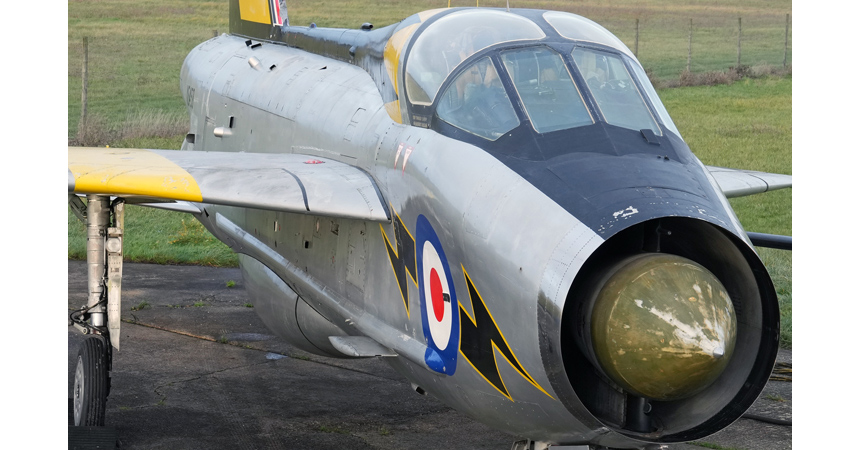
She currently wears a unique ‘split’ scheme which the aircraft has been wearing for well over a decade now, with the port side resplendent in the insignia blue of RAF No.92 Squadron, complete with the squadron crests of all former RAF Lightning units along the length of its upper fuselage. The starboard side wears the iconic markings of No.111 ‘Treble One’ Squadron, or the Tremblers as they were colloquially referred to, making this one good looking, and very unusual Lightning T.5. She is also noteworthy as currently being the only Lightning T.5 in the UK maintained in running order, something enthusiasts will hope to be able to enjoy once more in the not too distant future.
Members of the team were on hand to provide some operational scenes for the gathered photographers.
It really can be difficult for the UK based enthusiast to find new and interesting historic aviation events to attend these days, so when details of a photoshoot opportunity appeared on social media in the run-up to the festive period, it clearly captured the attention of many people. For an aircraft which had been out of the public eye for several years of late, the 60th anniversary of Lightning T.5 XS458’s first flight back in 1965 was something the current devoted custodians of this important aircraft were determined not to let pass without marking the occasion, with those fortunate enough to be in attendance being the beneficiaries.
Even though this aircraft has been absent from the UK historic aviation scene for some time, she is fortunate to be able to count on the devotion of a small group of people who are determined to keep this icon of the British aviation industry in good order, bearing in mind the fact that she’s currently preserved and maintained in an ‘open to the elements’ manner, and as such, they do a fine job.
Currently Europe’s only English Electric Lightning T.5 to be maintained in ‘Live’ condition, XS458 is now quite the rare bird, being the only remaining aircraft of the six Lightnings which flew into Cranfield at the end of June 1988 to still reside at the airfield.
Underlining the enduring affection in which the Lightning continues to be held, despite the relatively short notification period, this was a sell out event, with those securing tickets either wishing to check on the current condition of this famous aeroplane, or were looking to introduce themselves to it for the very first time, but all with camera in hand to document the occasion. The first nightshoot event run by this group, the photoshoot not only served to mark an important anniversary in the history of this aircraft, but would also provide much needed additional revenue for her ongoing upkeep, something those charged with her care would have been grateful for.
A British jet icon by night. This proved to be a hugely successful event for the Lightning T.5 Group.
Port-side view of this magnificent aircraft.
As for the event itself, I have to say that it was first class, with senior members of the team clearly communicating to those gathered what would, and also, what wouldn’t be possible from an event expectation perspective, but also inviting attendees to make requests when it came to the posing and lighting of the aircraft during the afternoon, and into the nightshoot itself. If they could make any of those requests happen, they would certainly endeavour to do so.
For those photographers who like a little ‘human interaction’ within their aircraft images, a couple of suitably attired members of the team posed as air and ground crew, and proved to be incredibly patient when it came to fielding the sometimes rather specific posing requests from their camera toting guests.
This was a truly memorable event and one which proved to be the perfect way in which to bring another busy year of aviation related features to a close. I would like to thank the XS458 team for making our time at Cranfield so memorable, in the hope that this will be just the first of many such events for this beautiful aeroplane in the future. Could we hope for ‘live’ engine runs for this Lightning in the years to come, or even perhaps the sight of XS458 blasting down the runway at Cranfield in spectacular fashion as she has done previously – now that really would be something.
As we head into an exciting new year of events, please enjoy this final selection of pictures taken during my time spent at this last event of 2025.
A special occasion for a special aeroplane – there’s a rainbow over XS458’s canopy, honest!
I’m afraid that’s all we have for you in this latest edition of Aerodrome, however, we’ll be back again in four week’s time with more news and pictures from the fascinating world of aviation. Thank you for your continued support and as always, if you would like to comment on anything blog related or suggest a subject you would like to see covered in a future edition of Aerodrome, please do drop us a line at aerodrome@airfix.com, where we would be delighted to hear from you.
Should you wish to continue the aviation discussions between editions, you will always find something of interest over on the Airfix Aerodrome Forum and if social media is more your thing, please use the respective official social media icon links at the bottom of the main Airfix and Corgi website homepages to access our official sites.
The next edition of Aerodrome is scheduled to be published on Friday 30th January, and we look forward to sharing more aviation inspired content with you then.
I hope to see you all back here in four weeks.
Michael