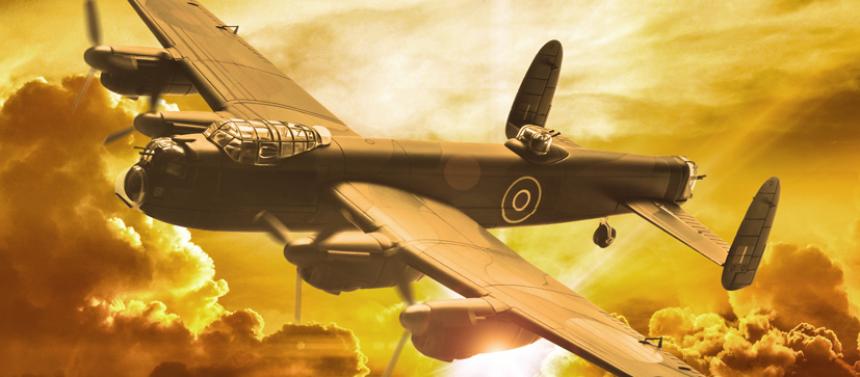
Lancaster 75 image created by Aerodrome reader Michael Collins
Saturday 9th January 2016 will mark the 75th anniversary of the first flight of one of the most famous bomber aircraft of the Second World War – the mighty Avro Lancaster. The Lancaster proved to be one of the most significant aircraft of WWII and as RAF Bomber Command began to take its night bombing strategy to targets and cities across occupied Europe and deep into Germany, the Avro Lancaster and her brave crews would make a telling contribution towards eventual victory. As was the case with many important aircraft of WWII, the development history of the Lancaster was not altogether straightforward and owed much to the perceived failure of an earlier Avro design. Its predecessor, the twin engined Avro Manchester, is viewed by many historians and aviation enthusiasts as an extremely disappointing aircraft, but we will see how it cannot have been all that bad, as it was to give rise to arguably the most effective bomber of the Second World War. In this latest edition of Aerodrome, we will be looking at why the Avro Lancaster proved to be such an effective design and how despite its name change, was still inextricably linked to the Greater Manchester area.
With the German invasion of Poland, the world watched in awe as the Wehrmacht war machine swept all before it and seemed to be all but invincible. Central to the effectiveness of Blitzkrieg was the close coordination between air and ground units, identifying strategic targets that may hold up the offensive and destroying them from the air, before they could pose too great a threat. Importantly, as these operations were taking place on mainland Europe, Luftwaffe aircraft were not operating over long distances and were able to mount several missions each day – the all important supply lines were rarely stretched and despite the relatively light bomb loads of these early German attack aircraft, air superiority and effective supply infrastructure dictated that their missions proved to be highly effective. It was only when the Luftwaffe were looking towards Britain and the significant natural barrier of the English Channel that the modest range of their aircraft became a significant strategic deficiency.
Even though the RAF were desperately trying to produce as many fighter aircraft as possible in the weeks leading up to the Battle of Britain, many senior commanders were clear that if Britain were to eventually prevail in this conflict, an effective bomber force would be essential. As the savage air battles above southern England were taking place, Bomber Command were already planning to introduce a new breed of bomber aircraft, which would be capable of striking at the heart of the German nation.
 The Vickers Wellington was the most capable RAF bomber in the early months of WWII
At the outset of war, Britain’s existing bomber force was woefully inadequate and was not capable of mounting a concerted, effective bombing strike campaign. Many of the aircraft in service were very much from an earlier era of aviation technology and were significantly inferior to the Luftwaffe aircraft they would be facing. Not only lacking in speed, manoeuvrability, range and bomb load, the aircraft also lacked modern equipment to allow crews to bomb accurately and poor defensive armament left them in an incredibly perilous position. Aircraft such as the Fairey Battle, Bristol Blenheim and even the unusual looking Handley Page Harrow were fulfilling the RAF bomber role at the outset of WWII, with the former pair being asked to carry the burden of the RAF strike response, in the face of some horrendous losses. Even the most capable bombers available to the RAF in early 1940, such as the Vickers Wellington and the Handley Page Hampden proved to be extremely vulnerable to fighter attack, should operations be mounted in daylight and were also lacking the range to mount operations deep into Germany. Bomber Command was desperately in need of a capable heavy bomber force, which could carry an effective bomb load to strategic targets in Europe, allowing them to cause significant levels of damage.
The first four engined heavy bomber developed for the RAF must have made for a particularly impressive sight. The Short Stirling was huge in every respect and was capable of carrying 14,000lb of bombs, which was double the load that could be carried by any previous bomber. With a long, deep fuselage and a massive main undercarriage, the Stirling was an impressive piece of engineering, which now gave the RAF the ability to strike at the very heart of Germany. Although many of the design features of the Stirling could trace their origins to the flying boats which Short Brothers were famous for producing, the performance of this aircraft would suffer due to the use of a wing design which was rather narrow and resulted in the aircraft only being able to operate at relatively low altitudes. Indeed, the wing for the new bomber was redesigned to be even shorter than the one used on the existing Sunderland flying boat design, on which it was based. It is often thought that this was a design requirement imposed by the Air Ministry, to ensure that the new bomber could fit through the doors of the largest RAF hangar doors, but this is not the case. The wingspan of the Stirling was 99 feet wide, whilst the hangar door width was 112 feet wide – the restriction was imposed in an attempt to encourage designers of the new bombers to keep the overall weight of their new aircraft down to sensible levels. As the first four engined heavy bomber in RAF service, the Short Stirling was an extremely advanced aircraft and one which transformed the offensive capabilities of Bomber Command.
 The imposing profile of the massive Short Stirling bomber
British aviation history shows us that whilst the Stirling was the first four engined heavy bomber to enter RAF service, it would soon be joined by two new and arguably more successful bomber designs. All three aircraft would be employed in Bomber Commands struggle to pound Germany into submission, carrying greater bomb loads, over greater distances. It is interesting to note however, that both of the other four engined bomber designs under development actually started out as twin engined medium bomber designs.
The second heavy bomber aircraft to enter service with the RAF was the Handley Page Halifax, which was originally intended as a twin engined design and was to be powered by the new Rolls Royce Vulture engine. At the time, Britain’s need for better bombers was so great that the Halifax was ordered off the drawing board, even though it was actually seen as a second string aircraft, falling behind the favoured design submitted by Avro. Importantly, the Rolls Royce Vulture powerplant that was to be used on both of these aircraft was itself still under development and this engine was to have a significant impact on the future of both the Handley Page and Avro designs.
As delays and disappointing performance figures from the new Rolls Royce Vulture engines began to manifest themselves, the Air Ministry instructed Handley Page to change the design of their aircraft to a four engined bomber, so that it could be developed using existing engine technologies and enter service earlier. At the end of 1940, the Handley Page Halifax became Britain’s second four engined heavy bomber to enter RAF service.
At approximately the same time, the original rival aircraft to the Halifax also entered RAF service, but saw its development continue as a twin engined design and still using the intended Rolls Royce Vulture engines that had proved so troublesome. The Avro Manchester is often viewed as a completely inadequate aircraft, that was almost unfit for squadron service and beset with numerous technical and design problems, but this is more than a little unfair, particularly as the basic design eventually gave rise to one of the most successful bomber aircraft of the Second World War. Central to it’s operational ineffectiveness was the use of the Rolls Royce Vulture engine to power the aircraft. The idea behind the Vulture was to take two Rolls Royce Peregrine V-12 engines and mount them one on top of the other, with the lower unit being inverted to produce an ‘X’ shaped engine block. This would produce a much more powerful engine, whilst providing some significant size and weight savings for the recipient aircraft – well, that was the theory, at least.
 The Avro Manchester proved to be a disappointment, but was just a Lancaster in waiting!
At this time and under wartime conditions, the technology behind the Vulture engine thinking was a little too ambitious and the engine proved to be a huge disappointment. Specifically, the power output from the new engine was significantly less than was intended, resulting in the Avro Manchester being seriously underpowered, for an aircraft that was required to carry a heavy bomb load over long distances. Many Manchester aircrews would describe how flying the aircraft on two engines was difficult enough and if you lost one during operations, you would not be coming home – there was only one way a single engined Manchester was going and that was down! The Vulture engines also developed a tendency to destroy themselves, whilst running up prior to take off. Early machines were found to have engines containing bearings of inferior manufacturing quality and were subsequently prone to failure. A bearing collapse would result in pistons and connecting rods flying through the side of the engine, resulting in an unserviceable aircraft and a lengthy period in the maintenance hangar. If this happened on the ground, it was frustrating and inconvenient – if it happened in the air, it was often disastrous and put the lives of the crew in jeopardy, for what was ostensively an avoidable technical issue. Clearly the Avro Manchester was not viewed with any great affection by Bomber Command aircrews and only around 200 aircraft saw service with the RAF, before production was cancelled just one year after the aircraft had entered service.
Despite the fact that the Avro Manchester is generally regarded to have been a failure as a bomber, the basic design of the aircraft was exceptional and simply required modification. Believing that his bomber design was sound, Avro’s chief designer, Roy Chadwick, was already working on an improved version of his aircraft, as the operational aircraft continued to experience difficulties. The main issue with the existing aircraft certainly stemmed from the problems with the Rolls Royce Vulture engines and Chadwick looked at replacing them with the more reliable and readily available Merlin engines, even though these generated less power. The move would require the wing of the aircraft to be increased in length by around 10ft, as four engines would now be needed to provide the power necessary to lift this mighty bomber off the ground. Other than this distinct difference, the general profile of the aircraft was that of a Manchester Mk.IA, which included the unusual central tail fin and wide span tailplane, with larger elliptical vertical stabilizers. The airframe to be used as the upgraded prototype aircraft was taken directly from the main Avro Manchester production line.
 Avro Manchester Mk.I of No.207 Squadron at RAF Waddington
The new Avro Manchester III prototype BT308 was assembled and prepared at Avro’s experimental flight section at Manchester Ringway Airport, which is still the site of today's massive International Airport. On Thursday 9th January 1941, prototype Manchester III lifted off from Ringway in the hands of test pilot H.A ‘Bill’ Thorn, immediately proving to be a significant improvement over the previous twin engined Avro bomber. Significantly, the first flight of this much improved aircraft actually took place before the Avro Manchester had completed its first operational sortie in RAF service.
With its larger wings and four Merlin engines, the Manchester III immediately confirmed the strength of the initial Avro design and transformed what was regarded as an extremely disappointing aircraft into one of the most capable bombers of the entire war. Almost as soon as the first flight of the prototype had been completed, the name of the aircraft was changed to ‘Lancaster’ and something of an aviation classic had been born. The performance improvement was dramatic and immediately resulted in orders for the new bomber being placed – partially completed Avro Manchester airframes currently under construction were to be converted into Lancasters, as the Air Ministry were desperate to get this impressive new bomber in to service as quickly as possible. As the last of the Avro Manchester twin engined bombers to be assembled were delivered to RAF Squadrons around the UK, these troubled aircraft were being sent on their first bombing raids over German soil.
Despite the many undoubted design achievements incorporated in the ill-fated Avro Manchester bomber, it was to be completely overshadowed by the aircraft that replaced it. However unfair it may be, to all but the most committed aviation enthusiast, the Avro Manchester has become an almost anonymous chapter in the annuls of Bomber Command during the Second World War.
When looking at the logistics of manufacturing large numbers of advanced bomber aircraft, during wartime conditions, the organisation required in machinery, materials and manpower is simply astonishing. The Air Ministry were obviously keen to ensure that production of aircraft proceeded as efficiently as possible, in order that they could equip RAF Bomber Command Squadrons with Lancasters quickly and keep them supplied with replacement aircraft as they began flying operational sorties. For the Avro Company themselves, the Lancaster represented a significant challenge, as it adopted the very latest manufacturing techniques and incorporated a host of ground-breaking technologies. They decided that the Lancaster would be constructed in a series of sections, which could be built at a number of their factories, before being sent to a central factory for final assembly. Importantly, all of these separate sections would be fitted out with all of the required components and equipment, before they were released for final assembly, which saved time later in the process. Both the wing and fuselage of the Lancaster were built in five major sub-sections, before the component parts were sent by road to the company’s Woodford aerodrome for final assembly and test flying.
 The Avro Lancaster production line at Chadderton, near Oldham
Even though the name of this magnificent new bomber changed from Manchester to Lancaster, the aircraft was still very much a product of the Manchester (more accurately, the Greater Manchester) aviation industry. Component parts for the Lancaster were built at the Avro factories at Chadderton, Newton Heath, Failsworth and Miles Platting, before heading for the nearby Cheshire factory at Woodford for final assembly. As Avro struggled to meet the production demand for their new bomber, even aircraft manufactured by Metropolitan Vickers at Trafford Park were taken to Woodford for assembly. At the height of production, almost sixty Lancasters a week were being assembled at Woodford, but despite this impressive figure, it was still not enough. Lancaster production was also undertaken by a number of other manufacturing companies, such as Austin Motors, Vickers Armstrong and Victory Aircraft Limited in Canada.
The first Lancaster Mk.I aircraft were delivered to RAF No.44 (Rhodesia) Squadron at Waddington at the end of 1941 and the Squadron became the first unit to completely convert to the new bomber. The first operation for a 44 Squadron Lancaster came on 3rd March 1944, when a Lancaster conducted a mine laying operation in the Heligoland Bight, off the North German Coast. A week later, three Lancasters took part in a major raid on Essen and marked the operational debut of Britain’s third four engined heavy bomber of WWII.
 Surviving Lancasters are some of the most popular historic aircraft in the world
Without doubt, the Avro Lancaster was one of the most capable bomber aircraft of WWII, but which of its many design attributes contributed most to its operational effectiveness? Although obviously open to some discussion, the decision to re-engine the aircraft with four readily available and extremely reliable Rolls Royce Merlin engines was central to the success of the Lancaster. The basic design of the Manchester was sound, but its reliance on underpowered and unreliable engines undermined what was in reality, an extremely capable aircraft design. The new Lancaster was to benefit from this existing design expertise and once it was married with the effective and reliable Merlin engine, it became the aircraft it was always intended to be. The Lancaster was an extremely rugged, reliable and flexible aircraft, which could carry greater bomb loads over greater distances and at higher speeds than any RAF bomber before it. A major contributory factor to its success was the cavernous, unobstructed bomb bay, which allowed the Lancaster to carry numerous combinations of ordnance, including the largest bombs available to the RAF. Without modification, the Lancaster could carry up to 14,000lb of bombs of various types, including the 4,000lb ‘Cookie’ blockbuster bomb within its bomb bay and deliver them on targets deep into Germany. Indeed, with some modification, the Lancaster could carry larger versions of the ‘Cookie’, as well as the 12,000lb ‘Tallboy’ and the 22,000lb ‘Grand Slam’ earthquake bombs – the ‘Grand Slam’ was the most powerful non-atomic bomb used during WWII.
 The cavernous bomb bay of the Avro Lancaster was an important design feature
Perhaps the most dramatic illustration of the Lancasters operational flexibility was its use during the Operation Chastise raid against German dams on the night of 16th/17th May 1943. Specially modified RAF No.617 Squadron Lancasters were equipped with a highly advanced ‘Upkeep bouncing bomb’, developed by the famous British inventor Sir Barnes Wallis, which had been designed specifically to breach the dam walls, causing massive flood damage to the surrounding industrial area. Critical to the successful use of this special bomb was the accurate delivery of the weapon, allowing the spinning bomb to backspin under the surface of the water, whilst hugging the wall of the dam. If the charge detonated in the correct position, Wallis calculated that the explosion, plus the weight of water behind the wall would be enough to cause the dam to fail. In what was possibly the most famous use of the Avro Lancaster during WWII, No. 617 Squadron, led by their inspirational commanding officer Guy Gibson, managed not only to develop a successful delivery technique for this unique weapon, but also to successfully breach both the Mohne and Edersee dams, causing significant damage to the heavily industrialised Ruhr Valley. Although the Germans were to repair the damage in a few short months, the raid was a huge propaganda coup for the RAF and clearly illustrated the changing fortunes of war, with the Allies very much in the ascendancy and German forces increasingly fighting a defensive battle.
As Bomber Command intensified its night bombing campaign against Germany, RAF bombers would arrive above their targets in ever increasing numbers, causing terrible damage to the towns and cities below. Flying at a higher altitude than either the Stirling, or the Halifax, Lancaster crews were arguably the safest crews on any bombing mission, but this was still an extremely hazardous occupation and the price paid by RAF aircrews was a heavy one. Even though the Lancaster was regarded as the best four engined RAF heavy bomber of the war, almost half of the aircraft delivered to the RAF were lost on operations, with their gallant crews being posted as missing, captured, or killed in action. Statistically, as more Lancasters became available to Bomber Command and they began to replace older, or less capable aircraft, the loss rates they suffered were almost exactly in line with the overall loss rates suffered by Bomber Command throughout the war. Although it is difficult to imagine what bomber crews must have been forced to endure throughout their operational service, the contribution they made towards eventual victory cannot be underestimated.

An evocative image of restored Lancaster ‘Just Jane’ at East Kirkby airfield
Even though the Avro Lancaster is now regarded as the finest RAF four engined heavy bomber of WWII and perhaps even the best bomber of WWII, the end of hostilities saw most of these thoroughbred aircraft unceremoniously scrapped. A total of 7,377 Lancasters were constructed between 1941 and the end of the war, with over half of them being destroyed on operations, or as a result of training accidents. At the end of the war, Marshal of the Royal Air Force, Sir Arthur ‘Bomber’ Harris, wrote to the head of Avro where he described his admiration for their work in producing the Lancaster. He wrote ‘I would say this to those who placed that shining sword in our hands – Without your genius and efforts, we could not have prevailed, for I believe that the Lancaster was the greatest single factor in winning the war.’
 Famous Battle of Britain Memorial Flight Lancaster PA474 pictured at its home base RAF Coningsby
Of the 7,377 Avro Lancasters produced during WWII, only two examples of this magnificent aircraft survive in flying condition. Both serve to mark the sacrifice of Bomber Command crews of all nationalities during WWII and are revered by aviation enthusiasts and Airshow audiences wherever they are seen. Without doubt, the most famous surviving airworthy Avro Lancaster is PA474, which is owned by the Royal Air Force and operated as part of the Battle of Britain Memorial Flight. As one of the most significant historic aircraft in the world, this beautifully presented Lancaster has a dedicated fan club all of her own and thousands flock to see her during the annual Airshow season. Following an unfortunate in-flight engine fire in early 2015, the Lancaster did not fly at any UK events last year, but her triumphant return will be the highlight for many during 2016.
The other airworthy Lancaster is based in Canada and is operated by the Canadian Warplane Heritage Museum. This Canadian built Mk.X Lancaster is also regularly flown at Airshows and unlike the UK based aircraft, even allows paying enthusiasts to fly in this magnificent machine, which must be something of an unforgettable experience. It is known as ‘The Mynarski Memorial Lancaster’ and is presented in the colours of Lancaster KB726 VR-A, which flew with RCAF No.419 (Moose) Squadron from RAF Middleton St. George, during 1944. It is dedicated to the memory of pilot Andrew Mynarski, who was posthumously awarded the Victoria Cross for his actions on 13th June 1944.
 The Canadian Warplane Heritage Lancaster made a historic visit to the UK in 2014
Mynarski’s Lancaster was shot down by a patrolling Luftwaffe night fighter and as the blazing aircraft fell to earth, Mynarski tried to free his tail gunner, who was trapped in the turret of the Lancaster. As the aircraft hit the ground, the tail gunner miraculously survived the impact, but Andrew Mynarski tragically died as a result of the severe burns he had sustained. The Canadian Lancaster carries Victoria Cross artwork on the side of the fuselage, as a mark of respect to Andrew Mynarski and his selfless sacrifice.
As one of the most significant aircraft ever produced by the British aviation industry and one of the most successful aircraft of the Second World War, the Lancaster has always been amongst the most popular subjects for both the plastic modeller and more recently, the die-cast collector. Airfix introduced their original Lancaster model in the 1960s and since this date, tens of thousands of these models have been built by modellers all over the world. The current Airfix range can boast a number of kit options for the modeller looking to build an example of the mighty Lancaster, including a couple of really spectacular models.
 Tiger Force livery option for the magnificent Airfix Lancaster B.1 (F.E)
A08013 is a new tooling release of the much loved Avro Lancaster, which has been developed using the impressive design technologies now available at Airfix. For the modeller, this means that Airfix have managed to produce a kit which is extremely accurate and full of detail, which befits one of Britain’s most famous aircraft. The options included allow the modeller to produce either a B.1 (F.E) ‘Tiger Force’ Lancaster of No.35 Squadron, from RAF Graveley in 1945, or a B.III Lancaster in the colours of RAF No.57 Squadron at Scampton, during August 1943. The latter option includes some rather spectacular nose art decals for this particular aircraft, which was named ‘Frederick II’.
 The fantastic Airfix Lancaster B.II allows the modeller to build this unusual version of the Lancaster
Airfix have also presented the modeller with a delightfully unusual version of the famous Avro Lancaster and one which was difficult for the modeller to attempt, before the arrival of this kit. The Lancaster was so important to the Allied war effort that military planners feared that a shortage of the widely used Merlin engines would seriously hamper their ability to supply Lancaster Squadrons with new and replacement aircraft in the future. In an attempt to prevent this, the Lancaster was modified to accept the Bristol Hercules radial engine, which was more readily available at that time and whilst this does not seem like a significant difference, it does produce a rather strange looking Lancaster. A08001 allows the modeller to produce an example of the B.II Bristol Hercules powered Lancaster and even though only 300 or so of this version were actually produced, it helps to complete the interesting story of Britain’s most famous bomber.
Arguably more than any other model in the Corgi Aviation Archive range, the 1/72nd scale die-cast Avro Lancaster was responsible for securing more new collectors to the hobby and infecting them with the die-cast bug. This magnificent model was the answer to many collectors prayers, who could hardly believe their good fortune when this spectacular model was first announced in 2001. Once they managed to handle this model for themselves, they were totally hooked, as it was finished to an impressively high standard and was fabulously heavy. Over the coming years, the Lancaster has remained one of the most popular Corgi models in the range, with each successive release continuing to sell out in no time at all. Every Corgi catalogue that features a Lancaster in the range will always see this as one of the most popular with collectors, as the popularity of the Lancaster and the quality of the model tooling never seems to fade.
 The latest Corgi Lancaster to be announced is AA32624. This prolific aircraft flew 140 bombing missions during WWII
The latest Corgi catalogue, which was launched just before Christmas, features the latest Lancaster announcement in this highly popular series and is already attracting significant numbers of collector pre-orders. AA32624 will be finished in the livery of RAF Lancaster B.III ED888 PM-M2 ‘Mike Squared’, of No.103 Squadron, based at Elsham Wolds in Lincolnshire. This magnificent aircraft completed an astonishing 140 bombing missions – the most flown by any Lancaster in WWII. Known as ‘The Mother of Them All’, this Lancaster managed to survive the war, shooting down two Luftwaffe fighters in the process. Avro Lancaster ED888 was the most prolific of the ‘Ton-up’ Lancasters and is a fitting way for the Corgi collector to mark the 75th anniversary of the first flight of Avro’s most famous bomber.
 Lancaster 75 image kindly supplied by Aerodrome reader Michael Collins
As a young man growing up in the Oldham area of Lancashire, I remember how our local newspaper would regularly feature articles about the nearby Avro factory at Chadderton and the magnificent aircraft it constructed. Of particular interest were the pictures that showed Lancaster fuselage sections being transported to Woodford, down roads that I was quite familiar with. At some point, I will try to visit the new Avro Heritage Centre site and see if I can obtain copies of these pictures to include in a future edition of Aerodrome.
I am sure that many of our readers will have similar aviation related experiences that they hold dear and throughout 2016, I am hoping to feature some of these stories within Aerodrome. With this in mind, we now have dedicated contact e-mail addresses for both Airfix Aerodrome and Corgi Aerodrome, to make it easier for readers to get in touch with us. All our existing social media details are still in place, but for e-mail contact and sending your stories, or pictures, please use either of the direct e-mail addresses above.
With Saturday 9th January marking the 75th anniversary of the first flight of the Lancaster, there really only could have been one subject for this week's article and I hope you enjoyed the read. With both the new Airfix and Corgi catalogues now live on our websites, it would also be a good time to have a quick look at what models we have available in the coming year, including our collection of Lancasters!
As usual, if you would like to discuss our latest blog, you can head for either the Airfix Aerodrome Forum or our Corgi Aerodrome Forum. If you have any specific comments, questions or suggestions for future editions of Aerodrome, please feel free to let us know by using either the Airfix Facebook or Corgi Facebook pages, or at Airfix Twitter or Corgi Twitter using #aerodrome.
I look forward to posting Aerodrome edition No.36 here next week.
Michael
© Hornby Hobbies Ltd. All rights reserved