From the early months of the Second World War, RAF bomber crews were forced to endure the horrors of endless operations over enemy territory night after night. With the numerous perils these men had to face, it is no wonder that superstitions and pre-flight rituals were widespread amongst aircrews, even though many would be conducted in relative privacy. Even though there are many stories of aircrew superstitions from WWII, few were prepared to admit their own rituals – when questioned, most former aircrew would describe how they did not have any superstition rituals themselves, but they knew a chap who did!
In the latest edition of Aerodrome, we are going to look at a particular Bomber Command aircraft whose crew decided to take on their Squadron’s particular superstition head on and attempt to break a tragic series of events. We will also look at how this famous aircraft has been commemorated by one of the most spectacular aircraft restoration projects of recent years and how it marks the wartime contribution of an entire county.
As Britain declared war on Germany in September 1939, she did not have a four engined heavy bomber in service, relying instead on the perceived speed and manoeuvrability advantages of smaller, twin engine bomber designs – the adoption of these aircraft also put less strain on government finances as they only used two engines and allowed savings in both the number of engines needed and on-going maintenance costs. Although most of these aircraft were seriously outdated by the time Britain was planning its first offensive bombing missions against German targets, these twin engined aircraft would be forced to carry out these dangerous missions, during the early months of WWII.

Wartime image of the early Halifax Mk.I
The development of a British four engined heavy bomber, capable of carrying much greater bomb loads had begun back in 1936. Although initially not included in the tendering process, Short Brothers Aviation were invited to submit a design, due to their experience in producing large, multi-engined flying boats. Their Stirling design was eventually selected for production and became the first four engined heavy bomber to enter service with the Royal Air Force – importantly, it was to herald the arrival of much larger aircraft, with the ability to carry significantly increased bomb loads over much longer distances. It would also herald the arrival of strategic bombing by night, as the RAF attempted to destroy both the fighting infrastructure of the enemy and the morale of their population.
The second RAF four engined bomber to enter service was the Handley Page Halifax. It began to appear only three months after the introduction of the Short Stirling, but was actually the first four engined bomber to drop bombs on Germany itself. Originally, the Halifax was designed as a twin engined bomber, using the highly advanced Rolls Royce Vulture 24 cylinder engine, but persistent development problems with the engine resulted in an eleventh hour re-design to incorporate four of the proven Merlin engines – this would also result in a much longer wing span and an associated increase in overall weight. The Halifax had a large bomb bay, with additional bomb cells in the wing roots – defensively, it had two powered gun turrets front and rear and positions for a further two .303 inch Vickers machine guns in the waist position of the aircraft.
Often overshadowed by the later and arguably more capable Avro Lancaster heavy bomber, the Halifax was not specifically developed just to perform a bombing role, with the design engineers challenged to produce the most adaptable aircraft they possibly could. In this regard they were extremely successful, as the deeper, more spacious and somewhat slab sided fuselage of the Halifax proved to be highly adaptable and resulted in the aircraft being used in a variety of operational roles – it proved to be something of a large, multi-role aircraft.

Cutaway section of the RAF Handley Page Halifax bomber
As with many new aircraft designs, the service introduction of the Halifax was not without its teething problems, but as it was entering Squadron service during wartime conditions, the lessons learned proved to be particularly costly for Bomber Command crews. Initially, RAF commanders felt that these heavily armed bombers would be able to easily conduct daytime operations autonomously, without the need for dedicated fighter escort, but this thinking proved to be disastrously optimistic and required an immediate rethink. Engine output issues also plagued the early service Halifax bombers, but these problems would prove insignificant compared with some control issues that also came to light. The twin rudder units of the early Halifax bombers had a distinctive pointed (almost triangular) appearance, but although adequate during most flight parameters, they had a tendency to lock if overloaded whilst undertaking violent manoeuvres. It was later found that the early rudder design was flawed and in certain circumstances could result in the destruction of the aircraft, as the pilot was unable to control his Halifax. The issue was quickly highlighted, but not before a number of aircraft were lost due to what were described as ‘unknown circumstances’ – add to this the relatively low altitudes at which the Halifax was operating and the heavy loss rates associated with this and it is not difficult to see why the Halifax was not initially viewed as a successful aircraft.
The general adaptability of the Halifax design was to prove one of the most successful attributes of this important aircraft and throughout its service life it was continually modified and upgraded. The rudder control issue was rectified with modifications as soon as it was identified, but it was not until the introduction of the much improved Mk.II version of the Halifax and its totally re-designed rectangular tail unit that the problem was finally eradicated. The introduction of the B. Mk.III saw the definitive version of the Halifax enter RAF service, which was very much the equal of the celebrated and highly successful Avro Lancaster. With more powerful Bristol Hercules engines, better defensive armament and longer, more rounded wing tips, the Mk.III version of the Halifax was an excellent aeroplane and was the main production variant of this important aircraft.
When discussing the subject of Britain’s main four engined heavy bombers of WWII and which aircraft was the best, you can be certain of some heated debate and convincing argument on both sides. There is however, no doubting that the Lancaster was capable of flying higher and further than the Halifax and was able to carry all the bombs available to Bomber Command, including the 22,000 lb. Grand Slam earthquake bomb. Counter this with the fact that the Halifax was used to perform many more operational duties than the Lancaster and the Mk.III variant of the Halifax was very closely matched to the performance of its more glamorous counterpart and it is easier to see how this question is not quite so easy to answer.

Internal view of Elvington’s Halifax – looking back to the tail gunner’s position

Internal view of Elvington’s Halifax – looking forward to the bomb aimer’s position
I suppose the most valid opinions on this subject must come from the men who actually flew these aircraft operationally, but you will obviously end up with arguments that highlight the loyalties of the aircrew of each aircraft. Halifax crews were extremely complimentary about the qualities of their aircraft, describing it as a very rugged and reliable aircraft to take to war, which was light on the flying controls and had a relatively spacious fuselage. They would also describe how the construction of the Halifax made it easier for crews to get out of the aircraft in the event of an emergency, which was not necessarily the case with the Lancaster. Obviously, from a loyalty perspective, you will have Lancaster crews describing how their aircraft was much the better and how they would rather take a Lancaster with just three working engines on a mission, than be forced to fly in a Halifax! The truth of the matter is that Bomber Command needed both aircraft (and indeed the earlier Stirling) to effectively conduct their bombing campaign against Germany and as greater numbers of Lancasters became available, the highly adaptable Halifax could be diverted to perform equally essential tasks in other theatres of operation, or perform other important duties to which it was eminently more suitable than the Lancaster. The flexibility of the Halifax is certainly a significant contributory factor to put forward in this contentious debate.

The crew of Halifax B.III LV907 ‘Friday the 13th’
In the early months of the RAF bomber offensive against Germany, the men of Bomber Command suffered heavy losses at the hands of Luftwaffe air and ground defences. Flying the Handley Page Halifax bomber, RAF No. 158 Squadron at Lissett airfield in East Yorkshire were not to escape these punishing losses and had seen a large number of crews fail to return from operations during 1943 and into 1944. Highlighting the terrible dangers the crews were facing, 158 Squadron had lost a succession of aircraft carrying the registration ‘F for Freddie’ over this period and it was beginning to affect morale of aircrew on the station. No fewer than seven aircraft carrying the letter ‘F’ had been lost during this period and some crews were becoming so superstitious that they simply refused to fly one of these F coded aircraft. As the latest ‘F for Freddie’ replacement aircraft arrived at Lissett (carrying serial number LV907), many of the crews stationed on the base were determined to avoid the aircraft like the plague.
Despite the sentiments surrounding Lissett based ‘F for Freddie’ Halifax aircraft, LV907 was to prove to be a much luckier aircraft right from its first bombing mission. On the night of 30th March 1944, LV907 was due to fly a mission against targets in the German city of Nuremberg with the rest of No.158 Squadron, but as yet, it did not have an assigned crew. Pilot Joe Hitchman was on a rest day, but this maximum effort had resulted in him being called in to take part in the raid – his usual aircraft ‘G for George’ would be flown by his Squadron Leader on that night, which left him flying the newly delivered LV907 ‘F for Freddie’, with something of a scratch crew – they would clearly be rather concerned at this unfortunate development.
As the crew of LV907 sped down the runway at RAF Lissett bound for Nuremberg, they would have been working almost by instinct, to ensure that everything on the aircraft was as it should be – if they had any time for reflection, they would surely have allowed themselves to be drawn to the terrible fate that had befallen the Squadrons previous ‘F’ marked aircraft. It was too late now, they were on their way to the target.
The Nuremberg raid of 30th/31st March 1944 proved to be particularly costly for Bomber Command. Despite a brilliant full moon, military planners had been assured of significant cloud cover over Europe by the met men, which would help to protect their bombers against potential Luftwaffe nightfighter attacks whilst over Europe – ordinarily, operations during a full moon would not be risked for this specific reason. Later reconnaissance information obtained by a meteorological flight Mosquito confirmed that the cloud cover over Germany was almost non-existent, but despite this critical piece of information, the raid was still authorised to take place. A force of 795 aircraft were sent to attack Nuremberg in bright moonlight, with very little cloud cover – as the formations crossed the coast of Belgium, the German nightfighters were waiting and conditions could not be better for them.
The raid was disastrous for Bomber Command. No fewer than 95 aircraft were lost, which represents an 11.9% loss rate and proved to be one of the highest Bomber Command attrition rates of the entire war. Tragically, when you consider that each of these aircraft had a crew of seven men, the magnitude of this terrible situation is difficult to comprehend – how on earth did the brave men of Bomber Command recover from something like this?
It was under these devastating circumstances that the so called unlucky LV907 ‘F for Freddie’ managed to bring its crew home from the carnage of the moonlit Nuremberg raid and from this date, started one of the most interesting bomber stories of the entire war. As pilot Joe Hitchman checked in for de-brief following his landing back at Lissett, he learned the terrible news that his usual aircraft ‘G for George’, which had been flown by his Squadron Leader, had failed to return from the raid.
As the latest 158 Squadron Halifax to arrive at RAF Lissett wearing the jinxed ‘F’ code, LV907 sat on the airfield awaiting allocation of a new crew. Understandably, many of the stations crews were extremely apprehensive at the possibility of flying this particular bomber, but it would have to be flown and someone was going to have to do it. The aircraft was given to the charge of Pilot Officer Cliff Smith and his crew and Smith knew exactly what he had to do. Being a no nonsense sort of chap, who did not really subscribe to superstitious thinking, he decided that he was going to take this jinx head on and break it once and for all. He had a new name painted on the port side of the bomber, specifically designed to take on the ‘F’ curse – he christened LV907 ‘Friday the 13th’. Not content with this, he also included artwork which depicted the Grim Reaper, in the form of a skull and crossbones, positioned under a scythe and also an upside down horseshoe. The final piece of artwork proved to be a step too far – he also included a painted ladder above the crew access hatch, meaning that the crew would have to symbolically walk under a ladder every time they got into the aircraft. This was just too much and base commanders ordered its removal.

Nose artwork comparison – the original Friday the 13th

Nose artwork comparison – Halifax Friday the 13th at Elvington
The naming of Halifax LV907 ‘Friday the 13th’ proved to be an inspirational move and the aircraft went on to be one of the luckiest bombers of the entire war. For the remaining months of WWII, ‘Friday the 13th’ carried a succession of different crews on bombing missions over enemy occupied territory and despite the horrendous perils they faced on every sortie, the aircraft always brought them back home. Amazingly, this aircraft completed 128 missions during the last months of WWII, more than any other Halifax bomber throughout the Second World War.
 Friday the 13th on display in central London after the war
Following the end of hostilities, the story of this famous bomber began to circulate amongst the British public and it became something of an aviation celebrity. Forming an imposing centrepiece for Victory celebrations, ‘Friday the 13th’ was put on display outside the bombed out Lewis’ department store in Oxford Street, London, where a grateful public could touch this famous bomber, which had helped to bring an end to the horrors of the Second World War. Unfortunately, not long after this short period in the limelight, the aircraft was taken back to Yorkshire and unceremoniously scrapped. Like so many RAF Halifax bombers before it, ‘Friday the 13th’ was taken to the Handley Page operated York Aircraft Repair Depot (YARD), where she was broken up for scrap – a sad end for this most famous bomber.


I tried to get the feeling of a wartime airfield with these pictures
With the formation of the Yorkshire Air Museum at Elvington airfield in the early 1980s, a group of committed people were determined to preserve the proud heritage of the York area and its links with RAF Bomber Command operations. Central to this idea was the hope of returning a Halifax bomber to Yorkshire, but with the lack of a restoration airframe, this was going to be an extremely difficult task. Not to be deterred, the idea progressed quickly, but it soon became clear that the project would be more of a re-creation, as opposed to a restoration. The team secured anything Halifax related that they possibly could, by asking for suitable donations, or recovering parts from crash sites. The major project components comprised of:
• The rear fuselage section of Halifax B.Mk.II HR792. This aircraft had belly landed at Stornoway airfield, whilst flying for No.58 Squadron Coastal Command, on 13th January 1945. The aircraft was scrapped and this fuselage section had been used as a chicken coop for more than 40 years, before the people from Elvington came to rescue it.
• The propellers and propeller hubs from Halifax LW687. This aircraft was unfortunately lost on the disastrous Nuremberg raid of 30th/31st March 1944, but these important components are an integral part of this magnificent re-construction.
• The wings are from Handley Page Hastings C.1A TG536. This four engined freight and troop carrying aircraft donated its wings to the Halifax re-creation project.

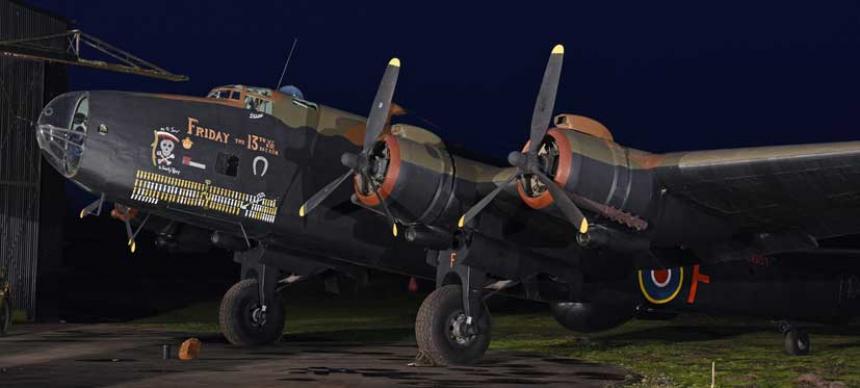
A recently taken night-shot of the magnificent Elvington Halifax
Basically starting from scratch, the project to return a Handley Page Halifax bomber to Yorkshire took over twelve years to complete, but what this team of volunteers managed to achieve was nothing short of miraculous. Using the collection of components they managed to amass over the years, they created an aircraft that has to be described as something of a hybrid, but which looks just like a Halifax bomber and to anyone lucky enough to see this magnificent aircraft, it is a Halifax. To commemorate Yorkshire’s most famous Halifax, the aircraft was finished as LV907 ‘Friday the 13th’ and following the lengthy re-creation process, the aircraft was fittingly rolled out on Friday 13th 1996 – on this date, the eyes of the historic aviation world were firmly on the former Bomber Command station at Elvington and the magnificent aeroplane that they had managed to produce. Although this is not actually the real aircraft, it is a magnificent tribute to the men of Bomber Command during WWII and the Halifax crews that flew from stations in the Yorkshire area. For anyone with even the slightest interest in aircraft and military history, walking into the hangar and seeing this Halifax for the first time will be an emotional experience and one that will surely have you heading back to Yorkshire many times in the years to come.

The port side of Elvington’s Halifax is finished as LV907 ‘Friday the 13th’

The starboard side now wears the markings of French Air Force NP763
The Yorkshire Air Museum is also the site of the Allied Air Forces Memorial and marks the contribution of French and Commonwealth pilots who fought with Bomber Command during WWII. In 2004, the museum’s famous Halifax aircraft was re-painted to commemorate the contribution of French Air Force Squadrons flying from RAF Elvington during WWII – the port side retains the famous ‘Friday the 13th’ markings of LV907 (NP-F), whilst the starboard side now wears the distinctive French Air Force colours of NP763 (H7-N). Although this might seem a little confusing to Elvington visitors at first, once the situation has been explained, the significance of this unusual presentation becomes clear. This is a magnificent aircraft and one which is a source of great pride for the Yorkshire Air Museum staff – it is also a significant attraction for Yorkshire as a whole and sees large numbers of visitors heading for Elvington each year.
Having been lucky enough to see Halifax ‘Friday the 13th’ on a number of different occasions, I am particularly attached to Yorkshire’s famous ‘undefeated bomber’ and I always look forward to making my next visit. If you have the opportunity to do so, you will not be disappointed and will be hugely impressed not just with Britain’s unique Halifax bomber, but also the delightfully atmospheric surroundings of this former Bomber Command station.

Corgi’s stunning Friday the 13th Halifax B.III model (AA37204)
There are quite a number of models in the Aviation Archive range that would easily qualify for ‘Classic’ status, but few can claim to have such widespread appeal as AA37204. This magnificent model is a 1/72nd scale Handley Page Halifax B.III in the markings of LV907 ‘Friday the 13th’ – the most successful Halifax bomber of WWII and the subject of this week's Aerodrome blog. Released way back in 2008, this model proved to be a massive success and sold out almost overnight – this is now one of the most sought-after models in the entire Aviation Archive range and when the odd example does appear on the secondary market, it is usually snapped up by an avid collector straight away and they are usually forced to pay a significant premium. If you have one of these models in your collection, you are extremely lucky and really should look after this beauty. If not, it has been some time since the Aviation Archive catalogue has included a Halifax model, so we will have to keep our fingers crossed and hope that a future catalogue will include an example of this famous British bomber.

Airfix have a magnificent 1/72nd scale Halifax B.III in their range of kits
For enthusiasts and modellers looking to construct an example of the Halifax B.III, the Airfix range currently includes this popular model and although the decal options do not include Friday the 13th, they do allow the modeller to finish their model as one of two famous Halifax bombers from 1944. The first option is for Halifax B.III MZ296 ‘Lily of the Lamplight’, which flew with No.462 (RAAF) Squadron, from RAF Driffield. The second option is Halifax B.III NZ426 ‘Mungo Taipo’, which flew with RAF No.78 Squadron out of RAF Breighton – both options mark Halifax bombers that operated from Yorkshire airfields during 1944 and either one would make a fitting tribute to this famous bomber. This model A06008A is available now on the Airfix website.
To enhance the appeal of this model even further, the Airfix range boasts a number of additional kits that help the modeller to create stunning airfield diorama displays. Of particular interest to modellers building the Halifax B.III is RAF bomber re-supply set A05330, which includes vehicles and accessories which were essential in the operation of Bomber Command stations during WWII. Again, this fantastic set is available on the Airfix website now and will enhance any collection of WWII Bomber Command models, either plastic, or die-cast metal.

Elvington’s stunning Halifax on a rare excursion out of the hangar
I hope that you have enjoyed this week’s look at the interesting story behind the famous Handley Page Halifax ‘Friday the 13th’ and how the aircraft on display at the Yorkshire Air Museum continues to commemorate its amazing wartime exploits. I am sure that many readers will have visited this unique aircraft and it would be great if you would share your pictures and stories with other Aerodrome readers. I must admit to being a little superstitious myself and I would have been really reluctant to fly on the aircraft, given its history and even less so whilst it was wearing its new artwork. I would certainly have tried to avoid being put in that uncomfortable position, if at all possible - I am also quite glad that this latest blog is being posted on Friday 20th!
As usual, you are welcome to discuss our latest blog either on the Airfix Aerodrome Forum or Corgi Aerodrome Forum. If you have any specific comments, questions or suggestions for future editions of Aerodrome, please feel free to let us know via Airfix Facebook or Corgi Facebook, or on Airfix Twitter or Corgi Twitter using #aerodrome.
Until next week, thank you very much for reading.
Michael
© Hornby Hobbies Ltd. All rights reserved