Welcome to this latest edition of Aerodrome and our regular look at the fascinating world of aviation. I think it is almost safe to say that we have negotiated another winter and enthusiasts can start looking forward to the coming Airshow season with some anticipation. Although most of us will have filled the winter months by organising our 2016 image files, or perhaps making one or two visits to airports and aviation museums, there is nothing quite like your first Airshow of the year to finally blow away all those closed season cobwebs. May is traditionally the month where intrepid aviation enthusiasts finally have the opportunity to venture out for their first outdoor events of the year, with Abingdon and the first Duxford show usually having the honour of marking the start of any Airshow season. For this year though, whilst not actually classed as an Airshow, last weekend’s Radial and Trainer Fly-in event at Halfpenny Green airfield near Wolverhampton heralded the start of the 2017 season and Aerodrome was there to mark the occasion. We are pleased to bring you a review of this event and a look at some of the interesting aircraft that took part.
There is nothing quite like getting the first Airshow of the season under your belt and if you manage to stay dry in the process, then you can really count this as an achievement. From a personal perspective and as far as I can remember, I don’t think that I have ever opened my Airshow account as early as April before in almost forty years of attending these kind of events, but this year’s Radial and Trainer Fly-in at Wolverhampton’s Halfpenny Green airfield offered an opportunity that was simply too good to pass up. It is also unusual for me to find myself at an event or airfield venue that I have never previously attended, so it was with some excitement that I set course for the West Midlands and the former RAF training airfield of Bobbington. Although classed as a fly-in and not an Airshow, the event was hoping to attract interesting aircraft from all over the country and as many would hopefully be arriving during Saturday morning, yet another early start was required. Pitching myself at the end of the main runway taxiway, I was hoping to grab as many of the visiting aircraft as possible and we will include an image rich review of the aviation attendees within this report, but before we get started, let’s take a look at the history of the airfield itself.

The Blackburn Botha was not the most successful aircraft to see RAF service
The land on which the aerodrome is built was acquired by the Air Ministry in 1939, who immediately began construction of a training base. Completed by early 1941, the airfield was named RAF Bobbington as this was the nearest village to the base, but was changed to Halfpenny Green later the same year, due to the original name causing confusion with another RAF airfield at Bovingdon, in Hertfordshire. The new airfield became operational in May 1941 and provided the RAF with an essential training base for navigators and air observers. No.3 Air Observers Navigation School was originally equipped with Blackburn Botha twin engined aircraft, which endured something of a troubled service record and later the much more successful Avro Anson, both in the navigational training role. Other interesting operations at Halfpenny Green included the aircraft and personnel of No.1545 Beam Approach Training Flight – this unit was flying Airspeed Oxfords to try and develop an effective system for helping pilots land their aircraft in poor weather. This obviously required the men and machines of this unit to fly landing approaches in some pretty grim weather conditions, which cannot have been for the faint-hearted. Following the end of WWII, flying operations at the airfield ceased for a number of years, before being revived in 1952 and the arrival of No.2 Air Signallers School, who once more made use of the venerable Avro Anson.

Jet Provost T.5A gate guardian at Halfpenny Green Airport
Halfpenny Green airfield was placed under Care & Maintenance in November 1956 and remained in this state until 1961, when the Air Ministry allowed civil aviation operations to take place, which resulted in the establishment of the Halfpenny Green Flying Club. Planning permission for a permanent civil aerodrome at the site was granted in 1967 and since that date, the airfield has been used for such activities as flying training, parachuting and the operation of airships. Today, this vibrant general aviation aerodrome is home to around seventy aircraft, including three fixed wing flying schools, helicopters and microlight aircraft – there is even a former RAF Jet Provost T.5A acting as a gate guardian, which helps to preserve the training heritage of this delightful little airfield.

Avro Ansons were based at Halfpenny Green During WWII
It is somehow fitting that the first aircraft we are featuring in our Halfpenny Green Airfield Radial and Trainer Fly-in is qualified to attend under both criteria and also happens to be one of the aircraft types that operated from the airfield during its time as a military airfield. The Avro Anson is a twin engined multi-role aircraft that heralds from the same design team that later produced the mighty Lancaster. In its own way, the Anson was something of a ground-breaking aircraft and has the distinction of being the first RAF aircraft to feature a retractable undercarriage. Although this sounds grand, the retraction system was not as simple for the aircrew as flicking a switch and actually required the pilot to hand crank the wheels up – around 140 cranks, all whilst attempting to effect a safe take-off. I’ll bet you could tell an Anson pilot by nature of one arm being more muscular than the other, as a result of this undercarriage retraction system.
Making its first flight in 1935, the Anson performed a multitude of duties during its wartime career, even though it was obsolete by the beginning of hostilities. Operating with both Bomber and Coastal Commands, the Anson was to excel in the role of training pilots, observers, navigators and air gunners and proved invaluable in performing these important tasks. More than 11,000 Ansons were built in the UK and Canada and despite the fact that it rarely saw front line duties during WWII, it was nevertheless one of Britain’s most important aircraft of the Second World War. With Ansons operating from Halfpenny Green during WWII and in the early 1950s, many enthusiasts would have been delighted to see this beautiful aircraft taking its place in the static aircraft park, just as its forebears would have done in the 1940s.

Anson WD413 has been a popular performer at UK Airshows over the years


Avro Anson WD413 was originally built at Yeadon in 1950 and performed navigational training duties during its RAF career, before later being converted to passenger transport (C.21) configuration. It is perhaps most famous for being a regular performer at Airshows all over the country since the 1970s, helping to preserve the legacy of this important aircraft type – although not as glamorous as the Spitfires of the Battle of Britain, the Avro Anson was responsible for training many thousands of British and Commonwealth aircrews.

Organisers were hoping to attract large numbers of Texans to their event
When you think of classic training aircraft of the Second World War, the North American T-6 Texan (Harvard in RAF use) is certainly amongst the most famous. This advanced trainer was used by many air forces to prepare their pilots for front line deployment and gave them valuable flight experience on powerful tail-dragger aircraft. Indeed, to this day, the Texan/Harvard continues to perform the task for which it was originally designed and still provides invaluable training experience for pilots hoping to progress to fly today's warbirds.

AT-6G N726KM ‘Happy Hour’ wears a smart South African Air Force scheme

In the weeks leading up to this event, it was hoped that large numbers of Texans would make the flight to Halfpenny Green, helping to make this a memorable gathering for these famous trainers. Unfortunately, operating old aeroplanes can be a challenging business and serviceability/pilot availability issues can always thwart even the most meticulous of planning. Even though only four or five Texans were present for the Saturday show, they were welcome additions to the static aircraft park and are always very popular with aircraft enthusiasts. Here is a further selection of Texan/Harvard images from the event.

There was great excitement when the Vampire arrived at the airfield
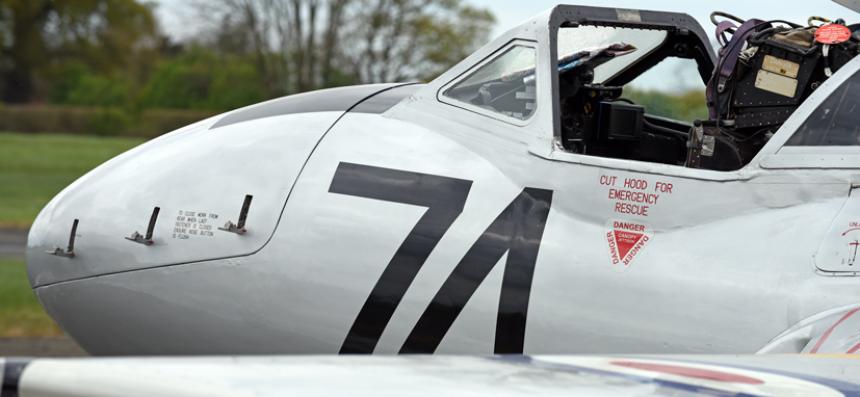
Although I have absolutely no evidence to support this statement, I suspect that many enthusiasts attending this fly-in event were lured by the prospect of seeing the beautiful de Havilland Vampire T.11 jet trainer of the Vampire Preservation Group, but that might just be my excuse. This magnificent former RAF jet trainer of the 1950s is thought to be the only airworthy example of the type in the northern hemisphere and its attendance at any Airshow event is guaranteed to increase attendance figures. The de Havilland Vampire was actually the second British jet aircraft to enter service, arriving at RAF stations only months after the end of the Second World War, but clearly illustrating the future of aviation propulsion. The attractive two seat T.11 variant of the Vampire entered service in early 1952, with the side by side configuration of the cockpit layout being particularly suited to the training of fast jet pilots. Some 600 T.11s were eventually produced, with this sole example allowing enthusiasts the opportunity to see how RAF pilots were trained during the early Cold War years.

A beautiful sight at any aviation event – Vampire WZ507
The Vampire Preservation Group are a non-profit making organisation, dedicated to the preservation and operation of de Havilland Vampire T.11 WZ507 and as such, are grateful for any financial support they receive. Appearing all too rarely at Airshows around the UK, it is difficult to understand why more show organisers are not desperate to secure this enigmatic aircraft for their event, as there is renewed interest in the aircraft of the Cold War era and the Vampire is a particularly handsome piece of British aviation history. There is no doubt that many people at Halfpenny Green last Saturday were glued to their scanners, hoping to hear information on the possible arrival of this beautiful little jet. At around midday, word began to circulate that the Vampire was about to take off from its home airfield at North Weald and would be with us in around half an hour – even though there was a distinct chill in the April air, this news warmed many a heart at Halfpenny Green and we prepared to receive a Vampire.
As possibly the star of the show, I am sure you will not mind if we include a selection of Vampire images, both from her arrival and when we caught up with her later on the far side of the airfield, where she was enjoying the adulation befitting such an aviation celebrity.


Many Aerodrome readers will be aware that the Vampire was involved in an incident during the Sunday of the Halfpenny Green fly-in and whilst I was not there to see it in person, I am pleased to report that the aircraft and everyone involved with its operation are perfectly fine. It seems that the powerful de Havilland Goblin engine managed to dislodge sections of the runway during the aircraft’s take off run and whilst the pilot was unaware of the situation and safely completed his take off, there were some dramatic scenes behind him, some of which found their way onto various media platforms. Despite the damage to the runway, the Vampire landed back safely at the airfield a little later and returned to North Weald later the same day, none the worse for the incident. Although many at Halfpenny Green will have been delighted to see the Vampire attending the event, I suspect airfield officials may not be sharing quite the same sentiments when looking at their runway.

The Antonov An-2 is the largest single engined biplane in the world
One aircraft that certainly left a sizeable impression on the crowds at the Halfpenny Green Radial and Trainer fly-in was the Soviet designed Antonov An-2. Given the NATO reporting name ‘Colt’, but known to the Russians as ‘Annushka’ (Annie), the An-2 is a beast of an aeroplane and one which seems to contradict all the rules of flight – surely this monster is too large to be powered by just a single engine! Designed to be a rugged and easy to operate utility aircraft, the An-2 has the distinction of being the largest single engined biplane aircraft in the world and despite its generous proportions, it is a remarkably agile performer. Capable of operating from landing strips where other aircraft would not attempt to land, the An-2 has proved to be a highly adaptable aircraft, suitable for performing a bewildering array of aviation tasks – this flexibility has seen more than 18,000 aircraft built during a production run that began back in 1947.
Once you have managed to get over the sheer size of the Antonov, you find yourself asking the question ‘how on earth does that massive aircraft fly so slowly?’ Powered by a single 9 cylinder Shvetsov radial engine, the An-2 only has a top speed of around 160 mph, but its slow speed performance is nothing short of spectacular. With a stall speed of 30mph, the An-2 has an automatic leading edge slat system that deploys as soon as the aircraft’s speed drops below 40mph, giving this mighty aeroplane spectacular slow speed performance. Indeed, if the aircraft is travelling into a headwind of around 35mph, it could actually be seen to be flying backwards, whilst under full control. This low speed performance, combined with the rugged nature of the Antonov design allows these aircraft to operate in some of the most demanding areas of the world and have helped to earn the An-2 almost legendary status.


This particular An-2 is the ‘TP’ version of the aircraft and is configured for both cargo and passenger carrying operations with seats for ten passengers folding away when cargo is carried. Carrying the Hungarian registration HA-MKF, this aircraft was manufactured in Poland by PZL-Mielec and it is interesting to note that nearly 72% of the total production of Antonov An-2 aircraft originated in Poland. The aircraft is owned and operated by the AN-2 Club, which is an organisation determined to promote the many virtues of the world’s largest biplane and to maintain aircraft in airworthy condition, so enthusiasts can experience this unique aircraft. As well as allowing people to view the cavernous interior of the An-2, the group also provide introductory flights for their members and try to attend as many Airshows and flying events as possible, with members always on hand to inform and educate on all matters Antonov. As you can imagine, the An-2 was the largest aircraft in attendance at the Radial and Trainer fly-in.
Let’s take a closer look at some of the other aircraft that took part in the early season aviation festivities at the Halfpenny Green 2017 Radial and Trainer fly-in.

Cessna 337G Skymaster is an unusual looking aircraft

The Russians are coming – YAK 52 adding some Soviet style

An old favourite, in the form of Barton based Morane Saulnier MS317

More training style from de Havilland, this time the Chipmunk

Slingsby T61F Venture Mk.2 ZA634

Auster AOP.9 WZ706 (G-BURR)

A little aviation culture in the shape of a Bucker Bu-181 Bestmann

Scottish Aviation Bulldog T.1

Taylorcraft Auster AOP 5 TJ343
I hope you have enjoyed this report from the Halfpenny Green fly-in event. The organising team are to be congratulated for arranging a truly memorable event and one that did not suffer from the usual stresses and exertions of a regular Airshow – the relaxed and friendly atmosphere will certainly have made an impression on visitors who will be only too keen to support this event in future years.

Hawker Hunter T.7 fuselage on its way to a new home at Newark
Our friends at the Newark Air Museum have kindly sent us details of the latest aircraft to further increase their impressive collection. Hawker Hunter T.7 XX467 arrived by road from Bruntingthorpe on Wednesday 3rd May, with the acquisition made possible thanks to the generosity of a museum member/trustee. The arrival of the Hunter fills a gap in the museum’s themed display of RAF training airframes and will help tell the fascinating story of RAF fast jet training. It also fulfils one aim of the museum’s stated Collecting Policy of acquiring “Aircraft used in a Training role.”
This particular airframe has a diverse service history both in the UK and overseas and the museum have not currently decided which colour scheme the aircraft will be repainted in. The aircraft was off-loaded on the museum’s Southfield site, where it was reassembled - it will be restored, repainted and displayed in the same location.
The airframe entered RAF service as XL605 and served with No.92 Squadron, including being assigned to the famous Blue Diamonds Aerobatic Display Team. It went on to see service with No. 66 Squadron and 229 OCU, before returning to Hawker Siddeley Aviation briefly, then heading off to sunnier skies, serving with Saudi Air Force as s/n 70-617 and Jordanian Air Force as s/n 836. The Hunter returned to the UK in 1972, where it was renumbered XX467 and went on to serve with the Royal Air Force once more and No.229 OCU, followed by a stint with No.1 TWU. Eventually struck off charge with the RAF in October 1983, the aircraft appeared on the UK civil register as G-TVII and operated out of Kemble and Exeter, before eventually arriving at Bruntingthorpe in 2011.

Already looking at home with the Lightning and Meteor at the Newark Air Museum
We would like to thank Howard Heeley for kindly supplying us with this information and allowing us to use his fantastic pictures. Just one more reason to make your next visit to the Newark Air Museum.
I am afraid that is all we have for you in this latest edition of Aerodrome, but we sincerely hope you found it an interesting read. As usual, if you would like to join in with all the latest social media discussions regarding Aerodrome and aviation matters in general, please head for either the Airfix Aerodrome Forum or our Corgi Aerodrome Forum and have your say. If you have any specific comments, questions or suggestions for future editions of Aerodrome, please do feel free to let us know by using either the Airfix Facebook or Corgi Facebook pages, or our Airfix Twitter or Corgi Twitter accounts, using #aerodrome – if you are Twitter regulars, you will know what this means! If good old fashioned e-mail is more your style, please use our usual address at aerodrome@hornby.com where we will be only too pleased to hear from you.
Finally, we would like to thank all our readers for your continued support. We will have more from the world of aviation in the next edition of our blog, which is scheduled for publication on 19th May.
Michael
© Hornby Hobbies Ltd. All rights reserved