
Welcome to this latest edition of Aerodrome and our regular look at the fascinating world of aeroplanes and the historic aviation scene around the UK.
Although many of the older enthusiasts amongst our ranks often lament the end of the golden era of Airshows and aviation related opportunities here in the UK, we do have to concede that we’re still incredibly fortunate with the number of venues and events we have access to in this country. In fact, you never really have to look too hard at all in order to find any number of interesting venues and events to attend, thanks to an army of passionate volunteers who remain steadfast in their determination to help preserve Britain’s proud aviation heritage for current and future generations.
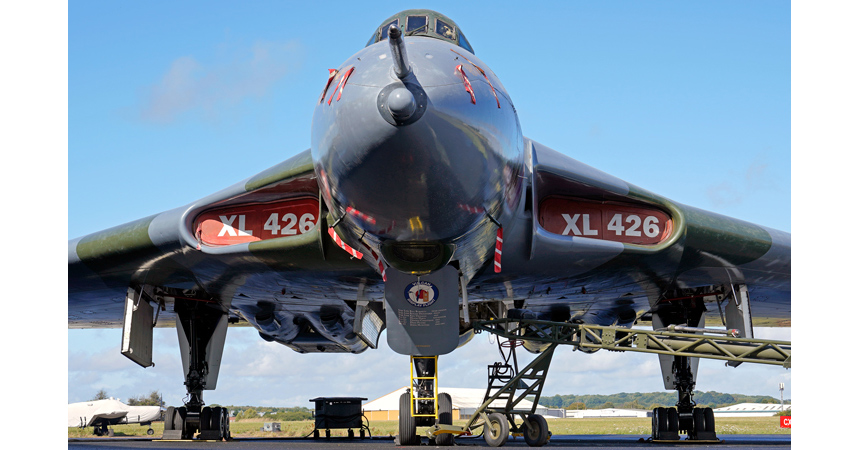
I was fortunate enough to attend one such event last month, my first ever visit to join members of the Vulcan Restoration Trust at their London Southend Airport home, where I was allowed to spend some quality time with the magnificent aircraft which is under their charge, Avro Vulcan B.2 XL426. This latest edition of Airfix and Corgi Aerodrome is my account of a thoroughly enjoyable day spent with the VRT team, and a celebration of the mighty Avro Vulcan, an aircraft type very much missed on the UK Airshow circuit, but with their own aircraft still making plenty of noise in reminding us of its impressive legacy, at the former RAF Rochford.
Please join us as we enjoy some Vulcan fast taxi action, in the company of volunteers and enthusiasts who are all playing their part in helping to preserve the heritage of this magnificent Cold War aviation leviathan.
A day outside the hangar. Avro Vulcan B.2 XL426 was looking forward to a day spent with her supporters at the summer Vulcan Restoration Trust fast taxi event at Southend Airport.
For a new aircraft which came from the same design stable as the war winning Avro Lancaster, it will come as absolutely no surprise whatsoever to learn that the company’s jet powered Lancaster replacement was itself something of an aviation classic. Although its first flight took place only ten years after the Lancaster had entered RAF service, and at a time when Lancasters were still in Royal Air Force service, the technology behind the two aircraft was worlds apart, with the new jet bomber looking as futuristic as it was spectacular. It was also designed to drop a payload possessing unimaginable destructive power, power which held the potential to deter any future descent into international conflict.
In response to Ministry of Defence requirement B35/46, work on designing Avro’s ambitious new jet bomber began in 1947, with the specifications of this new aircraft being something the like of which the British aviation industry had never previously seen. The requirements called for an aircraft capable of operating over distances in excess of 3,350 nautical miles, at a speed of 500 knots and with an operating ceiling of 50,000 feet. Significantly, the aircraft would also be required to carry a ‘special’ payload of 10,000 imperial pounds in weight, which as we now know clearly referred to a nuclear device, as its main role would be as a deterrent threat in preventing possible future attack by an aggressor nation.
These challenging design requirements said much about the military thinking of the day, and how the dangerous times which followed the end of the Second World War had everyone in Europe on edge. Extremely high altitude operation would be required to keep the new aircraft out of the range of ever improving surface-to-air missile defences, which would also make the new aircraft difficult to locate using radar technology, and operating at heights which meant that current enemy fighter aircraft wouldn’t be able to intercept it. The range requirement was clearly pointing to the belief that any potential future military threat would be coming from the Soviet Union and her allies, and from a weapons delivery perspective, the nuclear age was already dictating that bombing strategies would never be the same again.
In order to embrace these challenging design requirements, the Avro team started exploring the possibility of adopting revolutionary technologies in their new aircraft’s design, which soon began to take on a large delta configuration. Although this radically different thinking would present the team with many significant challenges throughout the manufacturing, development and testing phases, they remained steadfast in their conviction that the benefits offered by a large delta airframe would far outweigh those difficulties. Without question, their work was pioneering in the world of aviation.
When the huge doors of the construction hangar at the Woodford factory airfield were pushed open during the last week of August 1952, the sight must have been truly breathtaking. As Avro Vulcan prototype VX770 was wheeled out onto the hard standing on the airfield resplendent in its white ‘Anti-Flash’ paint finish and wearing RAF insignia, it must have been a proud moment for everyone involved with the project.
All the images featured in this article were all taken during our attendance at the recent Vulcan Restoration Trust summer fast taxi event.
Over the course of the next few days, a program of extensive systems testing and runway taxiing trials took place, in preparation for the all-important first flight of the new aircraft. Back then, the aircraft hadn’t been given an official name and was simply referred to as ‘698’, but it was about to make a rather large delta shaped mark on the history of British aviation.
On Saturday 30th August 1952, a beautiful English late summer day, Avro officials and authorised Woodford employees assembled for the historic first flight of the new Avro jet bomber prototype. The flight would be under the command of the highly experienced Avro test pilot Roland ‘Roly’ Falk, a man who had spent the last few years evaluating every aspect of delta flight in support of this project. Falk had previously served as the chief test pilot at the Royal Aircraft Establishment and in that position, had the chance to fly and evaluate many of the captured German aircraft from the Second World War, such as the Messerschmitt Me 262 jet fighter and the incredible Me 163 rocket powered fighter. He was also famous for conducting his Avro test flights wearing a smart pinstriped suit and tie, something which was somehow reassuringly British.
After successfully undertaking a final couple of fast taxi runs, followed by a short delay to clear a flock of birds from the edge of the runway, this stunning new aircraft blasted down Woodford’s runway and into the clear blue Cheshire skies. This was clearly a worrying time for Falk and the Avro designers, as much of the technology used on 698 was totally new and until the aircraft returned to Woodford safely, there would be a great many men in suits biting their nails and wringing their hands. The aircraft was taken to 10,000ft, before completing a series of pre-determined manoeuvres, before repositioning for landing back at Woodford.
Drama ensued following the lowering of the main undercarriage, as something was seen to fall from the underside of the aircraft, with airfield control passing the message on to Falk, who was instructed to perform a wide circuit of the airfield, while the situation was assessed. Both a de Havilland Vampire and Avro 707 research aircraft were sent to fly close to the bomber to assess the situation, and discovered that the fairing panels behind the undercarriage had become detached. As all three of the undercarriage legs had returned locked down indicator lights and the aircraft was under full control of the pilot, Falk was cleared to land back at Woodford, which he duly did, using the drogue parachute to reduce the landing distance to a minimum.
As the aircraft quickly slowed to a sedate pace, the gathered onlookers burst into a spontaneous round of applause, as the Avro team had achieved a significant aviation milestone, and the project could now progress to the next stage. One of the gathered onlookers later commented that as Britain was still subject to food rationing at the time, the celebrations centred around a nice hot cup of tea and a few biscuits.
At this point, it’s probably appropriate for us to spare a thought for the good people of Cheshire back in 1952, or as it would now be described, the South Manchester area. When they saw (and heard) this mighty delta shape in the skies above them, they must have thought that Armageddon was upon them, and a great many concerned citizens contacted the police to report the terrifying sight in the sky. It now seems strange that even though that first aircraft may well have initially spread fear amongst sections of the British population, the last flying example would become the best loved individual aircraft to ever fly on the British Airshow circuit, even carrying the title ‘The Spirit of Great Britain’ to underline the fact.
It wouldn’t be long before Britain was in the era of the Vulcan and the V-Bomber Force.
As the first Vulcans entered Royal Air Force service, they would also become the first delta-winged bombers to see service anywhere in the world. These extremely large triangular aeroplanes must have seemed truly spectacular to an aviation public used to seeing prop powered Lancasters, Lincolns and Washingtons, however, it also has to be remembered that delta technology was still relatively new and as the first aircraft entered service, unforeseen deficiencies began to surface.
Arguably the most problematic of these occurred when the more powerful Rolls Royce Olympus engines were installed in the aircraft, because at the higher speeds these powerplants supported, the massive wing of the Vulcan was reported to suffer from buffeting, something which concerned designers so much that the immediate modification of the entire wing shape design was initiated. Indeed, of the many upgrades and improvements incorporated into the Vulcan during its RAF service, the most noticeable would be this change in wing size and shape.
By the time the definitive Vulcan B.2 had entered service, the wing area had increased significantly and although still classed as a delta, so had its overall shape. To cope with the increased power output from subsequent engine upgrades and to overcome the stability issues associated with the original wing design, the B.2 wing had a very different planform, and now featured two defined kinks in its leading edge, well forward of the profile of the original. Wing. Rather than detract from the aesthetic appearance of the early Vulcan’s delta, the B.2 actually enhanced the profile of the aircraft, even though the design changes were obviously made purely for reasons of operational effectiveness.
The service introduction of the Vulcan B.2 would also coincide with Britain’s nuclear weapons program maturing somewhat and would see the number of weapons available to the V-bomber force increasing in both number and in the destructive potential they possessed. It would also bring about a change in thinking regarding the delivery of these weapons, as significant advances in Soviet anti-aircraft missile defence technology would now have an impact on the successful dropping of a free-fall gravity munition. A new weapon would be needed if the deterrent threat of the Vulcan and its V-bomber partners was to be maintained.
Blue Steel and the Vulcan B.2
In order to maintain the validity of Britain’s nuclear deterrent threat, the design team at Avro developed a capable air-launched nuclear stand-off missile, one which would allow V-bomber crews to launch their attacks well out of the range of Soviet surface-to-air missile batteries. Given the name ‘Blue Steel’, this new weapon significantly enhanced the capability of Britain’s V-bomber force and as a consequence, will have been a cause for much consternation within the Warsaw Pact nations. Potentially, this was a devastating new nuclear strike back development and although full details of its performance would have been highly classified at the time, certainly raised the nuclear stakes in Britain’s favour at that time.
Had a Vulcan been required to launch a Blue Steel strike, aircraft would have approached their assigned target at an altitude of approximately 50,000ft. When the aircraft was around 100 miles from said target, the missile would have been released, with the parent Vulcan immediately turning back on itself, to place as much distance between it and nuclear detonation. Approximately four seconds after release, the missile would ignite its main rocket motor and begin a climb to 70,000ft, travelling at speeds approaching Mach 2 and once close to the target, a second motor would fire, accelerating the missile to Mach 3. Once this motor was expended, the missile would freefall to its target, a scenario nobody wanted to ever realise.
The missile was designed to detonate its warhead as an air burst delivery weapon, with unimaginable devastation being the resultant consequence. After release from its parent aircraft, the missile was autonomous and therefore could not be jammed, or its course altered by enemy defensive countermeasures. The speed at which it travelled, and it’s trajectory prior to detonation meant that it would be impossible for the target to intercept the weapon once released, which allowed Blue Steel to provide Britain with the deterrent threat it needed to keep an uneasy peace.
Had such an unimaginable situation ever arisen, the fate of the Vulcan and its crew would have been ‘in doubt’ at best. Nuclear deterrent Vulcan bombers were finished in an all-over anti-flash white paint finish, one designed to have a dual benefit. As operations of this nature would have been flown at altitudes in excess of 40,000 feet, the white scheme made the aircraft extremely difficult to observe from the ground, therefore affording the bomber and its crew some much needed protection from possible SAM attack.
Secondly, in the event of a nuclear delivery, the white paint scheme was thought to provide the aircraft with heat reflecting benefits, something which would hopefully help to deflect any thermal energy hitting the aircraft following a detonation. Thankfully, all this proved to be hypothetical, with no Vulcan and its crew having to put this theory to the test. In fact, despite possessing all this destructive potential, no British bomber ever flew with a live nuclear weapon on board (other than test drops), something which speaks volumes about the deterrent threat Vulcans and the V-bomber force possessed.
Vulcans come down to earth
Unfortunately for Britain and her NATO allies, they didn’t have the monopoly on military technological advancement, and the latest developments in Soviet surface-to-air missile technology would quickly bring about a complete change in nuclear delivery strategies. The much publicised destruction of an American U2 spy plane flying at an altitude of 60,000ft highlighted the fact that height alone would no longer protect nuclear equipped Vulcans, and whilst they would still retain their nuclear capability, they would now have to fly at much lower altitudes, and carry smaller, tactical weapons. The iconic white anti-flash scheme would be replaced with a much darker and more sinister looking disruptive camouflage, and this change to lower altitude operations would actually suit the highly manoeuvrable Avro Vulcan, despite putting additional strain on every airframe. The Avro Vulcan would continue to serve the RAF with distinction until March 1984.
From 1969 onwards, the Royal Air Force would pass its strategic nuclear deterrent responsibilities onto the Royal Navy and their ‘Polaris’ missile equipped submarine fleet, a responsibility they continue uphold to this day.
‘Blue Steel’ Vulcans and the ‘Dambusters’
Many within Britain’s army of aviation enthusiast community would argue that the most iconic image of the mighty Avro Vulcan in its nuclear deterrent role, are the images which exist of the aircraft serving with the famous No.617 ‘Dambusters’ Squadron based at RAF Scampton in Lincolnshire. No.617 Squadron would enjoy a 23-year association with the mighty Avro Vulcan, something which seems rather fitting, bearing in mind their previous association with an earlier classic Avro bomber type. ‘Blue Steel’ equipped Vulcans arrived at Scampton in 1962 and immediately began working up to operational status, with some of the images of ‘Blue Steel’ equipped Vulcans on the runway at RAF Scampton serving as iconic visual reminders of Britain’s V-bomber force.
They also help to tell the story of how the destructive potential wielded by the Avro Vulcan served to keep the peace during a particularly volatile period in world history, unquestionably a powerful deterrent force, but one which served for good.
When you find yourself dealing with people who are so passionate about an aircraft as the Vulcan Restoration Trust are, you don’t mess about with their words, or the research they have undertaken into its history over the years, so as a consequence, much of the content included in this section has been taken straight from the Vulcan Restoration Trust website. Before we get started though, on the day of the event itself, I think I’m right in saying that their Vulcan was the only one in the world currently able to undertake fast taxi runs under the power of its own engines, something the team are understandably rather proud of.
XL426 in the Royal Air Force – She was the 44th of the 88 Vulcan B2s built.
In common with all other Vulcans, she was constructed by A V Roe & Co. at its Chadderton, and Woodford plants in the Northwest of England, and made her first flight, lasting 95 minutes, from Woodford on 23rd August 1962. After completing four further test flights, XL426 was collected by an RAF crew and entered service with No.83 Squadron at RAF Scampton on 13th September 1962.
RAF No.83 Squadron
The Scampton Wing (Nos. 27, 83 and 617 Squadrons) were at the time in the process of equipping with the Blue Steel stand-off missile. From September 1961, all aircraft delivered to these squadrons were specially modified to carry the new weapon, which was loaded, semi-recessed, in the Vulcan’s bomb bay.
In December 1962, Wing Commander (later Group Captain) John Slessortook over command of 83 Squadron from Wing Commander (later Air Commodore) Ray Davenport. John Slessor selected XL426 as his personal aircraft for his three-year tour, and she proudly bore the squadron commander’s pennant painted below her cockpit. On 10th September 1963, whilst returning from Goose Bay Canada, John Slessor flew XL426 to RAF Scampton in 4 hours 5 minutes - an unofficial record (pre-Concorde) for a crossing of the North Atlantic at that time.
Scampton Wing
In April 1964, the centralised servicing was introduced at RAF Scampton, meaning aircraft were no longer assigned to individual units, but instead were ‘pooled’ and assigned to squadrons on a day-by-day basis. XL426 was flown by all three squadrons of the Scampton Wing, which was now fully operational with Blue Steel.
With the transfer of the nuclear deterrent role to the Royal Navy in 1969, Blue Steel was withdrawn and the Scampton squadrons were assigned to the tactical nuclear and conventional bombing roles.
Dambuster Vulcan
Individual unit allocations were resumed in January 1971, and for the next 10 years, XL426 spent most of her time with 617 Squadron, although she also had brief spells with 27 Squadron and 230 Operational Conversion Unit, which had moved to RAF Scampton from RAF Finningley in December 1969.
In 1981, XL426 had the dubious distinction of being the 298th and final Vulcan to undergo a major service at RAF St Athan. Completion of the service was marked with a formal hand-over ceremony at which Air-Vice Marshal Richardson of RAF Support Command, and RAF Waddington’s Commanding Officer, Group Captain Warrington, both signed for the aircraft. Also present was Warrant Officer John ‘Bob’ Shillings, one of XL426’s first crew chiefs when she had entered service with 83 Squadron back in 1962.
RAF No.50 Squadron
RAF No.617 Squadron disbanded at the end of 1981 and XL426 was transferred to 50 Squadron at RAF Waddington, making the short flight south to join her new unit on 4th January 1982. No.50 Squadron became the last Vulcan squadron, operating six aircraft as air-to-air tankers until the Vulcan was finally withdrawn from operational service in 1984. XL426 was not converted to a tanker, but was one of three Vulcans retained by the squadron as a B2 to act as a crew trainer, helping to take some of the weight of flying off the shoulders of the already overstretched tanker force.
She had also been used as a trials aircraft as part of the Vulcan tanker test programme in 1982. XL426 was one of four Vulcans that took part in the Falklands Victory Flypast over London on October 12th, 1982 (although XL426 herself had not played an active role in the conflict). On 30th March 1984, XL426 had the ultimate accolade of performing 50 Squadron’s final display, in the hands of Squadron Leader Joe L’Estrange, at the squadron’s disbandment ceremony at RAF Waddington.
Display Vulcan
Withdrawal of the Vulcan from operational service did not, however, spell the end of XL426’s flying days. Very much aware of the Vulcan’s tremendous public relations appeal, and already committed to a number of air display appearances in the upcoming 1984 season, XL426 was kept airworthy (along with XH560 in reserve) for air display purposes. The two aircraft formed what became known as the Vulcan Historical Flight (later the Vulcan Display Flight - VDF), staffed initially entirely by volunteers. Under the command of Squadron Leader (later Group Captain) Bill Burnett, the Flight and XL426 gave their first display at No.IX Squadron’s Standard Presentation Parade at RAF Honington on 23rd May 1984.
The Flight went on to give more than 50 displays during the course of the 1984 season, and it was agreed to continue displaying XL426 into 1985. As the 1985 season progressed, a close eye was kept on XL426’s flying hours, as the time when she would require another major service was rapidly approaching. Plans were put in hand to replace her with another aircraft and eventually, a replacement aircraft – Avro Vulcan B.2 XH558 – was selected (retrieved from the fire dump at RAF Marham). Our aircraft XL426 subsequently gave her final display at the RAF Coningsby Open Day on 14th June 1986.
For sale
XL426 was put up for sale during the summer of 1986, and agreement was reached with a French consortium for her purchase. Meanwhile, the VDF was temporarily relocated to RAF Scampton to allow runway resurfacing to take place at Waddington, which saw XL426 making the short flight back to her former home on July 27th. The French deal subsequently fell through and XL426 was sold to Roy Jacobsen, who had purchased another Vulcan (XM655) two years earlier. XL426 was delivered to her new owner at Southend Airport on 19th December 1986, following a 20 minute ferry flight from RAF Scampton. On arrival at Southend, XL426 had amassed 6236 hours flying time, having completed over 1800 individual flights.
Roy Jacobsen had ambitious plans to operate XL426 as a civilian display aircraft, under the auspices of an organisation he had formed called the Vulcan Memorial Flight. XL426 was entered onto the British civil aircraft register as G-VJET and approaches were made to a number of potential sponsors for support. Unfortunately, the sums of money required to carry out the necessary servicing work and to finance the aircraft’s ongoing operation could not be found, and XL426 remained in a dormant state at Southend.
In 1990, local enthusiasts formed the Vulcan Memorial Flight Supporters Club(VMFSC) to help promote Mr Jacobsen’s continuing efforts to return XL426 to the air, and to also handle the ongoing preservation of the aircraft. The VMFSC took over ownership of XL426 in July 1993 and subsequently re-formed as a registered charity, todays Vulcan Restoration Trust.
XL426 made her final flight from RAF Scampton to Southend Airport on December 19th, 1986.
The flight was completed in the hands of Squadron Leader Paul Millikin (captain); Squadron Leader Neil McDougall (co-pilot); Squadron Leader Ken Denman (air electronics officer); Squadron Leader Dave Moore (navigator radar), and Squadron Leader Ray Leach (navigator plotter). Chief Tech Dave Thorpe(crew chief) was also on board for the flight.
Early Days
The aircraft was formally struck-off RAF charge three days later, with ownership passing to Roy Jacobsen, who had plans to return XL426 to the sky as a civilian display aircraft under the auspices of the Vulcan Memorial Flight. XL426 was entered onto the UK civil aircraft register as G-VJET on 7th July 1987, with XL426 being Roy Jacobsen’s second Vulcan, having purchased XM655 two years earlier. XM655 was based at Wellesbourne Mountford airfield in Warwickshire, where the short length of the runway, and the reluctance of British Aerospace to provide any formal backing to the project, meaning that the aircraft was effectively stranded. XL426 therefore provided new hope for the aim of getting an aircraft back into the air.
Southend-based Heavy Lift Aircraft Engineering had indicated that they would be willing to provide engineering support for XL426, however, this would be on a strictly commercial basis and Roy was never able to raise the sums of money needed for the necessary engineering work to be carried out.
Supporters Club
1990 saw the formation of a supporters club for the aircraft – the Vulcan Memorial Flight Supporters Club (VMFSC) – which began campaigning to raise funds to restore XL426 to airworthy condition. The Club commissioned British Air Ferries (also based at Southend) to carry out an airframe survey which indicated that, despite four years of storage outdoors, a restoration to airworthy condition was still possible. Easter 1991 saw the aircraft made available for public inspection for the first time since she arrived at Southend, inside one of the BAF hangars. This was all arranged as part of the Club’s ongoing fund raising campaign.
Up until that time, XL426 had been parked in full view of the Southend airport terminal, initially on the main apron but latterly on the grass at the rear of the apron. From 1991 however, XL426 found a new home at the northern end of Southend’s disused runway, well out of public view. Here she was free from airport parking charges, and an embryonic engineering team began to carry out regular, albeit relatively basic, preservation work on the aircraft.
Ownership of XL426 transferred from Roy Jacobsen to the VMFSC in July 1993, after Roy gifted the aircraft to the Club after it had paid off £8,000 of the aircraft’s parking debt owed to Southend Airport. The VMFSC then reformed as the Vulcan Restoration Trust (VRT) prior to achieving registered charity status in 1996. The VRT continued with the ultimate aim of returning XL426 to the sky, but also set itself an intermediate, and more achievable aim of restoring XL426 to full ground running condition, whereby its engines could be run regularly, and the aircraft taxied along Southend Airport’s runway.
Back to Life
Derek Potton, a then British Airways Concorde engineer, had for some time been restoring XL426’s electrical systems to working order. He was joined by Trevor Bailey, a young engineer then working for Heavy Lift, who set about bringing the XL426’s engine and airframe systems back to life. March 1994 saw all four engines dry-cycled (the first time they had been run since 1990 as part of the BAF airframe survey), followed shortly by the running of the No.2 and then all four engines. 1994 also saw the aircraft repainted for the first time since leaving Royal Air Force service.
The following year saw XL426 move from the end of the disused runway to its present home, a purpose-built pan on the airport’s eastern perimeter, adjacent to the London to Southend railway line, where the aircraft was more visible to the public visiting the airport’s flying clubs.
Work continued to get XL426 back to taxying condition, with this bearing fruit on 7th October 1995, when XL426 moved under her own power for the first time since arriving at Southend. Squadron Leader Joe L’Estrange and Captain Roger Frampton were at the controls for a slow speed ‘trundle’ along approximately 500 yards of the disused runway. Further work was required before XL426 could venture out onto the active runway and undertake the much more exciting high-speed taxy-runs.
On the move again
This feat was achieved in early 1997, a slow-speed run on the active runway being the precursor to the first high-speed run in March, with Group Captain Bill Burnett as captain. The first public high-speed taxy-run, complete with the deployment of the braking parachute, took place at the Airport Open Weekend held over the 1997 Spring Bank Holiday, this time with Squadron Leader John Reeve in charge.
Just over ten years since a rather shabby looking XL426 whistled over the airport perimeter to begin her retirement, the VRT had managed to achieve something extraordinary, as Avro Vulcan XL426 was a fully live airframe once again. Ultimately, the VRT relinquished its ambition of restoring XL426 to airworthy condition, choosing instead to concentrate on maintaining the aircraft in full ground running order.
Achievements since 1997 have been less dramatic but no less demanding or challenging. The Engineering Team has grown into a regular cadre of 15 or more volunteers, now lead by Matt Lawrence, and the engineering work on XL426 has increased in both its depth and scope. This has been recognised by the British Aviation Preservation Council, who now classify XL426 as a ‘benchmark’ example of its type. The VRT has continued to increase its stock of spare parts and, in 2000/01, XL426 underwent its second full repaint. In 2002, the VRT move into its own permanent workshop at the airport, and also enlarged and resurfaced XL426’s dispersal pan. 2002 also saw the VRT celebrate the 50th anniversary of the Vulcan’s first flight with a special Open Day on 31st August, an event which featured two high-speed taxy-runs.
Returning to Power
Since then, XL426 performing taxy-runs at Open Day events, and also for filming and engineering purposes, was a regular sight at Southend in the period from 1995 to 2005. Following the taxi-run at the Open Day in August 2005, the VRT took the decision to withdraw XL426 from taxying‘ service’ for a while, so we could carry out a programme of in-depth restoration and repair work on the aircraft. This programme, known as ‘Return to Power’, was intended to see XL426 returning to high-speed taxiing condition, and in a state to survive for many years to come at London Southend Airport.
The team keep a keen eye on the engine startup procedure at London Southend Airport.
It’s only when you have the opportunity to spend time with a ‘live’ Avro Vulcan that you realise just how magnificent an aircraft it actually is, and just how much we miss having one in our lives – that is, of course, unless you happen to be a member of the Vulcan Restoration Trust.
The main thing I remember about my day with the team at Southend was how they all seemed so pleased to have visitors there at their home, and how proud they all were to be showing of their exceptionally well maintained aircraft to their latest audience. I had the opportunity to spend a little quiet time with XL426, and I have to say that she’s a bit special, made all the more impressive with the knowledge that this aviation icon of the Cold War era would be coming to life during the early afternoon, firing up her engines for a quick sprint down the length of Southend Airport’s runway.
As the aircraft was moved from her position outside the hangar, to one on the airport taxiway, from where she had access to the runway, the excitement levels really started to increase, and everyone clung to the fence in order to get the best view possible of the impending spectacle. With the engines now started and checks completed, Avro Vulcan XL426 started to trundle along the airport taxiway, as she made her way towards the end of the active runway.
This brought the unusual sight of an EasyJet Airbus A321 holding to allow a Vulcan Bomber to taxi past it – this was quite a bizarre sight. One can only imagine what the captain announced to his passengers as their take off was delayed by the only current taxiable Vulcan bomber in the world.
Now that’s something you don’t see every day!
Such a magnificent sight – how we miss the Vulcan.
What the crowds came for – the Vulcan howls her appreciation for the support of the gathered masses.
The Vulcan entertainment for the afternoon would see the aircraft powering down the runway twice, the first time stopping on the runway opposite to where we had been positioned, where she would turn to face us, prior to her engines being run impressively at a high power setting. Obviously, we were all hoping to hear the famous Vulcan howl, and we were not disappointed – she howled so loudly that they probably heard it back at her former home base up in Lincolnshire.
After this treat, we had the spectacle of a high speed run down the length of the runway, which would be brought to a halt by the deployment of the aircraft’s mighty brake chute, something which a member of the volunteer team later told me was an absolute nightmare to fold up again. As the aircraft trumpeted down the runway like a crazed elephant, she did so with an enthusiasm which defied her years, and left us in no doubt whatsoever that if you want to experience an exciting aircraft simulated take off run, you really do need to get yourself down to Southend Airport on one of these event days. I’m sure I saw the aircraft’s nose wheel leaving the runway for just a second or two, or was that just wishful thinking?
It was such a treat to see a Vulcan coming to life once more, displaying how in her heyday, she was one of the world’s most potent and effective deterrent threats, maintaining peace by strength, and the fearsome devastation she was capable of wielding. Whatever an enemy did, they shouldn’t test the resolve of Britain’s Vulcan force, because this bomber and her crews were always ready for action and they were definitely made of the right stuff.
The event itself was nothing short of spectacular, and even though we had a thunderstorm later in the day, the weather held off for the duration of the Vulcan’s starring role, as nothing could be allowed to affect such a spectacle as this. Avro Vulcan B.2 XL426 is an absolute beauty, and she really knows how to play to an audience.
Significantly, she is a high profile credit to the work of the Vulcan Restoration Trust volunteers, who must be commended for the condition in which they keep this beautiful aeroplane. A registered charity with a huge and expensive aircraft to care for, they are always grateful for any support people can send their way, be that by attending one of their events at their London Southend Airport base, by making a purchase from their well-stocked online shop, or by donating to their ongoing cause. All support is greatly appreciated, in whichever form that takes.
In truth though, there really is no substitute for spending some time with this magnificent aircraft, so if you want to hear the howl of the Vulcan for yourself, and remember why the nation still holds this aircraft in such huge affection, you know where to come, and you’ll be assured of a warm welcome when you do.
May I take this opportunity to thank my contacts at the Vulcan Restoration Trust, and to thank everyone involved is arranging such a memorable day for Vulcan enthusiasts.
Until next time.
Job done and taxi mission accomplished. Avro Vulcan XL426 gave the crowds exactly what they had come to experience.
As the rain approaches, it was time to bring XL426 back under the protection of her hangar.
I’m afraid that’s all we have for you in this latest edition of Aerodrome, however, we’ll be back again in four weeks’ time with more news and pictures from the fascinating world of aviation. Thank you for your continued support and as always, if you would like to comment on anything blog related or suggest a subject you would like to see covered in a future edition of Aerodrome, please do drop us a line at aerodrome@airfix.com, where we would be delighted to hear from you.
Should you wish to continue the aviation discussions between editions, you will always find something of interest over on the Airfix Aerodrome Forum and if social media is more your thing, please use the respective official social media icon links at the foot of the main Airfix and Corgi website homepages to access our official sites.
The next edition of Aerodrome is scheduled to be published on Friday 7th November, and we look forward to sharing more aviation inspired content with you then.
I hope to see you all back here in four weeks.
Michael