

Welcome to the latest edition of Corgi Die-cast Diaries, your regular blog review of all the news, updates and topical stories from the captivating world of Corgi die-cast model collecting.
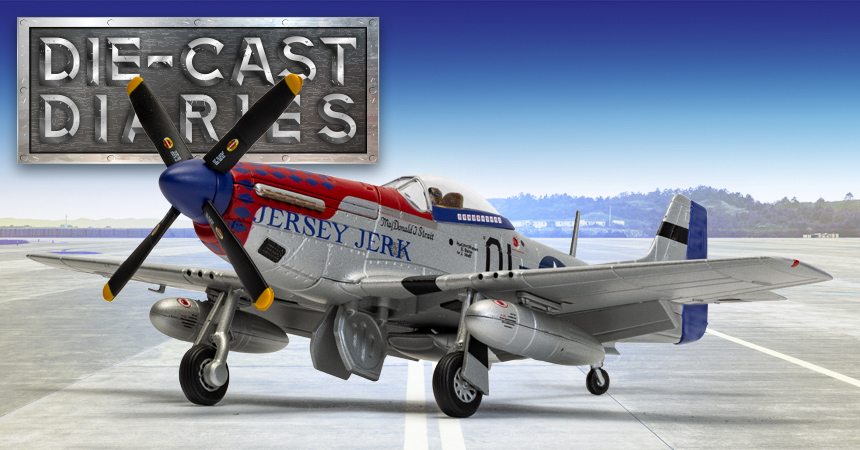
In this latest round of new Corgi model updates, our lead feature presents our latest scale die-cast tribute to an aircraft which many people would describe as the best, if not the most important single engined fighting aeroplane of the Second World War, one which will be marking the 85th anniversary of its first flight later this year, the superlative North American P-51 Mustang. As you can see from our header image this time around, our latest impending release tribute to this aircraft is something a little bit special, the mount of a USAAF fighter ace and quite possibly one of the most flamboyantly decorated fighting aeroplanes of the entire Second World War – that being the case, we will be spending a little time in the company of the ‘Martlesham Playboys’ this bank holiday weekend.
We will be following this by once more delving into the world of impending 1/43rd scale Vanguards model releases by bringing you a first advanced production sample look at a rather smart and extremely desirable little offering, one which could be described as something of a Yellow Peril, certainly if you were in the market for an appealing little family car possessing just that little bit extra. As our Head of Marketing has been doing a little video channel appearance moonlighting once again recently, we will be ending this latest edition by embedding his appearance on the Official Gerry Anderson Live channel into this latest blog, particularly as it’s bank holiday weekend and it’s just been Gerry Anderson Day.
We have collectable die-cast models galore for your update pleasure once again, in this latest edition of Die-cast Diaries.
Even though it only entered combat operations in Europe from early 1944, the P-51D Mustang would make a massive contribution towards the eventual Allied victory.
As one of the most celebrated aircraft of the Second World War, the North American Mustang has long been a favourite with Aviation Archive collectors, with the first 1/72nd scale die-cast collectable example appearing 25 years ago this year. Presenting us with metal models of this fighter, which was aerodynamically exceptional in many respects, collectors simply couldn’t get enough of these aircraft which were the mount of aces and some of the most attractively presented aircraft of the entire war.
These first models were joined by an even more impressive new model tooling three years later, when the beautifully clean lines of the P-51D were replicated in die-cast once more, this time in the much larger 1/32nd scale. This provided us with a model to serve as a fitting centrepiece to any model collection, and as far as we were concerned, it just wasn’t possible to have too many Mustangs in the collection! Underlining the enduring popularity of the Mustang as a scale model subject, Corgi engineers were of the opinion that the original 1/72nd scale tooling could be improved upon, and in 2015, the first release from our newly tooled P-51D model in this scale was announced.
Since that date, we have continued to bring the hobby beautiful die-cast examples of this magnificent aircraft, in the schemes which have fascinated aviation enthusiasts for the past 75 years or so, and look set to do so for many years to come. In a year which not only marks the 27th year of Aviation Archive, but also the 85th anniversary of the first flight of the Mustang prototype, we’re proud to be releasing our latest addition to this Corgi Mustang list, and we think she really is a cracker!
As one of the most famous fighting aeroplanes of the Second World War, it can sometimes be surprising to learn that the North American P-51 Mustang only made its European aerial combat debut towards the end of 1943, and how despite only seeing around eighteen months of combat, it still managed to achieve the reputation of being something of an ‘Ace Maker’. It’s significantly less surprising to learn that the success of the Mustang was directly linked to the insistence of North American executives in interviewing service pilots on their experiences using earlier variants of the Mustang in combat, and incorporating their suggested modifications and improvements into the definitive ‘D’ variant of the fighter.
Working closely with combat units and listening to the combat experiences of service pilots flying the existing B/C variant, the already impressive credentials of the Mustang were further refined in an attempt to hammer home its fighting potential in European skies. One of the main concerns pilots relayed back to North American executives was the relatively poor field of view they had from the earlier framed canopy of the original Merlon powered aircraft, and as every experienced fighter pilot will tell you, in combat, vision is everything.
The latest advancements in plexiglass moulding technology allowed engineers to produce a single piece 'blown' teardrop canopy to be manufactured for the latest incarnation of the fighter, one which greatly enhanced the pilot's field of view from a Mustang’s cockpit. The design of the fighter was modified behind the cockpit to allow the new canopy to sit high on the fuselage, with this modification incorporated into all new D and K model Mustangs manufactured from 1944 onwards. Introducing a host of additional improvements, this ultimate fighting Mustang also featured a modified wing, increased armament and the continued development of lightweight external fuel tanks, something which would further extend the operational range of this magnificent aircraft, and much to the dismay of the Luftwaffe.
Once again, production of this latest variant of Mustang was split between the two existing manufacturing plants at Inglewood in California, and Dallas, Texas, although this time, all aircraft manufactured would retain the same ‘D’ nomenclature. The only sub-variant of this 'Bubbletop' version of the Mustang were aircraft equipped with a different propeller, due to the preferred Hamilton Standard unit being in such short supply. Mustangs fitted with the slightly smaller Aeroproducts propeller were subsequently referred to as P-51Ks.
All the model images showcased here all feature an advanced sample model of this latest 1/72nd scale Mustang release.
The incredible dominance of the Mustang was clearly the result of several important factors, not all of which were linked to the aircraft’s production. When combining the ever-increasing number of Mustangs filling the skies of Germany during the latter stages of WWII with the terrible attrition rates being inflicted on the Luftwaffe at that same time, it was clear that this situation was only ever going to get worse for the Germans, particularly as the Allies could now escort their bombers all the way to their assigned targets deep in enemy territory, and back home again.
This ability was not only a result of the incredible performance of the Packard Merlin engines which were available in such large numbers, but also an unlikely invention which was only ever intended for ‘single use’. Lightweight paper/cardboard drop tanks proved to be something of a revelation, not only providing Allied fighters with the additional fuel they needed for missions deep into Germany, but were cheap and easy to make, not requiring the use of any high demand materials.
Created by wrapping layers of laminated paper over shaped formers, the two ends and central cylinder were bonded together in a final pressing process, before being tested under pressure and given two coasts of cellulose dope, before being finished with two further coats of aluminium paint. Once dry, they were wrapped in a coating of protective paper and sent to fighter stations all over Britain, only to be filled in the minutes prior to a mission. This was because once filled with fuel, it would slowly begin to dissolve the glue used during the laminating process, with the tank developing leaks after just a few hours use.
Once jettisoned, the tanks wouldn’t be providing the Germans with a ready supply of metal, just a fuel-soaked mush which would be of no use to them whatsoever. Unfortunately, the tanks were not considered robust enough to be able to survive a landing, so on the rare occasion when a mission was aborted not long after take-off, the tanks would have to be jettisoned on a pre-arranged area of ground close to the airfield, before the aircraft could attempt to land back at its home station.
With its Packard Merlin engines, six .50 calibre machine guns and laminated paper drop tanks, the North American P-51D variant of the Mustang was only in combat service for around twelve months prior to the end of the war in Europe, something which dictated that its post war service career would actually be longer than its wartime one. The undoubted ruler of the skies over Europe, the P-51D Mustang would continue to dominate until handing over this responsibility to the first jet powered types to enter USAAF service.
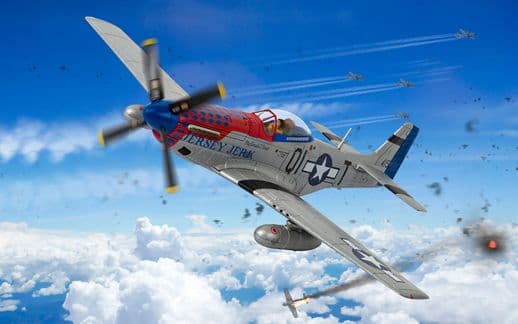
As far as distinctively presented Mustangs of the Second World War are concerned, few could claim to be as colourful as the machines flown by the 356th Fighter Group of the United States Army Air Force. Flying out of RAF Martlesham Heath in Suffolk, just a short flight from Britain’s North Sea coast, the group were colloquially referred to as either the ‘Martlesham Playboys’ or perhaps more understandably, the ‘Blue Diamonds’. The 356th only adopted the use of squadron colours relatively late in the war, with the 359th Fighter Squadron having yellow tails and spinners, the 360th using red and the 361st taking blue. Initially operating the mighty Republic P-47 Thunderbolt when the unit first deployed to England, they only received their Mustangs in November 1944, flying their first combat mission on the 20th of that same month – Interestingly, this was the very day that Captain Donald Jackson Strait assumed command of the 361st Fighter Squadron.
After successfully completing his flight training in the US, Donald J Strait arrived in England to fly the P-47 Thunderbolt in the Autumn of 1943. A native of Verona, New Jersey, he proudly took the name of his home state into combat with the Luftwaffe in the skies above Europe, naming his aircraft ‘Jersey Jerk’. Achieving three aerial victories whilst flying the Thunderbolt, Strait was to enjoy his most prolific period of combat success once his unit converted to the North American P-51D Mustang at the end of 1944.
Wearing the now distinctive markings of the 356th Fighter Group, Captain Strait and his ‘Jersey Jerk’ were to score a further 10.5 confirmed aerial victories in the final months of WWII, including a rather productive day on 20th February 1945 when he dispatched no fewer than three Fieseler Storch Luftwaffe observation aircraft during the same mission. With a total of 13.5 aerial victories, Donald Strait ended the war as the most successful ace pilot in the 356th Fighter Group.
Flying 413 missions between 15th October 1943 and 7th May 1945, the 356th Fighter Group had the unenviable reputation of suffering the highest loss to kill ratio in the Eighth Air Force during combat operations against the Luftwaffe. Known as the ‘Hard Luck Outfit’, despite the skill and professionalism of its pilots, they regularly found themselves facing superior numbers of enemy fighters during dogfight situations, whilst other Eighth Air Force units were struggling to come across any enemy units to engage in combat. Perhaps the Luftwaffe had a particular liking for the distinctively marked Mustangs of the 356th Fighter Group.
Our representation of this famous Mustang is intended to mark the period where the Mustangs of Martlesham first started adopting their squadron colours, for ease of recognition in combat. This particular aircraft did later fly operationally with red concentric rings around the blue spinner, and indeed, a restored Mustang sporting these colours is currently on the UK Airshow circuit.
That being said, we and many other researchers are of the opinion that these markings were applied initially at least, for strictly operational reasons and during the melee of aerial combat, there could be no opportunity for disidentification and possible friendly fire incidents. For that reason, our Jersey Jerk has been finished in the USAAF directive squadron marking representation.
When thinking about popular cars which could wear the title ‘Supermini’ with pride, the Ford Fiesta would certainly be high on such a list. A range of vehicles which have traversed many a decade, and been produced in seven different presentation incarnations, the Fiesta was a best seller for Ford and staple fare in the small family car sector. Affordable and economical, whether these were a first car, a much-loved family run-around, or something a little more refined, these popular little vehicles tended to touch the lives of so many people, arguably becoming some of the best loved vehicles on Britain’s roads.
Our latest Vanguards Fiesta release takes us back to the first incarnation of this popular car, but one which was manufactured to a higher spec level and was therefore intended for the slightly more discerning motorist. When the first generation Ford Fiesta was released in the UK at the beginning of 1977, it was the smallest car Ford had in their lineup at that time and indeed, was the smallest modern car they had ever produced – it also had the title of being Ford’s most costly car to develop to date. Cleverly leaked at several high-profile events by Ford’s marketing team, the car proved to be an instant success and was available in several different versions, each one offering different levels of trim and performance.
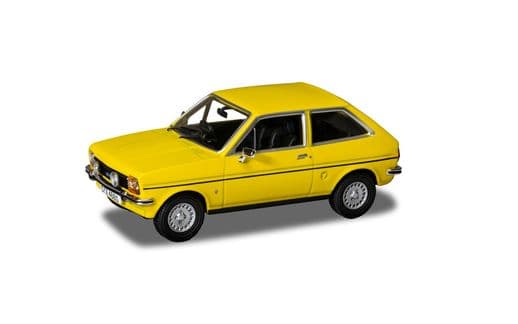
VA12513 – Ford Fiesta Mk.I, 1.1 Ghia, in Signal Yellow
The Fiesta was launched in mainland Europe in September 1976, shortly after Ford’s new purpose-built factory near Valencia, Spain, had started producing the company’s first front-wheel drive car. UK buyers had to wait until January 1977 before it could be ordered in right-hand drive, by which time production had commenced at Ford’s Dagenham plant in Essex. The Fiesta modelled here was built at Dagenham in June 1977, after being ordered from Ford dealer Perrys, Finchley, and was registered in August. Ghias were often in metallic colours, but this customer specified a yellow exterior with a black interior as well as Ghia alloys and spotlights, both then optional extras. He also had it Ziebart rust protected.
The car was exported to Malta immediately, then returned and sold to a new owner by the same branch of Perrys in November 1979. He kept it until April 2023, covering just over 40,000 miles, but ceased to use the car just after it had been serviced in 2008. It was exhumed from its garage by a dealer in early April 2023 and shortly afterward was bought by Dorset-based Ford collector and enthusiast Bruce Di Mario, who’d seen it advertised. Bruce was amazed by its originality and perfect interior; it even still featured its original lockable under luggage compartment storage. He has fitted a new front wing to repair its only corrosion, and had it resprayed so the exterior is as good as the interior.
Such a smart looking little car, is it any wonder Ford’s Ghia trimmed cars proved to be such desirable vehicles with British motorists. The model images shown here actually feature production samples of this attractive new Fiesta, and we expect it to be speeding towards model collections and Vanguards stockists as soon as we get back from the Easter holidays.
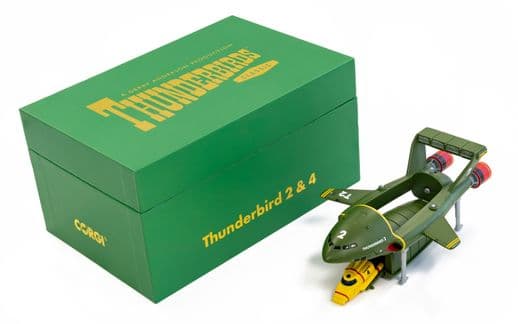
This year has already turned out to be something of a Thunderbirds tribute year from a Corgi die-cast perspective, with existing models benefitting from authentic new decoration presentation, existing tooling entering the design process for modification and exciting new tooling projects due to be joining the range later in the year – anyone would think it was an anniversary year!
Obviously, we’ve used a little poetic licence with the title of this section, as it’s a quote associated with Stingray, rather than Thunderbirds, however, it's just so appropriate as a title that we just had to go with it, and we don’t think Gerry Anderson aficionados will mind too much. This year’s Thunderbirds 60th Anniversary celebrations continued this week as the team at Official Gerry Anderson released their latest live video stream to mark Gerry Anderson Day, on what would have been the great man’s 96th birthday, and I’m sure you would like to join us in sending huge birthday wishes to him.
The special edition airing included the latest guest appearance by none other than our very own Head of Marketing David Mather, who was quizzed by the team on all things Corgi Jerry Anderson related during an entertaining 90 minutes or so. We thought as it’s a bank holiday weekend and we might all have a little extra time on our hand over the next few days, that you might like to take a look yourselves, so here it is:
We’re afraid that's all we have for you this time around, however, we’ll be back as usual in two weeks’ time with a further exclusive selection of the latest Corgi model updates. As ever, you could always drop us a line if you felt moved to do so, to comment on anything blog, collecting or Corgi model related, or even perhaps to suggest a topic you might like to see the team cover in a future edition. As always, our diecastdiaries@corgi.co.uk address is the one to use.
If you can’t wait for the next blog, you will find plenty of Corgi model collecting discussions taking place on our official social media channels, access to which can be obtained by clicking on the respective links at the foot of the Corgi website homepage.
Link access to Corgi social media sites.
Thank you for continuing to support your Corgi Die-cast Diaries blog. Our next edition is scheduled to be published on Friday 2nd May, and we look forward to seeing you all back here then.
Thank you for your continued support and Happy Easter to all!

